All of the following are true about the circulus arteriosus minor, except:
Which of the following is used to depict the actions of extraocular muscles?
Which stain is used to visualize the ocular basement membrane?
The hyaloid canal is found in which part of the eye?
Which HLA antigens are observed on ocular dendritic cells?
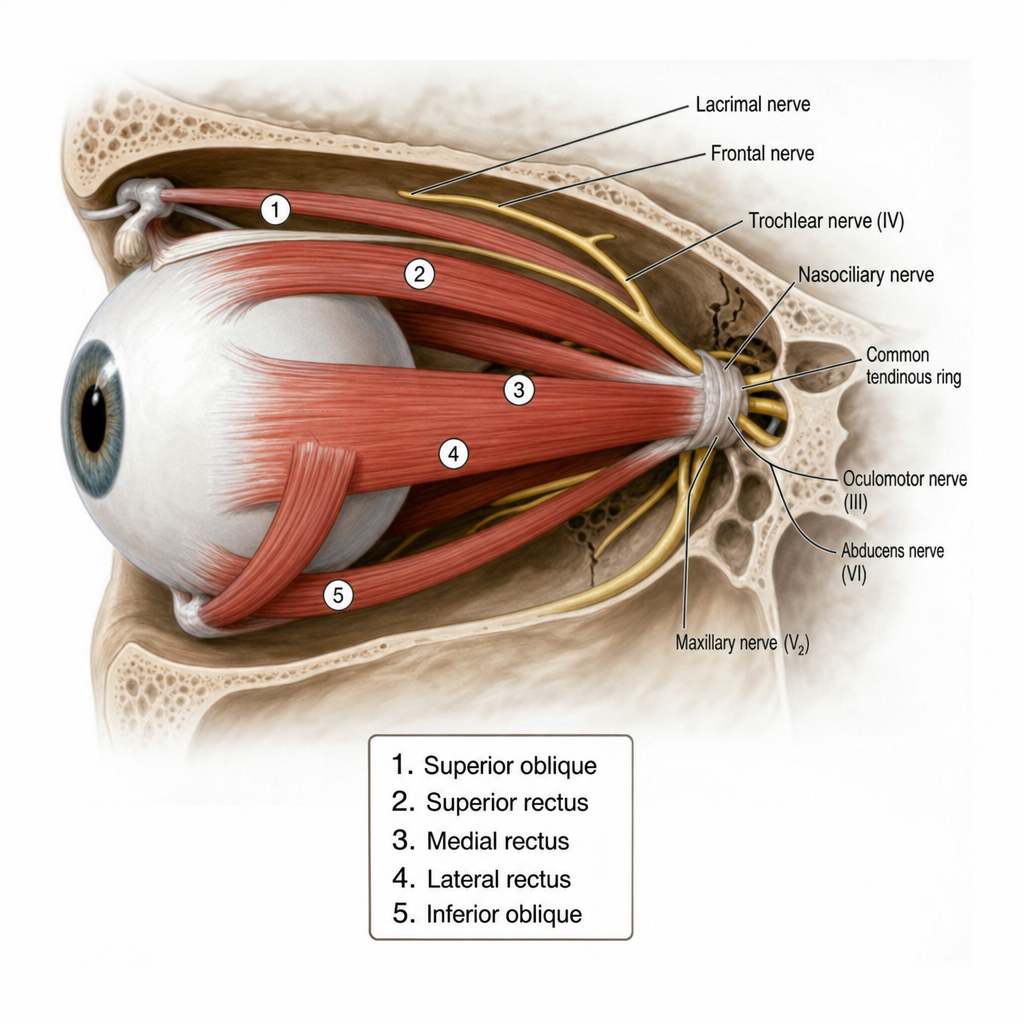
Which extraocular muscle does not originate at or near the apex of the orbit?
Uniocular diplopia occurs in all of the following conditions except:
Small opacities in the media of the eye are best detected by?
For biometric studies of the eyeball, which pulse echo technique on ultrasonography is best?
Occlusion of short posterior ciliary arteries may cause which of the following?
Explanation: ### Explanation The **circulus arteriosus minor** (minor circle of the iris) is an incomplete vascular circle located near the **pupillary margin** within the iris stroma. **Why Option D is the correct (false) statement:** The **ciliary processes** (specifically the non-pigmented ciliary epithelium) are the seat of aqueous humor formation, not the iris vasculature. The ciliary processes receive their blood supply from the **circulus arteriosus major** (major circle of the iris), which is located in the ciliary body, not the minor circle. **Analysis of other options:** * **Option A:** The blood supply to the iris originates from the **long posterior ciliary arteries (LPCAs)** and **anterior ciliary arteries (ACAs)**. These anastomose at the ciliary body to form the *major* circle, from which radial branches extend toward the pupil to form the *minor* circle. * **Option B:** While primarily discussed as an arterial network, the minor circle is part of a complex microvascular bed that includes both **arteriolar and venous components** (capillary plexuses) to facilitate nutrient exchange within the iris. * **Option C:** This is a defining anatomical feature. The **major circle** is at the iris root/ciliary body, while the **minor circle** is situated at the level of the collarette, near the pupillary margin. ### High-Yield Clinical Pearls for NEET-PG: * **Blood-Aqueous Barrier:** The tight junctions of the **non-pigmented ciliary epithelium** and the **endothelium of iris capillaries** form this barrier. * **Vascular Pattern:** Iris vessels have a characteristic "corkscrew" appearance to accommodate the constant movement (miosis/mydriasis) of the iris without kinking. * **Rubeosis Iridis:** Neovascularization of the iris usually starts at the pupillary margin (minor circle) or the angle, often secondary to retinal ischemia (e.g., Diabetic Retinopathy or CRVO).
Explanation: **Explanation:** The correct answer is **B. Hess chart**. The **Hess chart** is a clinical tool used to evaluate the status of extraocular muscle (EOM) balance and coordination. It is based on the principle of **foveal projection** and uses **Hering’s Law of equal innervation**. By dissociating the two eyes (typically using red-green goggles), it graphically depicts the field of action of each muscle. It is particularly useful in diagnosing paralytic strabismus, identifying which muscle is underacting (palsy) and which is overacting (sequelae), and monitoring the progress of the condition. **Why the other options are incorrect:** * **A. Goldman three mirror:** This is a contact lens used for **gonioscopy** (visualizing the anterior chamber angle) and for detailed examination of the **peripheral retina** and vitreous. * **C & D. Humphrey and Octopus fields:** These are types of **Automated Static Perimetry** used to map the **visual field**. They are primarily used to detect and monitor glaucoma and neurological field defects, not to assess muscle actions. **Clinical Pearls for NEET-PG:** * **Hering’s Law:** Innervation to the yoke muscles is equal and simultaneous (e.g., Right Lateral Rectus and Left Medial Rectus). * **Sherrington’s Law:** Increased innervation to an agonist muscle is accompanied by a corresponding decrease in innervation to its antagonist (e.g., Right Superior Rectus and Right Inferior Rectus). * **Lees Screen:** A variation of the Hess chart that uses two screens and mirrors instead of red-green dissociation; it is considered more accurate as it does not rely on color perception.
Explanation: **Explanation:** The correct answer is **PAS (Periodic Acid-Schiff)**. **1. Why PAS is the correct answer:** PAS is a histochemical stain used to detect polysaccharides, such as glycogen, and mucosubstances like glycoproteins and glycolipids. In the eye, the **basement membranes** (such as Descemet’s membrane, Lens capsule, and Bruch’s membrane) are exceptionally rich in glycoproteins. PAS stains these structures a deep **magenta/pink**, making it the gold standard for visualizing the ocular basement membrane and identifying thickening in pathologies like diabetic retinopathy. **2. Analysis of Incorrect Options:** * **Alcian blue:** This stain is specific for **acid mucopolysaccharides** (glycosaminoglycans). In ophthalmology, it is primarily used to stain the stromal ground substance or to identify Macular Corneal Dystrophy. * **Methylene blue:** This is a vital stain used clinically to stain the **lacrimal sac** during DCR surgery or to identify corneal mucus plaques. It does not specifically target the basement membrane. * **Giemsa stain:** This is a cytological stain used to identify **cellular morphology**. In ophthalmology, it is the stain of choice for conjunctival scrapings to detect inclusion bodies (Chlamydia), fungi, or inflammatory cells (eosinophils in VKC). **3. High-Yield Clinical Pearls for NEET-PG:** * **Descemet’s Membrane:** The thickest basement membrane in the body; stains strongly with PAS. * **Lens Capsule:** The thickest basement membrane in the eye; also PAS positive. * **Congo Red:** Used for staining **Amyloid** (Lattice corneal dystrophy), showing apple-green birefringence under polarized light. * **Masson Trichrome:** Used to differentiate Granular corneal dystrophy (stains red). * **Oil Red O / Sudan Black:** Used for staining lipids (Schnyder corneal dystrophy or Sebaceous cell carcinoma).
Explanation: **Explanation:** The **hyaloid canal** (also known as Cloquet’s canal or the Stilling canal) is an anatomical channel located within the **vitreous body**. It runs from the optic nerve head (Martegiani’s area) to the posterior surface of the lens (Berger’s space). **Why Option A is correct:** During fetal development, the **hyaloid artery** traverses this canal to supply the developing lens. In the third trimester, this artery normally undergoes regression. The hyaloid canal remains as a narrow, transparent tube of primary vitreous surrounded by secondary vitreous, serving as a vestigial remnant of this embryonic vascular system. **Why other options are incorrect:** * **B. Choroid:** This is the vascular layer of the eye located between the retina and sclera; it does not contain the hyaloid system. * **C. Optic stalk:** While the hyaloid artery enters the globe through the fetal fissure of the optic stalk, the canal itself is defined by its course through the vitreous cavity. * **D. Ciliary body:** This structure is involved in aqueous humor production and accommodation; it is peripheral to the central path of the hyaloid canal. **High-Yield Clinical Pearls for NEET-PG:** * **Mittendorf’s Dot:** A small, circular opacity on the posterior lens capsule representing the anterior attachment remnant of the hyaloid artery. * **Bergmeister’s Papilla:** A tuft of fibrous tissue on the optic disc representing the posterior remnant of the hyaloid system. * **Persistent Hyperplastic Primary Vitreous (PHPV):** A congenital condition resulting from the failure of the hyaloid artery to regress, often presenting with leukocoria (white pupillary reflex).
Explanation: **Explanation:** The correct answer is **Class I and II**. **1. Why Class I and II is correct:** Dendritic cells (DCs) are the most potent professional antigen-presenting cells (APCs) in the body, including the eye. In the ocular tissues (such as the conjunctiva, corneal limbus, and uvea), these cells play a critical role in immune surveillance. * **HLA Class I** antigens are expressed by almost all nucleated cells in the body (including DCs) and are used to present endogenous antigens to CD8+ T-cells. * **HLA Class II** antigens (specifically HLA-DR, DQ, and DP) are constitutively expressed by professional APCs like dendritic cells. These are essential for presenting exogenous antigens to CD4+ T-helper cells, initiating the adaptive immune response. **2. Why other options are incorrect:** * **Option A (Class I only):** While DCs do express Class I, this option is incomplete because it ignores the defining characteristic of professional APCs—the expression of Class II molecules. * **Option B (Class II only):** While Class II is the hallmark of APCs, all dendritic cells are nucleated and therefore also express Class I molecules. * **Option D (None):** This is incorrect as dendritic cells are the primary mediators of the ocular immune response and must express these surface markers to function. **High-Yield Clinical Pearls for NEET-PG:** * **Corneal Immunology:** The central cornea is traditionally considered "immune privileged" and was thought to be devoid of DCs. However, it is now known that **immature (MHC II negative)** DCs reside in the central cornea, while **mature (MHC II positive)** DCs are found in the limbus. * **HLA-B27:** The most high-yield HLA association in Ophthalmology; it is strongly linked with **Acute Anterior Uveitis**. * **HLA-B51:** Strongly associated with **Behcet’s Disease**. * **HLA-DR4:** Associated with **Vogt-Koyanagi-Harada (VKH) syndrome** and Sympathetic Ophthalmitis.
Explanation: ### **Explanation** The correct answer is **Inferior oblique**. **1. Why the Correct Answer is Right:** The anatomical origin of extraocular muscles is a high-yield topic in orbital anatomy. Most extraocular muscles originate at the **apex of the orbit** from the **Annulus of Zinn** (Common Tendinous Ring) or the adjacent sphenoid bone. The **Inferior Oblique (IO)** is the unique exception; it is the only extraocular muscle that originates from the **anterior** part of the orbit. Specifically, it arises from a shallow depression on the orbital plate of the **maxilla**, just lateral to the nasolacrimal canal. **2. Why the Other Options are Incorrect:** * **Inferior Rectus:** This is one of the four recti muscles that originate directly from the Annulus of Zinn at the orbital apex. * **Levator Palpebrae Superioris (LPS):** Although not a "rectus" muscle, it originates from the undersurface of the lesser wing of the sphenoid, just above the optic foramen at the orbital apex. * **Superior Oblique:** Unlike the inferior oblique, the superior oblique originates at the apex (lesser wing of sphenoid, superomedial to the optic foramen). It only changes direction anteriorly at the trochlea. **3. NEET-PG Clinical Pearls:** * **Shortest & Longest:** The Inferior Oblique is the shortest extraocular muscle, while the Superior Oblique has the longest tendon. * **Nerve Supply Rule:** Remember **LR6(SO4)3**. All muscles in the options are supplied by the Oculomotor nerve (CN III), except the Superior Oblique (Trochlear nerve, CN IV). * **Surgical Landmark:** Because the IO originates anteriorly, it is the muscle most commonly encountered (and potentially injured) during lower lid blepharoplasty or orbital floor fracture repairs.
Explanation: ### Explanation **Concept:** Diplopia (double vision) is categorized into **Binocular** and **Uniocular**. * **Binocular diplopia** occurs due to ocular misalignment (strabismus). When one eye is covered, the diplopia disappears. * **Uniocular diplopia** occurs due to structural abnormalities within a single eye that cause light rays to split before reaching the retina. Crucially, the diplopia persists even when the fellow eye is covered. **Why Option A is Correct:** **Paralysis of the inferior oblique muscle** causes a neuromuscular misalignment of the visual axes. This results in **binocular diplopia**, which is relieved by closing either eye. Extraocular muscle palsies (3rd, 4th, or 6th nerve) never cause uniocular diplopia. **Why the other options are incorrect:** * **Keratoconus (B):** The conical protrusion and irregular astigmatism of the cornea cause multiple focal points, leading to polyopia or uniocular diplopia. * **Iridodialysis (C):** A tear of the iris from its root creates a "second pupil." Light enters through both the normal pupil and the traumatic gap, creating two images on one retina. * **Incipient Cataract (D):** During the early stages of a cataract (especially cortical), the unequal refractive index in different sectors of the crystalline lens causes "lens splitting" of light rays, leading to uniocular polyopia. **NEET-PG High-Yield Pearls:** 1. **The "Cover Test" Rule:** If diplopia persists after covering one eye, it is **Uniocular** (usually optical/structural). If it disappears, it is **Binocular** (usually neurological/muscular). 2. **Common Causes of Uniocular Diplopia:** Ectopia lentis (subluxated lens), large iridectomy, keratoconus, incipient cataract, and malingering. 3. **Common Causes of Binocular Diplopia:** Myasthenia gravis, Thyroid Eye Disease, and Cranial Nerve palsies (III, IV, VI).
Explanation: **Explanation:** **Distant Direct Ophthalmoscopy (DDO)** is the most effective clinical method for detecting small opacities in the ocular media (cornea, aqueous, lens, and vitreous). **Why it is the correct answer:** In DDO, the examiner views the eye from a distance of about **20–25 cm** using a direct ophthalmoscope. The light reflects off the fundus, creating a uniform **red glow (red reflex)** in the pupillary area. Any opacity in the media obstructs this reflected light and appears as a **black shadow** against the red background. This high contrast makes even minute opacities, such as early lenticular changes or small vitreous floaters, easily visible. Furthermore, by asking the patient to move their eye, the clinician can determine the exact anatomical location of the opacity based on **parallax**. **Why other options are incorrect:** * **Direct Ophthalmoscopy:** Performed very close to the patient (approx. 2 cm). While it provides high magnification (15x) of the fundus, the field of view is too narrow and the focus too deep to survey the entire media for small opacities effectively. * **Indirect Ophthalmoscopy:** Provides a wide-field, stereoscopic view of the retina. While excellent for the fundus periphery, the intense illumination and lower magnification of the media make it less sensitive than DDO for detecting subtle, faint opacities. **High-Yield Clinical Pearls for NEET-PG:** * **Location by Parallax:** If the opacity moves in the **same direction** as the eye, it is in front of the pupillary plane (cornea/anterior chamber). If it moves in the **opposite direction**, it is behind the pupillary plane (posterior lens/vitreous). If it remains **stationary**, it is at the pupillary plane (anterior capsule of the lens). * DDO is the screening test of choice for **congenital cataracts** (Bruckner test). * It is also used to differentiate between a **true squint and a pseudo-squint** by observing the centricity of the corneal light reflex.
Explanation: **Explanation:** In ophthalmic ultrasonography, different modes are used depending on whether the goal is measurement (biometry) or visualization of structures. **Why A-Scan is Correct:** **A-scan (Amplitude modulation)** is a one-dimensional, time-amplitude display. It represents echoes as vertical spikes along a baseline. The distance between these spikes is used to calculate linear measurements with high precision. In clinical practice, A-scan is the gold standard for **biometry**, specifically for measuring the **Axial Length (AL)** of the eyeball, which is a critical parameter for calculating Intraocular Lens (IOL) power before cataract surgery. **Why Other Options are Incorrect:** * **B-scan (Brightness modulation):** This provides a two-dimensional, cross-sectional view of the eye. While excellent for visualizing posterior segment pathologies (like retinal detachment or vitreous hemorrhage) when the media is opaque, it lacks the linear precision required for accurate biometric measurements. * **C-scan:** This involves a coronal section (frontal plane) at a specific depth. It is rarely used in routine ophthalmology and is not used for axial measurements. **High-Yield Clinical Pearls for NEET-PG:** * **A-scan for Biometry:** Uses a frequency of **10 MHz**. * **Immersion A-scan** is more accurate than contact A-scan because it avoids corneal compression, which can artificially shorten the axial length. * **Standardized A-scan:** Used for tissue characterization (e.g., differentiating intraocular tumors like Choroidal Melanoma based on internal reflectivity). * **Ultrasound Biomicroscopy (UBM):** Uses high-frequency waves (**35–50 MHz**) to image the anterior segment (angle, ciliary body) at high resolution but low penetration.
Explanation: **Explanation:** The **short posterior ciliary arteries (SPCAs)**, typically numbering 15–20, are branches of the ophthalmic artery. Their primary anatomical role is to supply the **choroid** and the **optic nerve head (ONH)**. 1. **Why Option A is correct:** The SPCAs form the **Circle of Zinn-Haller**, an arterial anastomosis within the sclera that provides the main blood supply to the prelaminar and laminar portions of the optic nerve. Occlusion of these arteries leads to an interruption of blood flow to the optic nerve head, resulting in **Anterior Ischaemic Optic Neuropathy (AION)**. This presents clinically as sudden, painless vision loss with disc edema. 2. **Why Options B and C are incorrect:** * **Anterior segment ischaemia (Option C):** This is primarily caused by the occlusion of the **Long Posterior Ciliary Arteries (LPCAs)** and the **Anterior Ciliary Arteries** (derived from the recti muscles), which form the major arterial circle of the iris. * **Posterior segment ischaemia (Option B):** While the SPCAs supply the choroid, "posterior segment ischaemia" is a broad term. In medical exams, SPCA pathology is specifically linked to the optic nerve (AION). Furthermore, the retina (a major part of the posterior segment) is supplied by the **Central Retinal Artery**, not the SPCAs. **High-Yield Clinical Pearls for NEET-PG:** * **Circle of Zinn-Haller:** Formed by the anastomosis of short posterior ciliary arteries. * **AION:** Can be Arteritic (e.g., Giant Cell Arteritis) or Non-arteritic (associated with HTN/Diabetes). * **Blood Supply of Optic Nerve:** * Surface nerve fiber layer: Central retinal artery. * Prelaminar, Laminar, and Retrolaminar regions: Short posterior ciliary arteries.
Embryology of Eye
Practice Questions
Ocular Anatomy
Practice Questions
Ocular Physiology
Practice Questions
Ocular Biochemistry
Practice Questions
Ocular Microbiology
Practice Questions
Ocular Pharmacology
Practice Questions
Ocular Pathology
Practice Questions
Ocular Genetics
Practice Questions
Ocular Immunology
Practice Questions
Visual Neuroscience
Practice Questions
Ocular Imaging Physics
Practice Questions
Laser Physics in Ophthalmology
Practice Questions
Get full access to all questions, explanations, and performance tracking.
Start For Free