Injury to which of the following muscles that forms the deep support of the perineal body causes cystocele, enterocele and urethral descent?
Which of the following is not felt with a digital rectal examination?
All are causes of prolapse of cervix EXCEPT:
What is the treatment for uterine prolapse in nulliparous women?
In gonorrhea, which is not a presenting feature?
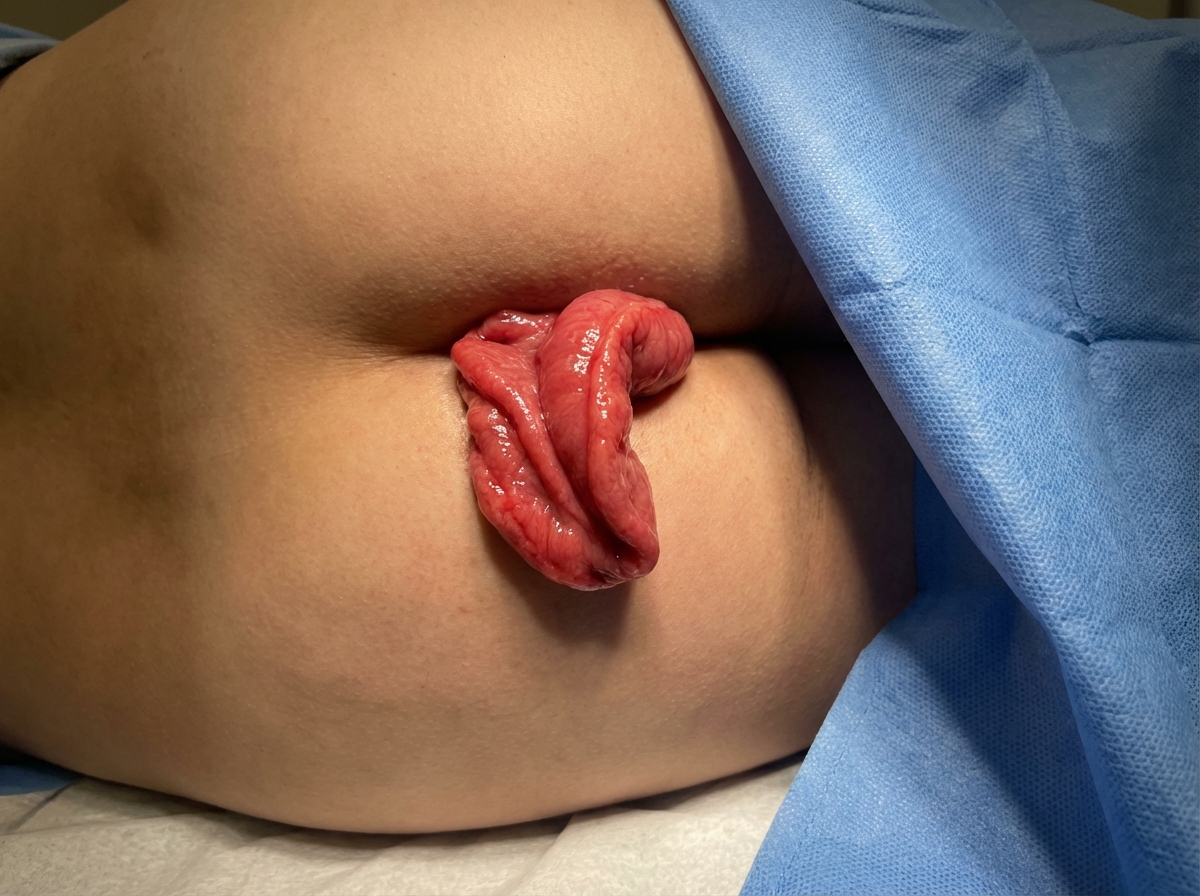
What is the last resort treatment for rectal prolapse in childhood?
Not a feature of rectosigmoid endometriosis on MRI
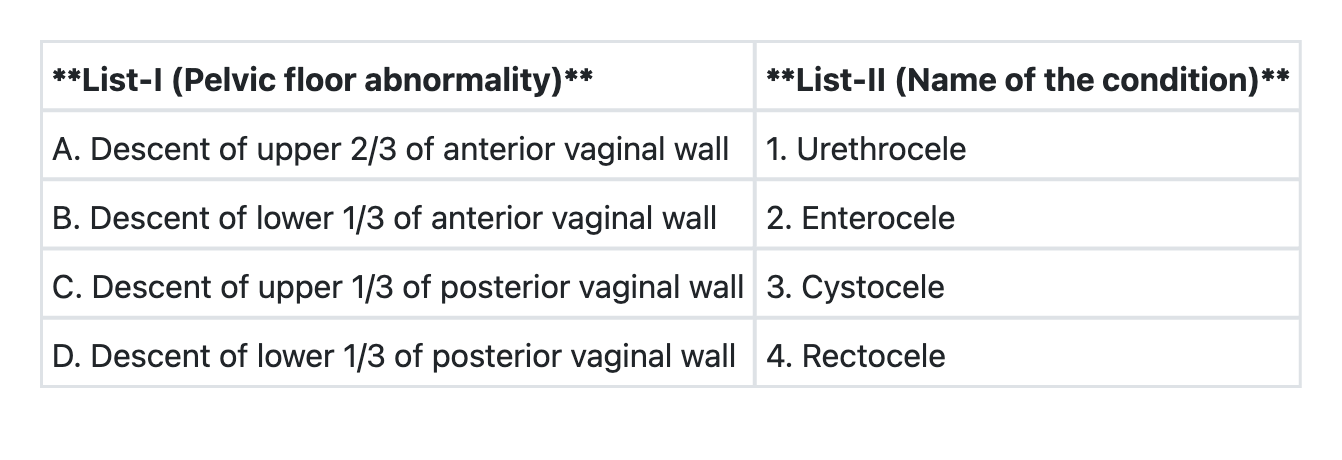
Match List-I with List-II and select the correct answer using the code given below the Lists:
Moschcowitz repair is done for:
A 40 year old lady is examined and found to have uterovaginal prolapse. What is the appropriate surgery to prevent recurrence?
Explanation: ***Pubococcygeus*** - The **pubococcygeus muscle** is a major component of the **levator ani muscle** group, forming the primary support structure of the pelvic floor [1]. Damage to this muscle impairs the support for the bladder, rectum, and uterus, leading to prolapse conditions like **cystocele**, **enterocele**, and **urethral descent**. - Its integrity is crucial for maintaining the position of pelvic organs and proper function of the urinary and defecatory systems, as it directly supports the vagina, rectum, and bladder neck [3]. *Sphincter of urethra and anus* - The **external urethral sphincter** primarily controls voluntary urination, and its injury mainly leads to **stress urinary incontinence**, not necessarily prolapse [2]. - The **external anal sphincter** controls defecation, and its injury would primarily lead to **fecal incontinence**, not cystocele, enterocele, or urethral descent [2]. *Bulbospongiosus* - The **bulbospongiosus muscle** is superficial, supporting the clitoris and compressing erectile tissue in females, and expelling semen/urine in males. - Its injury would primarily affect sexual function and perineal body integrity but is **not a primary cause of pelvic organ prolapse** like cystocele or enterocele [3]. *Ischiocavernosus* - The **ischiocavernosus muscle** is also superficial, maintaining erection of the clitoris/penis by compressing the crura. - Injury to this muscle would mainly disrupt **erectile function** and contribute minimally to pelvic organ support or prolapse.
Explanation: ***Ureter*** - The **ureters** are too deep and medially located to be reliably palpated during a **digital rectal examination** (DRE). - They are typically not accessible through the rectal wall due to their anatomical position posterior to the urinary bladder and prostate (in males). *Seminal vesicles* - The **seminal vesicles** are located superior to the prostate and can sometimes be palpated, especially if enlarged or inflamed. - They are adjacent to the posterior surface of the bladder and anterior to the rectum. *Prostate* - The **prostate gland** is directly anterior to the rectum and is the primary structure evaluated during a **DRE**. - Its size, consistency, and any nodules or tenderness can be assessed. *Rectovesical pouch* - The **rectovesical pouch** is the peritoneal reflection between the rectum and the bladder in males. - While not a distinct organ to "feel," pathology within this space (e.g., fluid collections, masses) can sometimes be appreciated as a fullness or mass effect above the prostate via the DRE.
Explanation: ***Regular exercise*** - **Regular exercise**, especially core-strengthening exercises, can actually help prevent pelvic organ prolapse by strengthening the **pelvic floor muscles**. - It does not contribute to the weakening of support structures necessary for cervical prolapse. *Menopause* - **Estrogen deficiency** during menopause leads to the thinning and weakening of **pelvic connective tissues** and muscles. - This loss of tissue elasticity and strength renders the pelvic organs more susceptible to prolapse. *Chronic cough* - A **chronic cough** significantly increases **intra-abdominal pressure** repeatedly. - This sustained downward force can strain and weaken the **pelvic floor muscles** and ligaments over time, contributing to prolapse. *Delivery of a big baby* - The **vaginal delivery** of a large baby can cause significant **trauma** and stretching to the **pelvic floor muscles**, ligaments, and fascia. - This physical damage can compromise the structural integrity supporting the cervix and other pelvic organs, increasing the risk of prolapse.
Explanation: ***Manchester operation*** - This procedure is sometimes considered for **nulliparous women** with uterine prolapse, particularly if combined with cervical elongation. - It involves **amputation of the cervix** and support of the cardinal ligaments, which can address the prolapse while preserving uterine function. *Sling used involving rectus sheath* - A sling using the rectus sheath is typically employed for **stress urinary incontinence**, not primarily for uterine prolapse. - While it supports the urethra and bladder neck, it does not directly address the descent of the uterus. *Anterior colporrhaphy* - This procedure repairs a **cystocele** (prolapse of the bladder into the vagina) by tightening the anterior vaginal wall. - It does not directly manage **uterine prolapse** itself, though a cystocele can coexist with uterine descent. *Posterior colporrhaphy* - This surgical repair targets a **rectocele** (prolapse of the rectum into the vagina) by tightening the posterior vaginal wall. - Similar to anterior colporrhaphy, it addresses a specific vaginal wall defect rather than the **uterine position**.
Explanation: ***Hematuria*** - **Hematuria**, or blood in the urine, is not a typical presenting feature of uncomplicated gonococcal infection. - While urinary tract infections can cause hematuria, **gonorrhea primarily affects mucous membranes** of the reproductive and urinary tracts, leading to inflammation and purulent discharge rather than bleeding within the urinary system itself. *Discharge* - **Urethral discharge** in men and **vaginal or cervical discharge** in women is a very common symptom of gonorrhea [1]. - The discharge is typically **purulent, thick, and yellowish-green**. *Dysuria* - **Dysuria**, or painful urination, is a frequent symptom, especially in men with **urethritis** due to gonorrhea [1]. - It results from the **inflammation of the urethra** caused by the bacterial infection. *Reddened lips of vulva and vagina* - **Erythema and inflammation of the vulva and vagina** can occur in women with gonococcal cervicitis or vaginitis [1]. - This irritation is a direct result of the **gonococcal infection** of the mucosal surfaces.
Explanation: ***Thiersch wiring*** - This procedure involves placing a **silver wire or non-absorbable suture** circumferentially around the anus to prevent external prolapse. - It is considered a **last resort** for rectal prolapse in children due to its potential complications and the fact that most childhood prolapses resolve spontaneously or with less invasive measures. - Reserved for cases that fail conservative treatment and minimally invasive options. *Lahaut's operation* - Lahaut's operation involves **injection of sclerosing agents** (sclerotherapy) into the perirectal tissues to induce fibrosis and fixation. - While this is a recognized minimally invasive approach for rectal prolapse, it is **not considered the last resort** in pediatric cases. - Thiersch wiring is typically reserved as the last surgical option when other measures fail. *Incision of prolapsed mucosa* - This is an **unconventional and potentially harmful** approach for rectal prolapse, as it risks severe bleeding, infection, and damage to the rectal tissue. - It does not address the underlying structural issues causing the prolapse and is not a recognized treatment. *Ripstein operation* - The Ripstein procedure (anterior sling rectopexy) is a **rectopexy** technique primarily used for **adult rectal prolapse**. - It involves fixing the rectum to the sacrum with a synthetic mesh and is generally too invasive for pediatric cases, especially when simpler options like Thiersch wiring are available.
Explanation: ***T2 hyperintensity*** - Endometriotic implants typically demonstrate **T1 hyperintensity** due to the presence of **hemorrhage** within the ectopic endometrial tissue. - On T2-weighted images, endometriosis usually appears **hypointense** or **isointense** due to the phenomenon of **T2 shading**, caused by chronic hemorrhage and fibrosis. *Mushroom cap sign* - This sign is characteristic of **deep infiltrating endometriosis** affecting the rectosigmoid. - It describes the appearance where the fibrotic endometriotic nodule infiltrates the bowel wall, creating a mushroom-like shape due to the **thickened muscularis propria** and overlying mucosal folds. *Fat stranding* - **Fat stranding** in the perirectal or perisigmoid fat is a common feature of **inflammatory conditions** including endometriosis. - It indicates **reactive inflammation** around the endometriotic implants, often seen in cases of deep infiltrating endometriosis. *Bowel wall thickening* - **Bowel wall thickening** is a frequent finding in rectosigmoid endometriosis due to **fibrotic reaction**, **smooth muscle hypertrophy**, and **edema** caused by the infiltrating endometrial tissue. - This thickening can lead to narrowing of the bowel lumen and obstructive symptoms.
Explanation: ***A→3 B→1 C→2 D→4*** - This option correctly matches each pelvic floor abnormality description with its corresponding condition. - **Cystocele** involves the descent of the bladder into the upper two-thirds of the anterior vaginal wall, **Urethrocele** describes the descent of the urethra into the lower one-third of the anterior vaginal wall, **Enterocele** refers to the descent of small bowel into the upper one-third of the posterior vaginal wall, and **Rectocele** involves the descent of the rectum into the lower one-third of the posterior vaginal wall. *A→4 B→1 C→2 D→3* - This option incorrectly matches the descent of the upper 2/3 of the anterior vaginal wall with a **rectocele** and the descent of the upper 1/3 of the posterior vaginal wall with a **cystocele**. - A **rectocele** involves the posterior vaginal wall, not the anterior, and a **cystocele** involves the anterior vaginal wall, not the posterior. *A→4 B→2 C→1 D→3* - This option incorrectly matches the descent of the upper 2/3 of the anterior vaginal wall with a **rectocele** and misidentifies other associations. - The pattern of descent and wall involvement for **urethrocele**, **enterocele**, and **cystocele** is not consistently maintained here according to the definitions. *A→3 B→2 C→1 D→4* - This option incorrectly associates the descent of the lower 1/3 of the anterior vaginal wall with an **enterocele**, and the descent of the upper 1/3 of the posterior vaginal wall with a **urethrocele**. - An **enterocele** involves the small bowel protruding into the posterior vaginal wall, and a **urethrocele** involves the urethra descending into the anterior vaginal wall.
Explanation: ***Enterocele*** - The **Moschcowitz repair** is a historical procedure designed to repair an **enterocele** by obliterating the cul-de-sac. - It involves placing a series of high **purse-string sutures** in the posterior cul-de-sac peritoneum to elevate it and prevent bowel herniation. *Vault prolapse* - Vault prolapse involves the **prolapse of the vaginal apex** after hysterectomy. - While it can coexist with an enterocele, the Moschcowitz repair specifically targets the **enterocele defect**, not the overall vault support. *Adenomyosis* - **Adenomyosis** is a condition where endometrial tissue grows into the muscular wall of the uterus. - It is managed medically or surgically via **hysterectomy**, and is unrelated to surgical repairs for pelvic organ prolapse. *Chronic inversion of uterus* - **Chronic uterine inversion** is a rare condition where the uterus turns inside out, typically following childbirth. - Management involves **manual or surgical repositioning of the uterus** and is unrelated to the Moschcowitz repair for enterocele.
Explanation: ***Vaginal hysterectomy with anterior and posterior colporrhaphy and McCall culdoplasty*** - This combination addresses **multiple compartments of pelvic organ prolapse**, including the uterus, anterior vaginal wall (cystocele), posterior vaginal wall (rectocele), and vaginal vault (enterocele/cuff prolapse). - **McCall culdoplasty** suspends the vaginal vault, and **anterior/posterior colporrhaphy** repairs defects in the bladder and rectal supports, significantly reducing recurrence rates. *Vaginal hysterectomy with McCall culdoplasty* - While **McCall culdoplasty** is excellent for preventing **vaginal vault prolapse** after hysterectomy, it doesn't directly address associated **cystocele** or **rectocele**. - A prolapse often involves multiple compartments, and addressing only the uterine component may lead to **recurrence** in the anterior or posterior vaginal walls. *Abdominal hysterectomy with Moschcowitz operation* - **Abdominal hysterectomy** is generally reserved for cases where a vaginal approach is not feasible or other abdominal procedures are required; it has a **longer recovery** and higher morbidity compared to vaginal approaches for prolapse. - The **Moschcowitz operation** is a type of culdoplasty, but an open abdominal approach for uncomplicated uterovaginal prolapse is less preferred than vaginal repairs due to increased invasiveness and potential for greater discomfort and recovery time. *Vaginal hysterectomy with sacrospinocolpopexy* - **Sacrospinocolpopexy** is a durable procedure, especially for **vaginal vault prolapse**, and often uses mesh for suspension. - While highly effective for vault suspension, it typically requires a **laparoscopic or abdominal approach** for mesh placement and often requires additional procedures to manage associated anterior and posterior wall defects, making a combined vaginal approach with anterior/posterior colporrhaphy and McCall culdoplasty more comprehensive for overall uterovaginal prolapse.
Get full access to all questions, explanations, and performance tracking.
Start For Free