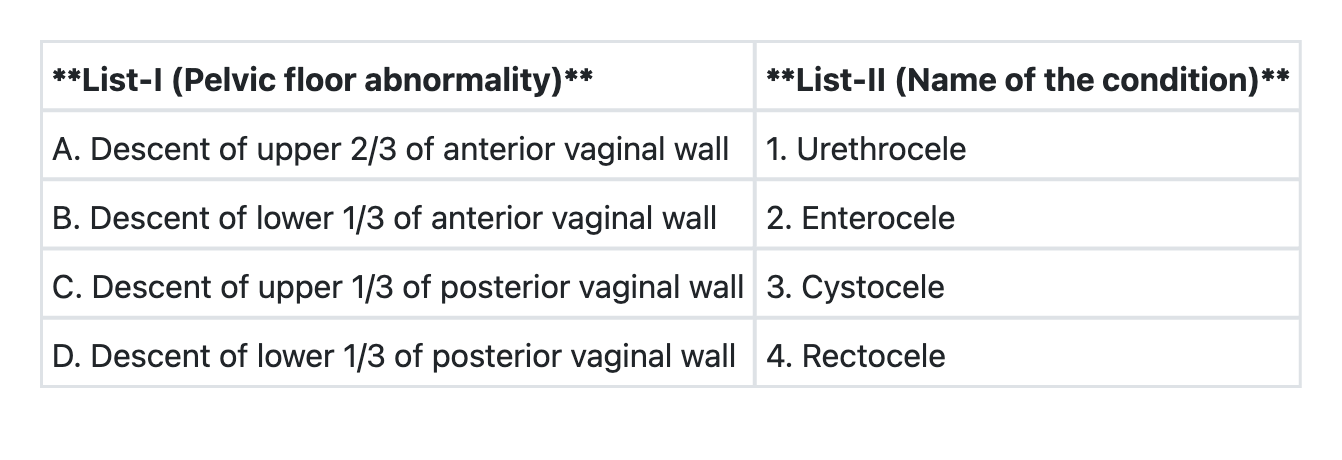
Regarding 'DeLancey's levels of vaginal support', consider the following pairs:

A 40 year old lady is examined and found to have uterovaginal prolapse. What is the appropriate surgery to prevent recurrence?
A 30 year old lady, mother of 3 children presents with mass descending per vaginum. On examination it is found to have stage 3 prolapse, moderate cystocele, no posterior vaginal wall prolapse. The recommended surgery would be:
Which of the following is NOT a component of Fothergill’s operation as a conservative surgery for uterovaginal prolapse?
The level of external cervical os in a second degree utero vaginal prolapse is:
Treatment of choice in 28 year old nullipara with third degree cervical descent is:
Surgical treatment of choice for a 20 year old nulliparous woman with uterine prolapse is:
Which of the following symptoms can be associated with pelvic organ prolapse? 1. Difficulty in passing urine 2. Incomplete evacuation of urine 3. Urgency and frequency Select the correct answer using the code given below:
A 32-year-old lady with intrauterine fetal death after normal vaginal delivery has continuous passage of urine from the vagina. What is the most probable diagnosis?
What is the most common cause of a descending mass per vaginum?
Explanation: ***1, 2 and 3*** - DeLancey's levels of vaginal support categorize the anatomical support structures of the vagina into three levels, providing a framework for understanding pelvic organ prolapse. - **Level I** refers to the **apical support** provided by the uterosacral and cardinal ligaments, supporting the uterus and upper vagina. - **Level II** supports the **mid-vagina**, including the paravaginal attachments to the arcus tendineus fascia pelvis (ATFP), providing lateral support. - **Level III** supports the **distal vagina**, including the fusion of the anterior and posterior vaginal walls with the levator ani muscles, perineal body, and urethral support. *2 only* - This option is incomplete as it only recognizes Level II, which supports the mid-vagina, but omits the correct descriptions for Levels I and III, which are also accurately presented. - All three levels described in the table correspond correctly to DeLancey's levels of vaginal support. *1 and 3 only* - This option is incomplete as it misses the correct description for Level II, which accurately states it supports the mid-vagina. - While Level I and Level III are correctly described, a comprehensive understanding requires all three levels. *2 and 3 only* - This option is incomplete because it omits the correct description for Level I, which corresponds to apical support. - Even though Levels II and III are correctly described, all three levels presented in the table are consistent with DeLancey's classification.
Explanation: ***Vaginal hysterectomy with anterior and posterior colporrhaphy and McCall culdoplasty*** - This combination addresses **multiple compartments of pelvic organ prolapse**, including the uterus, anterior vaginal wall (cystocele), posterior vaginal wall (rectocele), and vaginal vault (enterocele/cuff prolapse). - **McCall culdoplasty** suspends the vaginal vault, and **anterior/posterior colporrhaphy** repairs defects in the bladder and rectal supports, significantly reducing recurrence rates. *Vaginal hysterectomy with McCall culdoplasty* - While **McCall culdoplasty** is excellent for preventing **vaginal vault prolapse** after hysterectomy, it doesn't directly address associated **cystocele** or **rectocele**. - A prolapse often involves multiple compartments, and addressing only the uterine component may lead to **recurrence** in the anterior or posterior vaginal walls. *Abdominal hysterectomy with Moschcowitz operation* - **Abdominal hysterectomy** is generally reserved for cases where a vaginal approach is not feasible or other abdominal procedures are required; it has a **longer recovery** and higher morbidity compared to vaginal approaches for prolapse. - The **Moschcowitz operation** is a type of culdoplasty, but an open abdominal approach for uncomplicated uterovaginal prolapse is less preferred than vaginal repairs due to increased invasiveness and potential for greater discomfort and recovery time. *Vaginal hysterectomy with sacrospinocolpopexy* - **Sacrospinocolpopexy** is a durable procedure, especially for **vaginal vault prolapse**, and often uses mesh for suspension. - While highly effective for vault suspension, it typically requires a **laparoscopic or abdominal approach** for mesh placement and often requires additional procedures to manage associated anterior and posterior wall defects, making a combined vaginal approach with anterior/posterior colporrhaphy and McCall culdoplasty more comprehensive for overall uterovaginal prolapse.
Explanation: ***Manchester operation*** - This procedure (also called **Fothergill's operation**) involves **cervical amputation with cardinal ligament plication** and **anterior colporrhaphy** to address uterine prolapse with cervical elongation and cystocele. - The answer assumes **cervical elongation** is present in this stage 3 prolapse case, which is a common component of uterine descent, even when not explicitly stated. - Manchester operation is particularly suitable for **younger women desiring uterine preservation** (patient is 30 years old) who have completed their family but want to avoid hysterectomy. - It directly addresses both the **uterine prolapse** (via cervical amputation and ligament support) and the **moderate cystocele** (via anterior colporrhaphy). - The absence of posterior wall prolapse means no posterior repair is needed, making this a suitable choice. *Vaginal hysterectomy* - This is the **gold standard definitive treatment** for stage 3 uterine prolapse with cystocele in multiparous women when family is complete. - However, in a **30-year-old patient**, uterine preservation may be preferred for hormonal, sexual, or psychological reasons, even if fertility is not a concern. - While highly effective, Manchester operation offers an alternative that preserves the uterus with comparable anatomical outcomes for appropriately selected cases. *Rectocele repair* - This addresses **posterior vaginal wall prolapse** (descent of rectum), which is explicitly **absent** in this patient's examination. - Performing this procedure would be unnecessary given there is no posterior compartment defect. *Cystocele repair* - Anterior colporrhaphy alone only corrects the **bladder prolapse** and does not address the primary problem of **stage 3 uterine prolapse**. - The main complaint is a "mass descending per vaginum" due to **uterine descent**, which requires addressing the apical support defect. - This would be **inadequate as monotherapy** and would leave the uterine prolapse uncorrected.
Explanation: ***Cervicopexy*** - **Cervicopexy** involves fixing the cervix to a stable structure, which is generally part of reconstructive surgeries for prolapse but isn't a primary component of Fothergill's operation. - Fothergill's operation focuses on excising excess cervical tissue and strengthening the supports, rather than suspending the entire cervix. *Amputation of cervix* - **Cervical amputation** (also known as trachelorrhaphy in some contexts or Sturmdorf sutures) is a key step, where the elongated cervix is amputated to reduce its length and thus improve uterine support. - This step addresses the hypertrophied cervix often seen with uterovaginal prolapse, especially in cases of cervical elongation. *Plication of Mackenrodt's ligaments* - **Plication of Mackenrodt's (cardinal) ligaments** is crucial to shorten and strengthen the main uterine supports, helping to restore the uterus to its normal position. - This tightens the cardinal and uterosacral ligaments, enhancing the anatomical support for the uterus and cervix. *Anterior colporrhaphy* - **Anterior colporrhaphy** is almost always performed concurrently to repair the often present **cystocele** and strengthen the anterior vaginal wall. - This addresses defects in the anterior vaginal wall, preventing or correcting bladder prolapse and further stabilizing the pelvic floor.
Explanation: ***Introitus*** - In a **second-degree uterovaginal prolapse**, the external cervical os descends to the level of the introitus (hymenal ring). - The cervix reaches the vaginal opening but does not extend beyond it, typically becoming visible during straining or examination. - This is the defining characteristic of second-degree prolapse. *Between ischial spines and introitus* - This description refers to a **first-degree uterovaginal prolapse**, where the cervix descends into the lower vagina but remains above the introitus. - The external os has not yet reached the **introitus** and remains within the vaginal canal. *3 cm outside introitus* - This indicates a **third-degree uterovaginal prolapse (procidentia)**, where the cervix and entire uterus descend completely outside the vagina. - The measurement of 3 cm outside the introitus represents significant prolapse beyond the vaginal opening. *At the level of ischial spines* - The **ischial spines** serve as the anatomical zero point in the POP-Q (Pelvic Organ Prolapse Quantification) staging system. - If the external cervical os is at the level of the ischial spines, this represents minimal or no prolapse, as the cervix is in its normal anatomical position high in the vagina.
Explanation: ***Abdominal cervicopexy (Sacrohysteropexy)*** - For a **28-year-old nullipara**, **fertility preservation is paramount** as she may desire future pregnancies. - **Abdominal cervicopexy** (or sacrohysteropexy) suspends the uterus to the sacral promontory using mesh, effectively correcting third-degree uterine prolapse while **preserving the uterus and fertility potential**. - This is the **treatment of choice** in young women with significant pelvic organ prolapse who wish to maintain reproductive capability. - Has high success rates (>90%) with good anatomical outcomes and allows for future vaginal delivery in most cases. *Vaginal hysterectomy with PFR* - While this provides definitive surgical correction of prolapse, it **permanently eliminates fertility**. - This would be inappropriate as first-line treatment for a 28-year-old nulliparous patient unless she explicitly declines uterine preservation. - Reserved for patients who have **completed childbearing** or have additional indications for hysterectomy. *Fothergill's repair (Manchester repair)* - Involves cervical amputation, cardinal ligament shortening, and anterior colporrhaphy. - Although it preserves the uterus, it is **less effective for high-grade prolapse** (third degree) and may compromise fertility due to cervical amputation. - Has largely been replaced by modern uterine suspension procedures like sacrohysteropexy. *Anterior and posterior colporrhaphy* - Repairs **cystocele and rectocele** (vaginal wall defects) but **does not address uterine/cervical descent**. - Would be inadequate as sole treatment for third-degree uterine prolapse, though may be performed as adjunctive procedures.
Explanation: ***Sacrocolpopexy (Sacrohysteropexy variant)*** - For a **young, nulliparous woman**, the procedure of choice is **sacrohysteropexy** (also called sacrocervicopexy), which involves attaching the **uterus/cervix** to the **sacrum** using synthetic mesh, providing durable support while preserving the uterus. - This is ideal for young women as it **preserves fertility potential** and maintains vaginal length and sexual function. - The term sacrocolpopexy in this context refers to the uterine-preserving variant, crucial for women desiring future pregnancy. *Le Forte's repair* - This is an **obliterative procedure** primarily used in elderly women who are **no longer sexually active**, involving partial closure of the vagina. - It is absolutely contraindicated in a young, nulliparous woman who desires future sexual function and pregnancy. *Sling surgery* - **Sling surgery** is primarily indicated for **stress urinary incontinence**, not uterine prolapse. - While incontinence can co-exist with prolapse, a sling alone does not address uterine or vaginal apex support. *Abdominal hysterectomy with pelvic floor repair* - **Hysterectomy** removes the uterus and would **eliminate fertility**, which is unacceptable for a young, nulliparous woman desiring children. - Though effective for prolapse, it is an overly aggressive approach; uterine-preserving procedures like sacrohysteropexy are strongly preferred for fertility preservation.
Explanation: ***1, 2 and 3*** - Pelvic organ prolapse can cause **urinary symptoms** due to anatomical distortion affecting the bladder and urethra. - Patients may experience **difficulty in initiating micturition**, the sensation of **incomplete emptying**, **increased urgency**, and **frequency** as common manifestations. *1 and 3 only* - This option is incomplete as it excludes **incomplete evacuation of urine**, which is a frequent symptom of pelvic organ prolapse. - The sensation of incomplete emptying is often due to the physical obstruction or kink in the urethra caused by the prolapsed organ. *2 and 3 only* - This option is incorrect because it dismisses **difficulty in passing urine**, also known as **voiding dysfunction**, which can be a direct result of urethral compression or angulation. - **Voiding dysfunction** is a key symptom that impacts quality of life for women with prolapse. *1 and 2 only* - This choice omits **urgency and frequency**, common irritative symptoms of the bladder often associated with pelvic organ prolapse. - Even without infection, bladder irritation can stem from changes in bladder support and position caused by the prolapse.
Explanation: ***Vesicovaginal fistula*** - The continuous passage of urine from the vagina following delivery, especially in the context of an intrauterine fetal death where prolonged or difficult labor might occur, is highly suggestive of a **vesicovaginal fistula**. - A fistula creates an abnormal connection between the **bladder** and the **vagina**, leading to continuous urine leakage. *Urge incontinence* - Characterized by an **involuntary loss of urine** associated with a sudden, strong desire to void. - This is typically due to an **overactive detrusor muscle** and would not cause continuous leakage, especially not through the vagina itself after a delivery. *Stress incontinence* - Defined by the leakage of urine with activities that **increase intra-abdominal pressure**, such as coughing, sneezing, or laughing. - It results from weakness of the **pelvic floor muscles** or urethral sphincter, not continuous drainage from the vagina. *Bladder rupture* - While a bladder rupture can cause urinary leakage, it usually presents with **acute abdominal pain**, abdominal distension, and possibly **hematuria**, along with urine accumulating in the peritoneal cavity, rather than continuous passage solely from the vagina. - A rupture would likely be an acute, more severe event with systemic symptoms, distinct from the described continuous vaginal leakage of urine.
Explanation: ***Uterovaginal prolapse*** - This is the **most common cause** of a descending mass per vaginum, as it involves the descent of the uterus and/or vaginal walls into or beyond the vaginal introitus. - It is often due to weakening of the **pelvic floor muscles** and **connective tissues**, commonly associated with childbirth, aging, and increased intra-abdominal pressure. *Myoma* - A **myoma** (uterine fibroid) is a benign growth of the uterus that generally presents with symptoms like heavy menstrual bleeding, pelvic pressure, or pain. - While a large submucosal myoma can prolapse through the cervix and into the vagina, it is a **less common cause** of a descending mass per vaginum compared to uterovaginal prolapse itself. *Cervical polyp* - A **cervical polyp** is a benign growth protruding from the cervical canal that can prolapse through the external os. - While it can present as a descending mass, cervical polyps are typically small and **less commonly** present as a significant descending mass compared to uterovaginal prolapse. *Vaginal cyst* - A **vaginal cyst** (e.g., Gartner's duct cyst, inclusion cyst) is a fluid-filled sac within the vaginal wall. - These cysts are usually discovered during a pelvic exam and are less likely to present as a prolapsing, descending mass compared to uterovaginal prolapse.
Pelvic Floor Anatomy and Function
Practice Questions
Urinary Incontinence: Classification
Practice Questions
Stress Urinary Incontinence
Practice Questions
Overactive Bladder and Urge Incontinence
Practice Questions
Pelvic Organ Prolapse: Classification
Practice Questions
Cystocele and Urethrocele
Practice Questions
Uterine Prolapse
Practice Questions
Rectocele and Enterocele
Practice Questions
Surgical Management in Urogynecology
Practice Questions
Conservative Management Approaches
Practice Questions
Get full access to all questions, explanations, and performance tracking.
Start For Free