All of the following are raised in PCOS except?
Which of the following is NOT a feature of Stein-Leventhal syndrome?
What percentage of females with polycystic ovary syndrome (PCOS) experience oligomenorrhea?
Sexual infantilism is associated with which of the following conditions?
Which of the following is NOT a typical symptom or sign of Polycystic Ovarian Disease (PCOD)?
All of the following statements about Androgen Insensitivity Syndrome are true except?
Determination of serum progesterone level to document ovulation. For the evaluation, select the most appropriate day of a normal 28-day menstrual cycle for a woman with 5-day menstrual periods.
What is the best agent for premenstrual syndrome management?
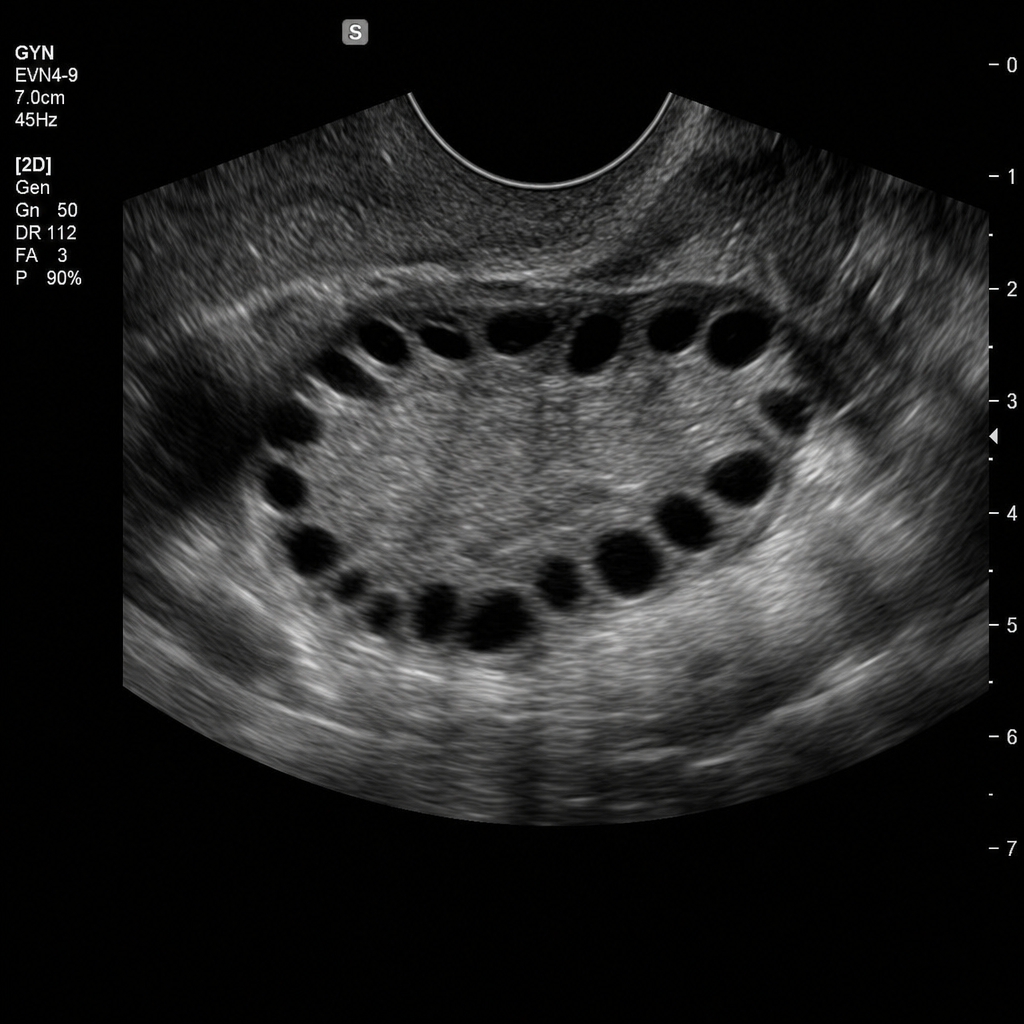
A patient presents with a history of amenorrhea and hirsutism. Ultrasound of the ovary is provided. What is the most likely diagnosis?
A 16-year-old female has not yet started having menstrual cycles. Her secondary sex characteristics appear normal, as does external examination of her genitalia. She is given an intramuscular injection of progesterone, and 5 days later she has her first period. What is the most likely mechanism responsible for the delay in menses?
Explanation: In Polycystic Ovary Syndrome (PCOS), the hormonal and metabolic profile is characterized by hyperandrogenism and insulin resistance. **Explanation of the Correct Answer:** * **A. E2:E1 ratio:** In PCOS, the ratio of **Estradiol (E2) to Estrone (E1) is decreased**, not raised. While E2 is the primary estrogen produced by the ovaries, PCOS involves significant peripheral aromatization of androstenedione into Estrone (E1) within adipose tissue. Consequently, **E1 levels become higher than E2**, leading to a reversal of the normal ratio. **Explanation of Incorrect Options:** * **B. LH:FSH ratio:** Raised. High-frequency GnRH pulses favor LH secretion over FSH. A ratio of **>2:1 or 3:1** is a classic (though not diagnostic) finding. * **C. LDL:HDL ratio:** Raised. Insulin resistance and hyperandrogenism lead to dyslipidemia, specifically increasing "bad" cholesterol (LDL) and decreasing "good" cholesterol (HDL). * **D. Fasting serum insulin:** Raised. Peripheral insulin resistance is a hallmark of PCOS, leading to compensatory hyperinsulinemia, which further stimulates ovarian androgen production. **High-Yield Clinical Pearls for NEET-PG:** * **Hyperestrogenism in PCOS:** It is a state of "chronic tonic estrogen" (mostly E1) without the progesterone surge, leading to an increased risk of **Endometrial Hyperplasia/Carcinoma**. * **SHBG:** Sex Hormone Binding Globulin is **decreased** in PCOS due to high insulin, leading to increased levels of **Free Testosterone**. * **Gold Standard for Insulin Resistance:** Hyperinsulinemic-euglycemic clamp (though rarely used clinically). * **AMH:** Anti-Müllerian Hormone levels are typically **raised** due to the high number of pre-antral follicles.
Explanation: **Stein-Leventhal Syndrome**, now more commonly known as **Polycystic Ovary Syndrome (PCOS)**, is a complex endocrine disorder characterized by chronic anovulation and hyperandrogenism. ### **Explanation of Options** * **Correct Answer: C. Galactorrhoea** Galactorrhoea is the spontaneous flow of milk from the breast, typically associated with **Hyperprolactinaemia**. While a small percentage of PCOS patients may show mildly elevated prolactin levels, galactorrhoea is not a diagnostic or cardinal feature of the syndrome. Its presence should prompt an investigation for a prolactinoma or drug-induced causes rather than PCOS. * **A. Increased Androgens:** This is a hallmark of PCOS. Ovarian theca cells, stimulated by high LH, overproduce androgens (androstenedione and testosterone), leading to clinical features like hirsutism and acne. * **B. Increased or Normal Oestrogens:** In PCOS, there is a state of "unopposed oestrogen." While cyclical estradiol may be low, total oestrogen (specifically **Oestrone/E1**) is increased due to the peripheral conversion of androgens in adipose tissue. * **D. Increased LH:** A classic biochemical finding is an elevated **LH:FSH ratio (>2:1 or 3:1)**. High-frequency GnRH pulses favor LH secretion, which further drives ovarian androgen production. ### **NEET-PG High-Yield Pearls** * **Rotterdam Criteria (2 of 3):** 1. Clinical/biochemical hyperandrogenism; 2. Oligo/anovulation; 3. Polycystic ovaries on ultrasound ("String of pearls" appearance). * **Gold Standard Diagnosis:** Clinical diagnosis based on Rotterdam criteria (Ultrasound is not mandatory if the first two are present). * **Metabolic Link:** Hyperinsulinemia and insulin resistance are central to the pathogenesis, increasing the risk of Type 2 Diabetes and Endometrial Hyperplasia/Carcinoma (due to unopposed oestrogen). * **Treatment of Choice:** * Hirsutism/Regularization: Combined Oral Contraceptive Pills (COCPs). * Infertility (Ovulation Induction): **Letrozole** (First-line) or Clomiphene Citrate.
Explanation: **Explanation:** Polycystic Ovary Syndrome (PCOS) is the most common endocrine disorder in women of reproductive age, characterized by a triad of hyperandrogenism, ovulatory dysfunction, and polycystic ovarian morphology. **Why 80% is correct:** Menstrual irregularities, specifically **oligomenorrhea** (defined as <9 periods per year or cycles >35 days) or amenorrhea, are the hallmark clinical features of PCOS. These occur due to chronic anovulation caused by an imbalance in the LH:FSH ratio and intra-ovarian hyperandrogenism, which arrests follicular development. Large-scale clinical studies and standard textbooks (such as Williams Gynecology) indicate that approximately **80%** of women diagnosed with PCOS present with these menstrual disturbances. **Analysis of Incorrect Options:** * **50% & 60%:** These figures significantly underestimate the prevalence. While some women with PCOS have "ovulatory PCOS" (regular cycles but with hyperandrogenism and PCO morphology), they represent a minority (approx. 20%). * **70%:** While closer, this value is statistically lower than the established clinical prevalence reported in high-yield medical literature for competitive exams like NEET-PG. **High-Yield Clinical Pearls for NEET-PG:** * **Rotterdam Criteria:** Diagnosis requires 2 out of 3: (1) Oligo/Anovulation, (2) Clinical/Biochemical Hyperandrogenism, (3) Polycystic ovaries on USG. * **LH:FSH Ratio:** Classically elevated to **>2:1 or 3:1**, though no longer a formal diagnostic criterion. * **Insulin Resistance:** Present in 50-70% of cases, leading to acanthosis nigricans. * **First-line treatment:** Lifestyle modification (weight loss). For infertility, **Letrozole** is now the drug of choice (superior to Clomiphene).
Explanation: **Explanation:** Sexual infantilism refers to the failure of secondary sexual characteristic development and the maintenance of prepubertal status beyond the expected age of puberty. This occurs due to a defect in the **Hypothalamic-Pituitary-Gonadal (HPG) axis**, resulting in either low gonadotropins (Hypogonadotropic Hypogonadism) or primary gonadal failure (Hypergonadotropic Hypogonadism). * **Pituitary Tumor (Option A):** Tumors like craniopharyngiomas or prolactinomas can compress or destroy gonadotroph cells in the anterior pituitary. This leads to a deficiency in FSH and LH, preventing the stimulation of ovaries/testes, thus causing sexual infantilism. * **Gonadal Aplasia (Option B):** The most common cause is **Turner Syndrome (45,XO)**. In these cases, the gonads fail to develop (streak gonads), leading to a lack of estrogen. Without estrogen, secondary sexual characteristics do not develop, despite high levels of FSH/LH. * **Dwarfism (Option C):** Panhypopituitarism (e.g., Lorain-Levi dwarfism) involves a deficiency in both Growth Hormone (leading to short stature/dwarfism) and Gonadotropins (leading to sexual infantilism). **Conclusion:** Since all three conditions disrupt the HPG axis at different levels, **Option D** is the correct answer. **High-Yield NEET-PG Pearls:** * **Most common cause of Sexual Infantilism with anosmia:** Kallmann Syndrome (Hypogonadotropic). * **Most common cause of Sexual Infantilism with short stature:** Turner Syndrome (Hypergonadotropic). * **Diagnostic Step:** The first step in evaluation is measuring serum **FSH levels** to differentiate between central (pituitary/hypothalamic) and peripheral (gonadal) causes.
Explanation: **Explanation:** **Polycystic Ovarian Disease (PCOD/PCOS)** is a complex endocrine disorder characterized by insulin resistance, hyperandrogenism, and chronic anovulation. **Why Weight Loss is the Correct Answer:** Weight loss is **not** a feature of PCOD; instead, **obesity** (specifically central/android obesity) is a hallmark sign, seen in approximately 50-60% of patients. Obesity exacerbates the condition because adipose tissue decreases Sex Hormone Binding Globulin (SHBG) and increases peripheral conversion of androgens to estrogens, further disrupting the hypothalamic-pituitary-ovarian axis. **Analysis of Incorrect Options:** * **Alopecia:** High levels of circulating free androgens (testosterone) lead to "male-pattern" hair loss (androgenetic alopecia) and hirsutism. * **Theca Cell Hyperplasia:** In PCOD, elevated Luteinizing Hormone (LH) levels cause hyperplasia of the ovarian theca cells. These cells are responsible for the overproduction of androgens (androstenedione and testosterone). * **Hyperandrogenism:** This is a core diagnostic criterion (Rotterdam Criteria). It manifests clinically as acne, hirsutism, and biochemically as elevated serum testosterone levels. **High-Yield Clinical Pearls for NEET-PG:** * **Rotterdam Criteria (2 out of 3):** 1. Oligo/Anovulation, 2. Clinical/Biochemical Hyperandrogenism, 3. Polycystic ovaries on Ultrasound ("String of pearls" appearance). * **LH:FSH Ratio:** Classically elevated to **>2:1 or 3:1**. * **Insulin Resistance:** Leads to **Acanthosis Nigricans** (velvety hyperpigmentation in skin folds). * **First-line Management:** Weight loss and lifestyle modification. For infertility, **Letrozole** is now the drug of choice (DOC), surpassing Clomiphene Citrate.
Explanation: **Explanation:** **Androgen Insensitivity Syndrome (AIS)**, formerly known as Testicular Feminization Syndrome, is an X-linked recessive condition where there is a functional defect in the androgen receptors. **Why Option B is the correct answer (The False Statement):** In AIS, although the body produces high levels of testosterone, the peripheral tissues cannot respond to it due to receptor resistance. Since the development of **pubic and axillary hair** is dependent on androgen action, these patients typically have **absent or very sparse** pubic and axillary hair. Therefore, the statement that pubic hair is "abundant" is incorrect. **Analysis of Incorrect Options:** * **Option A (XY Genotype):** True. These individuals are genetically male (46, XY). * **Option C (Blind Vagina):** True. Due to the presence of the Y chromosome, the SRY gene leads to the development of testes which secrete **Müllerian Inhibiting Substance (MIS)**. MIS causes regression of the Müllerian ducts (uterus, fallopian tubes, and upper 1/3rd of the vagina). The lower 2/3rd of the vagina (derived from the urogenital sinus) develops but ends blindly. * **Option D (Ovaries are absent):** True. These patients have undescended testes (often located in the labia majora or inguinal canal) rather than ovaries. **High-Yield Clinical Pearls for NEET-PG:** * **Phenotype:** Phenotypically female with well-developed breasts (due to peripheral conversion of testosterone to estrogen). * **Primary Amenorrhea:** AIS is a leading cause of primary amenorrhea with breast development. * **Management:** Gonadectomy is performed **after puberty** (to allow natural breast development) to prevent the risk of gonadoblastoma/dysgerminoma. * **Differential Diagnosis:** Differentiate from **Müllerian Agenesis (MRKH Syndrome)** where the genotype is 46, XX, ovaries are present, and pubic hair is normal.
Explanation: ### Explanation **Core Concept: The Luteal Phase and Progesterone Peak** In a normal 28-day menstrual cycle, ovulation typically occurs on Day 14. Following ovulation, the collapsed follicle transforms into the **corpus luteum**, which secretes progesterone. Progesterone levels begin to rise after ovulation, reaching their **peak during the mid-luteal phase**, which is approximately 7 days after ovulation (Day 21 of a 28-day cycle). To document that ovulation has occurred, serum progesterone must be measured when it is at its highest concentration. A level **>3 ng/mL** is generally considered evidence of ovulation. **Analysis of Options:** * **Day 21 (Correct):** This represents the mid-luteal phase (Day 7 post-ovulation). It is the gold standard timing for a single-sample progesterone test to confirm the presence of a functional corpus luteum. * **Day 3 (Incorrect):** This is the early follicular phase. Progesterone is at its baseline (nadir) level (<1 ng/mL). This day is typically used to measure FSH/LH for ovarian reserve testing. * **Day 8 (Incorrect):** This is the mid-follicular phase. The dominant follicle is still developing, and progesterone remains low. * **Day 14 (Incorrect):** This is the typical day of ovulation. While the LH surge occurs here, progesterone has not yet risen significantly enough to confirm ovulation. **NEET-PG High-Yield Pearls:** * **Formula for Variable Cycles:** If a woman has an irregular cycle, the test should be performed **7 days before the expected next period** (e.g., Day 28 for a 35-day cycle), as the luteal phase is constant at 14 days. * **Thresholds:** A progesterone level **>10 ng/mL** in a spontaneous cycle or **>15 ng/mL** in a stimulated cycle is often used to indicate "adequate" luteal function. * **Other Ovulation Indicators:** The most accurate method to predict ovulation is the **LH surge** (detected in urine), while the most accurate method to confirm it is **Transvaginal Ultrasound (TVS)** showing follicle disappearance.
Explanation: **Explanation:** Premenstrual Syndrome (PMS) and its more severe form, Premenstrual Dysphoric Disorder (PMDD), are characterized by cyclic physical and emotional symptoms occurring during the luteal phase. **Why SSRIs are the Correct Answer:** Selective Serotonin Reuptake Inhibitors (SSRIs) are considered the **first-line pharmacological treatment** for PMS/PMDD. The underlying pathophysiology involves a maladaptive response to normal fluctuations in gonadal steroids (estrogen and progesterone), which leads to a functional deficiency in **serotonin**. SSRIs rapidly increase synaptic serotonin levels, effectively alleviating both emotional (irritability, depression) and physical symptoms. Unlike in major depression, SSRIs for PMS can be administered either continuously or restricted to the luteal phase (starting on day 14). **Analysis of Incorrect Options:** * **Progesterone (A):** While PMS occurs during the progesterone-dominant luteal phase, clinical trials have shown that progesterone supplementation is no more effective than a placebo. * **Anxiolytics (B):** Benzodiazepines (like Alprazolam) may be used as a second-line adjunct for severe anxiety but are not first-line due to the risk of dependence and side effects. * **Vitamin E (D):** While sometimes suggested for cyclical mastalgia (breast pain), it lacks robust evidence for treating the global symptoms of PMS. **High-Yield Clinical Pearls for NEET-PG:** * **Gold Standard Diagnosis:** Symptoms must be documented prospectively for at least **two consecutive menstrual cycles** using a daily symptom diary. * **Symptom-Free Interval:** Symptoms must resolve within 4 days of the onset of menses and must not be present during the follicular phase (Days 4–12). * **Severe Cases:** If SSRIs fail, the next step is often **GnRH agonists** (to induce "medical oophorectomy") or COCPs (specifically those containing **Drospirenone**).
Explanation: ***Polycystic Ovary Syndrome (PCOS)*** - **Amenorrhea** and **hirsutism** are classic presenting symptoms of PCOS, part of the **Rotterdam criteria** for diagnosis. - Ultrasound typically shows **multiple peripheral follicles** arranged in a "**string-of-pearls**" pattern around the ovarian cortex. *Endometriosis* - Primarily presents with **cyclical pelvic pain** and **dysmenorrhea**, not amenorrhea or hirsutism. - Ultrasound would show **endometriomas** (chocolate cysts) rather than multiple peripheral follicles. *Adenomyomatosis* - This is a **benign gallbladder condition** characterized by **hyperplasia of the gallbladder wall**, not an ovarian pathology. - Would not cause **amenorrhea** or **hirsutism** as it doesn't affect reproductive hormones. *Choriocarcinoma* - A **malignant gestational trophoblastic neoplasm** that presents with **irregular bleeding** and elevated **β-hCG levels**. - Would not typically cause **hirsutism** or the characteristic ovarian ultrasound findings described.
Explanation: This question tests your understanding of the **Progesterone Challenge Test (PCT)** and the physiology of primary amenorrhea. ### **Explanation of the Correct Answer** The key to this case is the **positive Progesterone Challenge Test** (withdrawal bleeding occurred after progesterone administration). A positive test confirms three critical things: 1. **Adequate Estrogen:** The patient has sufficient endogenous estrogen to prime and proliferate the endometrium. 2. **Patent Outflow Tract:** The uterus, cervix, and vagina are anatomically intact (no obstruction). 3. **Functional Endometrium:** The lining is responsive to hormonal shifts. Since the patient has normal secondary sexual characteristics (indicating a functional HPO axis producing estrogen) and responds to progesterone with bleeding, the most likely diagnosis is **Constitutional Delay**. This is a variation of normal development where the onset of the ovulatory cycle is late, but the hormonal machinery is intact. ### **Why Other Options are Incorrect** * **A. Hypoestrogenism:** If estrogen levels were low, the endometrium would be atrophic. Progesterone cannot cause withdrawal bleeding in an unprimed endometrium. * **B. Hypopituitarism:** This would lead to low FSH/LH and subsequent low estrogen (hypogonadotropic hypogonadism). As with Option A, the PCT would be negative. * **C. End-organ abnormality:** Conditions like Müllerian agenesis (Mayer-Rokitansky-Küster-Hauser syndrome) or imperforate hymen would result in a **negative PCT** because there is either no uterus or no patent path for the blood to exit. ### **Clinical Pearls for NEET-PG** * **Definition of Primary Amenorrhea:** No menses by age 13 (without secondary sex characteristics) or by age 15 (with secondary sex characteristics). * **Positive PCT = Anovulation:** The most common cause of a positive PCT in a patient with amenorrhea is **Polycystic Ovary Syndrome (PCOS)** or, as in this younger patient, an immature HPO axis (Constitutional Delay). * **Negative PCT:** Next step is the **Estrogen-Progesterone Challenge Test**. If still negative, it confirms an **outflow tract obstruction** (e.g., Asherman syndrome or anatomical defects).
Hypothalamic-Pituitary-Ovarian Axis
Practice Questions
Disorders of Puberty
Practice Questions
Hirsutism and Virilization
Practice Questions
Primary Ovarian Insufficiency
Practice Questions
Hyperprolactinemia
Practice Questions
Hyperandrogenism
Practice Questions
Metabolic Dysfunction in PCOS
Practice Questions
Neuroendocrine Disorders and Reproduction
Practice Questions
Hormonal Evaluation and Testing
Practice Questions
Ovulation Induction
Practice Questions
Get full access to all questions, explanations, and performance tracking.
Start For Free