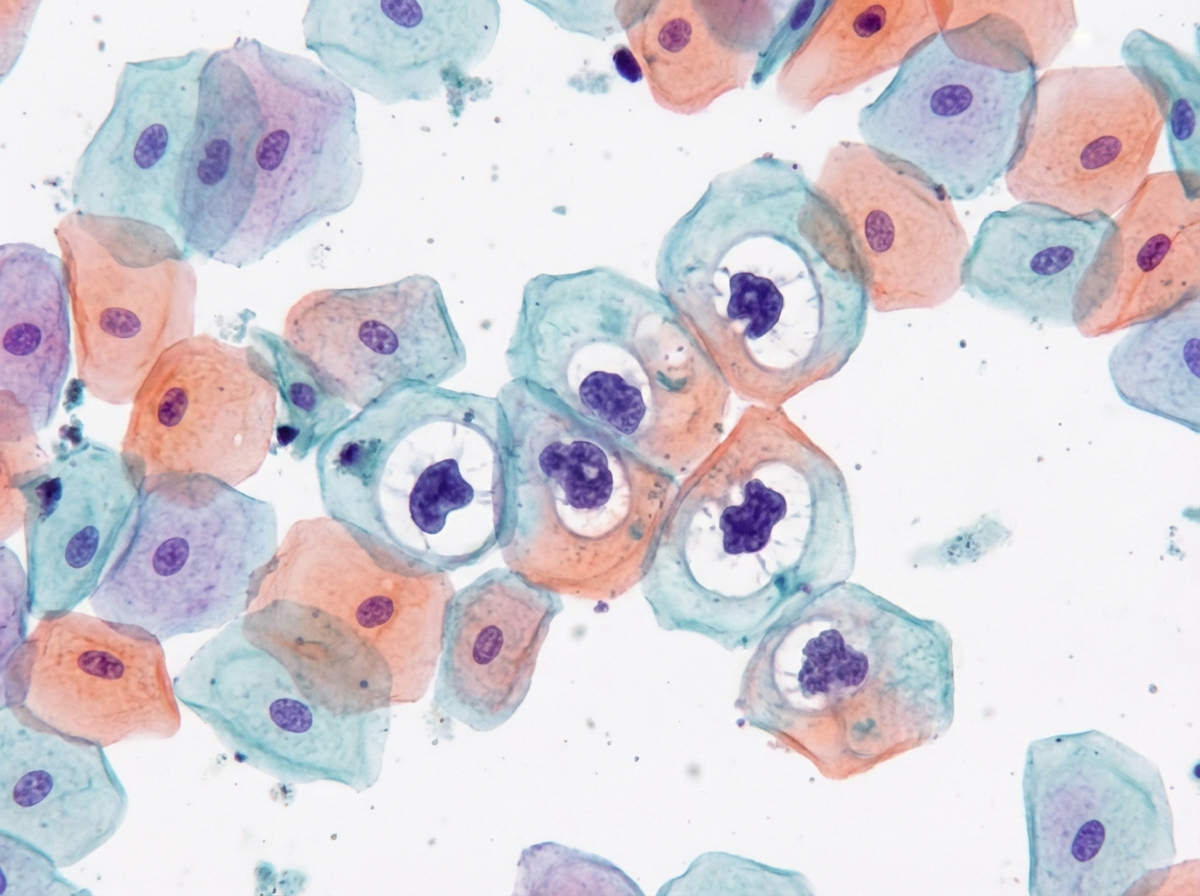
A woman in the late menstrual phase presents with an ovarian mass. Her Pap smear shows predominantly superficial cells stained orange (see image). What is the most likely ovarian tumor?
Which of the following are correct regarding androgen insensitivity syndrome? 1. Inherited as X-linked recessive disorder 2. Karyotype is 46 XXY 3. It is also called testicular feminization 4. Confirmation of diagnosis by gonadal biopsy Select the answer using the code given below.
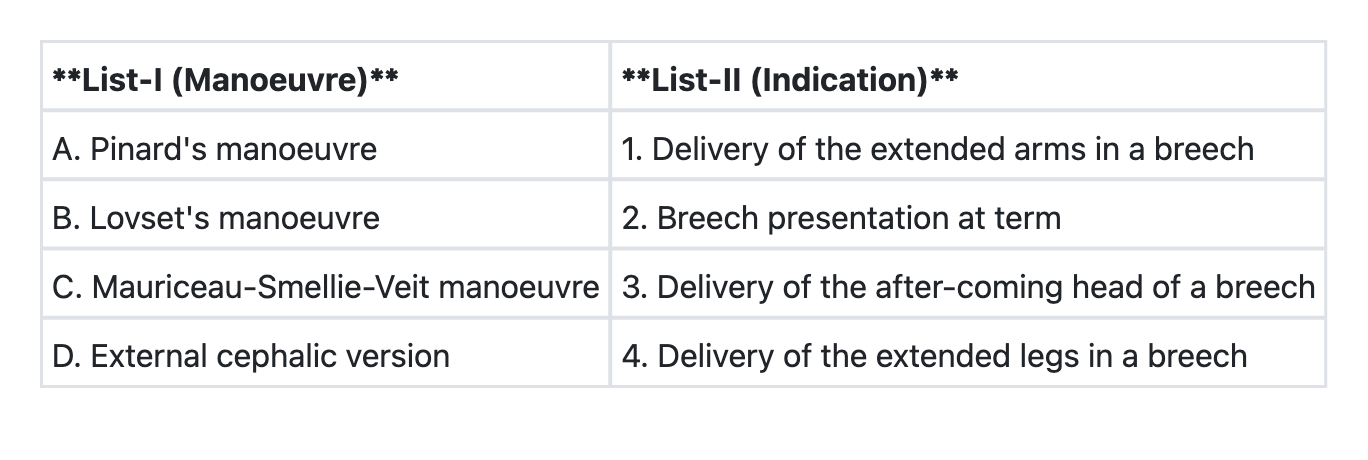
Match List-I with List-II and select the correct answer using the code given below the Lists:
The following hormonal changes mark the Polycystic Ovarian Disease except
If a patient of polycystic ovary syndrome on metformin conceives, how soon should the metformin be stopped?
A 16 year old girl presents with primary amenorrhea with absent vagina, cervix and uterus in the presence of normal secondary sexual characteristics. Ovaries are present on USG. The most probable diagnosis is:
A seven year old girl with precocious puberty is found to be having a 10 cm ovarian cyst on USG. The most likely etiology is
For a primary amenorrhea individual having an XY karyotype, normal infantile female external and internal genitalia, fibrous bands in place of gonads, and lack of development of secondary sexual characters, what is the most probable diagnosis?
Abundant cornified cells in vaginal exfoliative cytology indicate:
Diagnostic criteria for PCOS are: 1. Oligo/amenorrhea 2. Hyperandrogenism 3. Polycystic ovaries on ultrasound Which of the above are correct?
Explanation: ***Granulosa cell tumor*** - The predominance of **superficial cells** with an orange (eosinophilic) stain in a Pap smear indicates unopposed **estrogen effect**. - **Granulosa cell tumors** are sex cord-stromal tumors of the ovary that characteristically secrete estrogen, leading to such changes. *Serous cystadenoma* - This is a common **epithelial ovarian tumor** that is typically benign and does not produce hormones. - It would not cause an estrogenic effect on the Pap smear. *Mucinous cystadenoma* - Another common **epithelial ovarian tumor**, usually benign, which is not associated with hormone production. - It would not lead to the observed estrogen-mediated changes in the cervical cytology. *Fibroma* - An **ovarian fibroma** is a benign stromal tumor that does not typically produce hormones. - While some rare stromal tumors can be hormonally active (e.g., thecofibromas), a standard fibroma would not cause significant estrogenic effects on the Pap smear.
Explanation: ***1, 3 and 4*** - Androgen insensitivity syndrome (AIS) is inherited as an **X-linked recessive disorder** due to mutations in the androgen receptor gene on the X chromosome - It is also known as **testicular feminization syndrome** because affected individuals have a male karyotype (46, XY) with testes but develop a female phenotype due to androgen resistance - **Gonadal biopsy** can confirm the presence of testicular tissue and is used in diagnosis, though clinical features, hormonal profiles (high testosterone with high LH), and genetic testing are also important diagnostic tools - Statement 2 is incorrect: the karyotype is **46, XY** (not 46, XXY) *1, 2 and 3* - This combination is incorrect because statement 2 is false - The karyotype in AIS is **46, XY**, not 46, XXY - A karyotype of **46, XXY** is characteristic of **Klinefelter syndrome**, not AIS - While statements 1 and 3 are correct, including the false statement 2 makes this option incorrect *1, 2 and 4* - This combination is incorrect because statement 2 is false - The standard karyotype for AIS is **46, XY** with functional testes producing normal to high levels of testosterone - Patients are genetically male but phenotypically female due to **androgen receptor insensitivity** - 46, XXY (Klinefelter syndrome) presents with small testes, hypogonadism, and gynecomastia—a completely different clinical picture *2, 3 and 4* - This combination is incorrect because statement 2 is false - AIS patients have **46, XY karyotype** with intra-abdominal or inguinal testes - They present with primary amenorrhea, absent uterus and upper vagina, and normal female external genitalia in complete AIS - The key pathophysiology is **androgen receptor defect**, not chromosomal aneuploidy
Explanation: **List Mapping:** - List-I: A = Pinard's maneuver, B = Lovset's maneuver, C = Mauriceau-Smellie-Veit maneuver, D = External cephalic version - List-II: 1 = Breech presentation at term, 2 = After-coming head, 3 = Extended arms, 4 = Extended legs ***A→4 B→3 C→2 D→1*** - This is the **correct matching** of each maneuver to its primary indication. - **Pinard's maneuver (A→4)** is used for delivery of **extended legs** in breech presentation by flexing the legs at the knee. - **Lovset's maneuver (B→3)** is used for delivery of **extended arms** in breech by rotating the fetus. - **Mauriceau-Smellie-Veit maneuver (C→2)** is used for controlled delivery of the **after-coming head** in breech. - **External cephalic version (D→1)** is performed to convert **breech presentation at term** to cephalic presentation. *A→1 B→2 C→3 D→4* - This incorrectly matches Pinard's maneuver with breech at term (should be a conversion procedure, not delivery technique). - Lovset's is incorrectly matched with after-coming head instead of extended arms. - Mauriceau-Smellie-Veit is incorrectly matched with extended arms instead of after-coming head. - External cephalic version is incorrectly matched with extended legs instead of breech at term. *A→3 B→4 C→1 D→2* - This incorrectly matches Pinard's with extended arms (Lovset's indication). - Lovset's is incorrectly matched with extended legs (Pinard's indication). - Mauriceau-Smellie-Veit is incorrectly matched with breech at term (ECV indication). - External cephalic version is incorrectly matched with after-coming head (Mauriceau-Smellie-Veit indication). *A→4 B→1 C→2 D→3* - While Pinard's maneuver (A→4) is correctly matched with extended legs, the other matches are incorrect. - Lovset's is incorrectly matched with breech at term instead of extended arms. - External cephalic version is incorrectly matched with extended arms instead of breech at term. - Only Mauriceau-Smellie-Veit (C→2) is correctly matched with after-coming head.
Explanation: ***Raised LH, Raised FSH*** - In **Polycystic Ovarian Syndrome (PCOS)**, the characteristic LH/FSH ratio is typically **high LH and low-to-normal FSH**, not elevated levels of both. - A simultaneous elevation of both **LH and FSH** is more indicative of **primary ovarian failure** rather than PCOS, as the ovaries would no longer be producing sufficient hormones, leading to increased pituitary stimulation. *Raised LH, Low-to-normal FSH* - This hormonal pattern is a hallmark of **PCOS**, where the **increased LH** stimulates the ovarian theca cells to produce excess androgens. - The **low or normal FSH** prevents proper follicular development, contributing to anovulation and cyst formation. *Hyperinsulinaemia* - **Insulin resistance** and compensatory **hyperinsulinaemia** are very common findings in PCOS, driving increased ovarian androgen production. - High insulin levels potentiate the effect of LH on ovarian androgen synthesis and suppress hepatic production of sex hormone-binding globulin (SHBG). *Hyperandrogenism* - **Hyperandrogenism**, characterized by elevated levels of androgens (e.g., testosterone), is a central feature of PCOS and responsible for symptoms like hirsutism, acne, and alopecia. - This excess androgen production originates primarily from the ovaries and, to some extent, the adrenal glands, often exacerbated by hyperinsulinaemia.
Explanation: ***Immediately following the diagnosis of pregnancy*** - Based on **current evidence**, metformin can be safely **discontinued once pregnancy is confirmed** in PCOS patients. - The primary role of metformin in PCOS is to improve **ovulation and achieve conception**—once pregnancy occurs, this goal is accomplished. - Recent large randomized trials (including **PregMet** and **MiTy studies**) have shown **no significant benefit** in continuing metformin during pregnancy for reducing miscarriage or gestational diabetes. - Current practice favors **individualized decisions**, but routine continuation is not standard. *After the 1st trimester* - This was **older practice** based on theoretical benefits of reducing early pregnancy loss. - However, systematic reviews and meta-analyses have **not confirmed** these benefits in well-designed trials. - While some clinicians may continue metformin through the first trimester in selected cases, this is not the standard recommendation for all PCOS pregnancies. *After the 2nd trimester* - Continuing metformin this long is **not evidence-based** for routine PCOS management. - While metformin may be continued throughout pregnancy for **gestational diabetes** management (separate indication), this is not specifically for PCOS. - Most guidelines do not support routine continuation beyond pregnancy confirmation for PCOS alone. *Before the onset of labour* - This timing has **no physiological basis** for PCOS-related metformin use. - If metformin is being used for gestational diabetes (different indication), timing of discontinuation would be individualized, but this is not the standard answer for PCOS patients.
Explanation: ***Mayer Rokitansky Küster Hauser syndrome*** - This syndrome is characterized by **agenesis or hypoplasia of the Müllerian ducts**, leading to the absence of the vagina, cervix, and uterus. - The presence of **normal secondary sexual characteristics** and **ovaries** confirms that ovarian function (estrogen production) is intact and the karyotype is typically 46, XX. *Klinefelter's syndrome* - This is a chromosomal disorder in males (47, XXY) characterized by **primary hypogonadism**, small testes, and often infertility. - It would present as a male, not a 16-year-old girl with an absent uterus. *Androgen Insensitivity syndrome* - In this syndrome, individuals are **genetically male (46, XY)** but appear female due to target tissue insensitivity to androgens. - They typically have a short, blind-ending vagina but **lack a uterus, fallopian tubes, and ovaries**, having undescended testes instead. *Prader-Willi syndrome* - This is a genetic disorder characterized by **intellectual disability**, obesity, short stature, and **hypogonadism**. - It does not involve agenesis of the female reproductive organs and is not primarily linked to primary amenorrhea with absent reproductive structures.
Explanation: ***Granulosa cell tumour*** - This tumor is a common cause of **sexual precocity** in girls because it produces **estrogen**, leading to premature development of secondary sexual characteristics. - Granulosa cell tumors can grow to a significant size, like the **10 cm ovarian cyst** described, and are often malignant or borderline. *Choriocarcinoma* - Ovarian choriocarcinoma is a **highly malignant germ cell tumor** that typically secretes **human chorionic gonadotropin (hCG)**, not estrogen. - While it can cause precocious pseudopuberty by stimulating ovarian steroidogenesis through hCG, it is a very rare primary ovarian tumor. *Benign cystic teratoma* - These are **common germ cell tumors** that contain tissues from all three germ layers; however, they are usually **hormonally inactive** and do not typically cause precocious puberty. - While they can form large cysts, the presence of precocious puberty points away from this diagnosis. *Brenner tumour* - **Brenner tumors** are uncommon epithelial ovarian tumors that are typically **solid and benign**, though malignant forms exist. - They are generally **hormonally inactive** and do not cause precocious puberty; they also typically occur in older women.
Explanation: ***Swyer syndrome*** - **Swyer syndrome**, or **46,XY complete gonadal dysgenesis**, is characterized by an XY karyotype with female external and internal genitalia, but rudimentary gonads (streak gonads) that appear as fibrous bands. - The absence of functional testes leads to a lack of **androgen production** and **Müllerian inhibiting factor (MIF)**, resulting in a female phenotype, primary amenorrhea, and absent secondary sexual characteristics. *Testicular feminization syndrome* - In **Testicular feminization syndrome**, or **Androgen Insensitivity Syndrome (AIS)**, individuals have functional testes producing androgens but the target cells are unresponsive. - This leads to male internal gonads (testes) but female external genitalia and normal breast development, which contradicts the described "fibrous bands in place of gonad" and "lack of development of secondary sexual characters." *Mixed gonadal dysgenesis* - **Mixed gonadal dysgenesis** usually involves mosaicism (e.g., 45,X/46,XY), leading to an asymmetrical development of gonads, typically with a streak gonad on one side and a dysgenetic testis on the other. - This often results in ambiguous genitalia and a different hormonal profile than described. *Defective antimüllerian hormone* - A **defective antimüllerian hormone (AMH)** or its receptor would result in the persistence of Müllerian structures (uterus, fallopian tubes) in an individual with an XY karyotype and male external genitalia. - This condition does not explain the lack of secondary sexual characteristics or the presence of fibrous bands instead of testes.
Explanation: ***Late proliferative phase*** - During the **late proliferative phase**, estrogen levels are at their peak, leading to significant maturation and cornification of vaginal epithelial cells. - This phase is characterized by a high proportion of **superficial cells**, which are large, polygonal, and have small, pyknotic nuclei, reflecting extensive cornification. *Late secretory phase* - In the **late secretory phase**, progesterone levels are high, which causes an increase in **intermediate cells** and a decrease in superficial (cornified) cells. - The cytology would show a dominance of folded intermediate cells, often in clusters, and a **"navicular cell"** appearance, rather than abundant cornified cells. *Early secretory phase* - The **early secretory phase** is also dominated by progesterone's influence, leading to a shift from superficial to intermediate cells. - There would be a mixture of intermediate and some superficial cells, but not the abundance of **highly cornified cells** seen in the late proliferative phase. *Early proliferative phase* - The **early proliferative phase** follows menstruation and is characterized by rising estrogen, but not yet at its peak. - The cytology would typically show a mixture of **parabasal**, intermediate, and some superficial cells, reflecting the initial regeneration of the epithelium, with less cornification than the late proliferative phase.
Explanation: ***1, 2 and 3*** - All three listed features are the **Rotterdam criteria** for diagnosing PCOS, which is the most widely used diagnostic system. - The Rotterdam criteria require **at least 2 out of 3** of the following: **(1) oligo-ovulation/anovulation** (clinically presenting as oligo/amenorrhea), **(2) clinical or biochemical hyperandrogenism**, and **(3) polycystic ovaries on ultrasound**. - Since all three listed features are valid diagnostic criteria, the correct answer includes all of them (1, 2, and 3). - Note: Diagnosis requires meeting 2 out of 3 criteria, but all 3 are recognized valid criteria. *2 and 3 only* - This option incorrectly excludes **oligo/amenorrhea** (oligo-ovulation/anovulation). - Oligo/amenorrhea is a core criterion in the Rotterdam criteria and represents the ovulatory dysfunction that is central to PCOS. - Excluding this criterion makes the option incomplete. *1 and 3 only* - This option incorrectly excludes **hyperandrogenism**. - Hyperandrogenism (clinical signs like hirsutism, acne, or biochemical elevation of androgens) is a fundamental criterion in the Rotterdam criteria. - It reflects the hormonal dysregulation that characterizes PCOS and cannot be excluded as a valid diagnostic criterion. *1 and 2 only* - This option incorrectly excludes **polycystic ovaries on ultrasound**. - The ultrasound finding of polycystic ovarian morphology (≥12 follicles measuring 2-9 mm or ovarian volume >10 mL) is an essential criterion in the Rotterdam criteria. - Excluding this morphological feature makes the option incomplete.
Hypothalamic-Pituitary-Ovarian Axis
Practice Questions
Disorders of Puberty
Practice Questions
Hirsutism and Virilization
Practice Questions
Primary Ovarian Insufficiency
Practice Questions
Hyperprolactinemia
Practice Questions
Hyperandrogenism
Practice Questions
Metabolic Dysfunction in PCOS
Practice Questions
Neuroendocrine Disorders and Reproduction
Practice Questions
Hormonal Evaluation and Testing
Practice Questions
Ovulation Induction
Practice Questions
Get full access to all questions, explanations, and performance tracking.
Start For Free