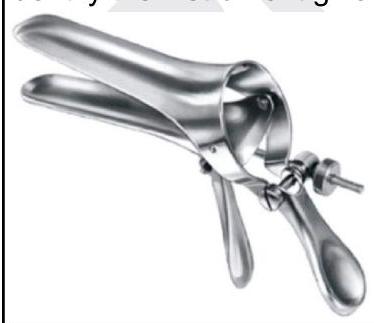
Identify the instrument shown in the image below:

The flexion point in ventouse (vacuum) delivery is located at:
Identify the instrument given below.
Which of the following instruments are used in the caesarean section? 1. Bard-Parker blade 2. Doyen's retractor 3. Cusco's speculum 4. Allis forceps 5. Shirodkar's uterine clamp 6. Green Armytage forceps
A lady with 36-week pregnancy with previous C-section comes with low BP, tachycardia, and on USG fluid present in peritoneum. What is the diagnosis and next management?
Which of these types of fibroid may be removed at the time of a cesarean section?
Which of the following is consistent with a decision to perform a cerclage?
Contraindications to ventouse delivery include all of the following except :
In modern era, the only indication for Internal Podalic Version is:
Shirodkar cerclage may be associated with all complications except:
Explanation: ***Kielland*** - Kielland forceps are distinguished by their **lack of pelvic curve** and the presence of a sliding lock mechanism designed for **rotation of the fetal head**. - They are primarily used for **rotational delivery** when the fetal head is in malposition, often in the mid-pelvis. *Simpson* - Simpson forceps have a distinct **cephalic curve** for grasping the fetal head and a **pelvic curve** to conform to the birth canal. - They are commonly used for **outlet and low-cavity deliveries** where minimal rotation is needed. *Wrigley* - Wrigley forceps are a type of **outlet forceps** with a very short shanks and blades, making them suitable only when the fetal head is on the **perineum**. - They are designed for situations where the head is already visible without separating the labia. *Pipers* - Pipers forceps are specifically designed for **delivery of the after-coming head in breech presentations**. - They feature a long, curved shank that allows placement from below the maternal pelvis to grasp the fetal head in this particular presentation.
Explanation: ***3 cm anterior to the posterior fontanelle*** - This is the **correct location of the flexion point** (also described as approximately 6 cm posterior to the anterior fontanelle along the sagittal suture). - This position optimizes the **flexion-traction axis** during vacuum extraction, ensuring that the fetal head descends through the birth canal in the most favorable attitude with maximum flexion. - Correct placement of the vacuum cup at this site provides a **mechanical advantage**, leveraging the natural pivot point of the fetal head for effective delivery and bringing the **occiput** down first. *3 cm posterior to the anterior fontanelle* - This location is **too far anterior**, only 3 cm from the anterior fontanelle, and does not correspond to the true flexion point. - Placing the cup here would result in **suboptimal flexion** and poor mechanical advantage during traction. - This may lead to **cup slippage**, increased rate of failed vacuum delivery, and potential scalp injury. *6 cm anterior to the posterior fontanelle* - Since the distance between fontanelles is approximately 9 cm, this position would be equivalent to 3 cm posterior to the anterior fontanelle (too anterior). - This is **not the correct flexion point** and would result in the same problems as placing the cup too far anterior. *Midway between the anterior and posterior fontanelle* - While this location (approximately 4.5 cm from either fontanelle) might seem intuitive, it does not precisely correspond to the optimal **flexion point** for vacuum extraction. - The true flexion point is slightly more posterior, at **3 cm anterior to the posterior fontanelle**, which optimizes the mechanism of labor.
Explanation: ***Cusco's speculum*** - This is a **bivalved, self-retaining speculum** with two articulated blades that open and close using a **thumbscrew/locking mechanism** at the handle. - Commonly used for **per speculum examination** to visualize the **cervix and vaginal walls** during gynecological procedures. *Sims' speculum* - A **single-bladed (univalve) speculum** that requires an **assistant to hold** during examination, unlike the self-retaining instrument shown. - Used to retract the **posterior vaginal wall** but lacks the dual-blade design visible in the image. *Graves' speculum* - Similar bivalved design to Cusco's but features **longer and wider blades** for better visualization in larger patients. - More commonly used in the **United States**, with a bulkier appearance than the instrument pictured. *Auvard's speculum* - A **weighted, self-retaining single-blade speculum** used as a **posterior vaginal retractor**. - Completely different design from the bivalved instrument shown, with only **one blade** and no locking mechanism.
Explanation: ***Correct: 1,2,4,6*** - **Bard-Parker blade** (scalpel) is used for making the abdominal and uterine incisions in caesarean section. - **Doyen's retractor** is a common abdominal wall retractor used in C-sections to provide good exposure of the uterus. - **Allis forceps** are used to grasp and hold tissues, often the rectus sheath or uterine edges, for traction or approximation during the procedure. - **Green Armytage forceps** are specialized obstetric forceps primarily used to clamp the uterine edges after incision to control bleeding. *Incorrect: 1,2,3,6* - This option incorrectly includes **Cusco's speculum**, which is a vaginal speculum used for gynecological examinations and procedures like colposcopy or Pap smears, not for a caesarean section. - While Bard-Parker blade, Doyen's retractor, and Green Armytage forceps are correct, the inclusion of Cusco's speculum makes this option incorrect. *Incorrect: 1,2,5,6* - This option incorrectly includes **Shirodkar's uterine clamp**. Shirodkar's procedure refers to a type of cervical cerclage, and there isn't a widely recognized "Shirodkar's uterine clamp" used in standard caesarean sections. - Bard-Parker blade, Doyen's retractor, and Green Armytage forceps are correct, but the presence of Shirodkar's uterine clamp makes the option incorrect in the context of a typical C-section. *Incorrect: 1,2,3,5* - This option incorrectly includes both **Cusco's speculum** and **Shirodkar's uterine clamp**. - As explained, Cusco's speculum is for vaginal examination, and Shirodkar's clamp is not a standard instrument for caesarean sections.
Explanation: ***Uterine scar rupture with Laparotomy*** - The presentation of **low blood pressure**, **tachycardia**, and **free fluid in the peritoneum** in a 36-week pregnant woman with a **previous C-section** is highly indicative of uterine scar rupture given the signs of **hemorrhagic shock**. - **Laparotomy** (emergency abdominal surgery) is the immediate and definitive management to repair the ruptured uterus, control bleeding, and deliver the fetus. *Abruptio and C-section* - **Placental abruption** typically presents with painful vaginal bleeding, uterine tenderness, and fetal distress, which are not explicitly mentioned as the primary symptoms here. - While a **C-section** would be indicated for abruption, the presence of free fluid in the peritoneum and hemodynamic instability in a woman with a prior C-section points more towards rupture. *Ectopic pregnancy and abortion* - An **ectopic pregnancy** is ruled out by the 36-week gestational age; these occur much earlier in pregnancy. - An **abortion** refers to the termination of pregnancy and does not cause these specific signs and symptoms at 36 weeks. *Impending dehiscence and Laparoscopy* - **Impending dehiscence** (separation of the uterine scar without complete rupture) would likely cause localized pain but typically not the severe signs of **hypovolemic shock** and free peritoneal fluid seen here. - **Laparoscopy** is a minimally invasive procedure and would not be appropriate for the emergency management of a potentially life-threatening hemorrhage from uterine rupture.
Explanation: ***Pedunculated fibroid*** - **Pedunculated subserosal fibroids** are the safest type to remove during cesarean section, particularly those on a **narrow stalk** - They can be easily accessed through the abdominal incision without disrupting the uterine wall integrity - The stalk can be **clamped, ligated, and divided** with minimal risk of hemorrhage if proper hemostatic technique is used - Removal does not compromise the **hysterotomy closure** or future uterine integrity - This is the **only type of fibroid** routinely considered safe for removal during C-section if clinically indicated *Intramural fibroid* - **Intramural fibroids** are embedded within the myometrial wall and their removal is **generally contraindicated** during cesarean section - Myomectomy during C-section carries significant risk of **severe hemorrhage** from the highly vascular pregnant uterus - Removal can compromise **uterine wall integrity** and interfere with proper hysterotomy closure - May increase risk of **uterine rupture** in subsequent pregnancies - Standard obstetric practice is to **avoid myomectomy at cesarean** unless the fibroid is directly obstructing delivery *Broad ligament fibroid* - **Broad ligament fibroids** are located between the layers of the broad ligament, often in close proximity to the **ureter** and **uterine vessels** - Removal carries extremely high risk of **ureteral injury** and **massive hemorrhage** from pedicle vessels - Their excision is **absolutely contraindicated** during cesarean section *Cervical fibroid* - **Cervical fibroids** are located in the cervix with its **rich vascular supply** from cervical branches of uterine arteries - Removal during C-section risks **uncontrollable hemorrhage** and can cause **cervical incompetence** - Excision is **contraindicated** during cesarean section and should be managed separately if needed
Explanation: ***Cervix dilated to 3 cm*** - In the context of **mid-trimester cervical dilation** (before 24 weeks) without contractions or bleeding, this represents **cervical insufficiency** - a potential indication for **emergency (rescue) cerclage**. - While 3 cm dilation is at the **upper limit** and somewhat controversial, emergency cerclage may still be considered if membranes are intact, there are no contractions, and gestational age is <24 weeks. - This is the **only option** that represents a clinical scenario where cerclage might be performed, as the other three options are **absolute contraindications**. - Note: Most clinicians prefer cervical dilation **<2 cm** for rescue cerclage, but individual cases at 2-3 cm may be considered based on clinical judgment. *Gestation of 26 weeks* - Cerclage is typically placed between **12-14 weeks** (prophylactic) or up to **23-24 weeks** (emergency). - At **26 weeks**, cerclage is **contraindicated** - the risks (membrane rupture, infection, preterm labor) outweigh benefits at this advanced gestation. - This is an **absolute contraindication** regardless of cervical findings. *Uterine bleeding* - **Active uterine bleeding** is an **absolute contraindication** to cerclage placement. - Bleeding increases risks of **infection, membrane rupture, and preterm labor**. - Must rule out **placental abruption, placenta previa**, or other complications before considering any cervical intervention. *Uterine contractions* - **Active uterine contractions** are an **absolute contraindication** for cerclage. - Placing cerclage during contractions can precipitate **preterm labor and delivery**. - Contractions indicate the cervix may be responding to labor stimuli, making cerclage ineffective and potentially harmful.
Explanation: ***Occipito transverse position*** - This is **NOT a contraindication** to ventouse delivery and is the correct answer - Ventouse can be successfully used to assist with **rotation** from occipito transverse to occipito anterior position before extraction - Modern ventouse techniques specifically allow for **controlled rotation** during delivery - This is a common indication for instrumental delivery rather than a contraindication *Face presentation* - Applying a ventouse cup to the fetal face is **absolutely contraindicated** due to high risk of **facial trauma**, soft tissue injury, eye damage, and neurological complications - The cup cannot achieve proper placement on the facial bones - Face presentation typically requires **cesarean section** or careful management with forceps only in specific mentum anterior positions *Fetal coagulopathies* - This is a **strong contraindication** to ventouse delivery due to the increased risk of **intracranial hemorrhage** and other bleeding complications in the neonate - Conditions like hemophilia, thrombocytopenia, or Von Willebrand disease make any instrumental trauma potentially life-threatening - The traction and pressure from the ventouse cup can cause **scalp hematomas, subgaleal hemorrhage, or intracranial bleeding** in coagulopathic fetuses *Extreme prematurity* - **Extreme prematurity** (typically <34 weeks gestation) is a contraindication to ventouse delivery due to the **fragility of the fetal skull** and markedly increased risk of **intracranial hemorrhage** - The incompletely ossified skull and delicate cerebral vasculature make preterm infants highly vulnerable to trauma from vacuum extraction - Instrumental delivery in preterm infants carries unacceptably high risk of **intraventricular hemorrhage** and long-term neurological injury
Explanation: ***Delivery of Second baby of twins*** - **Internal Podalic Version (IPV)** is primarily indicated for the delivery of the second twin in cases where the second twin presents in a **non-cephalic presentation** or has a malpresentation after the delivery of the first twin. - This procedure aims to quickly deliver the second twin by grasping its feet and converting it into a **breech presentation**, reducing the risk of complications such as **abruptio placentae** or fetal distress. *Transverse lie* - While a transverse lie would typically require intervention, **external cephalic version (ECV)** is usually attempted first to convert the fetus to a cephalic presentation. - If ECV fails or is contraindicated, a **cesarean section** is generally the safest approach for a transverse lie in a singleton pregnancy, rather than IPV. *Breech presentation* - For a singleton **breech presentation** at term, management options include planned **cesarean section** or, in select cases, a trial of vaginal breech delivery. - IPV is **not typically performed** for a primary breech presentation in a singleton pregnancy due to potential risks to the fetus and uterus. *Oblique lie* - An **oblique lie** is often unstable and may convert to a longitudinal or transverse lie spontaneously or with intervention. - Similar to a transverse lie, **external cephalic version (ECV)** would be the initial consideration to convert it to a cephalic presentation, or a **cesarean section** if ECV is unsuccessful or contraindicated.
Explanation: ***Paresthesia over inner aspect*** - Paresthesia over the inner thigh is typically associated with injury to the **femoral nerve** or its branches, or the **obturator nerve**. - While surgery in the pelvic region always carries some nerve injury risk, a Shirodkar sling operation, which is a cervical cerclage, is **unlikely to directly cause paresthesia** in this specific distribution. *Enterocele* - An **enterocele** is a type of pelvic organ prolapse where the small bowel descends into the lower pelvic cavity, creating a bulge in the vagina. - The Shirodkar sling procedure involves placing a suture around the cervix, which can alter pelvic anatomy and potentially contribute to the development or worsening of an enterocele, by **changing pressure dynamics** or creating adhesion. *Ureteral injury* - The **ureters** pass close to the cervix as they course into the bladder, especially where the uterosacral ligaments attach. - During the placement of the Shirodkar cervical cerclage, there is a risk of **ligating or damaging the ureters** due to their proximity to the surgical field. *Subacute intestinal obstructions* - Any pelvic surgery, including a Shirodkar sling operation, carries a risk of **adhesion formation**. - These **post-surgical adhesions** can involve segments of the bowel, potentially leading to kinking or narrowing of the intestinal lumen, which can cause symptoms of subacute intestinal obstruction.
Cesarean Section Techniques
Practice Questions
Vaginal Birth After Cesarean
Practice Questions
Instrumental Deliveries
Practice Questions
Breech Delivery
Practice Questions
Episiotomy and Repair
Practice Questions
Management of Multiple Gestation
Practice Questions
Cervical Cerclage
Practice Questions
Obstetric Hysterectomy
Practice Questions
Surgery During Pregnancy
Practice Questions
Surgical Complications in Obstetrics
Practice Questions
Get full access to all questions, explanations, and performance tracking.
Start For Free