The ideal distension medium for operative hysteroscopy using electro-cautery is
Which of the following is the most appropriate management in a ruptured tubal pregnancy?
In the process of MTP (Medical Termination of Pregnancy) done by suction and evacuation, it was realized that perforation of uterus occurred with cannula. The next step should be:
Manual Vacuum Aspiration (MVA) that has been introduced in primary health centres helps in reducing which of the following indices?
A patient of ectopic pregnancy had beta-hCG of 5800 IU/ml. Medical management was done by single dose methotrexate. Beta-hCG repeated after 48 hours was found 7000 IU/ml. What will you do further?
Which of the following conditions is best treated by a posterior colpotomy?
A 29 year old woman presents in emergency ward with amenorrhea of 6 weeks and pain. Urine pregnancy test shows positive. Examination shows diffuse significant lower abdomen tenderness. The pelvic examination is difficult to accomplish due to guarding. Her Beta-hCG level is 4000 mIU/ml. Transvaginal ultrasound shows no pregnancy in the uterus and no adnexal mass but moderate fluid in abdomen. Which of the following is the next best step?
Identify the maneuver shown in the image:
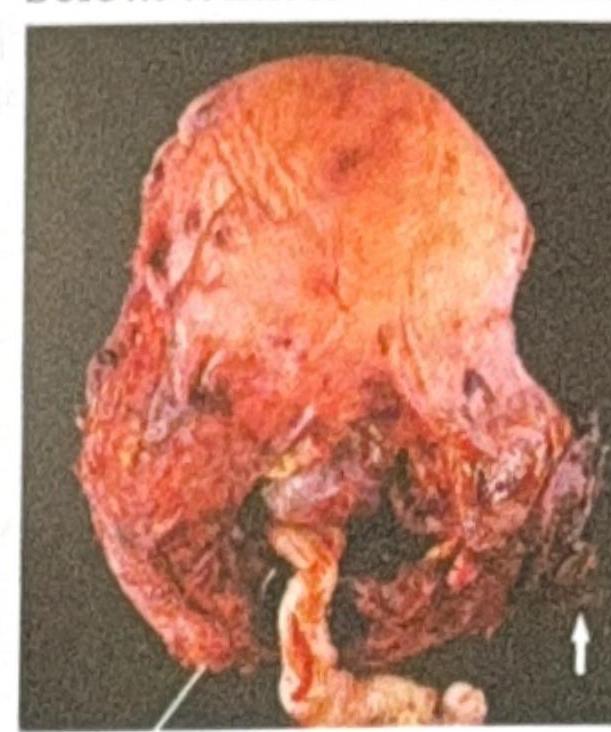
A G2P1L1 woman with a history of previous cesarean section presents with complications related to the placenta. The image below shows the gross appearance of the uterus. What is the most likely diagnosis?
A 30-year-old female, G2L2, with a history of cervical elongation presents for surgical consultation. What is the surgery of choice?
Explanation: ***1.5% glycine*** - **1.5% glycine** is an **electrically non-conductive hypotonic fluid**, making it the **ideal distension medium** for operative hysteroscopy using **monopolar electro-cautery**. - It allows safe transmission of electrical current without dispersion, enabling effective tissue cutting and coagulation. - Provides excellent visualization during operative procedures and can clear blood and debris effectively. - **Risk consideration**: Prolonged procedures with excessive absorption can lead to **hyponatremia, hypo-osmolality syndrome, and glycine toxicity** (causing visual disturbances and encephalopathy), requiring careful fluid balance monitoring. *CO₂* - **CO₂** is used exclusively for **diagnostic hysteroscopy**, not operative procedures. - While it is non-conductive, it provides **poor visibility when bleeding occurs** as it cannot clear blood or debris. - **Contraindicated in operative hysteroscopy** due to high risk of **gas embolism** when vessels are opened during surgery. - Rapid absorption can occur through opened blood vessels, making it unsafe for electrosurgical procedures. *5% dextrose saline* - **Dextrose saline** solutions are **electrically conductive** due to the saline component, causing current dispersion during monopolar electro-cautery. - Would lead to **non-target tissue damage** and ineffective surgical effect. - Also carries risk of **fluid overload and electrolyte disturbances** with excessive absorption. *N-saline* - **Normal saline** is an **electrically conductive** solution and is **contraindicated for monopolar electro-cautery** as it disperses electrical current. - It is the **preferred medium for bipolar electro-cautery** where the electrical circuit is contained between the two poles of the instrument. - Safe, isotonic, and no risk of hyponatremia, but cannot be used with monopolar systems.
Explanation: ***Quick resuscitation followed by laparotomy and excision of the offending tube*** - A ruptured tubal pregnancy is a **life-threatening emergency** requiring immediate intervention due to significant hemorrhage. - **Quick resuscitation** (IV fluids, blood products) stabilizes the patient, while **laparotomy** and **excision of the offending tube** are crucial to control bleeding and remove the ectopic pregnancy. *Autotransfusion of the fresh blood harvested from the peritoneal cavity* - While **autotransfusion** can be considered in some trauma cases with large volume internal bleeding, it is not the primary or immediate step in a ruptured ectopic pregnancy. - The immediate priority is to **stop the ongoing bleeding** surgically, as continued hemorrhage outweighs the benefits of autotransfusion if the source is not controlled. *Blood transfusion immediately after the clamps have been placed to control the bleeding* - **Blood transfusion** is essential in managing hemorrhagic shock, but typically begins *during* or *immediately upon presentation* to stabilize the patient, not strictly after surgical clamp placement. - The critical first step is to **achieve hemodynamic stability** (resuscitation) and simultaneously move towards surgical intervention to stop the bleed. *Excision of the offending tube and the ipsilateral ovary (salpingo-oophorectomy)* - **Salpingo-oophorectomy** (removal of tube and ovary) is generally overkill for an ectopic pregnancy, as preserving the ovary is important for future fertility and hormonal function. - A **salpingectomy** (removal of the tube only) is usually sufficient and preferred unless the ovary is also severely damaged or involved.
Explanation: ***Laparotomy with exploration of bowel*** - **Uterine perforation** during suction and evacuation abortion with a **cannula** (large instrument) carries high risk of bowel or vascular injury and necessitates surgical intervention. - **Laparotomy** (or laparoscopy in stable patients) allows for direct visualization of the injury, assessment of any associated bowel or vascular damage, and repair of the perforation. - Given the mechanism (cannula perforation), the risk of **intra-abdominal organ injury** is significant, warranting exploration. *Manual vacuum aspiration* - This procedure is used for uterine evacuation, not for managing a **uterine perforation**. - Continuing with aspiration after perforation risks aggravating the injury and causing further damage to internal organs. *Complete the evacuation with curette* - Using a **curette** after perforation would worsen the uterine injury and potentially cause damage to intra-abdominal organs. - The immediate concern is the perforation and its sequelae, not completing the abortion via the transcervical route. *Wait and watch* - While **small uterine perforations** from dilators without suspected visceral injury may be managed conservatively with close observation, **cannula perforation** represents a **high-risk mechanism**. - Given the size of the instrument and risk of bowel injury, immediate surgical exploration is required rather than expectant management.
Explanation: ***Maternal mortality*** - **Manual Vacuum Aspiration (MVA)** is a safe and effective method for managing **incomplete abortion** and **early pregnancy loss**, which are significant causes of **maternal mortality**, especially when performed in primary healthcare settings. - By providing timely and accessible care for these complications, MVA helps prevent severe complications like hemorrhage and sepsis that can lead to a mother's death. *Preterm mortality* - Preterm mortality is primarily related to **preterm birth** and its associated complications, such as respiratory distress syndrome and infection. - MVA is a procedure for managing early pregnancy loss or incomplete abortion and does not directly impact the incidence or outcomes of preterm births. *Neonatal mortality* - Neonatal mortality refers to deaths of infants within the first 28 days of life, often due to issues like **birth asphyxia**, **prematurity**, and **neonatal infections**. - MVA addresses complications of pregnancy for the mother and does not directly relate to the common causes of death in newborns. *Infant mortality* - Infant mortality encompasses deaths from birth up to one year of age, including causes such as **sudden infant death syndrome (SIDS)**, congenital anomalies, and infections occurring after the neonatal period. - While improved maternal health can indirectly benefit infant survival, MVA directly tackles maternal health crises rather than primary causes of infant death.
Explanation: ***Repeat the injection of methotrexate*** - In this scenario with **rising beta-hCG at 48 hours** (5800 to 7000 IU/ml, a 20.7% increase), some protocols advocate for **early second dose** rather than waiting for day 4-7 assessment, particularly when the rise is significant and initial levels are relatively high. - While standard single-dose methotrexate protocol monitors on **days 4 and 7** with success defined as ≥15% decline between these points, a **substantial rise at 48 hours** may indicate inadequate initial treatment, prompting earlier intervention in some clinical settings. - The decision balances **risk of ectopic rupture** during continued observation versus proceeding with second dose, considering the patient is clinically stable without signs of rupture. *Operate the patient* - Surgical intervention is indicated for **hemodynamic instability**, **ruptured ectopic pregnancy**, **absolute contraindications to methotrexate**, or **failed medical management** (typically after two methotrexate doses). - Since the patient appears clinically stable, only one dose has been given, and there are no signs of rupture mentioned, surgery would be premature at this stage. *Follow up with Beta-hCG after one week* - Standard **single-dose protocol** involves monitoring beta-hCG on **days 4 and 7** post-methotrexate to assess treatment response. - Waiting a full week without any interim assessment when hCG is rising would potentially miss treatment failure and increase risk of rupture, making this approach unsafe. *Follow up with Beta-hCG after 72 hours* - While continued monitoring is part of the standard protocol, **rising beta-hCG at 48 hours** in this case suggests the need for **active intervention** rather than observation alone. - In standard practice, beta-hCG levels are checked on **day 4 (96 hours)** and **day 7**, and a rise at 48 hours doesn't automatically indicate failure, but the clinical decision here favors earlier second dose given the magnitude of rise with relatively high initial levels.
Explanation: ***Pelvic abscess*** - A **posterior colpotomy** allows for direct access and drainage of a pelvic abscess located in the **cul-de-sac** (pouch of Douglas). - This minimally invasive surgical approach provides effective relief for loculated pelvic infections. - **Most definitive indication** for posterior colpotomy as it allows complete drainage of purulent material. *Pyosalpinx* - Refers to a pus-filled fallopian tube, which is typically located **laterally to the uterus** and not easily accessible via a posterior colpotomy. - Drainage of a pyosalpinx usually requires a **laparoscopic or open abdominal approach**. *Pyometra* - Characterized by **pus accumulation within the uterine cavity**, which is drained via the cervix, not the posterior vaginal fornix. - **Cervical dilation** and drainage are the primary treatment, not colpotomy. *Pelvic haematocele* - Involves a collection of **blood in the pelvic cavity**, often within the cul-de-sac. - While technically accessible via colpotomy, **pelvic haematoceles are usually managed conservatively** or require laparoscopy to identify and control the bleeding source. - Colpotomy drainage alone is insufficient as it doesn't address the underlying cause of bleeding.
Explanation: ***Emergency laparotomy*** - The patient presents with **amenorrhea**, **positive pregnancy test**, significant lower **abdominal tenderness**, and **free fluid in the abdomen** without an intrauterine pregnancy on ultrasound, strongly suggesting a **ruptured ectopic pregnancy**, which is a life-threatening emergency requiring immediate surgical intervention. - The high **Beta-hCG level of 4000 mIU/ml** with no intrauterine pregnancy on ultrasound, combined with acute abdominal pain and tenderness, points to a rapidly progressing ectopic pregnancy that may have already ruptured, necessitating **emergency laparotomy** for hemorrhage control and removal of the ectopic gestation. *Repeat Beta-hCG level in 48 hours* - While serial Beta-hCG measurements are used to monitor early pregnancies, this patient's acute symptoms of severe abdominal pain, tenderness, and fluid in the abdomen, along with a high Beta-hCG and no intrauterine pregnancy, indicate an **urgent condition** that cannot wait 48 hours. - Waiting for repeat hCG levels would delay critical intervention for a potentially ruptured ectopic pregnancy, which could lead to **hemorrhagic shock** and death. *Institution of methotrexate* - **Methotrexate** is typically considered for **unruptured, stable ectopic pregnancies** with lower Beta-hCG levels and no signs of acute abdominal distress or rupture. - This patient's presentation with acute pain, tenderness, and free fluid strongly suggests rupture, making **methotrexate inappropriate** and dangerous as it would not address the active bleeding and could worsen her condition. *Wait and watch* - A "wait and watch" approach is inappropriate and extremely dangerous given the patient's acute abdominal pain, tenderness, and evidence of free fluid in the abdomen, which are all signs of a **ruptured ectopic pregnancy**. - Delaying intervention in cases of potential ruptured ectopic pregnancy can lead to **massive hemorrhage**, shock, and maternal death.
Explanation: ***Mauriceau-Smellie-Veit*** - This maneuver is used for **head delivery in a breech presentation**, where the fetus's body is supported while pressure is applied to the maxilla or mandible to flex the head. - The image typically shows the operator's hand supporting the fetus's body and fingers placed on the fetal jaw to facilitate head flexion and delivery. *Burn Marshall* - The Burn Marshall maneuver involves **delivering the fetal head by applying suprapubic pressure** to the maternal abdomen while the fetal body is gently swept upwards over the maternal abdomen. - This maneuver is generally used for a **spontaneous breech delivery** if the head does not deliver easily after the body. *Lovset* - The Lovset maneuver is employed to **deliver the fetal shoulders** in a breech presentation by rotating the fetal trunk to bring the anterior shoulder under the pubic arch and then the posterior shoulder. - This maneuver aims to extract the shoulders sequentially, which might be necessary if they are impacted. *None of the options* - The visual representation aligns with the steps of the Mauriceau-Smellie-Veit maneuver, making this option incorrect. - This maneuver is clearly depicted by the hand placement and objective of aiding head delivery in breech.
Explanation: ***Placenta accreta*** - A previous **cesarean section** is a strong risk factor for placenta accreta, as it can lead to scarring and defects in the uterine wall, allowing the placenta to implant too deeply. - The image suggests a placenta that is **firmly adhered and possibly invasive** into the uterine wall, making separation difficult, which is characteristic of accreta due to the absence of a proper decidual layer. *Uterine inversion* - This condition involves the **fundus of the uterus collapsing inward** or turning inside out, which is a clinical event during postpartum and not a morphological feature visible in a resected specimen like this. - The image shows an attached placenta within a uterine specimen, not an inverted uterus. *Placental abruption* - Placental abruption is the **premature separation of the placenta** from the uterine wall before delivery, often leading to retroplacental hemorrhage. - While it's a serious complication, the image does not show evidence of a separated placenta or a large retroplacental clot; instead, it depicts an abnormally adherent placenta. *Placenta previa* - Placenta previa occurs when the **placenta implants over the cervical os**, which would be diagnosed prenatally based on its location in the uterus. - The image does not provide information about the placental location relative to the cervix, but rather illustrates the manner of placental attachment.
Explanation: **Fothergill** - The Fothergill operation, or **Manchester procedure**, is a surgical technique used for **cervical elongation** and **genital prolapse**, specifically involving suspension of the cardinal ligaments and cervical amputation. - This procedure addresses both the elongated cervix and associated pelvic organ prolapse without removing the uterus, making it suitable for women who wish to retain their uterus. *McCall* - The McCall culdoplasty is primarily performed to correct **vaginal vault prolapse** and is typically done during a hysterectomy or for post-hysterectomy prolapse. - It involves plicating the uterosacral ligaments to provide support to the vaginal vault; it does not directly address cervical elongation. *Lefort* - The Lefort colpocleisis is a **partial vaginal closure** procedure performed for severe pelvic organ prolapse in elderly women who are no longer sexually active. - This operation reduces symptoms of prolapse but closes off a significant portion of the vagina, making it unsuitable for sexually active patients or those desiring uterine preservation for fertility. *Hysterectomy* - A hysterectomy involves the **surgical removal of the uterus**, which would address cervical elongation by default as the cervix is part of the uterus. - However, for a 30-year-old female who may wish to retain reproductive function or avoid an extensive surgery if other options are available, hysterectomy is usually not the first-line choice for isolated cervical elongation.
Cesarean Section Techniques
Practice Questions
Vaginal Birth After Cesarean
Practice Questions
Instrumental Deliveries
Practice Questions
Breech Delivery
Practice Questions
Episiotomy and Repair
Practice Questions
Management of Multiple Gestation
Practice Questions
Cervical Cerclage
Practice Questions
Obstetric Hysterectomy
Practice Questions
Surgery During Pregnancy
Practice Questions
Surgical Complications in Obstetrics
Practice Questions
Get full access to all questions, explanations, and performance tracking.
Start For Free