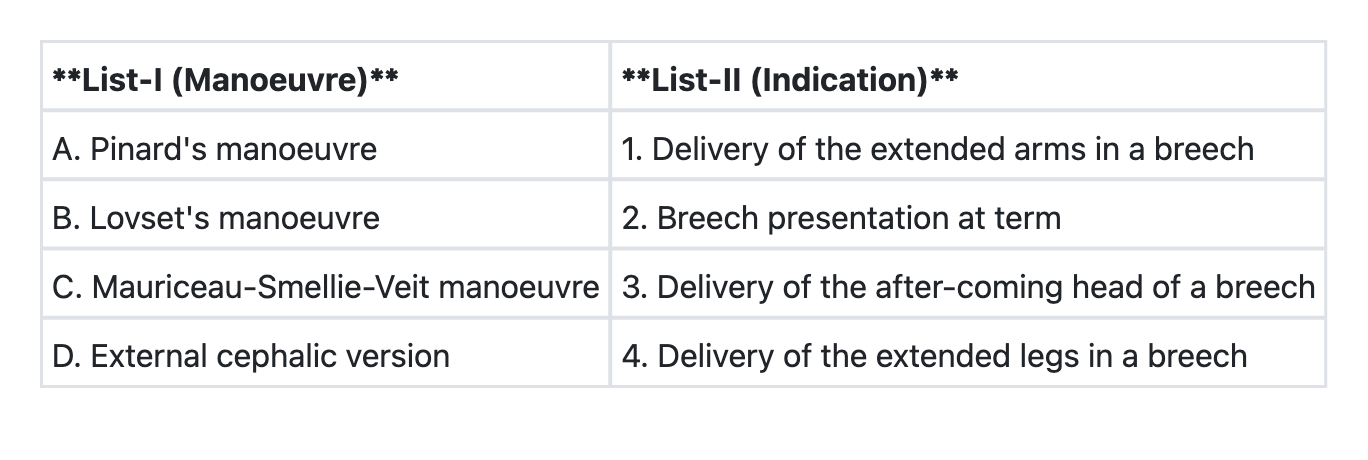
A cesarean section was performed in the previous pregnancy. All of the following would be indications for an elective repeat cesarean section except?
A 25-year-old primigravida is in labor. The second stage of labor has lasted for 1 hour after complete cervical dilatation. On examination, the leading point of the fetal skull is at +2 station, and rotation is 45 degrees. How should this case be managed?
Which of the following is the most probable cause for the deceleration shown below?

A 30-year-old primigravida presents with amenorrhea of 36 weeks, experiencing intermittent abdominal pain for 7 days. She has a history of Strassman's metroplasty. What is the best course of management?
Which of the following statements is true regarding the management of labor in an HIV-positive mother?
What is the pressure created in a vacuum?
Maternal serum alpha-fetoprotein (MSAFP) is elevated in all of the following conditions EXCEPT:
Which of the following is true regarding salpingostomy?
A 29-year-old female, G2 P1 A1, presents with 16 weeks of amenorrhea, lower abdominal pain, and vaginal bleeding. Ultrasonography shows a snowstorm appearance. What is the most feasible method of treatment?
Which of the following is NOT an absolute indication for cesarean section in pregnancy?
Explanation: **Explanation:** The core concept tested here is the selection criteria for a **Trial of Labor After Cesarean (TOLAC)** versus an **Elective Repeat Cesarean Section (ERCS)**. When a patient has a prior uterine scar, any additional obstetric complication that increases the risk of uterine rupture or reduces the likelihood of a successful vaginal birth (VBAC) becomes an indication for ERCS. **Why Polyhydramnios is the Correct Answer:** Polyhydramnios (excess amniotic fluid) is **not** a standalone indication for a repeat cesarean section. While it may be associated with malpresentation or cord prolapse, it does not inherently increase the risk of uterine rupture or obstruct labor. In the absence of other contraindications, a patient with polyhydramnios and one prior lower segment cesarean section (LSCS) can safely undergo TOLAC. **Analysis of Incorrect Options:** * **Breech Presentation:** Malpresentation is a major contraindication for TOLAC. The risk of head entrapment and the need for assisted maneuvers increase the mechanical stress on the old scar. * **Macrosomia:** A suspected fetal weight >4 kg (or >4.5 kg in non-diabetics) increases the risk of shoulder dystocia and failed TOLAC. The increased uterine distension also elevates the risk of scar dehiscence. * **Post-term Pregnancy:** Beyond 40-41 weeks, the success rate of VBAC drops significantly. Furthermore, the need for induction of labor (especially with prostaglandins) in a post-term pregnancy significantly increases the risk of uterine rupture compared to spontaneous labor. **NEET-PG High-Yield Pearls:** * **Best candidate for TOLAC:** A woman with one prior LSCS for a non-recurring indication (e.g., fetal distress) who has also had a previous successful vaginal delivery. * **Absolute Contraindications to TOLAC:** Prior classical/T-shaped incision, prior uterine rupture, or any contraindication to vaginal birth (e.g., placenta previa). * **Success Rate:** The average success rate of VBAC is approximately **60–80%**. * **Risk of Rupture:** For a single prior LSCS, the risk of rupture during TOLAC is roughly **0.5–0.9%**.
Explanation: This question tests the ability to classify forceps application based on the **American College of Obstetricians and Gynecologists (ACOG)** criteria, which is a high-yield topic for NEET-PG. ### **Explanation** The classification of forceps delivery is determined by the **station** and **rotation** of the fetal head: 1. **Why Option B is Correct:** According to ACOG, **Low Forceps** application is defined when the leading point of the fetal skull is at **station +2 or lower** (but not on the pelvic floor). In this case, the station is +2. Furthermore, low forceps are subdivided based on rotation: if rotation is ≤45°, it is a simple low forceps; if >45°, it is a rotation-requiring low forceps. Here, the rotation is exactly 45°, fitting the criteria perfectly. 2. **Why Option A is Incorrect:** **Outlet Forceps** require the fetal scalp to be visible at the introitus without separating the labia, the skull to have reached the pelvic floor, and the rotation to be ≤45°. A station of +2 is too high for an outlet application. 3. **Why Option C is Incorrect:** **Mid Forceps** are applied when the head is engaged but the leading point is above +2 station. These are rarely performed today due to high maternal and neonatal morbidity. 4. **Why Option D is Incorrect:** **High Forceps** (application before engagement) are obsolete and strictly contraindicated in modern obstetrics. ### **Clinical Pearls for NEET-PG** * **Station 0:** Head is at the level of the ischial spines (Engaged). * **Prerequisites for Forceps:** Remember the mnemonic **FORCEPS**: **F**etus alive, **O**pthalmic (membranes) ruptured, **R**ectum/Bladder empty, **C**ervix fully dilated, **E**ngaged head, **P**osition known, **S**ize (no CPD). * **Most common indication:** Prolonged second stage of labor (2 hours in primigravida without anesthesia). * **Most common complication:** Perineal tears (Maternal) and Facial nerve palsy (Neonatal).
Explanation: ***Head Compression*** - **Early decelerations** show a characteristic **mirror-image pattern** with uterine contractions, caused by fetal head compression during contractions triggering a **vagal reflex**. - These decelerations are **gradual** in onset and recovery, considered **benign**, and do not indicate fetal compromise. *Cord Compression* - Causes **variable decelerations** with **abrupt onset and recovery**, often described as having a **W or V shape** on CTG. - These decelerations are **unpredictable** in timing and do not follow the contraction pattern like early decelerations do. *Fetal Hypoxia* - Results in **late decelerations** due to **uteroplacental insufficiency**, showing gradual onset but **delayed recovery** after contractions end. - These are **ominous signs** indicating fetal acidosis and require immediate intervention, unlike the benign nature of early decelerations. *Feto-Maternal Hemorrhage* - Typically causes **sinusoidal pattern** on CTG with smooth, undulating baseline resembling a **sine wave**. - Associated with severe fetal anemia and does not produce the **mirror-image deceleration pattern** seen with head compression.
Explanation: **Explanation:** The core clinical issue in this scenario is the history of **Strassman’s metroplasty**, a surgical procedure used to unify a bicornuate uterus by making a deep incision through the uterine fundus. **1. Why Elective Cesarean Section is Correct:** Strassman’s metroplasty involves a **full-thickness incision** into the uterine wall (transverse incision across the fundus). Similar to a classical Cesarean section or a deep intramural myomectomy, this surgery results in a significant uterine scar. During labor, the intense uterine contractions and the stretching of the lower segment/fundus pose a high risk of **uterine rupture**. To prevent this catastrophic complication, an elective Cesarean section is indicated before the onset of active labor (usually at 37–38 weeks). **2. Why Other Options are Incorrect:** * **Options A & C:** Induction of labor (prostaglandins) or augmentation (oxytocin) are strictly contraindicated. These agents increase uterine pressure and the intensity of contractions, which significantly elevates the risk of rupture at the site of the previous metroplasty scar. * **Option D:** Administering antispasmodics and discharging the patient is dangerous. Given her surgical history and the fact that she is at 36 weeks with abdominal pain, she requires close monitoring and a planned delivery rather than symptomatic relief. **Clinical Pearls for NEET-PG:** * **Strassman’s Metroplasty:** Used for Bicornuate uterus (Unification). * **Jones & Tompkins Metroplasty:** Used for Septate uterus (Excision/Incision). * **Uterine Rupture Risk:** Any surgery that enters the uterine cavity (except uncomplicated cervical cerclage or hysteroscopic resection) generally mandates a Cesarean delivery in subsequent pregnancies. * **Timing:** For patients with a high risk of rupture (like classical CS or metroplasty), elective CS is typically planned between **37 0/7 and 38 6/7 weeks**.
Explanation: The management of labor in HIV-positive mothers focuses on minimizing **Vertical Transmission (MTCT)** by reducing fetal exposure to maternal blood and secretions. ### **Explanation of the Correct Option** **D. Routine suctioning of the newborn should be avoided:** This is the correct practice because vigorous or routine suctioning can cause trauma to the delicate neonatal oropharyngeal and nasal mucosa. Such micro-trauma creates a portal of entry for any maternal blood or vaginal secretions present in the newborn's mouth, thereby increasing the risk of HIV transmission. Suctioning should only be performed if there is clear evidence of airway obstruction. ### **Why Other Options are Incorrect** * **A. Cesarean delivery is the preferred method:** This is no longer a universal rule. If the maternal viral load is **<1000 copies/mL** at 36 weeks, a planned vaginal delivery is safe and recommended. Elective LSCS is reserved for patients with a viral load >1000 copies/mL or unknown status. * **B. Early artificial rupture of membranes (ARM):** ARM should be avoided. Prolonged rupture of membranes (>4 hours) is significantly associated with increased risk of transmission. Membranes should be kept intact as long as possible to act as a protective barrier. * **C. Vacuum vs. Forceps:** If instrumental delivery is necessary, **forceps are preferred over vacuum**. Vacuum extraction (ventouse) causes scalp abrasions and subgaleal trauma, increasing the risk of direct viral entry into the fetal circulation. ### **NEET-PG High-Yield Pearls** * **Zidovudine (AZT):** Should be administered intravenously during labor if the viral load is >1000 copies/mL. * **Avoid Invasive Procedures:** Scalp electrodes, fetal blood sampling, and episiotomies should be avoided to minimize blood exposure. * **Breastfeeding:** In the Indian context (WHO/NACO guidelines), exclusive breastfeeding is recommended for the first 6 months if replacement feeding is not "Acceptable, Feasible, Affordable, Sustainable, and Safe" (AFASS). Mixed feeding must be strictly avoided.
Explanation: **Explanation:** In operative obstetrics, the vacuum extractor (Ventouse) works on the principle of creating a negative pressure between the cup and the fetal scalp to facilitate traction. **1. Why 0.8 kg/cm² is correct:** To achieve effective traction and ensure the formation of a proper 'chignon' (artificial caput succedaneum), a negative pressure of **0.8 kg/cm²** (equivalent to 600 mmHg) is required. This pressure is reached gradually: initially, a vacuum of 0.2 kg/cm² is created to fix the cup, followed by increments of 0.1 kg/cm² every 2 minutes until the effective pressure of 0.8 kg/cm² is attained. This gradual increase prevents scalp trauma and ensures the cup is well-applied over the flexion point. **2. Analysis of Incorrect Options:** * **0.2 kg/cm² (Option B):** This is the **initial pressure** used to fix the cup to the scalp before increasing to the full therapeutic pressure. It is insufficient for actual traction. * **12 kgs and 18 kgs (Options A & D):** These represent units of **force/weight**, not pressure. While the maximum traction force exerted by a vacuum is roughly 10–12 kg (compared to 18–20 kg for forceps), the question specifically asks for the pressure setting on the gauge. **3. High-Yield Clinical Pearls for NEET-PG:** * **Flexion Point:** The cup should be placed over the flexion point (3 cm anterior to the posterior fontanelle along the sagittal suture). * **Chignon:** The artificial caput created by the vacuum; it usually subsides within 24 hours. * **Contraindications:** Vacuum is contraindicated in preterm babies (<34 weeks) due to the risk of subgaleal hemorrhage and in face/breech presentations. * **Safety Rule:** The "Rule of 3"—abandon the procedure if there are 3 pop-offs, 3 pulls with no descent, or 30 minutes of total application time.
Explanation: **Explanation:** Maternal Serum Alpha-Fetoprotein (MSAFP) is a glycoprotein produced initially by the yolk sac and later by the fetal liver. It enters the maternal circulation through fetal membranes and kidneys. The concentration of MSAFP is a crucial screening tool used between 15–20 weeks of gestation. **Why Chromosomal Trisomies is the Correct Answer:** In pregnancies affected by **Chromosomal Trisomies (such as Down Syndrome/Trisomy 21 and Edwards Syndrome/Trisomy 18)**, MSAFP levels are characteristically **decreased**, not elevated. In Down Syndrome, the mechanism is thought to involve reduced production by the fetal liver and a smaller-than-normal yolk sac. **Why the other options are incorrect (Conditions with Elevated MSAFP):** * **Neural Tube Defects (NTDs):** Conditions like anencephaly and spina bifida involve "open" defects where AFP leaks directly from the fetal serum/CSF into the amniotic fluid and subsequently into maternal serum. * **Esophageal Obstruction:** Any condition that interferes with fetal swallowing (e.g., esophageal or duodenal atresia) prevents the normal degradation of AFP in the fetal gut, leading to higher concentrations in the amniotic fluid and maternal serum. * **Gastroschisis/Omphalocele:** These are ventral wall defects where the fetal bowel or organs are exposed. Similar to NTDs, AFP leaks directly from the exposed fetal vessels into the amniotic fluid. **High-Yield Clinical Pearls for NEET-PG:** * **Most common cause of elevated MSAFP:** Incorrect gestational age (underestimation of pregnancy dates). * **Other causes of elevated MSAFP:** Multiple gestations, fetal demise, renal anomalies (Finnish-type nephrosis), and placental abruption. * **Triple Test for Down Syndrome:** Decreased MSAFP, decreased unconjugated estriol (uE3), and **increased** hCG. * **Quadruple Test:** Adds **Inhibin-A**, which is **increased** in Down Syndrome.
Explanation: **Explanation:** Salpingostomy is a conservative surgical procedure used for the management of unruptured ectopic pregnancy, where the products of conception are removed while preserving the fallopian tube. **1. Why Option A is Correct:** Because the fallopian tube is not removed, there is a risk that microscopic fragments of trophoblastic tissue may remain embedded in the tubal wall. This leads to **Persistent Ectopic Pregnancy (PEP)** in approximately 5–15% of cases. Consequently, patients must be monitored with weekly serial β-hCG levels until they reach <5 mIU/mL to ensure complete resolution. **2. Why the Other Options are Incorrect:** * **Option B:** **Laparoscopy** is the preferred gold-standard route for hemodynamically stable patients due to faster recovery, less blood loss, and lower cost. Laparotomy is reserved for hemodynamically unstable patients or cases with extensive adhesions. * **Option C:** In a salpingostomy, the tubal incision is typically **left open to heal by secondary intention**. Suturing the tube (salpingotomy) does not improve outcomes and may increase the risk of tubal scarring or stenosis. * **Option D:** Studies show that in the presence of a healthy contralateral tube, future fertility rates (intrauterine pregnancy vs. recurrent ectopic) are **comparable** between salpingostomy and salpingectomy. Salpingostomy is specifically preferred only when the contralateral tube is damaged or absent. **Clinical Pearls for NEET-PG:** * **Indication for Salpingostomy:** Hemodynamically stable patient, unruptured mass <4 cm, and a desire to preserve fertility (especially if the contralateral tube is diseased). * **Monitoring:** If β-hCG levels do not fall by >20% every 72 hours post-operatively, persistent trophoblastic tissue is suspected, often requiring **Methotrexate**. * **Rh-Negative Status:** Always administer Anti-D immunoglobulin to Rh-negative unsensitized women undergoing any surgical intervention for ectopic pregnancy.
Explanation: ### Explanation **Diagnosis:** The clinical presentation of 16 weeks amenorrhea, vaginal bleeding, and the classic **"snowstorm appearance"** on ultrasonography is pathognomonic for a **Hydatidiform Mole (Molar Pregnancy)**. **Why Suction Evacuation is Correct:** Suction evacuation (suction curettage) is the **gold standard** and most feasible treatment for a molar pregnancy, regardless of the uterine size. It is preferred because it allows for rapid emptying of the uterus while minimizing the risk of uterine perforation and excessive hemorrhage, which are common risks associated with sharp curettage in these cases. **Why Other Options are Incorrect:** * **Misoprostol & Mifepristone (Medical Management):** These are contraindicated for primary evacuation of a mole. Medical induction increases the risk of heavy hemorrhage and, theoretically, the risk of **trophoblastic embolization** into the maternal venous circulation due to uterine contractions. * **Hysterectomy:** While hysterectomy is an option for women who have completed their family or are over 40 years old (to reduce the risk of post-molar gestational trophoblastic neoplasia), it is not the "most feasible" or first-line method for a 29-year-old G2 P1 who may desire future fertility. **Clinical Pearls for NEET-PG:** 1. **Pre-operative Prep:** Always check thyroid function tests (TFTs) as high hCG can cause **hyperthyroidism** (due to molecular mimicry with TSH). 2. **Theca Lutein Cysts:** Often seen on USG; these are benign and usually regress after evacuation. 3. **Follow-up:** Monitor weekly serum **β-hCG levels** until three consecutive negative results are obtained to rule out Gestational Trophoblastic Neoplasia (GTN). 4. **Rh Isoimmunization:** Rh-negative mothers must receive Anti-D immunoglobulin after evacuation.
Explanation: **Explanation:** In obstetric practice, indications for Cesarean Section (CS) are categorized into **Absolute** (where vaginal delivery is impossible or life-threatening) and **Relative** (where vaginal delivery may be possible but carries higher risk). **Why Option C is the correct answer:** **Non-reassuring fetal heart rate (NRFHR)**, commonly referred to as fetal distress, is a **relative indication**. While it often necessitates an emergency CS, it is not absolute because the mode of delivery depends on the **cervical dilatation and station**. If the cervix is fully dilated and the fetal head is low (at or below the ischial spines), an operative vaginal delivery (forceps or vacuum) is often faster and safer than a CS. **Analysis of Incorrect Options (Absolute Indications):** * **Advanced Carcinoma of the Cervix:** Vaginal delivery is contraindicated as it can lead to torrential hemorrhage, cervical tearing, and potential dissemination of cancer cells. * **Central Placenta Previa (Type IV):** The placenta completely covers the internal os. Any attempt at vaginal delivery will cause massive, life-threatening maternal hemorrhage. * **Contracted Pelvis:** When the pelvic dimensions are significantly reduced (e.g., Outlet contraction or severe Cephalopelvic Disproportion), the fetus physically cannot pass through the birth canal. **High-Yield Clinical Pearls for NEET-PG:** * **Other Absolute Indications:** Pelvic tumors obstructing the birth canal (e.g., large low-lying fibroid), Vasa Previa, and previous classical CS. * **Most common indication for CS overall:** Previous CS. * **Most common indication for primary CS:** Dystocia (failure to progress). * **Rule of Thumb:** If the question asks for an "absolute" indication, look for mechanical obstructions that make the vaginal route physically impossible.
Cesarean Section Techniques
Practice Questions
Vaginal Birth After Cesarean
Practice Questions
Instrumental Deliveries
Practice Questions
Breech Delivery
Practice Questions
Episiotomy and Repair
Practice Questions
Management of Multiple Gestation
Practice Questions
Cervical Cerclage
Practice Questions
Obstetric Hysterectomy
Practice Questions
Surgery During Pregnancy
Practice Questions
Surgical Complications in Obstetrics
Practice Questions
Get full access to all questions, explanations, and performance tracking.
Start For Free