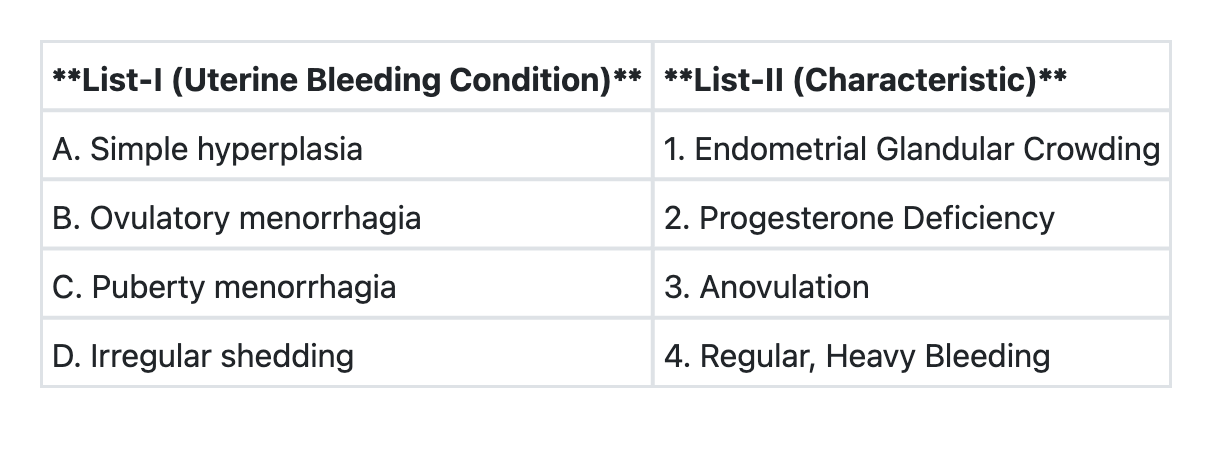
Congestive dysmenorrhea is seen in patients with:
Which of the following medications can be used in the treatment of primary dysmenorrhea?
Dysfunctional uterine bleeding is associated with which of the following conditions?
Which of the following is NOT a feature of Metropathia haemorrhagica?
Secondary amenorrhea after abortion due to intrauterine adhesions is seen in:
What is the most common cause of primary amenorrhea?
Which of the following statements regarding spasmodic dysmenorrhea is false?
Which progestogen has the greatest haemostatic effect for treating dysfunctional uterine bleeding (DUB)?
What is the most common histological finding of the endometrium in dysfunctional uterine bleeding (DUB)?
Which of the following statements is false regarding ablative procedures for abnormal uterine bleeding?
Explanation: **Explanation:** **Congestive dysmenorrhea** (also known as secondary dysmenorrhea) is characterized by pelvic pain that typically begins 3–5 days before the onset of menstruation and is relieved once the menstrual flow starts. The underlying pathophysiology is **chronic pelvic venous congestion** or increased vascularity within the pelvic organs. **Why "All the above" is correct:** 1. **Fibroids (Leiomyoma):** Large intramural or submucous fibroids increase the surface area of the endometrium and lead to pelvic vascular engorgement and uterine congestion. 2. **IUD Wearers:** Intrauterine devices can act as a foreign body, causing a local inflammatory response in the endometrium. This leads to increased vascular permeability and pelvic congestion. 3. **PID (Pelvic Inflammatory Disease):** Chronic PID causes persistent inflammation and adhesions, leading to fixed retroversion of the uterus and chronic pelvic adnexal congestion. **Clinical Pearls for NEET-PG:** * **Primary vs. Secondary:** Primary dysmenorrhea is spasmodic (due to Prostaglandin F2α), starts with the onset of menses, and has no organic pathology. Secondary (Congestive) dysmenorrhea always has an underlying organic cause. * **Key Symptom:** The "crescendo" premenstrual pain that subsides after the flow begins is the hallmark of congestive dysmenorrhea. * **Other Causes:** Endometriosis, adenomyosis, and pelvic varicosities (Pelvic Congestion Syndrome) are also frequent causes of congestive dysmenorrhea. * **Management:** Unlike primary dysmenorrhea (treated with NSAIDs/OCPs), secondary dysmenorrhea requires treating the specific underlying pathology (e.g., antibiotics for PID or surgery for fibroids).
Explanation: **Explanation:** **Primary dysmenorrhea** is defined as painful menstruation in the absence of pelvic pathology. The underlying pathophysiology involves the release of excess **Prostaglandins (specifically PGF2α)** from the secretory endometrium during menstruation. This leads to increased uterine tone, high-amplitude contractions, and uterine ischemia, which manifest as spasmodic pain. **Why "All of the above" is correct:** The management of primary dysmenorrhea focuses on inhibiting prostaglandin synthesis or suppressing ovulation. * **NSAIDs (Mefenamic acid and Indomethacin):** These are the **first-line medical treatment**. They act by inhibiting the enzyme cyclooxygenase (COX), thereby reducing the production of prostaglandins. Mefenamic acid is often preferred due to its dual action (inhibiting synthesis and blocking prostaglandin receptors). * **Oral Contraceptive Pills (OCPs):** These are highly effective for patients who also require contraception or do not respond to NSAIDs. OCPs work by **suppressing ovulation** and thinning the endometrial lining, which significantly reduces the total prostaglandin content in the menstrual fluid. **High-Yield Clinical Pearls for NEET-PG:** * **First-line drug of choice:** NSAIDs (specifically Mefenamic acid or Ibuprofen). * **Timing:** NSAIDs should ideally be started 1–2 days before the onset of menses or at the very first sign of pain for maximum efficacy. * **Secondary Dysmenorrhea:** If a patient does not respond to NSAIDs or OCPs within 3–6 months, clinicians must investigate for secondary causes, most commonly **Endometriosis**. * **Risk Factors:** Early menarche, long menstrual periods, and smoking are associated with increased severity.
Explanation: **Explanation:** **Dysfunctional Uterine Bleeding (DUB)** is defined as abnormal uterine bleeding in the absence of any detectable organic pelvic pathology, systemic disease, or pregnancy-related complications. It is primarily an endocrine disorder resulting from a disturbance in the hypothalamic-pituitary-ovarian axis. **Why Option A is Correct:** **Metropathia Haemorrhagica** (also known as Schroeder’s Disease) is a classic clinical variant of DUB. It is characterized by **anovulation**, which leads to a state of **unopposed estrogen**. Without ovulation, no corpus luteum is formed, and progesterone is absent. This causes the endometrium to undergo continuous hyperplasia without shedding, eventually leading to "breakthrough bleeding" when the estrogen levels fluctuate or the endometrium outgrows its blood supply. It typically presents as a period of amenorrhea followed by heavy, painless bleeding. **Why Other Options are Incorrect:** * **B. Fibroid Uterus:** This is a structural/organic pathology (leiomyoma). Bleeding caused by fibroids is classified under "Leiomyoma" in the PALM-COEIN classification, not DUB. * **C. Endometriosis:** This typically presents with dysmenorrhea and pelvic pain. While it can coexist with menstrual irregularities, it is an organic condition involving ectopic endometrial tissue. * **D. Ovarian Tumour:** These are organic growths. While some (like Granulosa cell tumors) can cause hormonal imbalances leading to bleeding, the bleeding is secondary to a primary organic lesion. **High-Yield Clinical Pearls for NEET-PG:** * **PALM-COEIN Classification:** DUB now falls under the "COEIN" (Non-structural) categories: **C**oagulopathy, **O**vulatory dysfunction, **E**ndometrial, **I**atrogenic, and **N**ot yet classified. * **Metropathia Haemorrhagica** is most common in perimenopausal women. * **Histology:** The classic finding in Metropathia Haemorrhagica is **Cystic Glandular Hyperplasia**, often described as a **"Swiss-Cheese" appearance** of the endometrium. * **Treatment of Choice:** In DUB, medical management (like combined oral contraceptives or Progestogens) is the first line, unlike organic causes which often require surgery.
Explanation: **Explanation:** **Metropathia Haemorrhagica** (also known as Schroeder’s Disease) is a specific form of Abnormal Uterine Bleeding (AUB) associated with anovulation. **1. Why Option A is the correct answer:** Metropathia haemorrhagica typically occurs in **perimenopausal women** (women in their 40s), not younger women. The underlying pathology is the persistence of an unruptured Graafian follicle, leading to a prolonged follicular phase without ovulation. This results in a period of amenorrhea (usually 6–8 weeks) followed by heavy, painless bleeding. **2. Analysis of incorrect options:** * **B. Uterus is bulky:** Due to the continuous, unopposed stimulation of estrogen without the counter-effect of progesterone (since no corpus luteum is formed), the myometrium undergoes hypertrophy, making the uterus feel symmetrically bulky (myometrial hyperplasia). * **C. Menorrhagia:** The hallmark clinical presentation is heavy, prolonged, and painless bleeding. Because the endometrium outgrows its blood supply in the absence of progesterone, it sheds irregularly and profusely. * **D. Endometrial hyperplasia:** Continuous estrogen causes the endometrium to become hyperplastic. Classically, this presents as **Swiss-cheese endometrium** (Cystoglandular hyperplasia), where glands of varying sizes are seen on histopathology. **NEET-PG High-Yield Pearls:** * **Classic Triad:** Amenorrhea (short period) → Followed by profuse, painless bleeding → In a perimenopausal woman. * **Ovarian finding:** Presence of a follicular cyst (unruptured follicle) and absence of corpus luteum. * **Histology:** "Swiss-cheese" appearance of the endometrium. * **Treatment of choice:** Dilatation and Curettage (D&C) serves both a diagnostic and therapeutic purpose (to stop the bleeding).
Explanation: **Explanation:** **Asherman’s Syndrome** is the correct answer because it refers to the formation of intrauterine adhesions (synechiae) following trauma to the basal layer of the endometrium. This most commonly occurs after vigorous curettage (D&C) for an incomplete abortion or postpartum hemorrhage. The destruction of the endometrium leads to the fusion of the uterine walls, resulting in secondary amenorrhea or hypomenorrhea and infertility. **Analysis of Incorrect Options:** * **Uterine Inertia:** This refers to weak or absent uterine contractions during labor (primary or secondary). It is a functional complication of the first or second stage of labor and has no association with intrauterine adhesions or amenorrhea. * **Imperforate Hymen:** This is a congenital anatomical cause of **primary amenorrhea**. It leads to cryptomenorrhea (hidden menstruation) where blood collects in the vagina (hematocolpos), but it is not acquired after an abortion. * **Bicornuate Uterus:** This is a congenital Mullerian duct anomaly where the uterus is heart-shaped with two horns. While it can lead to recurrent pregnancy loss or malpresentation, it does not cause secondary amenorrhea or adhesions. **High-Yield Clinical Pearls for NEET-PG:** * **Gold Standard Investigation:** Hysteroscopy is the gold standard for both diagnosis and treatment (adhesiolysis) of Asherman’s Syndrome. * **HSG Finding:** Classically shows "filling defects" within the uterine cavity. * **Treatment:** Hysteroscopic adhesiolysis followed by the placement of an IUCD or Foley catheter and high-dose estrogen therapy to promote endometrial regrowth. * **Amniotic Band Syndrome** is a different entity; do not confuse it with intrauterine synechiae.
Explanation: **Explanation:** Primary amenorrhea is defined as the absence of menarche by age 13 in the absence of secondary sexual characteristics, or by age 15 if secondary sexual characteristics are present. **Why Gonadal Dysgenesis is Correct:** **Gonadal dysgenesis** (specifically **Turner Syndrome, 45,XO**) is the most common cause of primary amenorrhea, accounting for approximately **43% of cases**. The underlying pathology involves the accelerated attrition of germ cells, leading to "streak gonads." This results in hypergonadotropic hypogonadism (elevated FSH/LH due to lack of estrogen feedback). Clinically, these patients present with short stature and absent secondary sexual characteristics. **Analysis of Incorrect Options:** * **B. Mullerian Agenesis (MRKH Syndrome):** This is the **second most common cause** (~15%). It is characterized by the congenital absence of the uterus and upper two-thirds of the vagina, but with normal ovaries and 46,XX karyotype. * **C. Androgen Insensitivity Syndrome (AIS):** A less common cause where the genotype is 46,XY. Patients have functioning testes (undescended) but a female phenotype due to receptor resistance. They present with scant pubic hair and a blind-ending vagina. * **D. Stein-Levinthal Syndrome (PCOS):** While a very common cause of *secondary* amenorrhea or oligomenorrhea, it is an infrequent cause of primary amenorrhea. **High-Yield Clinical Pearls for NEET-PG:** * **Most common cause overall:** Gonadal Dysgenesis (Turner’s). * **Most common cause with normal breast development:** Mullerian Agenesis. * **Initial Investigation:** Serum FSH levels. High FSH indicates gonadal failure; low/normal FSH suggests hypothalamic/pituitary causes or anatomical obstructions. * **Karyotyping** is mandatory in all cases of primary amenorrhea with high FSH to rule out Turner Syndrome or Y-chromosome material (risk of gonadoblastoma).
Explanation: ### Explanation **Spasmodic (Primary) Dysmenorrhea** is characterized by painful uterine contractions caused by the release of **Prostaglandin F2α (PGF2α)** from the secretory endometrium. #### Why Option C is False (The Correct Answer) In spasmodic dysmenorrhea, the pain typically begins a few hours before or exactly at the onset of menstruation. Crucially, the pain is **short-lived**, usually lasting only **12 to 24 hours**. It rarely persists beyond the first 48 hours. If pain persists for 2–3 days or longer, clinicians should suspect **Congestive (Secondary) Dysmenorrhea**, often associated with conditions like endometriosis or PID. #### Analysis of Other Options * **A. Often cured by delivery:** This is **true**. Vaginal delivery causes stretching of the adrenergic nerves in the isthmus and cervix (Frankenhauser’s plexus) and widens the cervical canal, which significantly reduces or eliminates primary dysmenorrhea. * **B. Pain appears on the first day:** This is **true**. The pain is spasmodic/colicky in nature and coincides with the peak of prostaglandin release and the heaviest menstrual flow on day one. * **D. Rare above the age of 35:** This is **true**. Primary dysmenorrhea typically begins shortly after menarche (once ovulatory cycles are established) and tends to improve with increasing age and parity. #### High-Yield Clinical Pearls for NEET-PG * **Mechanism:** High levels of PGF2α → Uterine hypercontractility → Ischemia → Pain. * **Prerequisite:** It occurs only in **ovulatory cycles** (Progesterone is required for PGF2α production). * **First-line Treatment:** NSAIDs (Mefenamic acid), which act as prostaglandin synthetase inhibitors. * **Drug of Choice for Contraception Seekers:** Combined Oral Contraceptive Pills (OCPs), which induce anovulation.
Explanation: **Explanation:** The primary goal in treating acute dysfunctional uterine bleeding (DUB) is to stabilize the sloughing endometrium and induce a "medical curettage." **Why Norethisterone is the Correct Answer:** Norethisterone (a 19-nortestosterone derivative) is the most potent oral progestogen for achieving rapid haemostasis. It possesses high **progestational activity** and significant **anti-estrogenic effects** on the endometrium. It works by inducing a rapid secretory change in a proliferative endometrium, effectively "bracing" the tissue and stopping the bleeding. Once the high-dose therapy is stopped, it results in a predictable, organized withdrawal bleed. **Analysis of Incorrect Options:** * **Medroxyprogesterone (MPA):** While commonly used for cycle regulation, it is less potent than 19-nor derivatives. It is often used for long-term maintenance rather than acute, heavy haemostasis. * **Hydroxyprogesterone:** This is a naturally occurring progestogen derivative (usually given as an injectable caproate). It has a slower onset of action and is primarily used for preventing preterm labor or recurrent miscarriages, not for acute DUB. * **Dydrogesterone:** This is a "retro-progesterone" with high selectivity for progesterone receptors. While it has fewer side effects (no androgenic activity), it is less effective at achieving rapid endometrial stability compared to Norethisterone in acute bleeding scenarios. **High-Yield NEET-PG Pearls:** * **Drug of Choice (DOC):** For acute heavy menstrual bleeding, Norethisterone (5mg TDS) is the clinical favorite. * **Mechanism:** Progestogens inhibit further estrogen-driven endometrial hyperplasia and stabilize the lysosomal membranes within endometrial cells. * **Contraindication:** Avoid Norethisterone in patients with a high risk of thromboembolism or active liver disease. * **LNG-IUS (Mirena):** Remember that for *chronic* management of DUB/AUB, the Levonorgestrel Intrauterine System is considered the "Gold Standard" medical treatment.
Explanation: **Explanation:** **Dysfunctional Uterine Bleeding (DUB)**, now more accurately referred to under the PALM-COEIN classification as AUB-O (Ovulatory dysfunction), is most commonly associated with **anovulation**. 1. **Why Hyperplastic is correct:** In anovulatory cycles, there is a failure of ovulation, meaning no corpus luteum is formed and no progesterone is produced. This results in a state of **"unopposed estrogen."** Estrogen causes the endometrium to continuously proliferate without the stabilizing effect of progesterone. This leads to a **hyperplastic** endometrium that eventually outgrows its blood supply, resulting in irregular, heavy, and prolonged shedding. 2. **Why other options are incorrect:** * **Atrophic:** This is the most common cause of postmenopausal bleeding, not DUB. It occurs due to a lack of estrogen. * **Cystic glandular hyperplasia:** While this is a *type* of hyperplasia (often called "Swiss-cheese" appearance), "Hyperplastic" is the broader and more accurate histological category for DUB across various age groups. * **Dysplastic:** Dysplasia (atypia) is a premalignant change. While long-term unopposed estrogen can lead to atypical hyperplasia, it is not the *most common* finding in routine DUB. **High-Yield Clinical Pearls for NEET-PG:** * **Most common cause of DUB:** Anovulation (90% of cases), typically seen at the extremes of reproductive life (menarche and perimenopause). * **Gold Standard Investigation:** Endometrial biopsy (D&C) is mandatory in women >35 years to rule out endometrial carcinoma. * **Drug of Choice (Medical):** Combined Oral Contraceptive Pills (COCPs) or Progestogens (to "oppose" the estrogen). * **Drug of Choice (Long-term/Heavy bleeding):** Levonorgestrel-releasing intrauterine system (LNG-IUS/Mirena).
Explanation: **Explanation:** Endometrial ablation is a surgical procedure designed to destroy the uterine lining (endometrium) to treat heavy menstrual bleeding (AUB-E/AUB-P) in women who wish to avoid a hysterectomy. **Why Option C is the correct (False) statement:** The primary goal of endometrial ablation is the permanent destruction of the basal layer of the endometrium. While it is not a guaranteed form of sterilization, it **significantly impairs fertility** and makes the uterine environment hostile for implantation. Furthermore, if pregnancy does occur, it is associated with high risks of placenta accreta, miscarriage, and growth restriction. Therefore, patients must be counseled that the procedure is **not fertility-preserving**, and reliable contraception is mandatory post-procedure. **Analysis of other options:** * **Options A & B:** These are **true**. Compared to hysterectomy, ablative procedures (like thermal balloons or radiofrequency) are minimally invasive, have lower morbidity (no major abdominal incision, less blood loss), and offer a much faster recovery time (usually returning to work within 1–2 days). * **Option D:** This is **true**. To ensure the endometrium does not regenerate, the procedure must destroy the entire thickness of the endometrium plus **2–3 mm of the underlying myometrium**, where the deep basal glands reside. **NEET-PG High-Yield Pearls:** * **Prerequisites:** Before ablation, a **hysteroscopy and endometrial biopsy** are mandatory to rule out malignancy or atypical hyperplasia. * **Ideal Candidate:** Women with AUB who have completed childbearing, have a uterine size <10–12 weeks, and no structural abnormalities like large submucosal fibroids. * **Amenorrhea Rate:** Approximately 30–50% of women achieve total amenorrhea, while the rest experience significantly reduced flow.
Normal Menstrual Physiology
Practice Questions
Primary Dysmenorrhea
Practice Questions
Secondary Dysmenorrhea
Practice Questions
Premenstrual Syndrome and PMDD
Practice Questions
Primary Amenorrhea
Practice Questions
Secondary Amenorrhea
Practice Questions
Polycystic Ovary Syndrome
Practice Questions
Abnormal Uterine Bleeding: Classification
Practice Questions
Evaluation of Menstrual Disorders
Practice Questions
Management Approaches to Menstrual Disorders
Practice Questions
Get full access to all questions, explanations, and performance tracking.
Start For Free