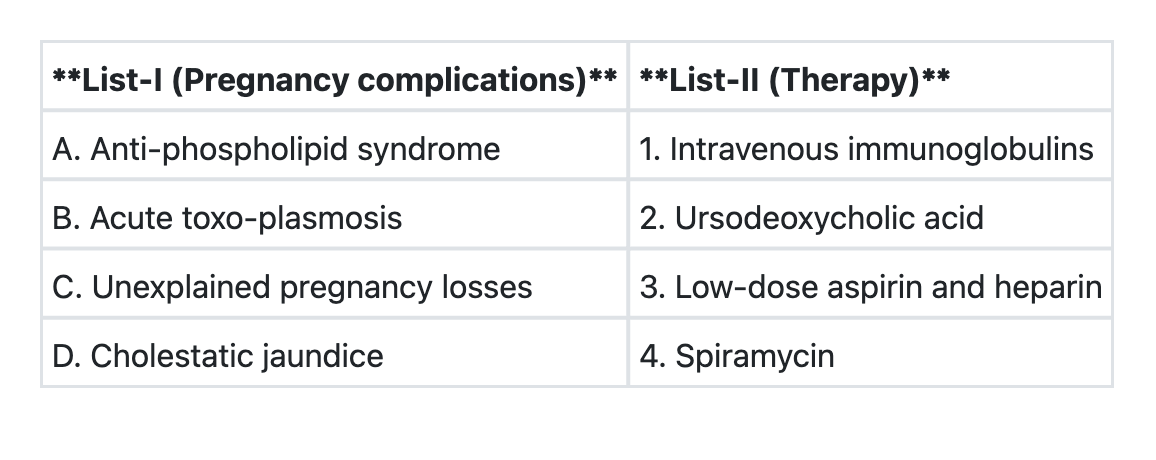
Match the diseases in List-I with their respective incubation periods in List-II and select the correct answer using the code given below:

The following changes may be seen in pre-eclampsia except
Consider the following markers: 1. Nuchal translucency 2. PAPP-A 3. GTT 4. Inhibin A Which of the above markers are included in the first trimester screening of Down's syndrome?
What is the most commonly observed fetal effect in women receiving magnesium sulphate therapy for pre-eclampsia/eclampsia ?
Which one of the following statements is not correct about obstetric cholestasis ?
Which of the following statements is true for maternal rubella infection?
What is the commonest cause of retention of urine at 12-14 weeks of pregnancy ?
The following conditions are associated with molar pregnancy except:
A pregnant woman in third trimester has normal blood pressure in the arms when standing and sitting but drops to 90/50 when lying down. What is the likely cause?
A 30-year-old woman presents with three-month amenorrhoea, pain abdomen for the last two days and fainting attacks for the last eight hours. On examination, her pulse rate is 102/min, and she has (1+) pallor. On abdominal palpation, she has tenderness. She is provisionally diagnosed with ectopic pregnancy. The most likely site of implantation within the fallopian tube is in the
Explanation: ***A→1 B→2 C→3 D→4*** - This option correctly matches **Measles (A)** with **10-14 days (1)**, which is the accurate incubation period for this **paramyxovirus infection**. - It properly pairs **Diphtheria (B)** with **2-6 days (2)**, reflecting the typical incubation period for **Corynebacterium diphtheriae**. - **Hepatitis A (C)** is correctly matched with **15-50 days (3)**, consistent with the incubation period of this **hepatotropic picornavirus**. - **Hepatitis B (D)** is correctly matched with **6 weeks-6 months (4)**, reflecting the prolonged incubation period of this **hepadnavirus**. *A→3 B→4 C→2 D→1* - This option incorrectly assigns **Measles** to **15-50 days**, which is far too long for this **viral exanthem** that typically manifests within **10-14 days**. - It also mismatches **Diphtheria** with **6 weeks-6 months**, when this **bacterial infection** has a much shorter incubation period of **2-6 days**. *A→4 B→3 C→2 D→1* - This option incorrectly assigns **Measles** to **6 weeks-6 months**, which is excessively long for this **acute viral infection**. - It also misplaces **Hepatitis A** to **2-6 days**, when its actual incubation period is much longer at **15-50 days**. *A→1 B→4 C→3 D→2* - This option correctly matches **Measles** with **10-14 days** but incorrectly assigns **Diphtheria** to **6 weeks-6 months** instead of the correct **2-6 days**. - It also mismatches **Hepatitis B** to **2-6 days**, when it actually has a much longer incubation period of **6 weeks-6 months**.
Explanation: ***Hemodilution*** - Pre-eclampsia is characterized by generalized **vasoconstriction** and **reduced plasma volume**, leading to **hemoconcentration**, not hemodilution. - The elevated hematocrit sometimes observed is a consequence of this reduced plasma volume. *Thrombocytopenia* - **Thrombocytopenia** (platelet count < 100,000/µL) is a common finding in severe pre-eclampsia and is part of the HELLP syndrome criteria. - It results from increased platelet consumption and destruction due to widespread endothelial dysfunction. *Decreased antithrombin III* - **Decreased antithrombin III** levels are characteristic of pre-eclampsia, reflecting disseminated intravascular coagulation (DIC) and increased consumption of coagulation factors. - This contributes to the procoagulant state often seen in severe pre-eclampsia. *Elevated uric acid* - **Elevated uric acid** is a common and early biochemical marker in pre-eclampsia, often correlating with disease severity. - It results from reduced renal clearance and increased production, reflecting renal impairment and widespread endothelial dysfunction.
Explanation: ***1 and 2*** - **Nuchal translucency (NT)** measurement and **Pregnancy-associated plasma protein A (PAPP-A)** are the key components of first-trimester screening for Down syndrome (combined test at 11-14 weeks). - Increased NT thickness (≥3.5 mm) and low PAPP-A levels are associated with higher risk of **trisomy 21 (Down syndrome)**. - This is typically combined with free β-hCG for the complete first-trimester combined screening. *2, 3 and 4* - This option incorrectly includes **GTT (Glucose Tolerance Test)**, which screens for **gestational diabetes mellitus**, not chromosomal abnormalities. - **Inhibin A** is a marker used in **second-trimester screening** (quadruple test at 15-20 weeks), not first trimester. - It correctly includes PAPP-A but omits the essential NT measurement. *1 and 4* - This option correctly includes **Nuchal translucency** but incorrectly adds **Inhibin A**. - **Inhibin A** is elevated in Down syndrome but is measured in the **second trimester** as part of the quad screen (AFP, hCG, uE3, Inhibin A). - It omits **PAPP-A**, which is the crucial biochemical marker for first-trimester screening. *2 and 3 only* - This option correctly includes **PAPP-A** but incorrectly includes **GTT**, which is completely unrelated to aneuploidy screening. - It omits **Nuchal translucency**, the most important ultrasound marker in first-trimester Down syndrome screening. - GTT is performed at 24-28 weeks for gestational diabetes screening.
Explanation: ***Respiratory depression*** - Magnesium sulfate readily crosses the placenta, leading to elevated magnesium levels in the fetus, which can cause **central nervous system depression** and **respiratory depression** at birth. - This is the **most commonly observed fetal effect**, manifesting as neonatal hypermagnesemia with respiratory compromise, hypotonia, and decreased reflexes. - The effect is due to magnesium's role as a **neuromuscular blocker**, reducing acetylcholine release at the neuromuscular junction. *Intestinal obstruction* - There is no direct link between maternal magnesium sulfate therapy and an increased risk of **fetal intestinal obstruction**. - Intestinal obstruction in neonates is typically associated with **structural anomalies** or conditions like meconium ileus, not magnesium exposure. *Variability in fetal heart rate pattern* - While magnesium sulfate can cause **decreased fetal heart rate variability** as a monitoring finding, this is not the "most commonly observed fetal effect." - Decreased variability is a **transient monitoring change** during therapy, whereas respiratory depression is a direct clinical effect observed at birth. - The question asks for the most common **fetal effect**, and respiratory depression at delivery is more clinically significant and commonly encountered. *Cerebral palsy* - Magnesium sulfate is actually used as a **neuroprotective agent** in preterm births to **reduce the risk of cerebral palsy**. - It does not cause cerebral palsy; rather, it provides fetal neuroprotection when given for preterm labor <32 weeks gestation.
Explanation: ***Associated with markedly high bilirubin and raised liver enzymes*** - While **elevated liver enzymes** (aminotransferases) and slightly **raised bilirubin** can occur in obstetric cholestasis, a **markedly high bilirubin** level is more characteristic of other severe liver conditions or acute liver failure, not typical obstetric cholestasis. - The primary biochemical markers for diagnosis are **elevated serum bile acids** (usually >10 μmol/L), with secondary increases in liver enzymes, but bilirubin levels are rarely "markedly high." *It results in pruritus without rash* - **Pruritus without a rash** is the hallmark symptom of obstetric cholestasis, often worsening at night and affecting the palms and soles. - This symptom is due to the accumulation of **bile acids** in the skin. *It is an indication of termination of pregnancy at 37 weeks* - **Planned delivery** at 37-38 weeks is a common management strategy for obstetric cholestasis to reduce the risk of **fetal complications**, such as stillbirth. - This timing is chosen to balance fetal maturity with the risk of ongoing exposure to elevated bile acids. *Risk of recurrence is high in future pregnancies* - Obstetric cholestasis has a significant **recurrence rate**, often exceeding 60-70%, in subsequent pregnancies. - This high recurrence rate suggests a genetic predisposition to the condition.
Explanation: ***The primary infection is responsible for birth defects*** - **Primary maternal rubella infection** during pregnancy is the primary cause of congenital rubella syndrome, as the virus can cross the placenta and infect the developing fetus. - The risk and severity of **birth defects** are highest when the mother is infected during the first trimester. *24% incidence of congenital infection if acquired during the last month of pregnancy* - While rubella infection late in pregnancy can still lead to fetal infection, the incidence of **congenital rubella syndrome** is significantly lower in the last trimester (typically less than 1%) compared to the first trimester. - The reported incidence of 24% is excessively high for an infection acquired in the **last month of pregnancy**. *It leads to abortions before 16 weeks of gestation* - While **rubella infection** can increase the risk of spontaneous abortion, especially if acquired early in pregnancy, it is not the *only* or *guaranteed* outcome. Many infected pregnancies continue to term with varying degrees of fetal compromise. - The statement suggests a direct and absolute causal link to abortion before 16 weeks, which is too definitive. *It causes blindness with recurrent infection* - **Congenital rubella syndrome** can cause ocular defects such as **cataracts**, **glaucoma**, and **retinopathy**, which can lead to blindness. - However, rubella infection typically confers **lifelong immunity**, making **recurrent infection** extremely rare and thus not a common mechanism for causing blindness.
Explanation: ***Retroverted gravid uterus*** - A **retroverted uterus** can become "trapped" in the pelvis as it enlarges during pregnancy, causing the **cervix to push against the urethra, leading to outflow obstruction**. - This typically occurs between **12-14 weeks of gestation** before the uterus ascents out of the pelvis. *Diminished bladder tone* - While bladder tone can be affected in pregnancy, it's not the primary or most common cause of **acute urinary retention** at this specific gestational age. - **Decreased bladder sensation** and volume capacity changes are more gradual and less likely to cause acute retention until later stages. *Prolapse of uterus* - **Uterine prolapse** is more common in **multiparous women** and tends to cause symptoms like pressure, discomfort, and potentially urinary incontinence, rather than acute retention, particularly in early pregnancy. - A prolapsed uterus is usually located **lower in the pelvic cavity**, which would not typically obstruct the urethra in the manner of a retroverted uterus. *Impacted pelvic tumour* - An **impacted pelvic tumour** could cause urinary retention, but it is a **less common cause** than a retroverted gravid uterus in the context of a healthy 12-14 week pregnancy. - This would be a more serious and typically pre-existing condition, often with other associated symptoms, and not a physiological consequence of pregnancy.
Explanation: **Gestational diabetes** - Gestational diabetes is not directly associated with a **molar pregnancy**. Its pathogenesis is related to **insulin resistance** and pancreatic beta-cell dysfunction during pregnancy. - While both conditions can occur during pregnancy, there is no increased risk of gestational diabetes in the presence of a molar pregnancy. *Thyrotoxicosis* - **Molar pregnancies** produce very high levels of **human chorionic gonadotropin (hCG)**, which has a structural similarity to thyroid-stimulating hormone (TSH). - This high hCG can stimulate the thyroid gland, leading to **hyperthyroidism** or thyrotoxicosis in some patients. *Hyperemesis gravidarum* - The extremely high levels of **hCG** produced in a **molar pregnancy** are strongly linked to the severity of nausea and vomiting experienced during pregnancy. - This often manifests as **hyperemesis gravidarum**, which is more common and severe in molar pregnancies due to the exaggerated hormonal response. *Pregnancy induced hypertension* - Patients with **molar pregnancies** are at an increased risk of developing **pregnancy-induced hypertension (PIH)**, often presenting earlier in gestation than typical pre-eclampsia. - The precise mechanism is thought to involve the abnormal placental development and exaggerated maternal inflammatory response associated with molar tissue.
Explanation: ***Compression of inferior vena cava*** - In the third trimester, the **gravid uterus** can compress the **inferior vena cava (IVC)** when the woman lies supine, reducing **venous return** to the heart. - This decreased preload leads to a drop in **cardiac output** and consequently a fall in **blood pressure** (supine hypotensive syndrome). *Compression of uterine artery* - Compression of the uterine artery would primarily affect **placental blood flow** and fetal well-being, but it is not the direct cause of the mother's systemic hypotension. - **Uterine artery compression** does not significantly impact overall systemic blood pressure in the mother. *Compression of aorta* - While the gravid uterus can compress the **aorta** (aortocaval compression), this typically leads to reduced blood flow to the lower extremities and uterus, not a generalized drop in systemic blood pressure, as collateral circulation usually compensates. - **Aortic compression** can cause a difference in blood pressure between the upper and lower extremities, but the scenario describes a drop in overall systemic pressure when recumbent. *Compression of internal iliac artery* - Compression of the internal iliac artery would mainly affect blood supply to the **pelvic organs** and gluteal region, but it does not account for the significant drop in systemic blood pressure observed in the supine position. - This compression would not cause a generalized reduction in **venous return** to the heart, which is the primary mechanism for supine hypotension.
Explanation: ***Ampullary region of the tube*** - The **ampulla** is the **widest and most tortuous part** of the fallopian tube, making it the most common site for egg fertilization and subsequent **ectopic implantation** (around 70-80% of cases). - Its larger lumen initially accommodates the growing embryo, but eventually, rupture and symptoms like **abdominal pain, amenorrhea**, and **fainting** (due to hemorrhage) occur. *Interstitial region of the tube* - Implantation in the **interstitial portion** (within the uterine wall) is less common but carries the highest risk of **massive hemorrhage** as it is surrounded by a rich vascular supply from the uterus. - Rupture usually occurs later, and symptoms can be more catastrophic due to its proximity to the uterine vessels. *Isthmic region of the tube* - The **isthmus** is the **narrowest part** of the fallopian tube. Ectopic pregnancies here are less common than in the ampulla but tend to rupture earlier due to the limited space. - Symptoms often present acutely and earlier in gestation compared to ampullary pregnancies due to the confined space. *Infundibular region of the tube* - Implantation in the **infundibulum** (fimbrial end) is the rarest site of tubal ectopic pregnancy, often described as an **abdominal pregnancy** if the ovum expels from the tube and implants elsewhere in the abdomen. - This location presents unique diagnostic and management challenges, often leading to later diagnosis and atypical symptoms.
Fetal Assessment Techniques
Practice Questions
Hypertensive Disorders in Pregnancy
Practice Questions
Intrauterine Growth Restriction
Practice Questions
Multiple Gestation
Practice Questions
Rh Isoimmunization and Other Blood Group Incompatibilities
Practice Questions
Intrauterine Fetal Therapy
Practice Questions
Prenatal Diagnosis and Genetic Counseling
Practice Questions
Placental Abnormalities
Practice Questions
Preterm Labor and Delivery
Practice Questions
Management of Medical Disorders in Pregnancy
Practice Questions
Get full access to all questions, explanations, and performance tracking.
Start For Free