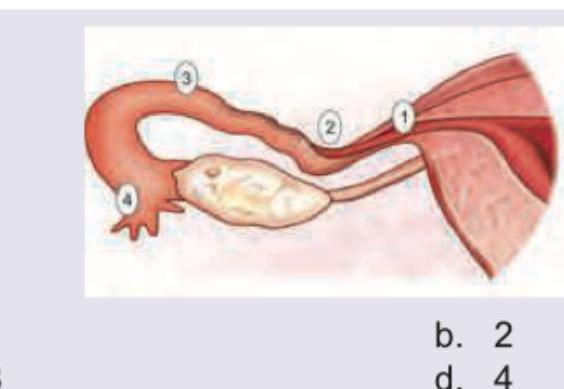
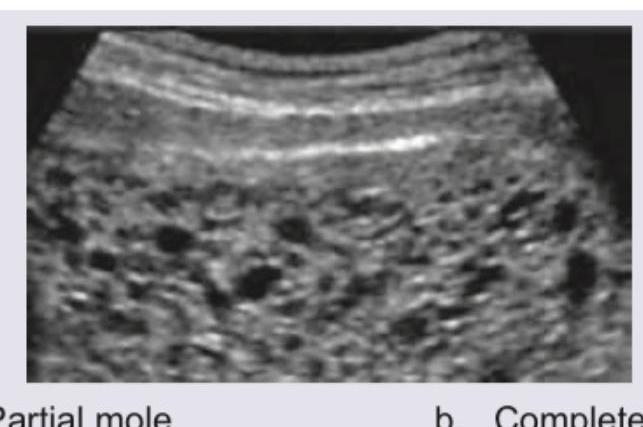
Edematous villi with chromosome XY were found. What will be the diagnosis?
Identify the given image of the placenta previa. 
If the division in the zygote occurs between 9-12 days after fertilization, which of the following twins is expected?
A 32-year-old woman at 32 weeks gestation presents with sudden-onset severe abdominal pain and vaginal bleeding. She has a history of cocaine use. On examination, the uterus is tender, firm, and woody hard. Fetal heart sounds are absent. Blood pressure is 90/60 mmHg, pulse 120/min. What is the most likely diagnosis?
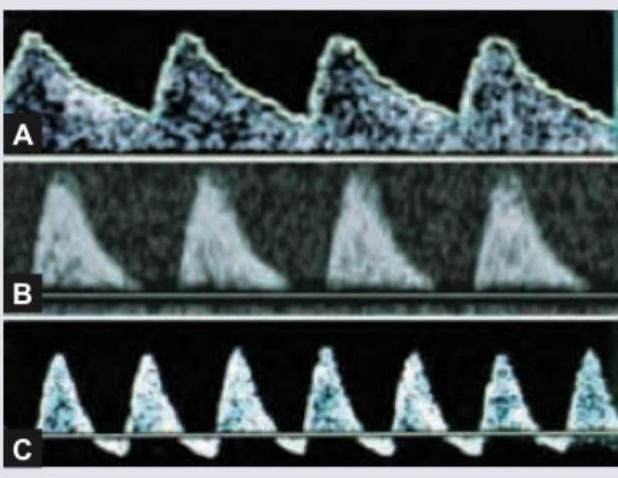
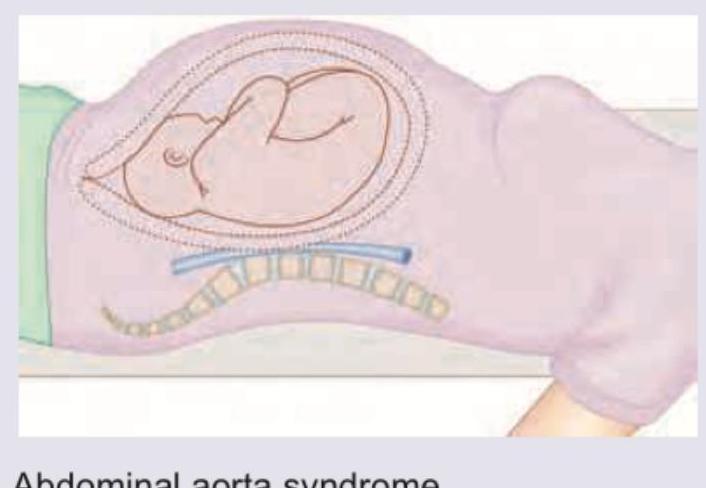
Which of the following does not cause fetal bradycardia?
Use of magnesium sulfate (MgSO4) in pre-eclampsia has all of the following effects except:
A 36-week pregnant woman is diagnosed with preeclampsia and started on magnesium sulfate therapy. According to the Pritchard regimen, what is the total loading dose of magnesium sulfate administered initially?
Which of the following drugs taken by the mother during pregnancy can cause the congenital defect shown in the image?

Identify the type of conjoined twins shown below.

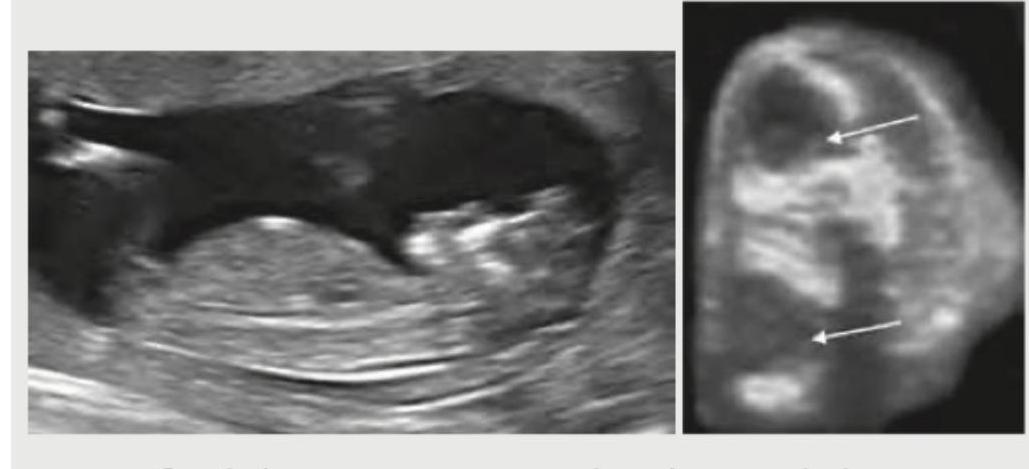
A patient presents with vaginal bleeding in the first trimester. Histopathological examination of the products of conception reveals the findings shown in the image below. What is the most likely diagnosis?

Explanation: ***Correct: Complete mole*** The finding of **edematous/hydropic villi** with a diploid karyotype (**46,XY**) is characteristic of a **Complete hydatidiform mole**. - A complete mole results from the fertilization of an 'empty' ovum by a single sperm (which duplicates, 46,XX) or two sperm (**46,XY**), leading to no fetal parts and diffuse **trophoblastic proliferation**. *Incorrect: Partial mole* A **Partial mole** is almost always triploid (e.g., **69,XXY** or 69,XXX), resulting from fertilization of a normal ovum by two sperm. - Histologically, it presents with a mixture of **normal and abnormal** (hydropic) villi, focal trophoblastic changes, and often identifiable **fetal parts**. *Incorrect: Cyst* This is a nonspecific term referring to a fluid-filled sac and does not account for the specific histological findings of abnormal **placental tissue** (edematous villi). - The presence of an abnormal **diploid karyotype (XY)** points towards a specific gestational trophoblastic disease rather than a generalized cystic structure. *Incorrect: Ectopic pregnancy* Ectopic pregnancy involves implantation outside the uterine cavity and, if villi are present, they are usually **normal chorionic villi** and not diffusely edematous. - The histological finding of **diffuse edematous villi** accompanied by the specific complete mole karyotype (**46,XY**) excludes a typical ectopic pregnancy.
Explanation: ***Marginal*** - In **marginal placenta previa**, the edge of the placenta is at the margin of the **internal cervical os** but does not cover it, which is consistent with the depiction in the image. - This type can lead to **painless, bright red vaginal bleeding**, particularly in the third trimester as the cervix begins to efface and dilate, causing separation of the placental edge. *Low lying* - A **low-lying placenta** is implanted in the lower uterine segment, and its edge is within **2 cm** of the internal os but does not reach the os itself. - The image shows the placenta directly abutting the os, which distinguishes it from a low-lying placenta where there would be a gap. *Incomplete* - **Incomplete** or **partial placenta previa** occurs when the placenta partially covers the internal cervical os. - The provided image clearly shows the cervical os is not covered by any placental tissue, ruling out this diagnosis. *Complete* - In **complete placenta previa**, the placenta entirely covers the internal cervical os, obstructing the birth canal. - This is the most severe form and is not represented in the image, as the os is visibly unobstructed.
Explanation: ***Monochorionic monoamniotic*** - Division of the inner cell mass (ICM) occurring between **9 and 12 days** after fertilization results in a twin pregnancy where both fetuses share a single **chorion** and a single **amnion**.- This stage marks division after the amnion has formed (around day 8) but before complete differentiation, leading to high risks like **cord entanglement**. *Dichorionic diamniotic* - This pattern results from division occurring very early, typically within the first **3 days** (2-cell stage to morula stage).- Since separation happens before the differentiation of the trophoblast and inner cell mass, both the **chorion** and the **amnion** are separate. *Conjoint twins* - Conjoint twins (Siamese twins) occur when the separation is delayed beyond the **13th day** after fertilization.- The division is incomplete, as it occurs *after* the formation of the **embryonic disc**. *Monochorionic diamniotic* - This type of twinning arises from division occurring between **4 and 8 days** after fertilization, typically during the blastocyst stage.- It leads to the sharing of the **chorion** but the development of separate **amnions**.
Explanation: ***Placental abruption*** - The sudden onset of severe, painful vaginal bleeding, coupled with a **tender, rigid, or 'woody' hard uterus**, is the classic triad for severe placental abruption. - **Cocaine use** is a major risk factor, causing intense vasoconstriction of the decidual spiral arteries, leading to ischemia, hemorrhage, and premature separation of the placenta. *Placenta previa* - Typically presents with **painless bright red vaginal bleeding** in the third trimester, often spontaneously resolving. - The uterus remains **soft or non-tender** on palpation, completely contradicting the painful, woody hard uterus described. *Uterine rupture* - While causing severe pain and maternal shock, rupture is usually associated with a history of prior **C-section or uterine surgery**. - The findings typically include **loss of fetal station** and a non-tender, distorted uterus, sometimes allowing palpation of fetal parts in the abdomen, rather than a uniformly woody hard uterus. *Vasa previa* - Characterized by **painless bleeding** that occurs secondary to the rupture of unprotected fetal vessels over the cervix, usually coinciding with amniotomy or membrane rupture. - The bleeding is **fetal in origin**, and while it leads rapidly to fetal demise (as seen here), it is not associated with severe maternal pain or a rigid, tender uterus.
Explanation: ***Maternal fever*** - Maternal fever causes **fetal tachycardia** or fetal heart rate acceleration, as the physiological response to fever is increased metabolism and heart rate. - The resulting fetal tachycardia is often a sign of impending or current **maternal infection** (e.g., chorioamnionitis). *Abruptio placenta* - Associated with acute fetal distress due to placental separation, leading to fetal **hypoxia** and **acidosis**. - Fetal hypoxia triggers a reflex bradycardia (late decelerations with bradycardia) to conserve oxygen and energy. *Meconium passage/staining* - Passage of meconium in utero is often a sign of **fetal distress** or hypoxia during labor. - Severe fetal distress and resultant cerebral hypoxia/acidosis can lead to prolonged or terminal **fetal bradycardia**. - Note: Meconium aspiration syndrome occurs postnatally, but meconium-stained amniotic fluid indicates antecedent fetal compromise. *Fetal head compression* - Leads to a transient increase in **intracranial pressure**, stimulating the **vagus nerve** mediated by the baroreceptors. - This **vagal stimulation** results in a brief, reflex slowdown of the fetal heart rate, known as **early decelerations**.
Explanation: ***Prevent abruption of placenta*** - **Magnesium sulfate (MgSO4)** is primarily a **CNS depressant** (anticonvulsant) and a vasodilator, and its use is not directly associated with preventing **placental abruption**. - Placental abruption is linked to factors like short umbilical cord, trauma, and **severe hypertension**, which MgSO4 does not consistently mitigate. ***Neuroprotection*** - Administered to women at high risk of imminent **preterm birth** (less than 32 weeks), MgSO4 has a proven benefit in reducing the risk of developing **cerebral palsy** in the neonate. - This neuroprotective effect is thought to be mediated by stabilizing the blood-brain barrier and its **antioxidant properties**. ***Decrease seizure incidence*** - MgSO4 is the **drug of choice** for both the prophylaxis and treatment of seizures (eclampsia) in women with **severe pre-eclampsia**. - It works by decreasing **acetylcholine release** at the neuromuscular junction and acting as a central anticonvulsant. ***Prevent preterm labour*** - MgSO4 is a weak **tocolytic agent** and can be used to temporarily suppress uterine contractions in women presenting with threatened **preterm labor**. - Although effective for short-term suppression, it is not the primary tocolytic agent and is most famously used for its **neuroprotective** and anti-seizure properties.
Explanation: ***14 grams*** - The **Pritchard regimen** mandates a total initial loading dose of **14 grams** of magnesium sulfate to rapidly achieve therapeutic serum levels and prevent seizures in severe preeclampsia or eclampsia. - This total dose comprises **4 grams** administered intravenously (IV) over 5-10 minutes, followed immediately by **10 grams** intramuscularly (IM) (5 grams into each buttock). *4 grams* - **4 grams** represents only the initial **intravenous component** of the loading dose, which is necessary for rapid onset of action. - This amount alone is insufficient to sustain the required therapeutic plasma concentration for an adequate duration, necessitating the added IM component. *10 grams* - **10 grams** represents the large intramuscular (IM) component of the loading dose (5g in each buttock), which provides a slow-release depot. - While crucial for the maintenance of therapeutic levels, it does not account for the immediate-acting IV component, hence failing to represent the total loading dose. *5 grams* - **5 grams** is the dose administered into a **single buttock** during the IM loading component (10g total IM) or the dose used for subsequent **maintenance therapy** (5g IM every 4 hours). - This dose, by itself, is far below the required total loading dose necessary to control acute symptoms of preeclampsia/eclampsia.
Explanation: ***Retinoic acid*** - The image depicts a severe **cleft lip and palate**, a common and well-documented teratogenic effect of **retinoids**, especially **isotretinoin (13-cis-retinoic acid)**, when taken during pregnancy. - Retinoic acid is an active metabolite of **vitamin A** and has critical roles in **embryonic development**; however, its excess can disrupt normal craniofacial development. *Folic acid* - **Folic acid** supplementation during pregnancy is protective and prevents **neural tube defects** (e.g., spina bifida, anencephaly), not associated with causing cleft lip or palate. - Adequate folic acid intake is recommended before and during early pregnancy to prevent neural tube defects. *Niacin* - **Niacin (vitamin B3)** supplementation in standard doses has not been directly implicated in causing cleft lip and palate. - Severe niacin deficiency can lead to **pellagra**, but this is not related to the craniofacial malformation shown. *Thiamine* - **Thiamine (vitamin B1)** supplementation is safe during pregnancy and not associated with teratogenic effects. - Thiamine deficiency can lead to **beriberi**, affecting the cardiovascular or nervous systems, but there is no established link between thiamine and cleft lip and palate.
Explanation: ***Omphalopagus*** - The image shows two infants joined at the **abdomen**, which is characteristic of omphalopagus conjoined twins. - This type often involves shared organs in the abdomen, such as the **liver** or **intestines**. *Craniopagus* - This type of conjoined twin is characterized by fusion at the **head** or **cranium**. - The twins in the image are clearly not joined at the head. *Ischiopagus* - Ischiopagus twins are conjoined at the **ischium** or **pelvis**, with varying degrees of shared lower body structures. - The fusion in the image is higher, at the abdominal region, not the pelvis. *Pygopagus* - Pygopagus twins are joined at the **sacrum** or **buttocks**, typically facing opposite directions. - The image shows twins joined at the front of their bodies, not the back.
Explanation: ***Partial mole*** - A partial mole is **triploid** (69,XXX, 69,XXY, or 69,XYY) and contains **fetal/embryonic tissue** alongside molar changes in the placenta. - It results from **fertilization of one ovum by two sperm** or by one diploid sperm, leading to both maternal and paternal genetic contributions. *Androgenetic complete mole* - Complete moles are **diploid** (46,XX or 46,XY) with **purely paternal genetic origin** and contain **no fetal tissue** by definition. - They present as **grape-like vesicles** without any embryonic or fetal structures, which contradicts the presence of fetal tissue in this image. *Biparental complete mole* - This extremely rare variant of complete mole has **genetic material from both parents** but still results in **no fetal development**. - Like all complete moles, it lacks **fetal tissue or embryonic structures**, making it inconsistent with the image findings. *Circumvallate placenta with IUD* - A circumvallate placenta involves **folded placental margins** where the chorionic plate is smaller than the basal plate, unrelated to molar pregnancy. - An **intrauterine device (IUD)** is a contraceptive device and would not be associated with the molar tissue changes described.
Fetal Assessment Techniques
Practice Questions
Hypertensive Disorders in Pregnancy
Practice Questions
Intrauterine Growth Restriction
Practice Questions
Multiple Gestation
Practice Questions
Rh Isoimmunization and Other Blood Group Incompatibilities
Practice Questions
Intrauterine Fetal Therapy
Practice Questions
Prenatal Diagnosis and Genetic Counseling
Practice Questions
Placental Abnormalities
Practice Questions
Preterm Labor and Delivery
Practice Questions
Management of Medical Disorders in Pregnancy
Practice Questions
Get full access to all questions, explanations, and performance tracking.
Start For Free