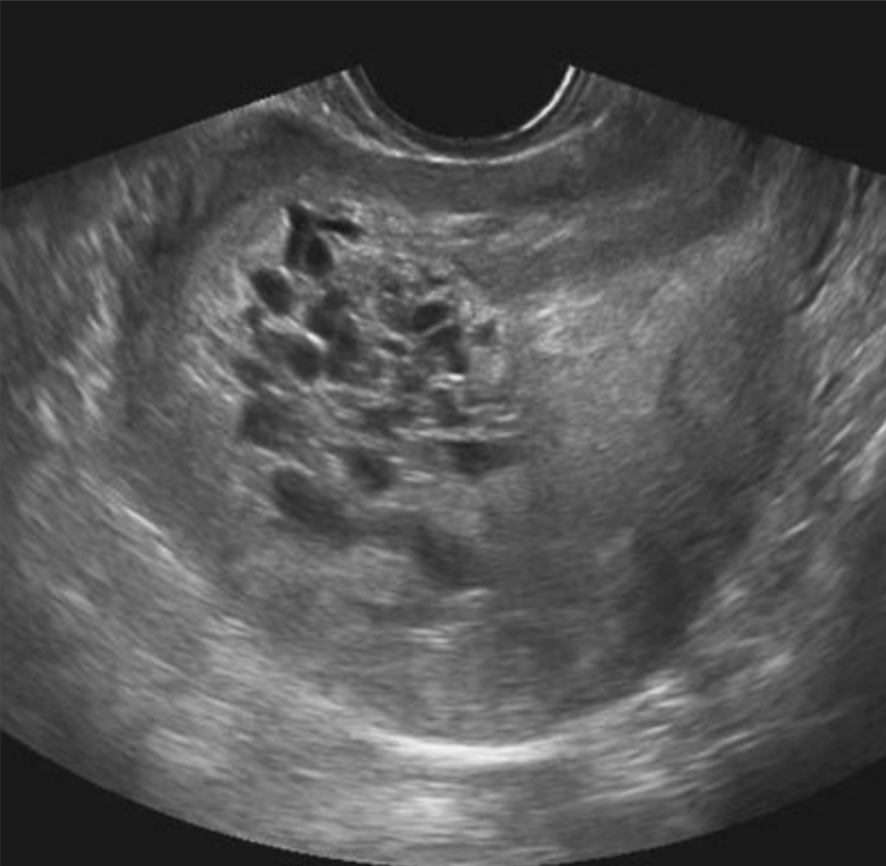
What is the recommended first-line medical therapy for hypertension in a pregnant patient with pheochromocytoma?
A 24-year-old woman is pregnant at 14 weeks with her first baby. She feels well and the pregnancy is uncomplicated. Routine screening is positive for chronic viral hepatitis for which perinatal transmission is of major epidemiologic significance. For this patient, what is the most likely viral agent?
What is the most common organism causing urinary tract infections in pregnant patients?
Complications of diabetes in pregnancy include all of the following except?
A 35-week pregnant patient presents with hydramnios and marked respiratory distress. What is the most appropriate management?
Which one of the following fetal functions is the last to be affected?
What is the most common symptom of an ectopic pregnancy?
In case of unstable lie of fetus, where is the placenta usually located?
Which hormone does not cross the placenta?
Single umbilical artery is associated with which of the following conditions?
Explanation: ### Explanation **Correct Answer: C. Alpha-blockers** **Why it is correct:** Pheochromocytoma is a catecholamine-secreting tumor. In pregnancy, these catecholamines cause severe vasoconstriction, leading to hypertensive crises and potential fetal demise. The primary goal of medical management is **Alpha-adrenergic blockade**. Alpha-blockers (typically **Phenoxybenzamine**) are the first-line therapy because they counteract the catecholamine-induced vasoconstriction, allowing for intravascular volume expansion and blood pressure stabilization. **Why the other options are incorrect:** * **Beta-blockers (B):** These should **never** be used as monotherapy. Blocking beta-receptors alone leaves alpha-receptors unopposed, leading to a paradoxical and life-threatening increase in blood pressure (hypertensive crisis). Beta-blockers are only added *after* adequate alpha-blockade is achieved to control tachycardia. * **Calcium-channel blockers (A):** While CCBs (like Nifedipine) can be used as adjunct therapy to further control blood pressure, they are not the primary first-line treatment for the specific pathophysiology of pheochromocytoma. * **Hydralazine (D):** This is a direct vasodilator often used in preeclampsia/eclampsia, but it is ineffective at addressing the catecholamine surge characteristic of pheochromocytoma. **Clinical Pearls for NEET-PG:** 1. **Drug of Choice:** Phenoxybenzamine (irreversible alpha-blocker) is the traditional choice; Prazosin (selective alpha-1 blocker) is also used. 2. **The "Alpha-First" Rule:** Always start alpha-blockers at least 10–14 days before considering beta-blockers. 3. **Surgical Timing:** The definitive treatment is surgical resection. The safest time for surgery is during the **second trimester** (before 24 weeks). If diagnosed in the third trimester, the patient is managed medically until the fetus is viable, followed by Cesarean section and subsequent tumor removal. 4. **Avoid:** Labor and vaginal delivery are generally avoided as they can trigger a massive catecholamine release.
Explanation: ### Explanation **Correct Answer: B. Hepatitis B virus** The core concept here is identifying the hepatitis virus where **vertical (perinatal) transmission** plays a "major epidemiologic role" globally. **Hepatitis B Virus (HBV)** is the most significant agent in this context. Perinatal transmission is the most common route of HBV infection worldwide, particularly in high-prevalence areas. If a mother is positive for both HBsAg and HBeAg, the risk of vertical transmission to the neonate is as high as **70-90%** without immunoprophylaxis. Furthermore, infants infected at birth have a **90% risk of developing chronic hepatitis B**, which significantly contributes to the global burden of cirrhosis and hepatocellular carcinoma. **Why other options are incorrect:** * **Hepatitis A (HAV):** Transmitted via the fecal-oral route. It does not cause chronic infection and vertical transmission is extremely rare. * **Hepatitis C (HCV):** While vertical transmission occurs, the rate is much lower (approximately **3-5%**). It is not the primary driver of the global HCV epidemic compared to parenteral routes. * **Hepatitis D (HDV):** A defective virus that requires HBV for replication. While it can be transmitted perinatally alongside HBV, it is not the primary agent of epidemiologic significance on its own. **High-Yield Clinical Pearls for NEET-PG:** * **Screening:** All pregnant women should be screened for **HBsAg** at the first prenatal visit. * **Management:** If the mother is HBsAg positive, the neonate must receive both the **HBV Vaccine** and **Hepatitis B Immunoglobulin (HBIG)** within 12 hours of birth. This reduces transmission risk by >90%. * **Antivirals:** If maternal HBV DNA is high (>200,000 IU/mL), Tenofovir is recommended starting at 28–32 weeks gestation to further reduce transmission. * **Breastfeeding:** Is **not contraindicated** in HBV-positive mothers, provided the infant receives the birth dose of the vaccine and HBIG.
Explanation: **Explanation:** **Correct Answer: A. E. coli** *Escherichia coli* is the most common uropathogen in both pregnant and non-pregnant women, accounting for approximately **70–90%** of all urinary tract infections (UTIs). In pregnancy, physiological changes such as progesterone-induced ureteral dilation (hydroureter) and mechanical compression of the bladder by the enlarging uterus lead to urinary stasis. This environment facilitates the ascent of fecal flora, primarily *E. coli*, from the perineum into the urinary tract. **Analysis of Incorrect Options:** * **B. Proteus:** While a known cause of UTIs, it is less common than *E. coli*. It is clinically significant for its association with struvite (staghorn) calculi due to its urease-producing nature. * **C. Staphylococcus saprophyticus:** This is the second most common cause of UTIs in young, sexually active women, but it remains significantly less frequent than *E. coli* in the obstetric population. * **D. Group B hemolytic Streptococcus (GBS):** While GBS can cause UTIs in pregnancy, its primary clinical importance lies in the risk of neonatal sepsis. Any colony count of GBS in a pregnant patient’s urine (even <10⁵ CFU/mL) warrants intrapartum antibiotic prophylaxis. **High-Yield Clinical Pearls for NEET-PG:** * **Asymptomatic Bacteriuria (ASB):** Defined as >10⁵ CFU/mL in an asymptomatic patient. It **must** be screened for and treated in pregnancy to prevent progression to pyelonephritis (up to 30-40% risk if untreated). * **Pyelonephritis:** The most common non-obstetric cause of hospitalization in pregnancy; it increases the risk of preterm labor and ARDS. * **Drug of Choice:** Nitrofurantoin or Fosfomycin are common first-line agents for cystitis/ASB. Avoid Nitrofurantoin near term due to the risk of neonatal hemolysis.
Explanation: **Explanation:** The correct answer is **C. Hyperglycemia in the newborn**. In reality, infants of diabetic mothers (IDMs) are at high risk for **neonatal hypoglycemia**, not hyperglycemia. **Pathophysiology (Pedersen Hypothesis):** Maternal hyperglycemia leads to fetal hyperglycemia because glucose crosses the placenta via facilitated diffusion. However, maternal insulin does not cross the placenta. The fetal pancreas responds to high glucose levels by producing excess insulin (**fetal hyperinsulinemia**). After birth, the glucose supply from the mother is abruptly cut off, but the neonate’s hyperinsulinemic state persists, causing rapid glucose uptake and profound hypoglycemia. **Analysis of Incorrect Options:** * **Macrosomia (A):** Fetal hyperinsulinemia acts as a growth promoter, leading to excessive fat deposition and organomegaly (birth weight >4000g or >4500g). * **Shoulder Dystocia (B):** Macrosomic infants have disproportionate fat deposition around the shoulders and trunk, significantly increasing the risk of birth trauma and shoulder dystocia during vaginal delivery. * **Intrauterine Growth Restriction (D):** While GDM usually causes macrosomia, **Pregestational Diabetes** (Type 1 or 2) with long-standing vascular complications (White’s Class D, F, R) can lead to placental insufficiency, resulting in IUGR. **High-Yield NEET-PG Pearls:** * **Most common cardiac anomaly:** Ventricular Septal Defect (VSD). * **Most specific cardiac anomaly:** Transposition of the Great Arteries (TGA). * **Most specific malformation overall:** Caudal Regression Syndrome (Sacral Agenesis). * **Neonatal Metabolic Triad:** Hypoglycemia, Hypocalcemia, and Hypomagnesemia. * **Other complications:** Polycythemia (due to fetal hypoxia/erythropoietin) and Hyperbilirubinemia.
Explanation: **Explanation:** The patient presents with **acute/symptomatic polyhydramnios** at 35 weeks gestation. When hydramnios causes maternal compromise—specifically **marked respiratory distress** or severe abdominal pain—the primary goal is to relieve the intra-abdominal pressure to stabilize the mother. **Why Amniocentesis is correct:** **Therapeutic Amniocentesis (Amnioreduction)** is the treatment of choice for symptomatic relief. By slowly removing excess amniotic fluid (usually 500 mL per hour, up to 1.5–2 L), the pressure on the diaphragm is reduced, immediately improving respiratory function. It is preferred over delivery at 35 weeks if the primary issue is mechanical distress, as it allows the pregnancy to gain further maturity while alleviating symptoms. **Why other options are incorrect:** * **A. Intravenous Furosemide:** Hydramnios is an accumulation of fluid in the amniotic sac, not maternal pulmonary edema or systemic fluid overload. Diuretics do not reduce amniotic fluid volume. * **B. Saline Infusion:** This would be used for oligohydramnios (amnioinfusion) or maternal dehydration; it would worsen the volume status in this context. * **D. Artificial Rupture of Membranes (ARM):** Performing ARM in a patient with polyhydramnios and a high presenting part carries a massive risk of **cord prolapse** and **abruptio placentae** due to the sudden decompression of the uterus. **NEET-PG High-Yield Pearls:** * **Definition:** Polyhydramnios is defined as an Amniotic Fluid Index (AFI) > 25 cm or a Single Deepest Pocket (SDP) > 8 cm. * **Indomethacin:** Can be used for medical management (decreases fetal urine output) but is generally avoided after **32 weeks** due to the risk of premature closure of the *ductus arteriosus*. * **Complication Risk:** Always perform amnioreduction slowly to prevent placental abruption.
Explanation: This question tests the understanding of the **Biophysical Profile (BPP)** and the sequential loss of fetal functions during progressive hypoxia, a concept known as the **Gradual Hypoxia Hypothesis**. ### **The Underlying Concept: Vintzileos' Hypothesis** Fetal biophysical activities are controlled by specific centers in the brain that develop at different gestational ages. These centers have varying sensitivities to hypoxia. As fetal oxygenation decreases, these activities disappear in the **reverse order** of their embryological development. 1. **Fetal Tone (Cortex):** Appears at 7.5–8.5 weeks. It is the most robust and the **last to disappear** because it is controlled by the most primitive part of the brain. 2. **Fetal Movement (Cortex/Nuclei):** Appears at 9 weeks. 3. **Fetal Breathing (Medulla):** Appears at 20–21 weeks. 4. **Fetal Heart Rate Reactivity (Posterior Hypothalamus):** Appears at 26–28 weeks. It is the most sensitive and the **first to be affected** by hypoxia. ### **Analysis of Options** * **A. Tone (Correct):** Being the first to develop, it is the most resistant to acidemia. Its absence indicates severe, chronic fetal distress. * **B. Movement:** Disappears after breathing movements but before tone. * **C. Heart rate reactivity:** This is the most sensitive indicator and the first parameter to disappear during acute hypoxia. * **D. Breathing movements:** These are highly sensitive to pH changes and disappear early, usually after the loss of heart rate reactivity. ### **NEET-PG High-Yield Pearls** * **Mnemonic for disappearance:** **"Eat My Baby's Toes"** (FHR **E**vents/Reactivity → **M**ovement → **B**reathing → **T**one). *Note: While breathing often stops before gross movement in some clinical models, Reactivity is always first and Tone is always last.* * **BPP Scoring:** Each of the 5 parameters (FHR, Breathing, Movement, Tone, and Amniotic Fluid) is given 0 or 2 points. * **Acute vs. Chronic:** FHR, Breathing, Movement, and Tone reflect **acute** fetal status, whereas Amniotic Fluid Volume (AFV) reflects **chronic** utero-placental sufficiency.
Explanation: **Explanation:** The classic clinical triad of ectopic pregnancy consists of **amenorrhea, abdominal pain, and vaginal bleeding**. However, this triad is present in only about 50% of cases. **1. Why "Pain in the lower abdomen" is correct:** Abdominal pain is the **most common presenting symptom**, occurring in approximately **95–99%** of patients. The pain is typically caused by the distension of the fallopian tube or peritoneal irritation from leaking blood. It is usually the first symptom that prompts a patient to seek medical attention. **2. Analysis of Incorrect Options:** * **Amenorrhea (B):** While a history of a missed period is common (75–90%), it is a *sign* or a historical finding rather than the primary *symptom* that defines the clinical presentation. Some patients may mistake early vaginal bleeding for a period, leading to a negative history of amenorrhea. * **Vaginal Bleeding (C):** This occurs in about 60–80% of cases. It is usually "scanty, dark brown (prune juice appearance), and spotting" in nature. While common, it occurs less frequently than abdominal pain. * **Fainting attack (D):** This is a sign of **ruptured ectopic pregnancy** leading to hemoperitoneum and hypovolemic shock. It is a late, life-threatening complication rather than the most common symptom of ectopic pregnancy in general. **NEET-PG High-Yield Pearls:** * **Most common site:** Fallopian tube (97%), specifically the **Ampulla** (most common overall). * **Most common site for rupture:** Isthmus (occurs early, at 6–8 weeks). * **Gold Standard Investigation:** Transvaginal Ultrasound (TVS) combined with quantitative β-hCG (Discriminatory zone: 1500–2000 mIU/mL). * **Arias-Stella Reaction:** Hypersecretory endometrium seen on curettage, suggestive of pregnancy but not specific to ectopic.
Explanation: **Explanation:** The correct answer is **Lower segment**. **1. Why the Lower Segment is Correct:** An unstable lie refers to a situation where the fetal longitudinal axis frequently changes (e.g., switching between transverse, oblique, and longitudinal) after 37 weeks of gestation. The most common anatomical cause for this is a **Placenta Previa** (placenta located in the lower uterine segment). When the placenta occupies the lower segment, it prevents the fetal head from engaging in the pelvic brim. This lack of engagement allows the fetus excessive mobility, leading to an unstable or transverse lie. **2. Why Other Options are Incorrect:** * **Cornual, Lateral wall, and Fundus:** These are all locations within the **upper uterine segment**. A placenta located in the upper segment is considered normal and does not obstruct the pelvic inlet. In these cases, the fetal head can easily engage, which typically stabilizes the fetus into a longitudinal lie (usually cephalic) as term approaches. **3. Clinical Pearls for NEET-PG:** * **Definition:** Unstable lie is only diagnosed after **37 weeks**; before this, it is common due to relatively high liquor volume. * **Management:** If an unstable lie persists at term, the primary goal is to exclude placenta previa via ultrasound. * **Risk:** The most dangerous complication of an unstable lie with ruptured membranes is **Cord Prolapse**. * **Other Causes:** Apart from placenta previa, consider pelvic tumors (fibroids), polyhydramnios, grand multiparity, and uterine anomalies (e.g., arcuate or subseptate uterus).
Explanation: ### Explanation The correct answer is **D. None of the above**, because all the listed hormones (Thyroxine, Estrogen, and Insulin) cross the placenta to some degree, contrary to older medical teachings that suggested they were completely blocked. **1. Why "None of the above" is correct:** The placental barrier is a semi-permeable membrane. While it prevents the passage of large molecules (like Heparin or IgM), most hormones cross via simple diffusion or carrier-mediated transport. **2. Analysis of Options:** * **Thyroxine (T4):** Small amounts of maternal T4 cross the placenta throughout pregnancy. This is critical for fetal brain development, especially in the first trimester before the fetal thyroid gland becomes functional (around 12 weeks). * **Estrogen:** As a steroid hormone, estrogen is lipid-soluble and crosses the placenta easily via simple diffusion. In fact, the feto-placental unit works together to produce estriol (E3), which circulates in both maternal and fetal compartments. * **Insulin:** Traditionally, it was taught that insulin does not cross the placenta. However, modern research shows that **insulin-antibody complexes** (in diabetic mothers) can cross. More importantly, while maternal *endogenous* insulin passage is negligible, the question asks which "does not cross"—and since minimal amounts or complexes do cross, it cannot be classified as "not crossing" in a strict competitive exam sense. **High-Yield Clinical Pearls for NEET-PG:** * **Large Molecules (Do NOT cross):** Heparin, Insulin (free/large molecules), IgM (too large). * **Small Molecules (DO cross):** Warfarin (Teratogenic), IgG (only antibody to cross), Steroids, T4. * **The "Rule of I's":** **I**nsulin, **I**gM, and **I**ntrinsic factor do not cross the placenta (clinically significant levels). However, in the context of this specific MCQ, if Thyroxine and Estrogen are known to cross, "None of the above" becomes the most accurate choice. * **Fetal Thyroid:** Fetal TSH does not cross; the fetus depends on maternal T4 until mid-gestation.
Explanation: **Explanation:** **Single Umbilical Artery (SUA)**, also known as a two-vessel cord, occurs when one of the two umbilical arteries is absent (usually the left). While it is often an isolated finding in 75% of cases, it is a significant marker for associated structural anomalies and chromosomal syndromes (like Trisomy 18). **Why Congenital Heart Disease (CHD) is correct:** Among the various organ systems affected, **cardiovascular anomalies** are the most frequently associated structural defects in fetuses with SUA. Common defects include ventricular septal defects (VSD) and conotruncal abnormalities. Other commonly associated systems include the renal/urinary tract and gastrointestinal systems. **Analysis of Incorrect Options:** * **A. Neural Tube Defects (NTD):** While SUA can be associated with CNS anomalies, NTDs are more specifically linked to folic acid deficiency and are not the primary association for a two-vessel cord. * **B. Hydrops Fetalis:** This is a condition of excessive fluid accumulation in fetal compartments, usually caused by Rh-isoimmunization or parvovirus B19. It is not a classic association of SUA. * **D. In utero fetal demise (IUFD):** While SUA increases the risk of **Intrauterine Growth Restriction (IUGR)** and preterm labor, it is not a direct cause or primary association of fetal demise unless part of a lethal chromosomal syndrome. **High-Yield Clinical Pearls for NEET-PG:** * **Incidence:** Occurs in ~1% of singletons and ~5% of twin pregnancies. * **Most common association:** Cardiovascular and Renal anomalies. * **Management:** If SUA is detected on a level II scan, a **fetal echocardiogram** and detailed renal survey are mandatory. * **Growth:** SUA is strongly associated with **IUGR**; therefore, serial growth scans are recommended in the third trimester even if no structural anomalies are found.
Fetal Assessment Techniques
Practice Questions
Hypertensive Disorders in Pregnancy
Practice Questions
Intrauterine Growth Restriction
Practice Questions
Multiple Gestation
Practice Questions
Rh Isoimmunization and Other Blood Group Incompatibilities
Practice Questions
Intrauterine Fetal Therapy
Practice Questions
Prenatal Diagnosis and Genetic Counseling
Practice Questions
Placental Abnormalities
Practice Questions
Preterm Labor and Delivery
Practice Questions
Management of Medical Disorders in Pregnancy
Practice Questions
Get full access to all questions, explanations, and performance tracking.
Start For Free