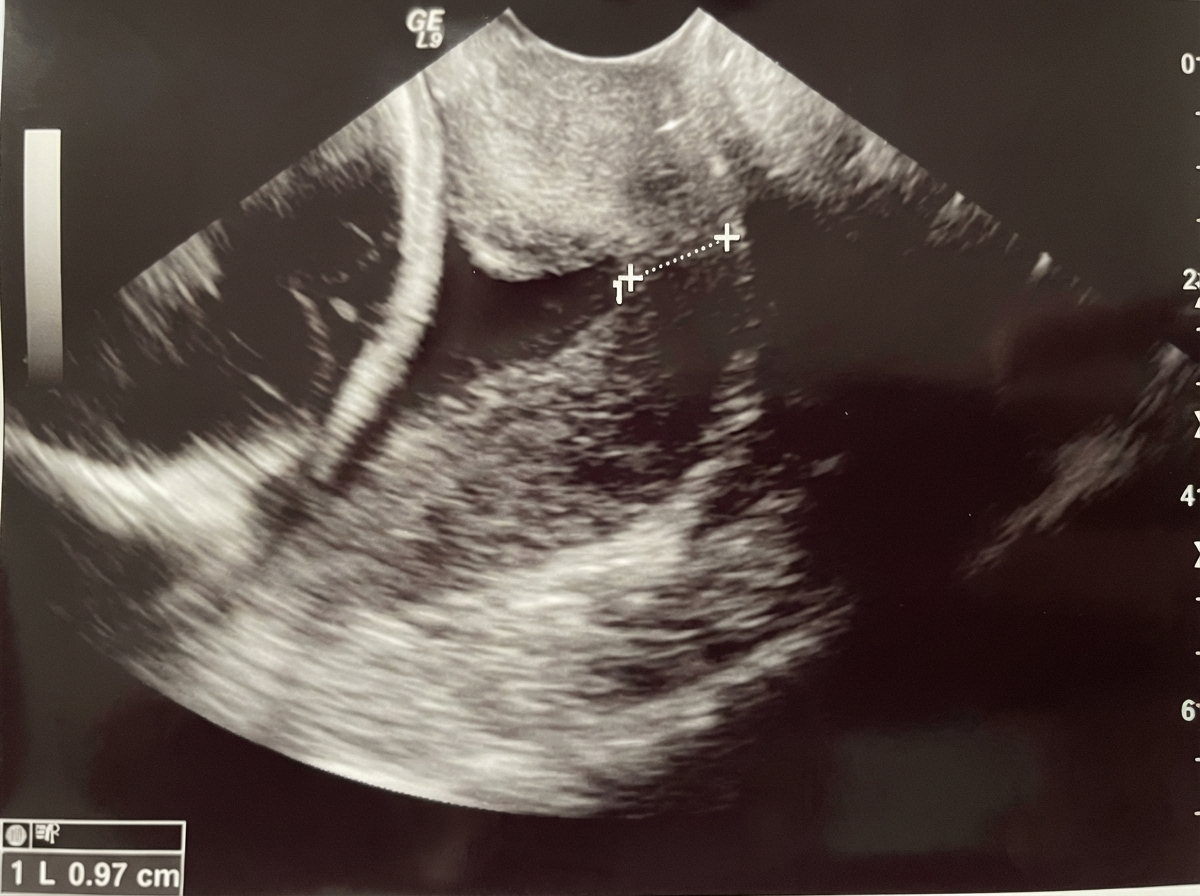
Which of the following is a cause of hydrops fetalis?
A 25-year-old G2P1 female has a history of previous preterm birth at 32 weeks. What is the percentage chance of preterm birth in this pregnancy?
A patient with twin pregnancy presents for ultrasound at 26 weeks gestation. The ultrasound reveals a single placenta. The first twin has an amniotic fluid index (AFI) of 5 cm, a fetal weight of 700 grams, and an non-visible bladder. The second twin has an AFI of 16 cm and a fetal weight of 1200 grams. What is the most likely diagnosis?
Abnormal baseline variability in a fetus is defined as:
What is the best method for fetal monitoring or screening?
What is macrosomia?
In which type of placenta do the chorionic vessels separate before reaching the placental margin?
Fetal biophysical profile used for the assessment of fetal well-being does not include which of the following?
All of the following are increased in infants of mothers with heart disease, except:
All of the following diseases are transmitted vertically in the 3rd trimester of pregnancy except?
Explanation: **Explanation:** **Hydrops Fetalis** is defined as the abnormal accumulation of fluid in two or more fetal compartments (e.g., ascites, pleural effusion, pericardial effusion, or skin edema). It is categorized into Immune (Rh isoimmunization) and Non-immune (NIFH) types. **Why Parvovirus B19 is correct:** Parvovirus B19 is the most common viral cause of non-immune hydrops fetalis. The virus has a specific tropism for **erythroid progenitor cells** (via the P-antigen receptor). It inhibits erythropoiesis, leading to **aplastic anemia**. The resulting profound fetal anemia causes high-output cardiac failure, which leads to hepatic congestion, decreased albumin production, and subsequent fluid extravasation (hydrops). **Why other options are incorrect:** * **B. Herpes Simplex Virus (HSV):** Typically causes localized skin, eye, or mouth lesions (SEM), or disseminated neonatal disease/encephalitis. It is not a classic cause of hydrops. * **C. Cytomegalovirus (CMV):** While CMV is the most common congenital infection, it typically presents with microcephaly, periventricular calcifications, and IUGR. Though it can rarely cause hydrops via myocarditis, Parvovirus is the definitive "textbook" association for hydrops. * **D. HIV:** Congenital HIV does not cause structural malformations or hydrops; it primarily affects the neonatal immune system later in life. **High-Yield Clinical Pearls for NEET-PG:** * **Diagnosis:** Middle Cerebral Artery (MCA) Peak Systolic Velocity (PSV) Doppler is the gold standard to screen for fetal anemia. * **Management:** If hydrops is due to Parvovirus and the fetus is pre-viable/immature, **intrauterine blood transfusion (IUT)** can be life-saving. * **Mirror Syndrome:** A rare condition where the mother "mirrors" the fetal hydrops, developing edema and preeclampsia-like symptoms.
Explanation: **Explanation:** The single most significant risk factor for preterm birth (PTB) is a **prior history of spontaneous preterm birth**. The risk of recurrence increases significantly based on the number and timing of previous episodes. **1. Why 15% is correct:** Statistically, a woman with one previous preterm birth has a **15–17% risk** of recurrence in her subsequent pregnancy. This represents a nearly three-fold increase compared to the baseline risk in the general population (which is approximately 5–10%). If a woman has two prior preterm births, the risk escalates further to approximately 30–35%. **2. Analysis of Incorrect Options:** * **A (5%):** This represents the lower end of the baseline risk for a primigravida or a woman with a previous full-term delivery. * **B (10%):** This is the average global incidence of preterm birth but does not account for the significantly increased risk conferred by a prior history. * **D (25%):** This risk level is typically associated with women who have had **two** previous preterm births, rather than one. **High-Yield Clinical Pearls for NEET-PG:** * **Prophylaxis:** For patients with a history of spontaneous PTB, the standard of care is **17-alpha-hydroxyprogesterone caproate** (starting at 16–24 weeks) or vaginal progesterone. * **Cervical Screening:** Serial transvaginal ultrasound (TVUS) to measure **cervical length** is indicated. A length **<25 mm** before 24 weeks is a strong predictor of PTB. * **Golden Rule:** The earlier the gestational age of the previous preterm birth, the higher the risk of recurrence in the current pregnancy.
Explanation: **Explanation:** The correct diagnosis is **Twin-to-Twin Transfusion Syndrome (TTTS)**. This condition occurs in **monochorionic** (single placenta) twin pregnancies due to unbalanced vascular anastomoses in the placenta, leading to a shunting of blood from one twin (donor) to the other (recipient). **Why Option D is correct:** The clinical presentation perfectly matches the **Quintero Staging** criteria for TTTS: * **Donor Twin (Twin 1):** Exhibits "stuck twin" features—oligohydramnios (AFI ≤ 5 cm), growth restriction (700g), and a non-visible bladder (indicative of Stage II TTTS due to decreased renal perfusion). * **Recipient Twin (Twin 2):** Exhibits polyhydramnios (AFI ≥ 8-10 cm or MVP > 8 cm) and macrosomia (1200g) due to volume overload and polyuria. **Why incorrect options are wrong:** * **Option A:** While the first twin does have growth restriction, the presence of a single placenta and the specific combination of **polyhydramnios-oligohydramnios sequence (TOPS)** makes TTTS the definitive diagnosis rather than isolated IUGR. * **Options B & C:** Twin Reversed Arterial Perfusion (TRAP) syndrome, also known as **Acardiac Twin**, involves a normal "pump" twin and a severely malformed twin without a functioning heart. In this case, both twins are structurally intact, though one is smaller and has an empty bladder. **High-Yield Clinical Pearls for NEET-PG:** * **Prerequisite:** TTTS only occurs in **Monochorionic** pregnancies. * **Diagnosis:** Based on ultrasound (Single placenta, same sex, and the Poly-Oli sequence). * **Quintero Staging:** Stage I (Poly/Oli), Stage II (Empty bladder in donor), Stage III (Abnormal Dopplers), Stage IV (Hydrops), Stage V (Death). * **Treatment of Choice:** Fetoscopic Laser Photocoagulation of placental anastomoses.
Explanation: **Explanation:** Baseline variability refers to the fluctuations in the fetal heart rate (FHR) that are irregular in amplitude and frequency. It is a critical indicator of fetal oxygenation and the functional integrity of the autonomic nervous system. **1. Why Option D is Correct:** According to standard obstetric guidelines (including FIGO and RCOG), **abnormal (reduced) variability** is defined as a beat-to-beat variation of **less than 5 beats per minute (bpm) for a duration of 90 minutes or more**. This prolonged duration is necessary to distinguish a pathological state from a physiological fetal sleep cycle. A fetus typically has sleep cycles lasting 20 to 40 minutes; therefore, persistent low variability for 90 minutes strongly suggests fetal hypoxia, acidosis, or neurological compromise. **2. Why Other Options are Incorrect:** * **Options A, B, and C:** While a variation of <5 bpm is considered "minimal," it is not classified as "abnormal" or "pathological" if it lasts for only 40 or 60 minutes. These shorter durations often represent **fetal sleep cycles** or the effects of maternal medications (like opioids or magnesium sulfate). Labeling these as abnormal would lead to unnecessary obstetric interventions. **3. High-Yield Clinical Pearls for NEET-PG:** * **Normal Variability:** 5 to 25 bpm. * **Increased (Saltatory) Variability:** >25 bpm for >30 minutes (may indicate early hypoxia or umbilical cord compression). * **Sinusoidal Pattern:** A smooth, sine-wave-like pattern (frequency 3-5 cycles/min) lasting >30 minutes; it is a "pre-terminal" sign indicating severe fetal anemia (e.g., Rh isoimmunization) or acute hypoxia. * **Silent Pattern:** Variability <2 bpm (indicates severe CNS depression).
Explanation: **Explanation:** The **Manning score**, also known as the **Biophysical Profile (BPP)**, is considered the gold standard for fetal monitoring because it combines both acute and chronic markers of fetal well-being. By utilizing ultrasound to assess four parameters (fetal breathing movements, gross body movements, fetal tone, and amniotic fluid volume) alongside the Non-Stress Test (NST), it provides a comprehensive evaluation of the fetal central nervous system and placental function. This multi-parameter approach significantly reduces the rate of false-positive results compared to using any single test in isolation. **Analysis of Incorrect Options:** * **Bishop score:** This is used to assess **cervical ripeness** and predict the success of induction of labor; it is not a method for monitoring fetal well-being. * **Non-stress test (NST):** While a common screening tool, it only assesses the acute fetal heart rate response. It has a high false-positive rate and is less comprehensive than the Manning score, of which it is actually a component. * **Cardiff count 10 formula:** This is a method for **Daily Fetal Movement Count (DFMC)** performed by the mother. While useful for screening in low-risk pregnancies, it is subjective and less reliable than clinical biophysical monitoring. **Clinical Pearls for NEET-PG:** * **Manning Score Components:** Each of the 5 parameters is scored as 0 or 2. A score of **8-10 is normal**, while **4 or less indicates fetal distress** requiring urgent intervention. * **Modified BPP:** Consists of only the **NST** (acute marker) and **Amniotic Fluid Index** (chronic marker). It is often used as a faster alternative to the full Manning score. * **First sign to disappear:** In fetal hypoxia, fetal breathing movements are usually the first to be lost, while fetal tone is the last to disappear (indicating severe acidemia).
Explanation: **Explanation:** **Fetal Macrosomia** is a clinical term used to describe a neonate who is significantly larger than average. In clinical practice, it is defined as a birth weight of **>4,000 grams** (some sources use >4,500g), regardless of gestational age. However, in the context of growth curves, it is synonymous with a **Large-for-Gestational-Age (LGA)** infant, typically defined as a birth weight above the **90th percentile** for that specific gestational age. **Why the correct answer is right:** * **Option A:** Macrosomia (from the Greek *macro* meaning "large" and *soma* meaning "body") refers to the overgrowth of the entire fetus. It is most commonly associated with maternal diabetes, where fetal hyperinsulinemia acts as a growth hormone, leading to increased deposition of fat and glycogen. **Why the incorrect options are wrong:** * **Option B (Large mouth):** This is termed **macrostomia**, often seen in syndromes like Treacher Collins or Beckwith-Wiedemann. * **Option C (Large head):** This is termed **macrocephaly**, which can be constitutional or due to conditions like hydrocephalus. * **Option D (Large tongue):** This is termed **macroglossia**, a classic feature of Beckwith-Wiedemann Syndrome and Down Syndrome. **High-Yield Clinical Pearls for NEET-PG:** * **Risk Factors:** Maternal diabetes (strongest), maternal obesity, multiparity, and post-term pregnancy. * **Complications:** The most feared intrapartum complication is **Shoulder Dystocia**. It also increases the risk of birth canal lacerations and Postpartum Hemorrhage (PPH) due to uterine atony. * **Management:** Elective Cesarean section is recommended if the estimated fetal weight is **>5,000g** in non-diabetic women or **>4,500g** in diabetic women.
Explanation: **Explanation:** The correct answer is **Velamentous placenta**. In a **Velamentous insertion of the cord**, the umbilical cord inserts into the fetal membranes (amnion and chorion) rather than directly into the placental mass. Consequently, the umbilical/chorionic vessels must travel through the membranes, unprotected by Wharton’s jelly, before reaching the placental margin. This makes the vessels vulnerable to compression or rupture. **Analysis of Options:** * **Battledoor placenta (Marginal insertion):** The cord attaches at the very margin of the placenta rather than the center. However, the vessels do not travel through the membranes; they remain within the placental disc. * **Circumvallate placenta:** This is a morphological variation where the chorionic plate is smaller than the basal plate. It is characterized by a thickened, opaque ring (a double fold of amnion and chorion) at the periphery. The vessels do not separate in the membranes here. * **Placenta marginata:** A milder form of circumvallate placenta where the fetal membranes insert at the edge of the placental disc without the characteristic peripheral fold or shelf. **High-Yield Clinical Pearls for NEET-PG:** * **Vasa Previa:** If velamentous vessels cross the internal os ahead of the presenting part, it is called vasa previa. Rupture of these vessels (often during ROM) leads to painless vaginal bleeding and rapid fetal exsanguination (**Benckiser’s hemorrhage**). * **Diagnosis:** Velamentous insertion is best diagnosed using **Color Doppler Ultrasound**. * **Apt Test:** Used to differentiate fetal blood from maternal blood in cases of antepartum hemorrhage.
Explanation: The **Fetal Biophysical Profile (BPP)**, also known as Manning’s score, is a non-invasive ultrasound-based assessment used to evaluate fetal well-being and identify potential chronic hypoxia. It consists of five specific parameters, each scored as either 2 (normal) or 0 (abnormal). ### Why "Contraction Stress Test" is the Correct Answer The **Contraction Stress Test (CST)** is a separate method of fetal surveillance that evaluates the fetal heart rate response to uterine contractions. While it assesses fetal reserve, it is **not** a component of the BPP. The BPP focuses on ultrasound markers and the Non-Stress Test (NST). ### Explanation of Incorrect Options (BPP Components) The five components of the BPP (Mnemonic: **BATMAN** – Breathing, Amniotic fluid, Tone, Movement, and NST) include: * **Fetal Breathing Movements (A):** At least one episode of rhythmic breathing lasting ≥30 seconds within a 30-minute window. * **Fetal Tone (B):** At least one episode of active extension with return to flexion of a limb or trunk (e.g., opening/closing a hand). * **Amniotic Fluid Volume (C):** A pocket of fluid measuring at least 2 cm in two perpendicular planes (Vertical pocket >2cm). * **Fetal Body Movements:** At least three discrete body or limb movements in 30 minutes. * **Non-Stress Test (NST):** Reactive heart rate pattern (this is the only non-ultrasound component). ### High-Yield Clinical Pearls for NEET-PG * **Modified BPP:** Consists of only two parameters: **NST** (indicator of acute acid-base status) and **Amniotic Fluid Index** (indicator of long-term placental function). * **Sequence of Loss:** In fetal hypoxia, the first sign to disappear is the **NST (reactivity)**, followed by breathing, then movement. **Fetal tone** is the last to disappear and indicates severe acidemia. * **Scoring:** A score of **8-10** is normal; **6** is equivocal (repeat in 24 hours); **0-4** is abnormal and usually necessitates immediate delivery.
Explanation: **Explanation:** Maternal heart disease significantly impacts fetal outcomes primarily through two mechanisms: **chronic fetal hypoxia** and **genetic predisposition**. **Why Neural Tube Defects (NTD) is the correct answer:** Neural tube defects are primarily associated with folic acid deficiency, maternal diabetes, or exposure to teratogens (like valproate). There is no direct pathophysiological link between maternal cardiac disease and the failure of neural tube closure. Therefore, the incidence of NTDs remains the same as in the general population. **Analysis of Incorrect Options:** * **Prematurity:** Mothers with significant heart disease (especially those with cyanosis or congestive heart failure) have a higher incidence of preterm labor, often due to chronic hypoxia or iatrogenic delivery necessitated by deteriorating maternal health. * **Intrauterine Growth Restriction (IUGR):** Chronic maternal hypoxia and reduced cardiac output lead to placental insufficiency. This results in a suboptimal supply of oxygen and nutrients to the fetus, leading to symmetrical or asymmetrical growth restriction. * **Increased Incidence of Cardiac Disease:** Congenital heart disease (CHD) has a polygenic inheritance pattern. If a mother has CHD, the risk of the fetus having a cardiac defect increases from the baseline 0.8% to approximately 3–5% (depending on the specific lesion). **NEET-PG High-Yield Pearls:** * **Most common heart disease in pregnancy (India):** Rheumatic Heart Disease (Mitral Stenosis is the most common lesion). * **Most common heart disease in pregnancy (Developed countries):** Congenital Heart Disease. * **Highest risk period:** The immediate postpartum period (first 24–48 hours) due to the sudden "autotransfusion" of blood from the involuting uterus into the systemic circulation. * **Predictor of Fetal Risk:** Maternal cyanosis (Oxygen saturation <85%) is the strongest predictor of poor fetal outcome.
Explanation: **Explanation:** The core concept tested here is the **timing of vertical transmission** and the resulting fetal pathology. While many infections can occur at any stage, their peak incidence of transmission often varies by trimester. **Why Parvovirus B19 is the correct answer:** Parvovirus B19 specifically targets **erythroid progenitor cells** in the fetal bone marrow and liver. The peak period of fetal vulnerability and vertical transmission is the **second trimester** (specifically 13–24 weeks), as this is the period of maximal hepatic hematopoiesis. Infection during this window leads to severe fetal anemia, high-output cardiac failure, and **Hydrops Fetalis**. While transmission can occur later, it is classically associated with second-trimester complications rather than third-trimester transmission. **Analysis of Incorrect Options:** * **Congenital Syphilis:** Transmission can occur at any stage, but the risk **increases with gestational age**, reaching its peak in the third trimester. * **Congenital Toxoplasmosis:** There is an inverse relationship between severity and transmission. While first-trimester infection is more severe, the **highest rate of transmission (up to 60-80%)** occurs in the third trimester. * **Congenital Hepatitis B:** Vertical transmission (primarily peripartum) is most common if the mother acquires the infection in the **third trimester** (up to 90% risk) compared to the first trimester (only 10%). **NEET-PG High-Yield Pearls:** * **Toxoplasmosis:** Transmission risk is highest in the 3rd trimester; Severity is highest in the 1st trimester. * **Parvovirus B19:** Most common cause of non-immune hydrops fetalis; diagnosed via MCA-PSV doppler (looking for fetal anemia). * **Syphilis:** Langhans layer of the placenta prevents transmission before 16 weeks; hence, treating the mother before 16 weeks prevents congenital syphilis.
Fetal Assessment Techniques
Practice Questions
Hypertensive Disorders in Pregnancy
Practice Questions
Intrauterine Growth Restriction
Practice Questions
Multiple Gestation
Practice Questions
Rh Isoimmunization and Other Blood Group Incompatibilities
Practice Questions
Intrauterine Fetal Therapy
Practice Questions
Prenatal Diagnosis and Genetic Counseling
Practice Questions
Placental Abnormalities
Practice Questions
Preterm Labor and Delivery
Practice Questions
Management of Medical Disorders in Pregnancy
Practice Questions
Get full access to all questions, explanations, and performance tracking.
Start For Free