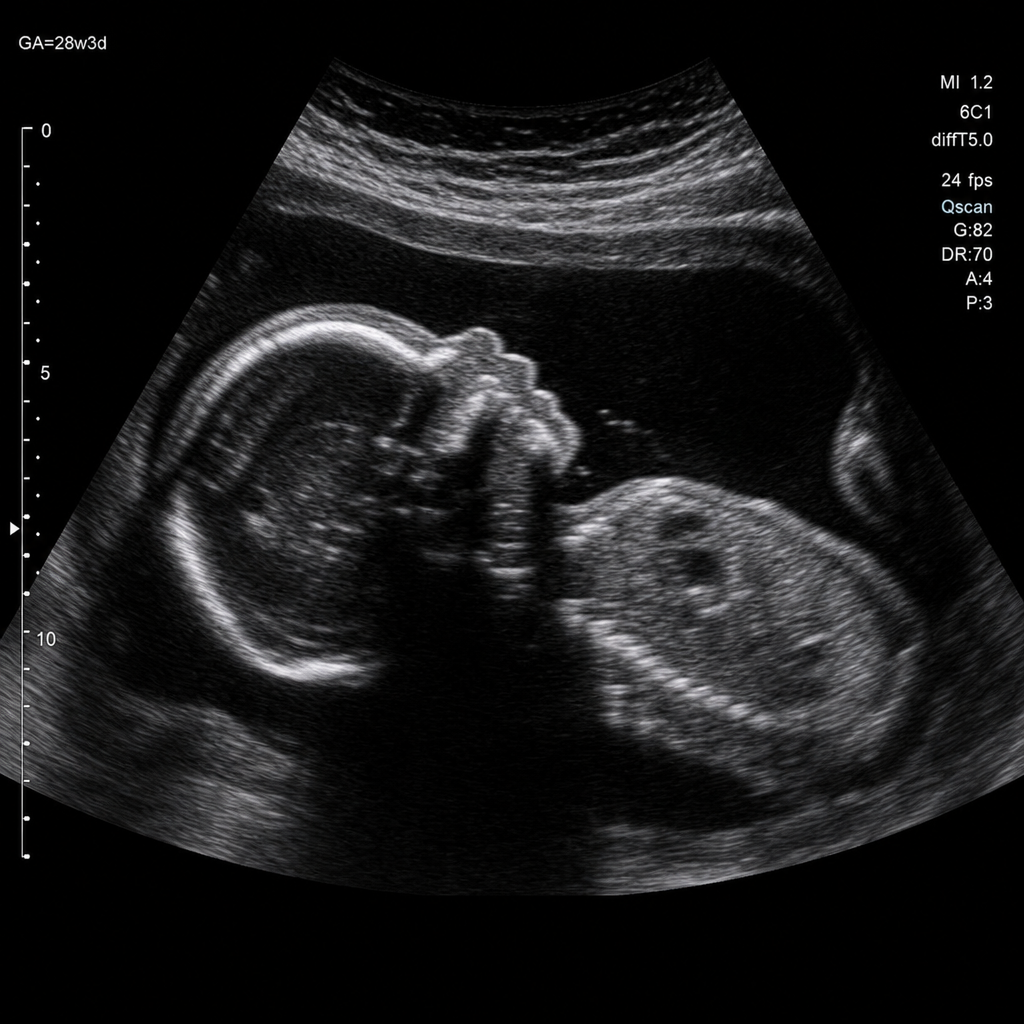
A 19-year-old woman, gravida 2, para 0, abortion 1, is at 30 weeks gestation. Her fundal height measures 25cm. An obstetrical ultrasound examination reveals a 4-quadrant amniotic fluid index (AFI) of 4cm. Which of the following fetal conditions is associated with this finding?
What is the dose of anti-D gamma globulin given after term delivery for an Rh-negative mother and Rh-positive baby?
Which of the following is a non-invasive test used to diagnose fetal Rh genotype in Rh D alloimmunization?
Which of the following statements is true?
Which fetal abnormality is commonly associated with maternal diabetes mellitus?
What is the treatment for acute hydramnios with respiratory depression?
The classic triad of ruptured ectopic pregnancy includes all EXCEPT?
What is the management of choice for placenta previa at 32 weeks gestation?
The lecithin/sphingomyelin (L/S) ratio is measured for assessing maturity of which organ?
The KleihauerBetke test is used to detect:
Explanation: **Explanation:** The clinical presentation describes **Oligohydramnios**, defined as an Amniotic Fluid Index (AFI) ≤ 5 cm or a Single Deepest Pocket (SDP) < 2 cm. At 30 weeks gestation, the fundal height (25 cm) is lagging significantly behind the gestational age, which is a classic clinical sign of reduced liquor volume. **Why Renal Agenesis is Correct:** From the second trimester onwards, fetal urine production is the primary contributor to amniotic fluid volume. **Renal agenesis** (Potter sequence) results in a total failure of urine production (anephric), leading to severe, early-onset oligohydramnios. Other renal causes include multicystic dysplastic kidneys or posterior urethral valves (in males). **Why Other Options are Incorrect:** * **A & C (Duodenal Atresia and Tracheoesophageal Fistula):** These conditions interfere with the fetal ability to swallow or transit amniotic fluid through the GI tract. Since swallowing is the major pathway for fluid removal, these conditions lead to **Polyhydramnios** (AFI > 25 cm), not oligohydramnios. * **B (Open Spina Bifida):** Neural tube defects are generally associated with **Polyhydramnios**. This occurs due to the transudation of fluid across the exposed meninges and an impaired swallowing reflex if there is associated hindbrain herniation (Chiari II malformation). **High-Yield Clinical Pearls for NEET-PG:** * **Amniotic Fluid Dynamics:** Production is mainly via fetal urine; clearance is mainly via fetal swallowing. * **Potter Sequence:** Characterized by bilateral renal agenesis → Oligohydramnios → Pulmonary hypoplasia, limb deformities (clubfoot), and typical "Potter facies" (flattened nose, recessed chin). * **Drug-induced Oligohydramnios:** Maternal use of **ACE inhibitors** (causes fetal renal tubular dysgenesis) or **NSAIDs** (decreases fetal renal perfusion) can lead to low liquor. * **Most common cause of Oligohydramnios:** Premature Rupture of Membranes (PROM) or Placental Insufficiency (IUGR).
Explanation: **Explanation:** The administration of Anti-D gamma globulin (RhoGAM) is a critical intervention to prevent **Rh isoimmunization** in Rh-negative mothers. When an Rh-negative mother is exposed to Rh-positive fetal red blood cells (fetal-maternal hemorrhage), she develops antibodies that can cause Hemolytic Disease of the Fetus and Newborn (HDFN) in subsequent pregnancies. **Why 300 micrograms is correct:** The standard dose after a term delivery is **300 micrograms (1500 IU)**, administered intramuscularly within 72 hours. This dose is specifically calculated to neutralize up to **30 mL of Rh-positive whole blood** (or 15 mL of packed red cells). Since most term deliveries involve a feto-maternal hemorrhage of less than 30 mL, this dose is sufficient for routine prophylaxis. **Analysis of Incorrect Options:** * **50 micrograms:** This "mini-dose" is used only for first-trimester events (up to 12 weeks gestation), such as spontaneous abortion or ectopic pregnancy, where fetal blood volume is minimal. * **100 & 200 micrograms:** These are sub-therapeutic doses for term deliveries and do not follow standard international or national (FOGSI/ACOG) guidelines for post-exposure prophylaxis. **High-Yield Clinical Pearls for NEET-PG:** * **Kleihauer-Betke (KB) Test:** Used to quantify the volume of fetal-maternal hemorrhage. If the hemorrhage exceeds 30 mL, additional doses of Anti-D are required. * **Antenatal Prophylaxis:** A routine dose of 300 mcg is also given at **28 weeks** of gestation to all Rh-negative unsensitized mothers. * **Indirect Coombs Test (ICT):** Must be negative in the mother before administration (indicates she is not yet sensitized). * **Route:** Intramuscular (IM) is standard; however, intravenous (IV) preparations exist for specific scenarios.
Explanation: **Explanation:** The correct answer is **Cell-free fetal DNA (cffDNA) analysis**. This technology utilizes fragments of fetal DNA that circulate in the maternal plasma (derived from the placenta). In Rh-negative mothers, cffDNA can be tested for the presence of the *RHD* gene. If the gene is detected, the fetus is Rh-positive; if absent, the fetus is Rh-negative. This is considered **non-invasive** because it only requires a maternal peripheral blood sample, eliminating the risk of miscarriage or further maternal sensitization. **Analysis of Incorrect Options:** * **Chorionic Villus Sampling (B) and Amniocentesis (C):** While these tests can accurately determine the fetal genotype, they are **invasive** procedures. They carry a small risk of pregnancy loss and, more importantly, can cause feto-maternal hemorrhage, which may worsen maternal alloimmunization by increasing the antibody titer. * **Middle Cerebral Artery Peak Systolic Velocity (MCA-PSV) (D):** This is a non-invasive **functional** test used to detect **fetal anemia**, not the genotype. In anemic fetuses, blood viscosity decreases and cardiac output increases, leading to a higher PSV. It is the gold standard for monitoring the severity of Rh-isoimmunization but does not identify the Rh status itself. **High-Yield Clinical Pearls for NEET-PG:** * **Screening:** The first step in managing an Rh-negative pregnancy is a **Direct Coombs Test (DCT)** on the newborn or an **Indirect Coombs Test (ICT)** on the mother. * **Critical Titer:** An ICT titer of **1:16** (in most centers) is considered the critical threshold; beyond this, fetal monitoring with MCA-PSV is mandatory. * **Liley’s Chart:** Historically used to predict anemia via bilirubin levels in amniotic fluid ($\Delta OD_{450}$); it has largely been replaced by MCA-PSV Doppler. * **Anti-D Prophylaxis:** Standard dose is **300 $\mu$g**, which covers up to **30 ml** of fetal whole blood (or 15 ml of packed RBCs) entering maternal circulation.
Explanation: **Explanation:** **1. Why Option D is Correct:** Phosphatidylglycerol (PG) is a minor constituent of surfactant that appears late in gestation (usually after 35–36 weeks). Its presence in the amniotic fluid is highly specific; it acts as a "final marker" of biochemical lung maturity. Unlike the L/S ratio, PG is **not affected by contamination** with blood or meconium, making it a reliable indicator. If PG is present, the risk of Respiratory Distress Syndrome (RDS) is virtually zero (<1%), making it a "100% confirmatory" marker for clinical purposes. **2. Analysis of Incorrect Options:** * **Option A:** Glyburide (a second-generation sulfonylurea) is **not absolutely contraindicated**. While Insulin remains the gold standard, ACOG and SMFM acknowledge Glyburide as an alternative if a patient cannot tolerate insulin or metformin, though it is generally considered second-line due to higher risks of macrosomia and neonatal hypoglycemia. * **Option B:** Routine delivery at 34–36 weeks is incorrect. For well-controlled GDM (on diet or meds), delivery is usually recommended between **39 weeks 0 days and 39 weeks 6 days**. Early delivery (37–38 weeks) is reserved only for poorly controlled cases. * **Option C:** **PTH (Parathyroid Hormone) does not cross the placenta.** Fetal calcium homeostasis is independent; calcium is actively transported across the placenta, but the regulatory hormones (PTH, Calcitonin) are maternal-fetal independent. **3. NEET-PG High-Yield Pearls:** * **L/S Ratio:** A ratio >2:1 indicates maturity, but it can be falsely elevated by blood or meconium. * **Diabetes & Lung Maturity:** In diabetic pregnancies, hyperinsulinemia can delay surfactant production. Therefore, PG is the preferred marker in these patients to ensure maturity. * **Steroids:** Dexamethasone (4 doses of 6mg, 12h apart) or Betamethasone (2 doses of 12mg, 24h apart) are used to accelerate lung maturity between 24 and 34 weeks.
Explanation: **Explanation:** **Sacral agenesis** (also known as Caudal Regression Syndrome) is the most specific fetal malformation associated with maternal diabetes mellitus. While the absolute incidence is low, a child born with sacral agenesis is over 200 times more likely to have a mother with diabetes compared to the general population. This condition involves the incomplete development of the lower spine and is thought to result from hyperglycemia-induced oxidative stress during the first trimester (organogenesis). **Analysis of Incorrect Options:** * **B. Hydrocephalus:** While CNS anomalies (like neural tube defects) are more common in diabetic pregnancies, hydrocephalus is not as pathognomonic or specifically linked to diabetes as sacral agenesis. * **C. Respiratory Distress Syndrome (RDS):** This is a common **neonatal** complication of maternal diabetes (due to hyperinsulinemia inhibiting surfactant production), but it is a functional/maturational issue rather than a structural **fetal abnormality** or malformation. * **D. Phocomelia:** This is the hallmark malformation associated with maternal **Thalidomide** intake, characterized by the absence of long bones in the limbs. **High-Yield Clinical Pearls for NEET-PG:** * **Most Common Malformation:** Congenital Heart Defects (specifically **Ventricular Septal Defect**). * **Most Specific Malformation:** Sacral Agenesis/Caudal Regression Syndrome. * **Cardiac-specific:** Transposition of the Great Arteries (TGA) and Hypertrophic Cardiomyopathy (asymmetric septal hypertrophy) are also highly associated. * **Screening:** HbA1c levels >8.5% in the first trimester significantly increase the risk of these structural anomalies.
Explanation: **Explanation:** **Acute Polyhydramnios** is a rare obstetric emergency characterized by a rapid accumulation of amniotic fluid over a few days, typically occurring before 24 weeks of gestation. The sudden uterine distension leads to severe pressure symptoms, most critically **respiratory distress** (due to splinting of the diaphragm) and abdominal pain. **Why Amniocentesis is the Correct Choice:** The primary goal in acute hydramnios with respiratory depression is the immediate relief of maternal distress. **Slow decompression via medicinal amniocentesis (amnioreduction)** is the treatment of choice. By removing the excess fluid (usually 500–1000 ml at a rate of ~500 ml/hour), the intra-abdominal pressure is reduced, allowing the diaphragm to descend and alleviating respiratory compromise. **Why Other Options are Incorrect:** * **Termination of Pregnancy:** While acute hydramnios is often associated with fetal anomalies (e.g., esophageal atresia) or twin-to-twin transfusion syndrome (TTTS), the immediate priority is maternal stabilization. Termination is not the first-line treatment for managing acute respiratory distress. * **Diuretics:** Polyhydramnios is an accumulation of fluid in the amniotic sac, not maternal systemic edema. Diuretics have no role in reducing amniotic fluid volume and may cause maternal dehydration. * **Sedation:** This is contraindicated as it may further depress the maternal respiratory drive and does not address the underlying mechanical cause of the distress. **NEET-PG High-Yield Pearls:** * **Definition:** Polyhydramnios is defined as an Amniotic Fluid Index (AFI) >25 cm or a Single Deepest Pocket (SDP) >8 cm. * **Complication of Amnioreduction:** Rapid decompression can lead to **abruptio placentae** due to a sudden decrease in surface area of the uterine wall. * **Indomethacin:** Used for chronic polyhydramnios (reduces fetal urine output) but is avoided after 32 weeks due to the risk of premature closure of the *ductus arteriosus*.
Explanation: The classic clinical triad of ectopic pregnancy is a high-yield concept for NEET-PG. Understanding the difference between the "classic triad" and "symptoms of rupture" is key to answering this question correctly. ### **Explanation** The **classic triad** of ectopic pregnancy consists of: 1. **Abdominal pain:** The most common symptom (95–100%), usually localized to the iliac fossa. 2. **Amenorrhea:** A history of a missed period (75–90%), typically 6–8 weeks prior. 3. **Vaginal bleeding:** Usually slight, dark brown "spotting" (70%), occurring after the onset of pain. **Fainting (Option A)** is the correct answer because it is **not** part of the classic triad. While fainting or syncope occurs in ruptured ectopic pregnancy due to intraperitoneal hemorrhage and hypovolemic shock, it is considered a **sign of rupture/complication** rather than a component of the primary diagnostic triad. ### **Analysis of Incorrect Options** * **Abdominal Pain (Option B):** The primary presenting symptom caused by tubal distension or peritoneal irritation. * **History of Amenorrhea (Option C):** Essential for the suspicion of any pregnancy-related pathology. * **Vaginal Bleeding (Option D):** Caused by the shedding of the decidua due to falling progesterone levels; it is a core component of the triad. ### **Clinical Pearls for NEET-PG** * **Gold Standard Investigation:** Transvaginal Ultrasound (TVS) + Serum β-hCG. * **Discriminatory Zone:** The β-hCG level (usually 1500–2000 mIU/mL) at which a gestational sac should be visible on TVS. * **Arias-Stella Reaction:** Hypersecretory endometrium seen on curettage, characteristic of (but not pathognomonic for) ectopic pregnancy. * **Most Common Site:** Ampulla of the Fallopian tube. * **Most Common Site of Rupture:** Isthmus (occurs early, around 6–8 weeks).
Explanation: **Explanation:** The primary goal in managing placenta previa before term (less than 37 weeks) is to prolong the pregnancy to allow for fetal lung maturity, provided there is no active, life-threatening hemorrhage. This approach is known as **MacAfee’s Conservative Management**. **Why Conservative Treatment is Correct:** At 32 weeks, the fetus is preterm. If the maternal and fetal conditions are stable (bleeding is not profuse), the patient is managed with bed rest, corticosteroids (for lung maturity), and close monitoring. This reduces the risks associated with prematurity while keeping the patient in a facility equipped for an emergency Cesarean section if bleeding recurs. **Why Other Options are Incorrect:** * **Oxytocin & Ergometrine:** These are uterotonic agents. Oxytocin is used for induction of labor or postpartum hemorrhage (PPH) management, and Ergometrine is strictly for PPH. Using them in placenta previa before delivery is contraindicated as they cause uterine contractions, which can lead to massive placental separation and fatal hemorrhage. * **Per Vaginal (PV) Examination:** This is **strictly contraindicated** in suspected placenta previa. A digital exam can dislodge a clot or tear the placenta, leading to torrential, life-threatening bleeding. PV exams should only be performed in a "Double Setup" (in an OT ready for immediate surgery). **High-Yield Clinical Pearls for NEET-PG:** * **MacAfee’s Criteria:** Pregnancy <37 weeks, bleeding is not active/profuse, and the mother/fetus are stable. * **Investigation of Choice:** Transvaginal Ultrasound (TVS) is the gold standard (safe and more accurate than transabdominal). * **Delivery Timing:** In stable cases of placenta previa, elective delivery is usually planned at **36–37 weeks**. * **Stallworthy’s Sign:** A drop in fetal heart rate when the head is pressed into the pelvis (seen in posterior placenta previa).
Explanation: **Explanation:** The **Lecithin/Sphingomyelin (L/S) ratio** is the gold standard biochemical test for assessing **fetal lung maturity**. **1. Why Lung is Correct:** Lecithin (Dipalmitoylphosphatidylcholine) is a major component of **surfactant**, which reduces surface tension in the alveoli to prevent collapse during expiration. While Sphingomyelin levels remain relatively constant throughout pregnancy, Lecithin production increases significantly after 32–34 weeks of gestation. * An **L/S ratio > 2:1** typically indicates mature lungs and a low risk of Respiratory Distress Syndrome (RDS). * An **L/S ratio < 1.5:1** indicates a high risk of RDS. **2. Why Other Options are Incorrect:** * **Brain, Heart, and Spleen:** While these organs undergo functional maturation during gestation, their maturity is not assessed via phospholipid concentrations in the amniotic fluid. Brain maturity is often clinically inferred by gestational age or neurological reflexes post-delivery, rather than biochemical markers. **3. NEET-PG High-Yield Pearls:** * **Diabetes Mellitus:** In pregnancies complicated by maternal diabetes, an L/S ratio of 2:1 may still result in RDS due to delayed functional maturity (interference by high insulin). In these cases, a ratio of **3:1** or the presence of **Phosphatidylglycerol (PG)** is a more reliable indicator. * **Phosphatidylglycerol (PG):** Its presence in amniotic fluid (appearing around 35 weeks) is the most reliable marker that RDS will not occur. * **Amniotic Fluid Sample:** The sample is obtained via **amniocentesis**. Contamination with blood or meconium can falsely alter the results. * **Shake Test (Bubble Stability Test):** A rapid bedside screening test for lung maturity; if bubbles form after shaking with ethanol, surfactant is present.
Explanation: ### Explanation **Correct Answer: C. Fetomaternal blood leak** The **Kleihauer-Betke (KB) test** is the gold standard for quantifying the volume of **fetomaternal hemorrhage (FMH)**. It is based on the principle of **acid elution**. * **Mechanism:** Fetal hemoglobin (HbF) is resistant to acid elution, whereas adult hemoglobin (HbA) is acid-labile. When a maternal blood smear is treated with an acid buffer and then stained (e.g., with eosin), the adult red cells lose their hemoglobin and appear as pale "ghost cells." The fetal red cells retain their hemoglobin and appear bright pink/dark under the microscope. * **Clinical Utility:** It is primarily used in Rh-negative mothers to calculate the required dose of **Anti-D immunoglobulin** (RhoGAM) after a sensitizing event (e.g., trauma, placental abruption, or delivery). --- ### Why the other options are incorrect: * **A. Ferning pattern:** This refers to the crystallization of cervical mucus under the influence of estrogen, used to detect ovulation or the rupture of membranes (Amniotic fluid ferning). * **B. Cephalopelvic disproportion (CPD):** This is a clinical or radiological diagnosis where the fetal head is too large to pass through the maternal pelvis. It is assessed via clinical pelvimetry or trial of labor. * **D. Sperm-cervical mucus interaction:** This is evaluated using the **Post-Coital Test (Huhner Test)** to assess infertility factors. --- ### High-Yield Pearls for NEET-PG: 1. **Formula for Anti-D Dosage:** * Volume of FMH (mL) = (Number of fetal cells / Total cells counted) × Maternal blood volume (approx. 5000 mL). * One 300 µg dose of Anti-D neutralizes **30 mL of fetal whole blood** (or 15 mL of fetal packed RBCs). 2. **Screening vs. Quantification:** The **Rosette test** is a qualitative screening test for FMH; if positive, the KB test is performed to quantify the leak. 3. **False Positives:** The KB test can be falsely positive in maternal conditions with high HbF, such as **Sickle Cell Anemia** or **Thalassemia**.
Fetal Assessment Techniques
Practice Questions
Hypertensive Disorders in Pregnancy
Practice Questions
Intrauterine Growth Restriction
Practice Questions
Multiple Gestation
Practice Questions
Rh Isoimmunization and Other Blood Group Incompatibilities
Practice Questions
Intrauterine Fetal Therapy
Practice Questions
Prenatal Diagnosis and Genetic Counseling
Practice Questions
Placental Abnormalities
Practice Questions
Preterm Labor and Delivery
Practice Questions
Management of Medical Disorders in Pregnancy
Practice Questions
Get full access to all questions, explanations, and performance tracking.
Start For Free