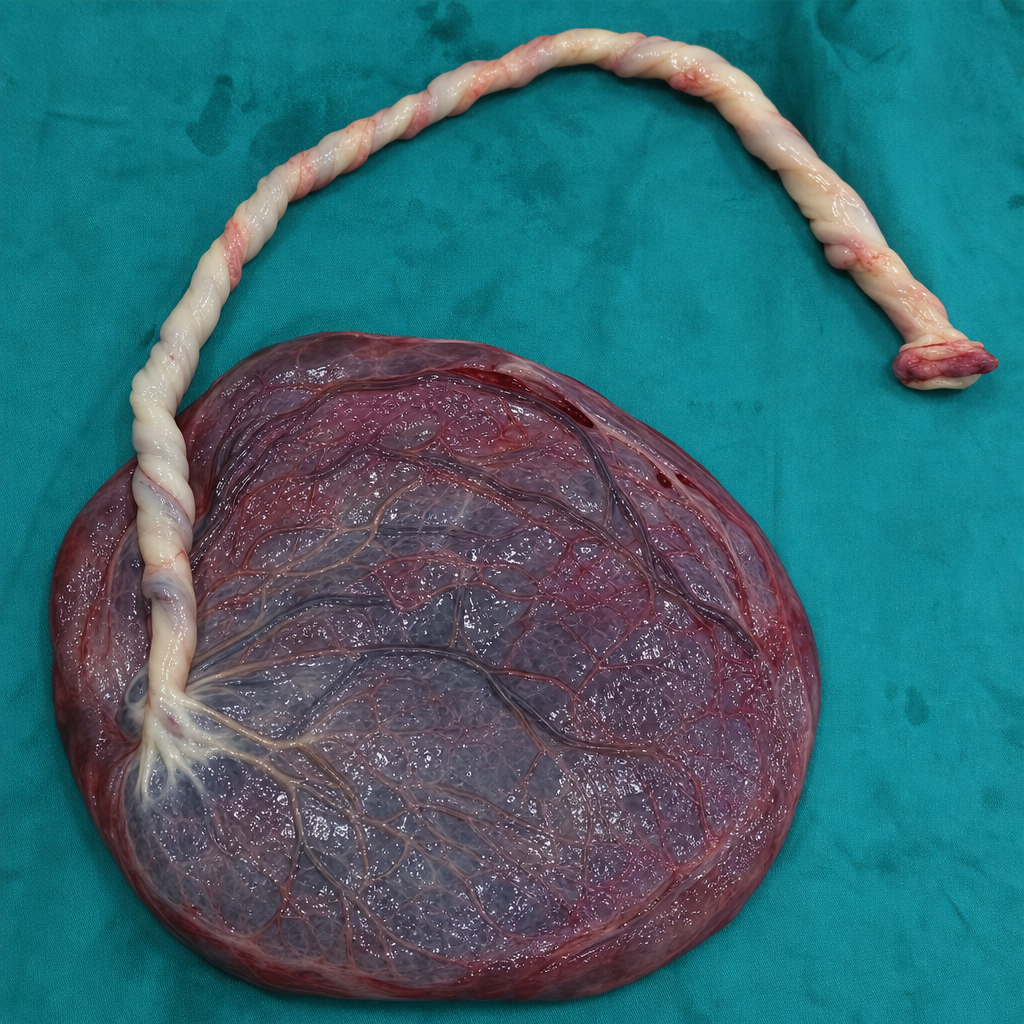
Nitabuch's layer is absent in which of the following conditions?
Which medication should be avoided in diarrhea during pregnancy?
What is the most common cause of Intrauterine Growth Restriction (IUGR)?
A healthy, 44-year-old woman, gravida 2, para 1, has a screening ultrasound at 18 weeks' gestation that shows no fetal anomalies. At 32 weeks' gestation, she experiences decreased fetal movement, and ultrasound reveals fetal growth restriction with relative sparing of the fetal head. The placenta appears normally positioned in the lateral fundus but seems small, and the amniotic fluid index is reduced. Maternal blood pressure is normal. Which of the following conditions is most likely present?
Which of the following infections is NOT transmitted congenitally?
USG examination of a 28-week pregnant primigravida shows vasa previa. All of the following are true regarding this condition, EXCEPT:
A 22-week pregnant patient, gravida 3 with a history of a second-trimester abortion, presents with abdominal pain. Ultrasound reveals internal os tunneling and a cervical length of 21 mm. What is the ideal management?
All of the following statements about prenatal steroids are true EXCEPT?
What is considered a normal Biophysical Profile (Manning Score)?
What is the normal beat-to-beat variability in a Non-Stress Test (NST) on a term fetus?
Explanation: **Explanation:** **Nitabuch’s layer** is a fibrinoid layer located between the **decidua basalis** and the **chorionic villi** (specifically the syncytiotrophoblast). Its primary physiological role is to prevent the over-invasion of trophoblastic tissue into the myometrium. **1. Why Placenta Accreta is correct:** In **Placenta Accreta**, there is a partial or complete absence of the **decidua basalis**. Because Nitabuch’s layer is a derivative of the decidua, its absence leads to the direct attachment of chorionic villi to the underlying myometrium. This lack of a cleavage plane results in a placenta that is morbidly adherent and fails to separate after delivery, often leading to life-threatening postpartum hemorrhage (PPH). **2. Why other options are incorrect:** * **Placenta Previa:** This refers to the abnormal *location* of the placenta (implanted in the lower uterine segment). While previa is a major risk factor for accreta, the layer itself is present unless co-existing with an adherence defect. * **Placenta Membranacea:** A rare condition where the entire fetal sac is covered by functional villi (placenta diffusa). The placenta is thin but the decidual layers are generally intact. * **Circumvallate Placenta:** A morphological variation where the chorionic plate is smaller than the basal plate, causing the membranes to double back. It involves the peripheral anatomy, not the absence of the fibrinoid layer. **High-Yield Clinical Pearls for NEET-PG:** * **Rohr’s Stria:** A similar fibrinoid layer found more superficially, at the bottom of the intervillous space and surrounding the attachment of anchoring villi. * **Risk Factors for Accreta:** Previous Cesarean section (most common) and Placenta Previa. * **Management:** The gold standard for morbidly adherent placenta (Accreta, Increta, Percreta) is often a planned **Cesarean Hysterectomy**.
Explanation: **Explanation:** The management of diarrhea in pregnancy focuses on maintaining hydration while avoiding substances that can induce uterine activity or harm the fetus. **Why Stimulant Purgatives are avoided:** Stimulant purgatives (e.g., Castor oil, Senna, Bisacodyl) work by irritating the intestinal mucosa to increase peristalsis. In pregnancy, these are strictly contraindicated because the increased intestinal motility and pelvic congestion can lead to **reflex uterine contractions**, potentially causing preterm labor or miscarriage. Specifically, Castor oil is known to stimulate prostaglandin receptors in the uterus, making it dangerous. **Analysis of other options:** * **Oral Rehydration Therapy (ORT):** This is the **first-line management** for diarrhea in pregnancy. It safely replaces lost fluids and electrolytes without any risk to the mother or fetus. * **Loperamide:** Classified as FDA Category C, it is generally considered the safest antimotility agent if pharmacological intervention is absolutely necessary, though it is usually reserved for refractory cases. * **Diphenoxylate-atropine (Lomotil):** While generally avoided in the first trimester due to potential teratogenicity (Category C), it is not as acutely contraindicated as stimulant purgatives, which pose a direct mechanical risk of inducing labor. **Clinical Pearls for NEET-PG:** * **First-line treatment:** Hydration (ORT) and dietary modifications (BRAT diet). * **Castor Oil:** Historically used to "induce labor," it is now avoided due to the risk of unpredictable, violent contractions and fetal distress. * **Drug of choice for Constipation in pregnancy:** Bulk-forming laxatives (e.g., Isabgol/Psyllium) or osmotic laxatives (e.g., Lactulose) are preferred over stimulants.
Explanation: **Explanation:** The correct answer is **None of the above** because the most common cause of Intrauterine Growth Restriction (IUGR) is **Maternal Factors**, specifically **Maternal Vascular Disease** (such as Preeclampsia and Chronic Hypertension). 1. **Why "None of the above" is correct:** While IUGR is multifactorial, maternal conditions that lead to decreased uteroplacental blood flow are the leading contributors. Among these, **Maternal Hypertension/Preeclampsia** is the single most common identifiable cause. Since "Maternal Factors" or "Hypertension" is not listed among the options, "None of the above" is the most accurate choice. 2. **Analysis of Incorrect Options:** * **Idiopathic:** While many cases of IUGR remain unexplained, it is not the "most common" category when compared to the broad spectrum of maternal vascular causes. * **Intrauterine Infection:** Infections (most commonly **CMV** under the TORCH umbrella) account for only about 5–10% of IUGR cases. These typically result in "Symmetric IUGR." * **Placental Insufficiency:** While placental insufficiency is the *pathophysiological mechanism* behind growth restriction, it is usually a secondary result of maternal vascular diseases rather than the primary cause itself. **Clinical Pearls for NEET-PG:** * **Symmetric IUGR (Type I):** Occurs early in pregnancy; caused by intrinsic factors like genetic anomalies or infections. Ponderal index is normal. * **Asymmetric IUGR (Type II):** Most common type (70–80%); occurs in the third trimester due to maternal factors (Hypertension). Characterized by "Brain Sparing" (Head circumference > Abdominal circumference). * **Gold Standard for Diagnosis:** Serial Ultrasonography (specifically Abdominal Circumference is the most sensitive parameter). * **Best Predictor of Perinatal Outcome:** Umbilical Artery Doppler (look for Absent or Reversed End-Diastolic Velocity).
Explanation: **Explanation:** The clinical presentation describes **asymmetric Fetal Growth Restriction (FGR)**, characterized by "head sparing" (the brain is prioritized over the body) and oligohydramnios (reduced amniotic fluid). **1. Why Uteroplacental Insufficiency is Correct:** In this patient, the advanced maternal age (44 years) is a significant risk factor for placental dysfunction. Asymmetric FGR typically occurs in the third trimester due to extrinsic factors that limit nutrient and oxygen delivery. The fetus compensates by redistributing cardiac output to the brain, heart, and adrenals at the expense of the liver and kidneys. Reduced renal perfusion leads to decreased fetal urine production, resulting in **oligohydramnios**. The small placenta further supports the diagnosis of primary placental failure. **2. Why Incorrect Options are Wrong:** * **Congenital Treponema pallidum (Syphilis):** Infections (TORCH) usually cause **symmetric FGR** (global growth lag) and are often associated with a *large, thick* placenta and polyhydramnios, rather than a small placenta and oligohydramnios. * **Galactosemia:** This is a metabolic disorder that typically manifests in the neonatal period after the introduction of milk. It does not cause FGR or placental insufficiency in utero. * **Preeclampsia:** While preeclampsia is a leading cause of uteroplacental insufficiency, the question explicitly states the maternal blood pressure is **normal**. Therefore, the underlying pathology is isolated uteroplacental insufficiency. **Clinical Pearls for NEET-PG:** * **Symmetric FGR:** Occurs early (1st/2nd trimester); caused by chromosomal anomalies or early infections. * **Asymmetric FGR:** Occurs late (3rd trimester); caused by maternal hypertension, smoking, or placental issues. * **Ponderal Index:** Low in asymmetric FGR; normal in symmetric FGR. * **Doppler:** Umbilical artery Doppler is the most important tool for monitoring FGR; "Absent or Reversed End Diastolic Flow" (AREDF) indicates severe compromise.
Explanation: **Explanation:** The core concept tested here is the distinction between **congenital (transplacental)** transmission and **perinatal (vertical)** transmission. **Why Candida is the correct answer:** *Candida albicans* is not transmitted congenitally (across the placenta). Instead, it is typically acquired during birth as the neonate passes through an infected birth canal (**perinatal transmission**) or postnatally. While *Candida* can cause "Congenital Cutaneous Candidiasis" if there is ascending infection following premature rupture of membranes, it does not cross the placental barrier to cause systemic fetal infection in an intact pregnancy. **Why the other options are incorrect:** * **Rubella Virus (Option D):** The classic "T" in TORCH. It is highly teratogenic and crosses the placenta, especially in the first trimester, leading to Congenital Rubella Syndrome (CRS). * **HIV (Option B):** Can be transmitted at three stages: in-utero (transplacental), during delivery (intrapartum), and via breastfeeding (postpartum). In-utero transmission accounts for approximately 25-30% of vertical transmission in untreated cases. * **HSV (Option A):** While 90% of neonatal herpes is acquired during delivery (contact with lesions), HSV is capable of transplacental transmission (rarely), leading to a specific triad of skin vesicles, eye damage, and microcephaly/hydranencephaly. **NEET-PG High-Yield Pearls:** * **TORCH Infections:** Toxoplasmosis, Others (Syphilis, Varicella, Parvovirus B19), Rubella, CMV, and HSV are the primary agents of congenital infection. * **Most common congenital infection:** Cytomegalovirus (CMV). * **Most teratogenic:** Rubella (highest risk in the first 8 weeks). * **HIV Prevention:** The risk of transmission can be reduced to <1% with HAART, elective C-section (if viral load >1000 copies), and avoidance of breastfeeding.
Explanation: **Explanation:** **Vasa Previa** is a high-stakes obstetric emergency where fetal vessels (unprotected by Wharton’s jelly) run through the membranes across the internal os. **Why Option B is the Correct Answer (The Exception):** The statement in Option B underestimates the severity of the condition. In **undiagnosed cases** of vasa previa, the fetal mortality rate is significantly higher, ranging from **50% to 95%**. This occurs because when membranes rupture (ARM or SRM), the fetal vessels tear, leading to rapid fetal exsanguination. Since the total fetal blood volume is small (approx. 80-100 ml/kg), even a small amount of bleeding is catastrophic. **Analysis of Other Options:** * **Option A:** The incidence is approximately **1:1500 to 1:2500** pregnancies, making it a rare but critical diagnosis. * **Option C:** Vasa previa is strongly associated with placental abnormalities such as **low-lying placenta**, **succenturiate lobes** (vessels connecting the lobes), and **velamentous insertion of the cord**. * **Option D:** **Elective Cesarean section** (usually at 34–36 weeks) is the definitive management to avoid labor and membrane rupture, which would otherwise lead to fetal death. **High-Yield Clinical Pearls for NEET-PG:** * **Classic Triad:** Rupture of membranes + Painless vaginal bleeding + Fetal distress/bradycardia. * **Diagnostic Test:** Antenatal **Color Doppler USG** is the gold standard. * **Apt’s Test/Ogita Test:** Used to differentiate fetal hemoglobin from maternal blood in vaginal bleeding. * **Management:** If diagnosed antenatally, the survival rate exceeds 95%. If diagnosed intrapartum, immediate CS is mandatory.
Explanation: ### Explanation The patient presents with signs of **Cervical Insufficiency** (also known as cervical incompetence), characterized by painless cervical shortening and "tunneling" or "funneling" of the internal os. Given her history of a second-trimester abortion and the current ultrasound findings at 22 weeks, surgical intervention is indicated to prevent preterm birth. **Why McDonald’s Suture is Correct:** The **McDonald’s suture** is a type of cervical cerclage performed transvaginally. It involves a purse-string suture placed at the cervicovaginal junction to reinforce the cervix. In this case, it is considered an **"Ultrasound-indicated" or "Rescue" cerclage** because the cervical length is <25 mm before 24 weeks of gestation in a patient with a suggestive history. It is the standard treatment for cervical insufficiency to provide mechanical support to the internal os. **Analysis of Incorrect Options:** * **A & B (Dinoprost and Misoprost):** These are prostaglandins used to *induce* labor or abortion by causing cervical ripening and uterine contractions. They are contraindicated here as the goal is to maintain the pregnancy. * **C (Fothergill’s Suture):** This is part of the Manchester operation used for treating **pelvic organ prolapse** (uterine descent) in women who wish to preserve their uterus. It is not used for cervical insufficiency in pregnancy. **Clinical Pearls for NEET-PG:** * **Timing:** Cerclage is ideally performed between **12–14 weeks** (prophylactic) but can be done up to **24 weeks** (rescue). * **Shirodkar Cerclage:** An alternative technique where the suture is placed higher (submucosal), requiring bladder reflection. * **Contraindications to Cerclage:** Chorioamnionitis, active bleeding, ruptured membranes, or fetal anomalies incompatible with life. * **Removal:** The suture is typically removed at **36–37 weeks** or at the onset of labor to allow for vaginal delivery.
Explanation: **Explanation:** Antenatal corticosteroids (ACS) are a cornerstone of management in preterm labor, significantly improving neonatal outcomes. **Why Option D is the Correct Answer (The Exception):** Clinical chorioamnionitis is a **contraindication** to the administration of prenatal steroids. Chorioamnionitis is an intrauterine infection that necessitates immediate delivery regardless of gestational age. Delaying delivery to complete a 48-hour course of steroids in the presence of active infection increases the risk of maternal and neonatal sepsis. Therefore, steroids are withheld, and the focus shifts to prompt delivery and antibiotic therapy. **Analysis of Other Options:** * **Option A:** ACS are highly effective, reducing the incidence of Respiratory Distress Syndrome (RDS), Intraventricular Hemorrhage (IVH), and Necrotizing Enterocolitis (NEC) by approximately 50%. * **Option B:** The standard window for administration is **24 to 34 weeks** of gestation. (Note: Recent guidelines also consider "Late Preterm" steroids up to 36 weeks 6 days in specific scenarios). * **Option C:** Diabetes and hypertension are **not** contraindications. While steroids can cause transient hyperglycemia (requiring insulin adjustment in diabetics), the neonatal benefits outweigh the risks. **High-Yield Clinical Pearls for NEET-PG:** * **Standard Regimen:** Betamethasone (12 mg IM, 2 doses, 24 hours apart) or Dexamethasone (6 mg IM, 4 doses, 12 hours apart). * **Peak Effect:** Benefits are maximal if delivery occurs **24 hours to 7 days** after the first dose. * **Mechanism:** Steroids induce **Type II pneumocytes** to produce surfactant, increasing lung compliance.
Explanation: The **Biophysical Profile (BPP)**, or Manning’s Score, is a critical antepartum fetal surveillance tool used to assess fetal well-being and identify potential hypoxia. It evaluates five parameters: four via ultrasound (Fetal Breathing, Movements, Tone, and Amniotic Fluid Volume) and one via Non-Stress Test (NST). Each parameter is scored as either 2 (present/normal) or 0 (absent/abnormal). ### **Explanation of Options** * **A (8-10): Correct.** A score of 8 or 10 is considered **normal** and reassuring. It indicates a low risk of chronic or acute fetal asphyxia. If the score is 8/10 due to a non-reactive NST but with normal liquor, it is still considered normal. * **B (6): Equivocal.** A score of 6 is considered "equivocal" or suspicious. It suggests possible fetal hypoxia and usually warrants a repeat test within 24 hours or delivery if the fetus is at term. * **C & D (0-4): Abnormal.** These scores are highly suggestive of fetal distress and significant acidemia. A score of 4 requires urgent evaluation and likely delivery; a score of 0-2 is a fetal emergency requiring immediate delivery. ### **NEET-PG High-Yield Pearls** 1. **Modified BPP:** Consists of only two components: **NST** (indicator of acute acid-base status) and **Amniotic Fluid Index** (indicator of long-term placental function). 2. **Sequence of Loss:** In progressive fetal hypoxia, the first sign to disappear is **Fetal Heart Rate reactivity (NST)**, followed by fetal breathing. **Fetal Tone** is the last to disappear and indicates severe distress. 3. **Amniotic Fluid:** This is the only parameter that reflects **chronic** placental insufficiency (due to decreased fetal renal perfusion). 4. **Mnemonic for BPP:** "BATMAN" – **B**reathing, **A**mniotic fluid, **T**one, **M**ovement, **A**nd **N**ST.
Explanation: **Explanation:** **Baseline Fetal Heart Rate (FHR) Variability** is defined as the fluctuations in the baseline FHR that are irregular in amplitude and frequency. It is the single most important indicator of an intact fetal central nervous system and adequate fetal oxygenation. 1. **Why Option A is Correct:** According to standard obstetric guidelines (ACOG/NICE), **Moderate Variability** is defined as an amplitude range of **6 to 25 beats per minute (bpm)**. In the context of a term fetus, a range of **10–25 bpm** falls squarely within this "Moderate" category, representing a healthy, well-oxygenated fetus with a functional autonomic nervous system. 2. **Why Other Options are Incorrect:** * **Option B (5–10 bpm):** While this is technically within the moderate range (6–25), it is at the lower end. In many classifications, variability $\leq$ 5 bpm is considered "Minimal," which can occur during fetal sleep cycles, maternal sedation, or early hypoxia. * **Option C (>25 bpm):** This is termed **Marked Variability**. It is often seen during acute fetal gasping or umbilical cord compression and is not considered the "normal" baseline. * **Option D:** This is incorrect because variability refers to the *oscillation* around the baseline, not just the baseline value itself. A flat line at 140 bpm (absent variability) is highly pathological despite being above 110 bpm. **High-Yield Clinical Pearls for NEET-PG:** * **Absent Variability:** Amplitude range undetectable (Sign of severe fetal acidemia). * **Minimal Variability:** Amplitude $\leq$ 5 bpm (Fetal sleep, drugs like magnesium sulfate/opioids, or hypoxia). * **Reactive NST:** Requires at least 2 accelerations (15 bpm above baseline lasting 15 seconds) in a 20-minute window with moderate variability. * **Sinusoidal Pattern:** A smooth, sine-wave-like pattern (amplitude 5–15 bpm) indicating severe fetal anemia (e.g., Rh isoimmunization) or acute hemorrhage.
Fetal Assessment Techniques
Practice Questions
Hypertensive Disorders in Pregnancy
Practice Questions
Intrauterine Growth Restriction
Practice Questions
Multiple Gestation
Practice Questions
Rh Isoimmunization and Other Blood Group Incompatibilities
Practice Questions
Intrauterine Fetal Therapy
Practice Questions
Prenatal Diagnosis and Genetic Counseling
Practice Questions
Placental Abnormalities
Practice Questions
Preterm Labor and Delivery
Practice Questions
Management of Medical Disorders in Pregnancy
Practice Questions
Get full access to all questions, explanations, and performance tracking.
Start For Free