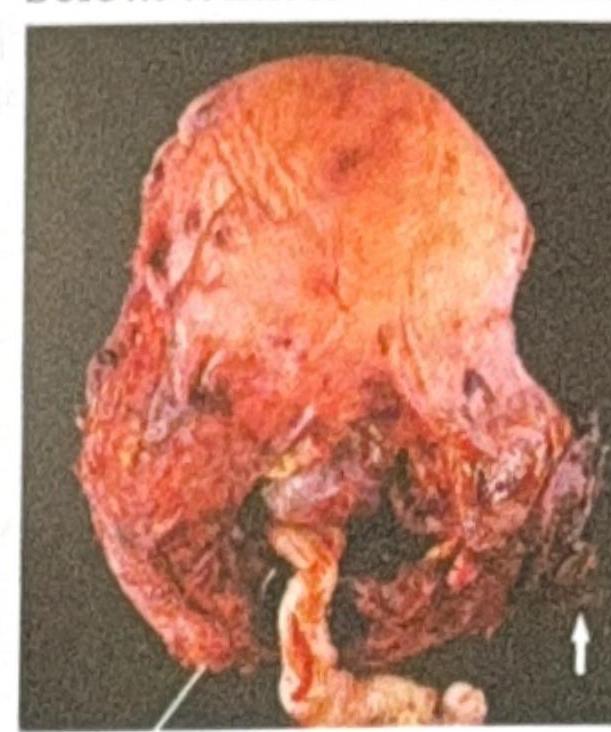
A 32 years old woman with two live children was brought to emergency with history of missed period for 15 days, spotting since 7 days and pain abdomen since 6 hours. Her pulse was 120 per minute, pallor + +, systolic B.P. 80 mm Hg. There was fullness and tenderness on per abdomen examination. Copper T thread was seen through external os on per speculum examination. On p/ v examination, cervical movements were tender, uterus was anteverted, bulky and soft. There was fullness in pouch of Douglas. Most likely, she is suffering from:
Consider the following: 1. Fetal pulmonary hypoplasia 2. Fetal chromosomal anomalies 3. Prostaglandin synthetase inhibitors 4. Amniotic fluid index of 15 cm Which of the above are associated with oligohydramnios?
HELLP syndrome includes the following except:
Which of the following is the most common cause of abortion during first trimester?
A 23 year old presents with recurrent abortions at 16 weeks gestation. She should be investigated for:
Which one of the following conditions is not associated with oligohydramnios during pregnancy?
Which of the following is the type of antepartum haemorrhage where blood loss is foetal?
Polyhydramnios is not caused by which one of the following?
Regarding hypertensive disorders of pregnancy, the following are true except:
Which of the following is not a potentially teratogenic infection if contracted in pregnancy?
Explanation: ***Ruptured ectopic pregnancy*** - The patient presents with **classic signs of ruptured ectopic pregnancy**: missed period, vaginal spotting, acute abdominal pain, **hypovolemic shock** (tachycardia, hypotension, pallor), and signs of internal bleeding (abdominal fullness, tenderness, cervical motion tenderness, fullness in the pouch of Douglas). - The presence of a **Copper T IUD** further increases the risk of ectopic pregnancy if conception occurs, as IUDs are highly effective at preventing intrauterine pregnancies but less so at preventing ectopic ones. *Pelvic inflammatory disease* - While PID can cause abdominal pain and cervical motion tenderness, it is usually associated with **fever, purulent vaginal discharge**, and a history of sexually transmitted infections, which are not mentioned here. - The **acute hemodynamic instability** (shock) and history of missed period are not typical features of uncomplicated PID. *Missed abortion with infection* - A missed abortion involves a non-viable pregnancy with a closed cervix, and while infection can occur, it typically presents with **fever, foul-smelling discharge**, and abdominal pain that is less acute and severe than seen in this case. - The profound shock and localized fullness in the pouch of Douglas are more indicative of **hemoperitoneum** from a ruptured ectopic pregnancy rather than an infected missed abortion. *Threatened abortion* - Threatened abortion is characterized by vaginal bleeding with a **closed cervix** and a **viable intrauterine pregnancy**, usually without severe pain or signs of shock. - The patient's **hemodynamic instability**, severe abdominal pain, and findings suggestive of internal bleeding rule out a simple threatened abortion.
Explanation: ***1, 2 and 3*** - **Fetal pulmonary hypoplasia** is associated with oligohydramnios as a significant **complication** of severe and prolonged oligohydramnios. Reduced amniotic fluid impairs normal fetal breathing movements and lung expansion, leading to pulmonary hypoplasia. This is a consequence rather than a cause, but represents an important clinical association. - **Fetal chromosomal anomalies** (such as Turner syndrome, Trisomy 18) can lead to structural renal abnormalities including renal agenesis, multicystic dysplastic kidney, or obstructive uropathy. These conditions result in decreased or absent fetal urine production, which is the primary source of amniotic fluid in the second half of pregnancy, thereby **causing oligohydramnios**. - **Prostaglandin synthetase inhibitors** (e.g., indomethacin, other NSAIDs) decrease fetal renal blood flow and glomerular filtration rate, leading to reduced fetal urine output. This effect is particularly significant when used in the third trimester, and can **cause oligohydramnios**. *2, 3 and 4* - While fetal chromosomal anomalies and prostaglandin synthetase inhibitors are correctly associated with oligohydramnios as causative factors, **Amniotic fluid index (AFI) of 15 cm** represents a **normal value**. Normal AFI ranges from 8-18 cm (or 5-25 cm by some references), and oligohydramnios is defined as AFI <5 cm. Therefore, AFI of 15 cm is not associated with oligohydramnios. - This option is incorrect because it excludes fetal pulmonary hypoplasia, which has a well-established association with oligohydramnios. *1, 2 and 4* - This option incorrectly includes **AFI of 15 cm**, which is within normal range and not associated with oligohydramnios. - While fetal pulmonary hypoplasia and fetal chromosomal anomalies are correctly associated with oligohydramnios, the inclusion of a normal AFI value makes this option incorrect. *1, 3 and 4* - This option incorrectly includes **AFI of 15 cm**, which is a normal finding that indicates adequate amniotic fluid volume, not oligohydramnios. - Although fetal pulmonary hypoplasia and prostaglandin synthetase inhibitors are associated with oligohydramnios, the inclusion of normal AFI makes this option incorrect.
Explanation: ***Leucocytosis*** - HELLP syndrome is characterized by **hemolysis**, **elevated liver enzymes**, and **low platelet count**. Leucocytosis (an elevated white blood cell count) is **not a defining feature** of HELLP syndrome. - While leucocytosis can occur in conditions associated with inflammation or stress, it is **not a diagnostic criterion** for HELLP syndrome and doesn't represent one of its core components. *Low platelet count* - **Thrombocytopenia** (platelet count below 100,000/microL) is a critical component of HELLP syndrome, representing the "LP" in the acronym. - It results from increased platelet consumption and destruction due to widespread endothelial dysfunction. *Hemolysis* - **Hemolysis** (breakdown of red blood cells) is the "H" in the HELLP acronym. - It is evidenced by findings such as **schistocytes** on peripheral blood smear, elevated **lactate dehydrogenase (LDH)**, and unconjugated **hyperbilirubinemia**. *Elevated liver enzymes* - **Elevated liver enzymes** (e.g., aspartate aminotransferase (AST) and alanine aminotransferase (ALT) being at least twice the upper limit of normal) are the "EL" in HELLP. - This elevation indicates **hepatic dysfunction** and hepatocellular damage, often associated with periportal hemorrhage and fibrin deposition.
Explanation: ***Chromosomal anomalies of foetus*** - **Chromosomal anomalies** are the leading cause of **sporadic first-trimester abortions**, accounting for up to 50-70% of cases. - These anomalies, such as **aneuploidy (e.g., trisomy 16, monosomy X)**, often lead to developmental abnormalities incompatible with life. *Antiphospholipid antibody syndrome* - While a significant cause of **recurrent pregnancy loss**, particularly in the second and third trimesters, it is less common than chromosomal anomalies for **sporadic first-trimester abortions**. - It causes abortions through **thrombotic events** in the placental vasculature. *Progesterone deficiency* - **Inadequate progesterone levels** can contribute to early pregnancy loss by compromising endometrial support for the embryo. - However, it is a less frequent cause of first-trimester abortion compared to **chromosomal abnormalities**. *Cervical incompetence* - **Cervical incompetence** primarily causes **second-trimester losses** due to the inability of the cervix to retain the pregnancy under increasing pressure. - It is not a common cause of first-trimester abortion, which is typically due to issues with the early embryo or implantation.
Explanation: ***Incompetent cervix*** - Recurrent abortions, particularly in the **second trimester** (around 16 weeks gestation), are highly suggestive of an incompetent cervix. - An incompetent cervix dilates painlessly and prematurely without contractions, leading to **fetal loss**. *TORCH infection* - TORCH infections (Toxoplasmosis, Other [syphilis, varicella-zoster, parvovirus B19], Rubella, Cytomegalovirus, and Herpes) typically cause **fetal anomalies** or **early pregnancy loss**, or affect the neonate. - While they can cause miscarriage, recurrent losses at 16 weeks without other symptoms are less characteristic of isolated TORCH infections. *Hepatitis B infection* - **Hepatitis B infection** can be transmitted to the fetus, but it is not a direct cause of recurrent second-trimester abortions. - The primary concern with Hepatitis B in pregnancy is **vertical transmission** to the neonate. *Balanced paternal translocation* - A **balanced translocation** in either parent can lead to recurrent miscarriages, but these typically occur earlier in pregnancy due to genetically unbalanced conceptions. - While possible, the specific timing of 16 weeks recurrent loss points more strongly towards an anatomical issue like an incompetent cervix.
Explanation: ***Oesophageal atresia*** - **Oesophageal atresia** hinders the fetus from swallowing amniotic fluid, leading to an *increase* in amniotic fluid, a condition known as **polyhydramnios**, not oligohydramnios. - The inability of the fetus to properly absorb and excrete amniotic fluid through the gastrointestinal tract is the primary mechanism. *Post term pregnancy* - In **post-term pregnancies** (beyond 40 weeks), placental function can decline, reducing blood flow to the kidneys which can decrease fetal urine production. - Decreased fetal urine output is a major contributor to **oligohydramnios**. *Ruptured membrane* - A **ruptured membrane** (premature rupture of membranes) directly allows amniotic fluid to leak out of the uterus. - This leakage results in a reduction of the total amniotic fluid volume, causing **oligohydramnios**. *Intrauterine growth restriction* - In **intrauterine growth restriction (IUGR)**, the fetus experiences chronic stress and reduced perfusion due to placental insufficiency. - This often leads to **redistribution of fetal blood flow** away from non-essential organs like kidneys, decreasing urine production and contributing to oligohydramnios.
Explanation: ***Vasa previa*** - In **vasa previa**, foetal blood vessels traverse the foetal membranes unprotected across the cervical os, making them vulnerable to rupture during labor or membrane rupture, leading to **foetal blood loss**. - This condition is often suspected when **foetal bradycardia** or sinusoidal heart rate patterns appear following membrane rupture, especially if accompanied by vaginal bleeding. *Circumvallate placenta* - This refers to a placental anomaly where the chorionic plate is smaller than the basal plate, causing the membranes to fold back and create an elevated ring around the umbilical cord insertion. - While it can be associated with higher rates of **antepartum hemorrhage**, preterm labor, or foetal growth restriction, the blood loss is typically maternal in origin, from marginal placental separation. *Placenta previa* - **Placenta previa** occurs when the placenta partially or completely covers the cervical os, leading to painless vaginal bleeding in the second or third trimester. - The hemorrhage in placenta previa is **maternal blood loss** due to the separation of the maternal decidua from the placental villi. *Abruptio placenta* - **Abruptio placenta** involves the premature separation of a normally implanted placenta from the uterine wall. - The bleeding in abruptio placenta is predominantly **maternal blood**, often accumulating between the placenta and uterine wall, and is typically associated with abdominal pain and uterine tenderness.
Explanation: ***Single kidney*** - A single kidney or other renal agenesis conditions typically lead to **oligohydramnios**, not polyhydramnios, because fetal urine production is reduced or absent. - The fetal urinary system is crucial for maintaining amniotic fluid volume, and its malfunction results in decreased fluid. *Spina bifida* - **Neural tube defects** such as spina bifida can contribute to polyhydramnios by affecting fetal swallowing mechanisms or increasing fluid secretion from exposed meninges. - While not the most common cause, severe forms can impair neural control over fetal fluid regulation. *Oesophageal atresia* - This condition prevents the fetus from **swallowing amniotic fluid**, leading to its accumulation in the amniotic sac. - Fetal swallowing is a primary mechanism for amniotic fluid reabsorption, and its mechanical obstruction results in polyhydramnios. *Anencephaly* - **Anencephaly** is a severe **neural tube defect** where the brain and skull fail to develop, often leading to impaired fetal swallowing and excessive urination. - The exposed meninges can also leak cerebrospinal fluid into the amniotic sac, further contributing to polyhydramnios.
Explanation: ***Urinary dipstick result of +1 is equivalent to urinary protein concentration of 300 mg/dl*** - A protein dipstick result of **+1** is typically considered to represent a protein concentration of **30 mg/dL**, not 300 mg/dL. - A protein concentration of **300 mg/dL** on a dipstick usually corresponds to a result of **+3** or higher. *Significant proteinuria is more than/equal to 0.3 g/24hr* - This statement is **true** according to major guidelines (e.g., ACOG) for the diagnosis of **preeclampsia**. - A 24-hour urine collection yielding **300 mg (0.3 g)** or more of protein is the gold standard for defining significant proteinuria. *Eclampsia may present in the absence of hypertension* - This statement is **true**; while eclampsia typically involves hypertension, seizures can occur with **mild hypertension** or even in its **absence**, especially in women with underlying neurological conditions or atypical presentations. - This highlights the importance of considering eclampsia in pregnant or postpartum women with new-onset seizures, regardless of blood pressure readings. *A protein:creatinine ratio more than 30 mg/mmol is considered significant* - This statement is **true**; a **protein:creatinine ratio (PCR)** of **≥ 30 mg/mmol** (or 0.3 mg/mg) is a reliable and convenient alternative to the 24-hour urine collection for diagnosing significant proteinuria. - This threshold is widely accepted for identifying proteinuria indicative of **preeclampsia** or other renal pathologies.
Explanation: ***Influenza virus*** - While influenza can cause severe illness in pregnant women, it is **not generally considered teratogenic**, meaning it does not typically cause birth defects like the other listed infections. - The primary risks of influenza in pregnancy are severe maternal complications, **preterm birth**, and **low birth weight**, rather than congenital anomalies. *Chicken pox* - Maternal infection with **varicella-zoster virus (chickenpox)** during the first 20 weeks of pregnancy can lead to **Congenital Varicella Syndrome**, characterized by skin scarring, limb hypoplasia, microphthalmia, and neurological deficits. - Infection late in pregnancy can cause **neonatal varicella**, which can be severe and life-threatening for the newborn. *Rubella* - Maternal infection with **rubella (German measles)**, especially during the first trimester, is a well-known cause of **Congenital Rubella Syndrome (CRS)**. - CRS can result in severe birth defects, including **cataracts**, **heart defects** (e.g., patent ductus arteriosus, pulmonary artery stenosis), and **sensorineural hearing loss**. *Cytomegalovirus* - **Congenital cytomegalovirus (CMV)** infection is a leading cause of **non-hereditary sensorineural hearing loss** and neurodevelopmental disabilities. - While many infected infants are asymptomatic at birth, some develop **microcephaly**, periventricular calcifications, hepatosplenomegaly, and **chorioretinitis**.
Fetal Assessment Techniques
Practice Questions
Hypertensive Disorders in Pregnancy
Practice Questions
Intrauterine Growth Restriction
Practice Questions
Multiple Gestation
Practice Questions
Rh Isoimmunization and Other Blood Group Incompatibilities
Practice Questions
Intrauterine Fetal Therapy
Practice Questions
Prenatal Diagnosis and Genetic Counseling
Practice Questions
Placental Abnormalities
Practice Questions
Preterm Labor and Delivery
Practice Questions
Management of Medical Disorders in Pregnancy
Practice Questions
Get full access to all questions, explanations, and performance tracking.
Start For Free