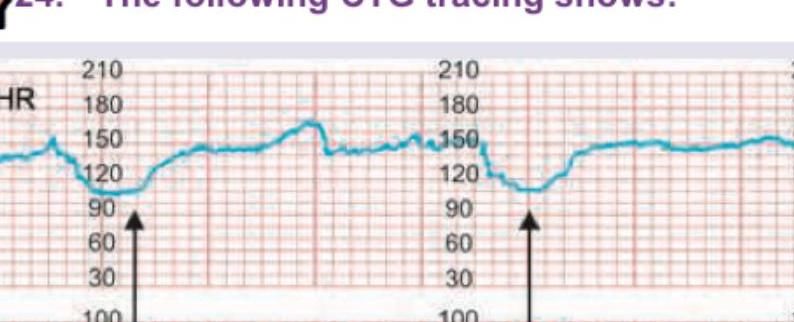
The following CTG tracing shows:

The following CTG shows:
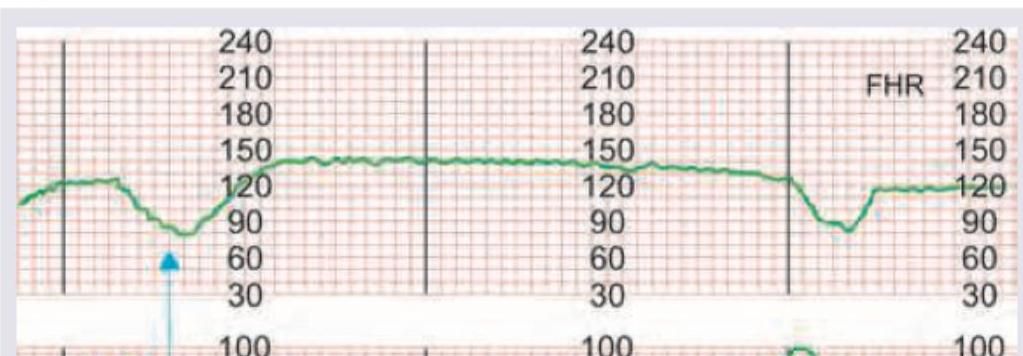
The following CTG indicates:
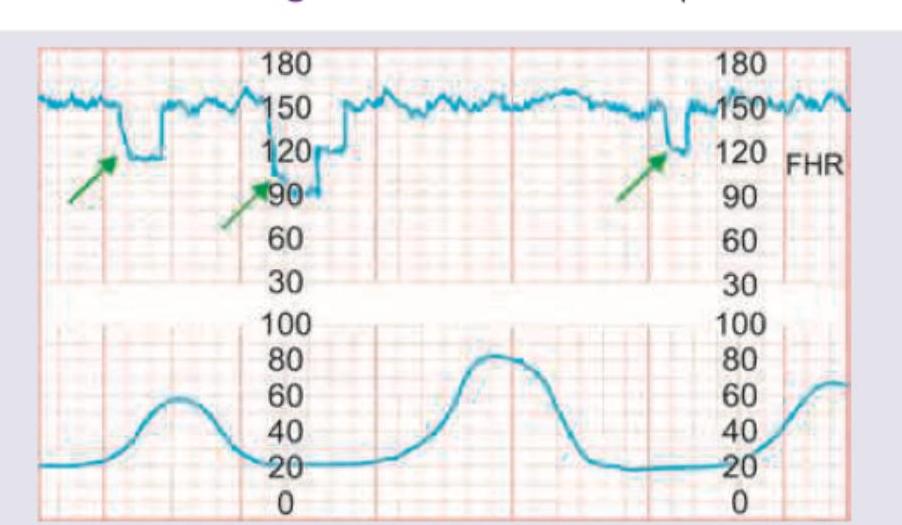
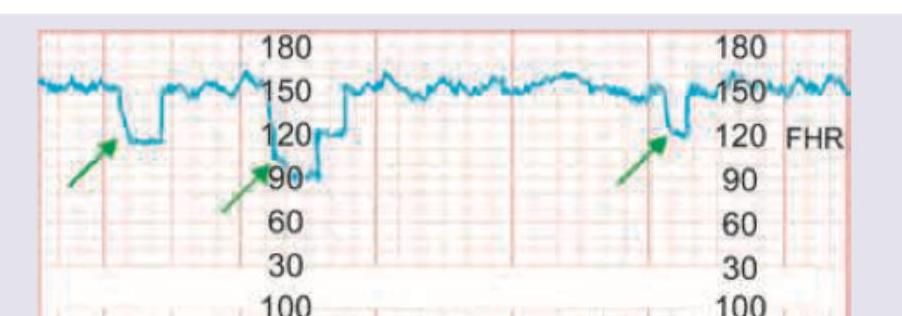
The following CTG indicates:
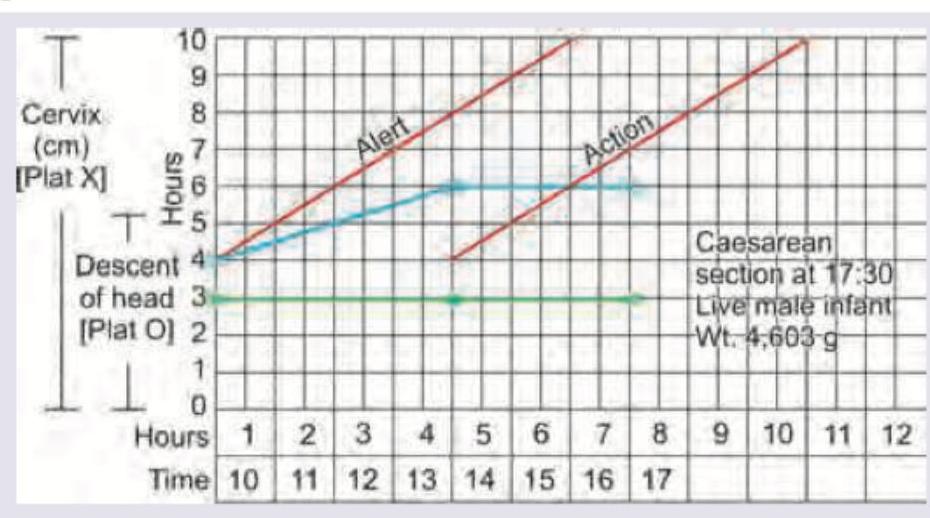
The following partogram shows:
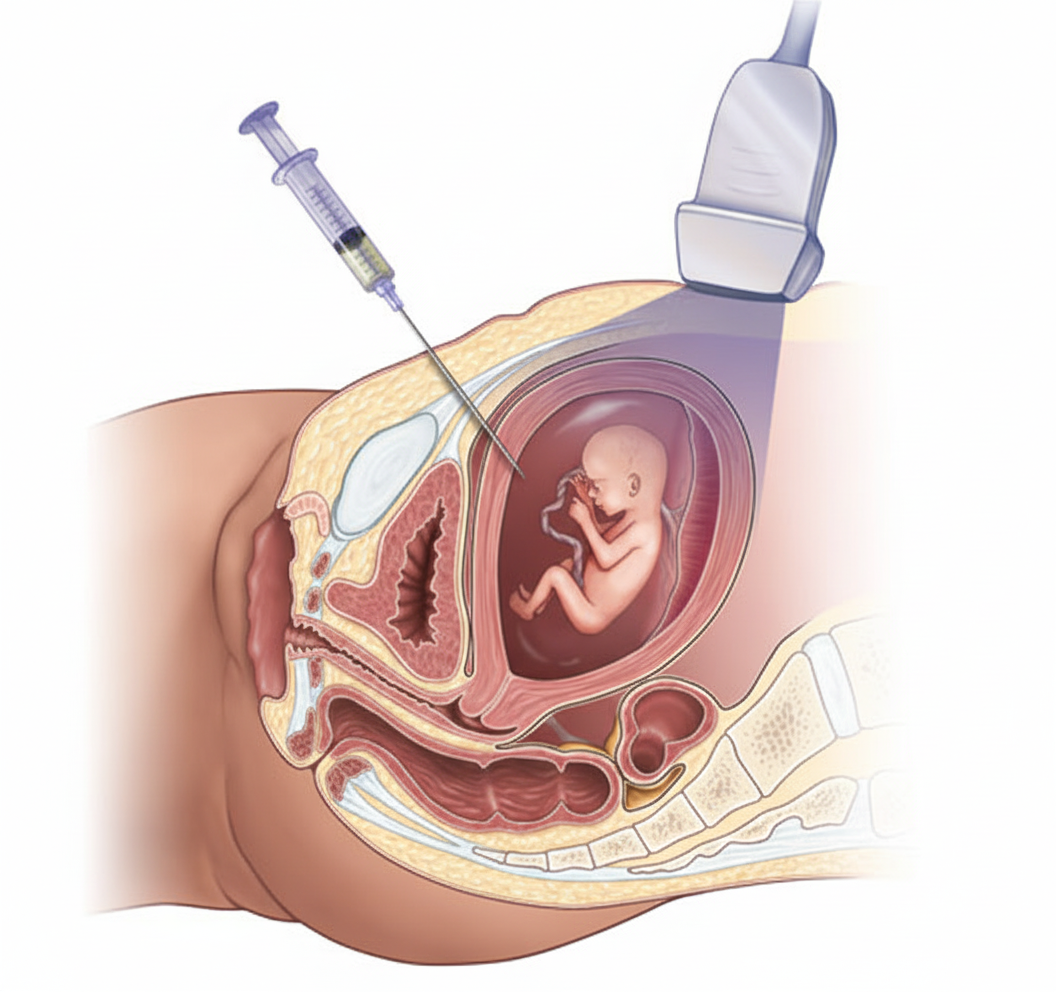
What procedure is being demonstrated in the image?
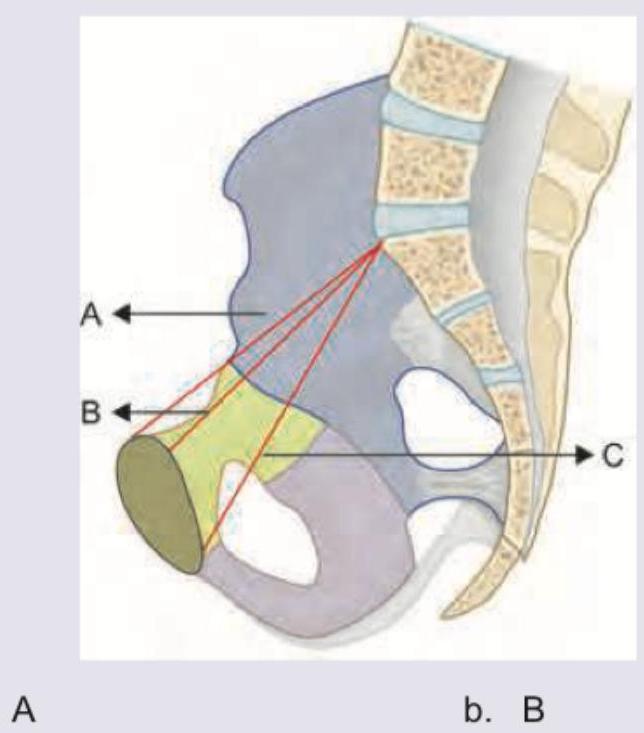
Which of the following is obstetric conjugate? (DNB Pattern 2018)
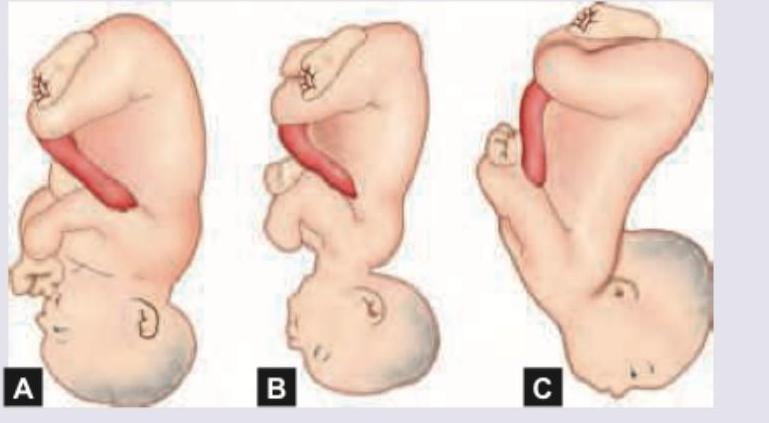
Which of the following combinations is correct? (DNB Pattern 2018)
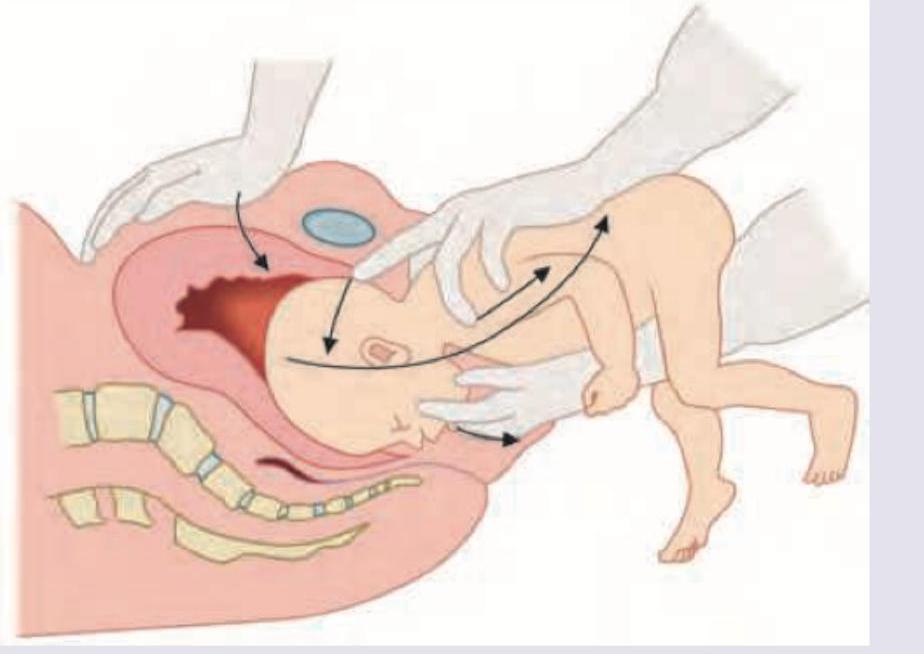
Name the maneuver shown in the image: (DNB Pattern 2018)
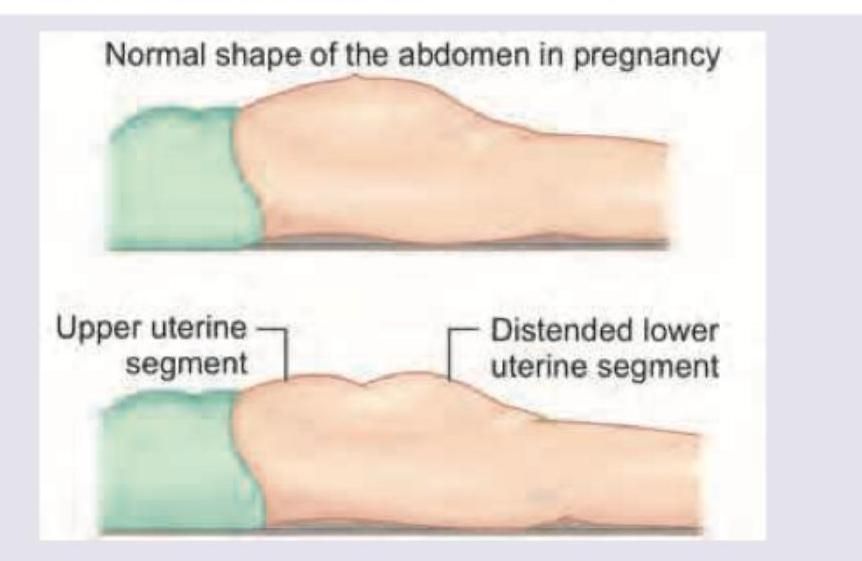
A 25-year-old primigravida has presented in obstructed labour. On examination she is exhausted and has a tender uterus with a groove felt per abdomen as shown in the image. Fetal parts are not felt. What is the diagnosis? (DNB Pattern 2018)
Explanation: ***Late deceleration*** - This tracing shows a **fetal heart rate (FHR) deceleration** that begins **after the onset of the uterine contraction** and recovers after the contraction ends. - This pattern is characteristic of **uteroplacental insufficiency** and indicates fetal hypoxia. *Early deceleration* - **Early decelerations** mirror the contractions, beginning and ending with the uterine contraction, and are typically due to **head compression**. - The FHR decrease in early decelerations starts at or just before the peak of the contraction, unlike the tracing shown. *Sinusoidal pattern* - A **sinusoidal pattern** is a smooth, undulating wave-like FHR with fixed amplitude and frequency, usually associated with severe fetal anemia or hypoxia. - The tracing here shows discrete drops in FHR, not a continuous wave-like pattern. *Variable deceleration* - **Variable decelerations** are characterized by an **abrupt decrease in FHR**, variable in shape, duration, and depth, and are often unrelated to the timing of uterine contractions. - They are typically associated with **umbilical cord compression**, which is not indicated by the uniform and consistent pattern seen here.
Explanation: ***Early deceleration*** - This CTG shows a **deceleration** in fetal heart rate that mirrors the uterine contraction. The drop in FHR begins with the contraction, reaches its lowest point at the peak of the contraction, and recovers by the end of the contraction. - Early decelerations are usually **benign** and are caused by **head compression** during contractions, which leads to a vagal response. *Late deceleration* - **Late decelerations** begin after the peak of the contraction and return to baseline only after the contraction has ended. - They are often associated with **uteroplacental insufficiency** and can indicate fetal hypoxia. *Sinusoidal pattern* - A **sinusoidal pattern** is characterized by a smooth, sine wave-like undulating FHR with a fixed frequency and amplitude, resembling a sine wave. - This pattern is **rare** but ominous, often indicating severe fetal anemia or hypoxia. *Normal tracing* - A **normal tracing** would exhibit a baseline FHR between 110-160 bpm, moderate variability (6-25 bpm), and the presence of accelerations and/or the absence of decelerations. - The presence of repetitive decelerations in the provided CTG indicates it is not a normal tracing.
Explanation: ***Fetal head compression*** - The CTG shows **early decelerations**, characterized by a gradual decrease in fetal heart rate (FHR) that mirrors the contraction onset (as indicated by the green arrows and lower graph). - Early decelerations are typically benign and are caused by **fetal head compression**, which increases intracranial pressure and stimulates the vagus nerve. *Cord compression* - **Variable decelerations** are associated with cord compression and are characterized by an abrupt, jagged decrease in FHR that is variable in timing and shape relative to contractions. - The pattern displayed here is smooth and consistent with contractions, not the abrupt changes seen in variable decelerations. *Normal tracing* - A normal tracing would show a **baseline FHR within the normal range**, moderate variability, and either no decelerations or only occasional, reassuring accelerations. - The repeated decelerations observed here, while benign, indicate a physiological response to contractions and therefore do not represent a completely normal tracing. *Fetal anemia* - Fetal anemia can cause a variety of FHR patterns, including **tachycardia** (due to increased cardiac output) or **sinusoidal heart rate patterns**, which are smooth, undulating FHR tracings. - The decelerations seen in this CTG are not characteristic of fetal anemia.
Explanation: ***Variable deceleration*** - This CTG shows **abrupt, irregular drops in fetal heart rate (FHR)** that do not consistently correspond to uterine contractions. The onset, depth, and duration of the decelerations vary, which is characteristic of variable decelerations. - Variable decelerations are often associated with **umbilical cord compression**, leading to a transient decrease in blood flow to the fetus. *Early deceleration* - Early decelerations are **gradual, symmetrical drops in FHR** that mirror the shape of the uterine contraction, meaning they begin and end with the contraction. - They are typically benign and caused by **fetal head compression** during contractions. *Late deceleration* - Late decelerations are **gradual, symmetrical drops in FHR** where the nadir of the deceleration occurs after the peak of the uterine contraction, and the recovery to baseline also occurs after the contraction has ended. - They are indicative of **uteroplacental insufficiency** and can be a sign of fetal hypoxia. *Sinusoidal pattern* - A sinusoidal pattern is characterized by a **smooth, undulating, sine wave-like FHR rhythm** with an amplitude of 5-15 bpm and a frequency of 2-5 cycles per minute, lasting for 20 minutes or more. - This pattern is highly concerning and is associated with **severe fetal anemia** or hypoxia.
Explanation: ***Secondary arrest*** - The **cervical dilatation line** (blue line) progresses initially but then **plateaus** at 6 cm, remaining flat for several hours and crossing the **action line**. - This pattern indicates that cervical dilation was occurring, but then it completely stopped before full dilation, which is characteristic of a **secondary arrest of labor**. *Normal* - A **normal partogram** shows continuous, progressive cervical dilation along or to the left of the **alert line**. - In this partogram, the cervical dilation line crosses both the **alert** and **action lines**, indicating a deviation from normal labor progress. *Prolonged active phase* - A **prolonged active phase** refers to a slower than expected rate of cervical dilation (more than 1 cm/hour for primigravidas or 1.2-1.5 cm/hour for multiparas), but not a complete arrest. - Here, the dilatation completely stops, rather than just slowing down. *Prolonged latent phase* - The **latent phase** of labor involves cervical effacement and dilation up to 3-4 cm. A prolonged latent phase would show a delay in reaching this initial active phase. - In this case, the cervix dilates from 4 cm to 6 cm within the expected timeframe before arresting, so the latent phase was not prolonged.
Explanation: ***Amniocentesis*** - The image clearly depicts a needle being inserted through the maternal abdomen into the **amniotic sac** to withdraw **amniotic fluid**, which is the procedure for amniocentesis. - This procedure is typically performed for prenatal diagnosis of genetic conditions, **fetal lung maturity assessment**, or to evaluate for uterine infections. *Artificial rupture of membranes* - This procedure involves using a specialized instrument (amniohook) to **break the amniotic sac** through the cervix during active labor to facilitate delivery, which is not what is shown. - The image shows an abdominal approach and aspiration of fluid, not membrane rupture through the vagina. *Fetal scalp pH monitoring* - Fetal scalp pH monitoring involves taking a small **blood sample from the fetal scalp** during labor to assess for fetal acidosis, typically done vaginally and not via abdominal puncture. - The instrument shown is a needle for fluid aspiration, not a blood sampling device or pH electrode. *Paracervical block* - A paracervical block is a regional anesthetic procedure involving injections into the **cervical tissue** to relieve pain during labor, which is not depicted in the image. - The image shows a procedure involving access to the amniotic fluid, not local anesthesia of the cervix.
Explanation: ***A*** - Line A in the diagram represents the **obstetric conjugate**, which extends from the **sacral promontory** to the mid-point of the **symphysis pubis**. - This measurement cannot be directly measured by clinical examination, but it is the **true conjugate** that determines the anteroposterior diameter of the pelvic inlet for fetal head descent. *B* - Line B represents the **diagonal conjugate**, which is measured from the **sacral promontory** to the **inferior border of the symphysis pubis**. - This is the only conjugate that can be estimated by **vaginal examination**, and the obstetric conjugate is estimated by subtracting 1.5 cm from the diagonal conjugate. *C* - Line C points generally towards the **ischial spines**, which are important landmarks for determining the **station of the fetal head**. - The **interspinous diameter** is the narrowest part of the mid-pelvis and is crucial for assessing potential mid-pelvic dystocia. *None* - This is incorrect because line A clearly depicts the **obstetric conjugate**, which is a key measurement in pelvimetry. - The diagram provides a clear anatomical representation of the different pelvic conjugates.
Explanation: ***A = Vertex (well-flexed head), B = Brow, C = Face presentation*** - Image A depicts a **well-flexed head**, where the chin is tucked to the chest, presenting the smallest diameter (suboccipitobregmatic) for delivery, which is characteristic of a **vertex presentation**. - Image B shows a **partially deflexed head**, where the occiput is not fully flexed, and the brow is the presenting part. This is a **brow presentation**. - Image C illustrates an **extended head**, where the neck is hyperextended, and the face is the presenting part, known as a **face presentation**. *A = Vertex (deflexed head), B = Brow, C = Face presentation* - Image A shows a **well-flexed head**, not a deflexed head. A deflexed head would involve some extension, increasing the presenting diameter. - The categorizations for B and C are correct, but the description for A is inaccurate. *A = Vertex (well flexed head), B = Face presentation, C = Brow* - While Image A is correctly identified as a **vertex (well-flexed head)** presentation, the designations for B and C are swapped. - Image B clearly shows the brow presenting, and Image C shows the face presenting due to hyperextension. *A = Vertex (deflexed head), B = Face presentation, C = Brow* - This option incorrectly identifies A as a **deflexed head**; A is a well-flexed vertex presentation. - Additionally, the classifications for B and C are reversed; B is a brow presentation and C is a face presentation.
Explanation: ***Mauriceau-Smellie-Veit maneuver*** - This maneuver is used for **controlled delivery of the aftercoming head** in breech presentation. - The baby's body straddles the operator's forearm with the **index and middle fingers placed on the maxilla** (not in the mouth) to flex the fetal head. - The **other hand applies traction on the shoulders** from above while an assistant may apply **suprapubic pressure** to maintain flexion of the head. - This technique ensures controlled flexion and delivery of the fetal head through the birth canal. *Pinard maneuver* - The Pinard maneuver involves **flexing and abducting the fetal thigh** to deliver the extended legs in a breech presentation. - This is used specifically for **delivering the legs**, not the head, and involves sweeping the leg out of the birth canal. *Loveset maneuver* - The Loveset maneuver is used to deliver the **shoulders and arms** in a breech presentation when they are extended. - It involves **rotating the fetal trunk 180 degrees** to bring each posterior shoulder anteriorly under the pubic symphysis for delivery. - This does not involve head delivery. *Burns Marshall method* - The Burns Marshall method involves **allowing spontaneous delivery of the fetal head** by lifting the baby's trunk upward in an arc over the maternal abdomen. - The head delivers by extension as the body is elevated, using **gravity and maternal effort** rather than manual manipulation of the head itself.
Explanation: ***Retraction ring*** - The description of a "groove felt per abdomen" along with signs of **obstructed labor** and a **tender uterus** is characteristic of a pathological **retraction ring (Bandl's ring)**. - This sign indicates an extreme thinning and overdistension of the lower uterine segment, signifying impending uterine rupture due to prolonged obstructed labor. *Constriction ring* - A constriction ring is a **localized spasm** of the uterine muscle, typically identified as a pathological ring, but it does not cause the clear abdominal groove or the severe overdistension of the lower uterine segment seen with a retraction ring. - Unlike a retraction ring, a constriction ring does not necessarily indicate impending uterine rupture but can still cause obstructed labor. *Abruptio placentae* - While abruptio placentae can cause a **tender and rigid uterus**, it is primarily characterized by **vaginal bleeding** (though concealed in some cases) and **fetal distress**, not usually an externally palpable groove with a distended lower segment. - The absence of fetal parts being palpable is consistent with significant uterine tonus, but the formation of a pathological ring is not a feature of abruption. *Cervical dystocia* - **Cervical dystocia** is a failure of the cervix to dilate during labor, leading to obstruction. While it contributes to obstructed labor, it does not typically present with a palpable groove in the abdomen due to the formation of a pathological retraction ring. - The primary defect is at the cervix itself, not a delineation within the uterine body.
Physiology of Labor
Practice Questions
Stages of Labor and Normal Progression
Practice Questions
Fetal Monitoring Techniques
Practice Questions
Pain Management in Labor
Practice Questions
Induction and Augmentation of Labor
Practice Questions
Operative Delivery (Forceps and Vacuum)
Practice Questions
Cesarean Section: Indications and Techniques
Practice Questions
Dystocia and Abnormal Labor Patterns
Practice Questions
Obstetric Emergencies
Practice Questions
Postpartum Hemorrhage Management
Practice Questions
Get full access to all questions, explanations, and performance tracking.
Start For Free