Shoulder dystocia is diagnosed when the anterior shoulder fails to deliver after what time following delivery of the head?
In which of the following cases is the drug below contraindicated?
In a primigravida what is a satisfactory dilation rate?
All of the following are true about audit in obstetrics except:
A 28-year-old primigravida at 38 weeks gestation presents in active labor. Fetal heart rate monitoring shows variable decelerations with each contraction. Cervix is 6 cm dilated, and the umbilical cord is palpable alongside the presenting part. What is the most appropriate immediate management?
In managing shoulder dystocia during vaginal delivery, which of the following is the correct sequence of maneuvers?
A 32-year-old G2P1 woman with a previous cesarean section is undergoing a trial of vaginal delivery at 39 weeks. She is in active labor with 8 cm cervical dilation and fetal station at -1. Continuous fetal monitoring reveals fetal bradycardia, and maternal pulse is 110/min. What is the most appropriate next step in management?
A 38-week pregnant woman in active labor with 5 cm cervical dilatation and regular contractions suddenly develops umbilical cord prolapse. What is the most appropriate immediate management?
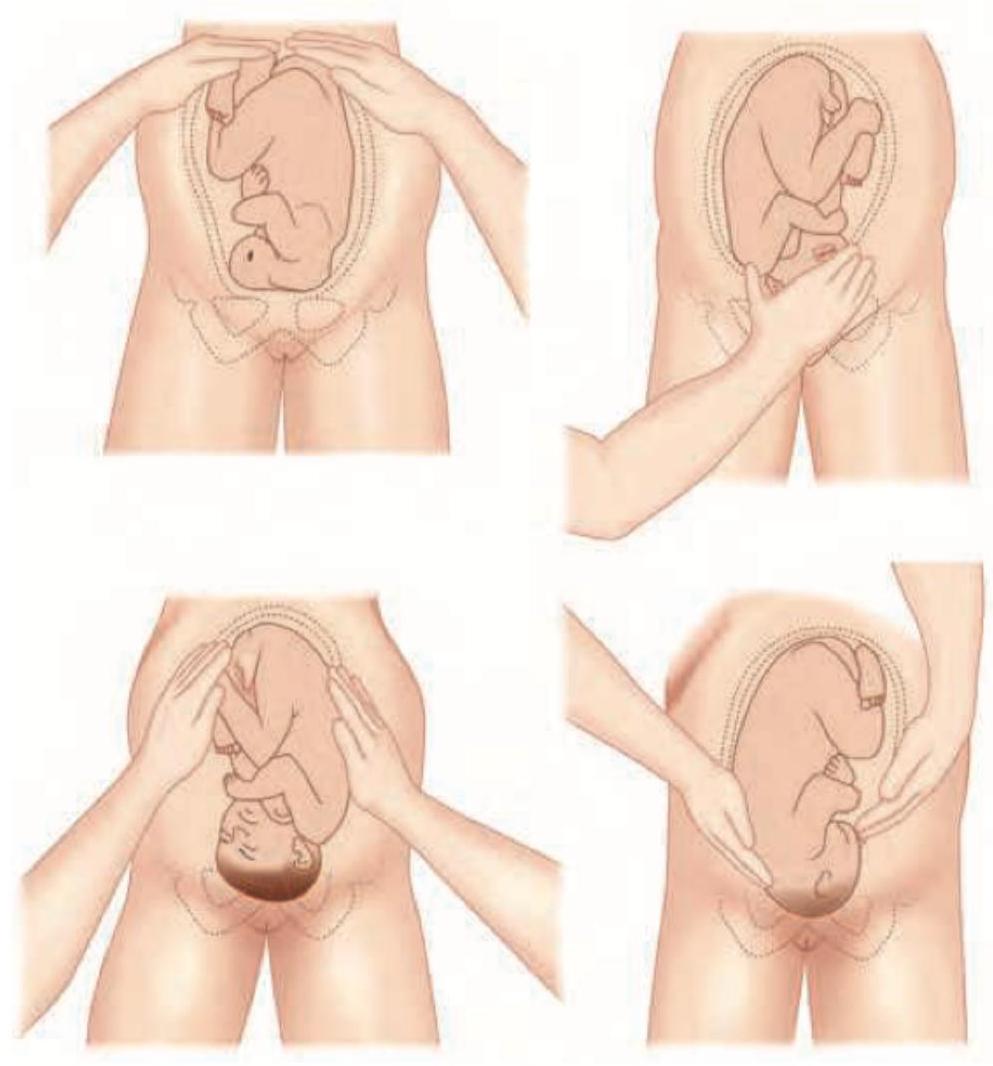
Identify the maneuver shown in the image.
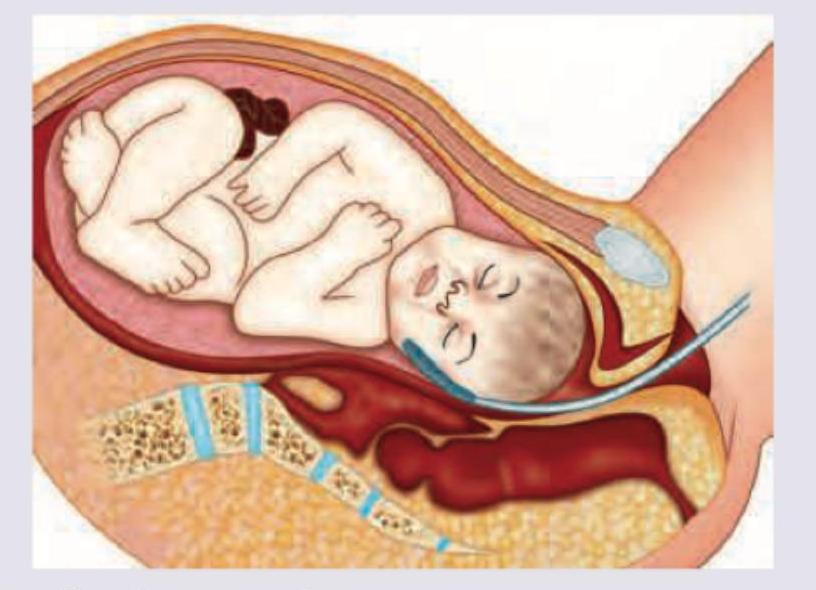
Which technique of intrapartum fetal monitoring is shown here?
Explanation: ***60 sec*** - Shoulder dystocia is generally defined as the failure of the shoulders to deliver spontaneously after the head is already delivered, requiring additional obstetrical maneuvers. - Using a time criterion, the condition is classified when the interval between the delivery of the fetal head and the delivery of the shoulders exceeds **60 seconds (1 minute)**. - The definition is established at **60 seconds** because delays exceeding this time significantly elevate the risk of fetal injury, particularly **brachial plexus injury**. *15 sec* - This time interval is typically too short to define true shoulder dystocia, as spontaneous delivery of the shoulders often occurs within the first 30 seconds. - A delay of **15 seconds** usually reflects normal variation in the second stage of labor. *30 sec* - While a delay greater than **30 seconds** is sometimes cited as an *increased risk* indicator, it is not the standard, universally endorsed cutoff for formally diagnosing shoulder dystocia. - Most major obstetric guidelines (ACOG and RCOG) use the **60-second** criterion. *45 sec* - Although indicative of a slower process, **45 seconds** falls short of the critical **60-second** mark used by most major obstetric guidelines to classify the complication. - Using 45 seconds could lead to over-diagnosis, while the 60-second rule ensures appropriate identification of high-risk cases.
Explanation: ***Malpresentation of fetus*** - The drug shown is **Oxytocin**, which induces strong uterine contractions. If the fetus is in an abnormal position (e.g., **transverse lie**, **breech**), forcing labor with oxytocin can lead to **uterine rupture** or **cord prolapse**. - Inducing labor in the setting of malpresentation is contraindicated because a safe vaginal delivery is not possible, and it significantly increases the risk of severe **fetal distress** and **maternal trauma**. *Heart disease in mother* - While caution is needed due to potential cardiovascular effects like **hypotension** and water retention, maternal heart disease is a relative contraindication, not an absolute one. - Oxytocin is crucial in the third stage of labor to prevent **postpartum hemorrhage**, which is a major concern in patients with cardiac conditions. *Premature labour* - Oxytocin is used to *induce* or *augment* labor, whereas in premature labor, the primary goal is often **tocolysis** (stopping contractions) with drugs like magnesium sulfate or nifedipine. - It is not a contraindication if a medically indicated preterm delivery is planned; rather, it is used when the decision to deliver has been made. *Hypothyroidism* - Maternal hypothyroidism, especially when well-controlled, is not a recognized contraindication for the use of oxytocin. - There is no known adverse interaction between thyroid status and the action of oxytocin on the uterus.
Explanation: ***1.2 cm/hr***- This rate is the classical minimum acceptable cervical dilation velocity during the **active phase of labor** in a **primigravida**, according to the Friedmann curve.- A dilation rate falling below **1.2 cm/hr** in a primigravida is generally treated as an abnormally slow progression, or a **protraction disorder**.*0.5 cm/hr*- A dilation rate of **0.5 cm/hr** is significantly protracted and would be indicative of a high-risk labor pattern requiring re-evaluation and typically intervention, such as **oxytocin augmentation**.- Even the modern, slower labor curves (Zhang curve) do not support such a slow rate as satisfactory for the entire active phase.*0.75 cm/hr*- This rate is below the recognized minimum benchmark of **1.2 cm/hr** for a primigravida during the active phase of labor.- Persistence at this slow rate would likely lead to a diagnosis of **protracted active phase** and increase the risk of maternal and fetal complications.*1.5 cm/hr*- While **1.5 cm/hr** represents rapid and favorable cervical progression, the classical standard for the *minimum satisfactory* rate in a primigravida is established as **1.2 cm/hr**.- **1.5 cm/hr** is often cited as the minimum satisfactory rate for a **multigravida**, who generally progresses faster than a primigravida.
Explanation: ***Should be done before analyzing outcomes*** - An **audit** is defined as a systematic process of reviewing quality of care, which involves comparing current practice (outcomes and processes) against standards. - Therefore, analyzing existing outcomes is an integral **first step** of the audit process, not something that should be done before the audit itself, rendering this statement false. *Improve treatment* - The core objective of any clinical audit in obstetrics is to close the gap between actual performance and best practices, leading directly to the **improvement of patient care and treatment protocols**. - By identifying areas of deviation from established standards, audits enable the implementation of targeted interventions to enhance the quality of **maternal and neonatal outcomes**. *Change in hospital administration and practices* - If an audit reveals systemic failures or resource limitations contributing to poor outcomes, implementing necessary corrections often requires changes in **hospital administrative policies** and practices. - Auditing ensures that institutional resources, documentation, and organizational structures effectively support high standards of **obstetric care**. *Fetal death data is analyzed* - **Perinatal and maternal mortality audits** are essential components of obstetric quality assessment, focusing on severe adverse outcomes. - Analysis of fetal death data (e.g., stillbirths) is crucial for identifying key risk factors, preventable causes, and system weaknesses in **antenatal and intrapartum care**.
Explanation: ***Immediate manual elevation of the presenting part and preparation for emergent Caesarean section*** - The presence of a **palpable umbilical cord** alongside variable decelerations indicates an acute **umbilical cord prolapse**, which is a life-threatening obstetric emergency requiring immediate intervention. - The priority is to relieve cord compression by manually elevating the presenting fetal part (e.g., holding the fetal head up) and initiating the fastest delivery route, which is typically an emergent **Category 1 Cesarean section**. *Continue expectant management and monitor FHR* - Expectant management is appropriate for benign FHR patterns, but it is **contraindicated** here because the FHR pattern (severe variable decelerations) and clinical finding (cord prolapse) denote **acute fetal compromise**. - Delaying definitive intervention significantly increases the risk of **fetal hypoxia** and neurological damage. *Proceed with immediate attempt at instrumental vaginal delivery* - Instrumental delivery (vacuum or forceps) is not possible because the patient is only **6 cm dilated** and not in the second stage of labor. - Trying to achieve vaginal delivery before full dilation would be traumatic and critically delay the resolution of the **cord prolapse emergency**. *Start oxytocin augmentation and administer amnioinfusion* - **Amnioinfusion** is used for recurrent variable decelerations secondary to oligohydramnios or loss of cushion but is not the primary treatment for confirmed cord prolapse. - **Oxytocin augmentation** is absolutely contraindicated as it increases the frequency and strength of contractions, thereby worsening the **pressure on the prolapsed cord** and further compromising fetal oxygenation.
Explanation: ***McRoberts → Rubin → Gaskin → Zavanelli*** - This sequence represents the general escalation of maneuvers, starting with the **McRoberts maneuver** and suprapubic pressure, which are the first-line and most effective steps. - Management proceeds logically from simple positional changes/minimal invasiveness (**Rubin's internal rotation, Gaskin position**) to the highly invasive, **last-resort Zavanelli maneuver** (cephalic replacement). *Zavanelli → Gaskin → Rubin → McRoberts* - This sequence is incorrect because the **Zavanelli maneuver** (cephalic replacement) is the absolute last step, only considered after all other maneuvers have failed due to its high associated morbidity. - The crucial and simple first-line maneuver, the **McRoberts maneuver**, is incorrectly placed as the final step in this order. *Rubin → McRoberts → Zavanelli → Gaskin* - The **McRoberts maneuver** is typically performed first along with suprapubic pressure, as it often provides adequate space and disimpaction before internal rotation techniques like Rubin. - The **Zavanelli maneuver** must always be attempted after non-invasive positional changes like the **Gaskin maneuver** (on all fours) have been tried and failed. *Gaskin → McRoberts → Rubin → Zavanelli* - The **McRoberts maneuver** is universally the first physical maneuver attempted after calling for help and assessing the need for episiotomy, so it generally precedes the **Gaskin maneuver**. - While effective, the Gaskin maneuver (assuming the all-fours position) requires repositioning the mother and is usually attempted after the simpler positional change of McRoberts fails.
Explanation: ***Emergency cesarean section*** - The combination of **fetal bradycardia** (acute distress) and maternal **tachycardia** (suggesting hemorrhage/shock) in a patient undergoing **trial of labor after C-section (TOLAC)** is highly indicative of **uterine rupture**. - Uterine rupture is a **Category I obstetric emergency** requiring immediate delivery to minimize fetal hypoxia/demise and manage maternal bleeding. *Continue monitoring and wait* - Waiting is dangerous and contraindicated in the presence of non-reassuring fetal tracing (bradycardia) combined with signs pathognomonic for **uterine rupture** (maternal tachycardia). - Any delay in delivery and surgical intervention significantly increases the risk of associated maternal and fetal **morbidity and mortality**. *Administer oxytocin to augment labor* - Oxytocin is absolutely contraindicated when **uterine rupture** is suspected, as increasing uterine contractility will exacerbate the tear, potentially worsening fetal compromise and maternal hemorrhage. - Augmentation would be appropriate only if labor was prolonged and vital signs were reassuring, which is not the case here. *Perform operative vaginal delivery* - The fetal station is still high at **-1**, making an immediate or easy operative vaginal delivery unlikely or risky. - The primary goal is immediate access to the uterus to control bleeding and deliver the fetus, which is best achieved via an **emergency laparotomy** (C-section).
Explanation: ***Manually elevate the presenting part, fill the bladder retrogradely, and prepare for emergency cesarean section*** - The immediate priority in **umbilical cord prolapse** is to relieve pressure on the cord by manually elevating the **presenting fetal part** (e.g., the head) to prevent **fetal hypoxia**. - **Retrograde bladder filling** (500–750 mL saline) is a temporary measure, alongside administering **tocolytics** (like terbutaline) to stop contractions, while preparing urgently for an **emergency cesarean section**, which is the definitive management. *Wait and observe* - This approach is highly inappropriate and dangerous, as cord prolapse is an **obstetric emergency** requiring immediate intervention. - Observing or delaying action allows persistent compression, leading rapidly to **fetal circulatory compromise** and death. *Perform vaginal packing to protect the cord* - **Vaginal packing** is ineffective and may actually exacerbate compression on the exposed cord, worsening **fetal blood flow**. - The focus must be on elevating the presenting part away from the cervix and cord. *Administer oxytocin to expedite labor* - **Oxytocin** stimulates uterine contractions, which would significantly increase the compression forces on the **prolapsed cord**, thereby worsening **fetal distress** and ischemia. - Since the cervix is not fully dilated (5 cm), **emergency cesarean section** is necessary, not expedited vaginal delivery.
Explanation: ***Leopold maneuvers*** - **Leopold maneuvers** are the comprehensive set of **four systematic abdominal palpation techniques** used to assess fetal position, presentation, lie, and engagement. - This is the correct answer as it encompasses **all four maneuvers** shown in the image, rather than referring to just one specific technique. *Pawlik grip* - This refers specifically to the **third Leopold maneuver** only, which assesses the presenting part at the pelvic inlet. - Too narrow in scope as it doesn't encompass the complete systematic examination shown. *Fundal grip* - This refers specifically to the **first Leopold maneuver** only, which determines the fetal part occupying the fundus. - Incorrect because it represents only one component of the complete four-step examination technique. *Pelvic grip* - This refers specifically to the **fourth Leopold maneuver** only, which assesses fetal engagement and descent into the pelvis. - Too specific as it doesn't represent the entire systematic abdominal palpation sequence demonstrated.
Explanation: ***Fetal scalp pH sampling*** - The image shows a device inserted through the cervix to the fetus's scalp, suggesting a procedure to obtain a sample, characteristic of **fetal scalp pH sampling**. - This technique is used to assess fetal well-being by directly measuring the pH of a small blood sample from the fetal scalp, typically in cases of ambiguous or non-reassuring cardiotocography (CTG) patterns. *Cardiotocography* - **Cardiotocography (CTG)** involves external transducers placed on the maternal abdomen to monitor fetal heart rate and uterine contractions, which is not depicted in the image. - While CTG is a primary method of fetal monitoring, the illustrative setup here does not represent its application. *Fetal pulse oximetry* - **Fetal pulse oximetry** would involve a sensor placed on the fetal face or head to measure oxygen saturation directly, but the device shown is designed for blood sampling, not continuous oxygen monitoring. - This technique is less commonly used and involves a different type of sensor and placement. *Fetal movement monitor* - A **fetal movement monitor** typically relies on maternal perception or external sensors for detecting fetal activity, which is not what the invasive device in the image is designed to do. - This method is usually non-invasive and does not involve direct contact with the fetal scalp for sampling.
Physiology of Labor
Practice Questions
Stages of Labor and Normal Progression
Practice Questions
Fetal Monitoring Techniques
Practice Questions
Pain Management in Labor
Practice Questions
Induction and Augmentation of Labor
Practice Questions
Operative Delivery (Forceps and Vacuum)
Practice Questions
Cesarean Section: Indications and Techniques
Practice Questions
Dystocia and Abnormal Labor Patterns
Practice Questions
Obstetric Emergencies
Practice Questions
Postpartum Hemorrhage Management
Practice Questions
Get full access to all questions, explanations, and performance tracking.
Start For Free