A pregnant lady presented with painless bleeding in the 3rd trimester. What is the most common cause?
A primigravida with a full-term pregnancy has been in labor for 1 day. She presents to the emergency department after a difficult delivery. On examination, she is dehydrated, slightly pale, with a pulse of 100/min, and BP 120/80 mm Hg. Abdominal examination reveals a fundal height of 36 weeks, cephalic presentation, absent fetal heart sounds, and mild uterine contractions. On per vaginal examination, the cervix is fully dilated, the head is at +1 station, with caput and molding present. The pelvis is adequate. There is foul-smelling, infected discharge. What is the best management option after initial work-up?
Treatment of cord prolapse is based on all of the following factors, except?
What marks the end of the first stage of labor?
A 26-year-old primigravid woman at 42 weeks' gestation comes to the labor and delivery ward for induction of labor. The prenatal course was significant for a positive group B Streptococcus culture performed at 35 weeks. Antenatal testing over the past 2 weeks has been unremarkable. The patient is started on lactated Ringer's IV solution. Sterile vaginal examination shows that the patient's cervix is long, thick, and closed. Prostaglandin (PGE2) gel is placed into the vagina, and electronic fetal heart rate monitoring is continued. In approximately 60 minutes, the fetal heart rate falls to the 90s, as the tocodynamometer shows the uterus to be contracting every 1 minute with essentially no rest in between contractions. Which of the following was most likely the cause of the uterine hyperstimulation?
What is the definition of fetal position?
Arrest of labor is defined as failure of the fetal head to descend within:
What is a common injury to a neonate during birth?
Surgery for mitral stenosis during pregnancy is ideally performed at which gestational age?
What is the treatment of choice for a 30-year-old primipara in labor with a transverse lie?
Explanation: ### Explanation **Correct Answer: A. Placenta previa** **Why it is correct:** In the third trimester, bleeding per vaginum is termed **Antepartum Hemorrhage (APH)**. The hallmark clinical presentation of **Placenta Previa** (where the placenta is implanted in the lower uterine segment) is **painless, causeless, and recurrent** bright red vaginal bleeding. Since the lower segment stretches and thins out in the third trimester, the inelastic placenta separates from its attachment, leading to open maternal sinuses and bleeding. Because there is no retroplacental clot formation or uterine tension, the patient does not experience pain. **Why the other options are incorrect:** * **B. Abruptio placentae:** This is the premature separation of a normally situated placenta. It typically presents with **painful** vaginal bleeding, uterine tenderness, and a "woody hard" uterus. It is the most common cause of *painful* APH. * **C. Vesicular mole:** While this causes vaginal bleeding, it typically presents in the **first or early second trimester** (usually before 20 weeks). It is characterized by "white currant" or grape-like vesicles and disproportionately high hCG levels. **NEET-PG High-Yield Pearls:** * **Investigation of Choice:** Transvaginal Ultrasound (TVS) is the gold standard for diagnosing the location of the placenta (safer and more accurate than transabdominal). * **The "Golden Rule":** Never perform a per-vaginal (PV) examination in a case of APH until Placenta Previa is ruled out by ultrasound, as it can provoke torrential, life-threatening hemorrhage (Stallworthy's sign). * **Most common cause of APH:** Abruptio placentae (overall), but for *painless* bleeding, it is always Placenta Previa.
Explanation: ### Explanation The patient is a primigravida in the **second stage of labor** (cervix fully dilated, head at +1 station) with an **intrauterine fetal death (IUFD)**, as evidenced by absent fetal heart sounds. She also shows signs of prolonged labor and infection (foul-smelling discharge). **1. Why Ventouse (Vacuum) Delivery is correct:** The goal in this scenario is to achieve a quick vaginal delivery to prevent further maternal morbidity (sepsis/exhaustion). Since the cervix is **fully dilated**, the head is **engaged (+1 station)**, and the pelvis is **adequate**, the criteria for instrumental delivery are met. Vacuum extraction is preferred over forceps in the presence of infection to minimize maternal trauma and because it requires less space in an already potentially edematous birth canal. **2. Why other options are incorrect:** * **A. Cesarean section:** This is contraindicated in the presence of a dead fetus and intrauterine infection unless there is a maternal life-threatening indication (e.g., obstructed labor or hemorrhage). It significantly increases the risk of maternal peritonitis and sepsis. * **B. Oxytocin drip:** While she has mild contractions, the presence of caput, molding, and infection suggests the second stage is already prolonged. Relying solely on oxytocin may delay delivery unnecessarily. * **D. Craniotomy:** Destructive operations like craniotomy are reserved for cases where instrumental delivery fails or where there is a gross cephalopelvic disproportion with a dead fetus. Since the pelvis is "adequate" and the head is at +1 station, a less invasive instrumental delivery (Ventouse) should be attempted first. **Clinical Pearls for NEET-PG:** * **Prerequisites for Instrumental Delivery:** Fully dilated cervix, ruptured membranes, engaged head, and adequate pelvis. * **Management of IUFD in Labor:** Vaginal delivery is always the preferred route. Avoid C-sections to protect future obstetric potential and prevent sepsis. * **Molding and Caput:** These are signs of prolonged labor and potential disproportion; however, at +1 station with an adequate pelvis, a trial of instrumental delivery is justified.
Explanation: **Explanation:** The management of umbilical cord prolapse is an obstetric emergency where the primary goal is to minimize cord compression and expedite delivery to prevent fetal hypoxia. The choice of treatment depends on the **urgency of delivery** and the **prognosis for the fetus.** **Why Fetal Weight is the Correct Answer:** While fetal weight is a general consideration in obstetrics, it is **not a primary determinant** in the acute management of cord prolapse. The decision-making process focuses on whether the fetus is alive and salvageable, and how quickly it can be delivered. A very low birth weight or macrosomia does not change the immediate emergency protocols (like manual elevation of the presenting part or emergency Cesarean section) if the fetus is viable. **Analysis of Other Options:** * **Fetal Viability (A):** This is the most critical factor. If the fetus is dead (no heart tones), the urgency for a C-section is removed, and the mother is allowed to proceed with vaginal delivery to avoid surgical morbidity. * **Fetal Maturity (B):** If the fetus is pre-viable (extreme prematurity), aggressive surgical intervention may not be indicated. Management changes significantly based on whether the fetus has reached a gestational age where survival is possible. * **Cervical Dilatation (D):** This determines the **route of delivery**. If the cervix is fully dilated and the head is low, an immediate instrumental vaginal delivery (forceps/vaccum) is preferred. If the cervix is not fully dilated, an emergency Cesarean section is mandatory. **Clinical Pearls for NEET-PG:** * **Immediate Action:** The first step in management is **manual elevation of the presenting part** to relieve pressure on the cord. * **Positioning:** Place the patient in the **Trendelenburg** or **Knee-chest position**. * **Bladder Filling:** The **Vago method** (filling the bladder with 500ml of saline via catheter) can help elevate the presenting part while preparing for surgery. * **Diagnosis:** Most commonly occurs following **Artificial Rupture of Membranes (ARM)** with a high/unengaged presenting part.
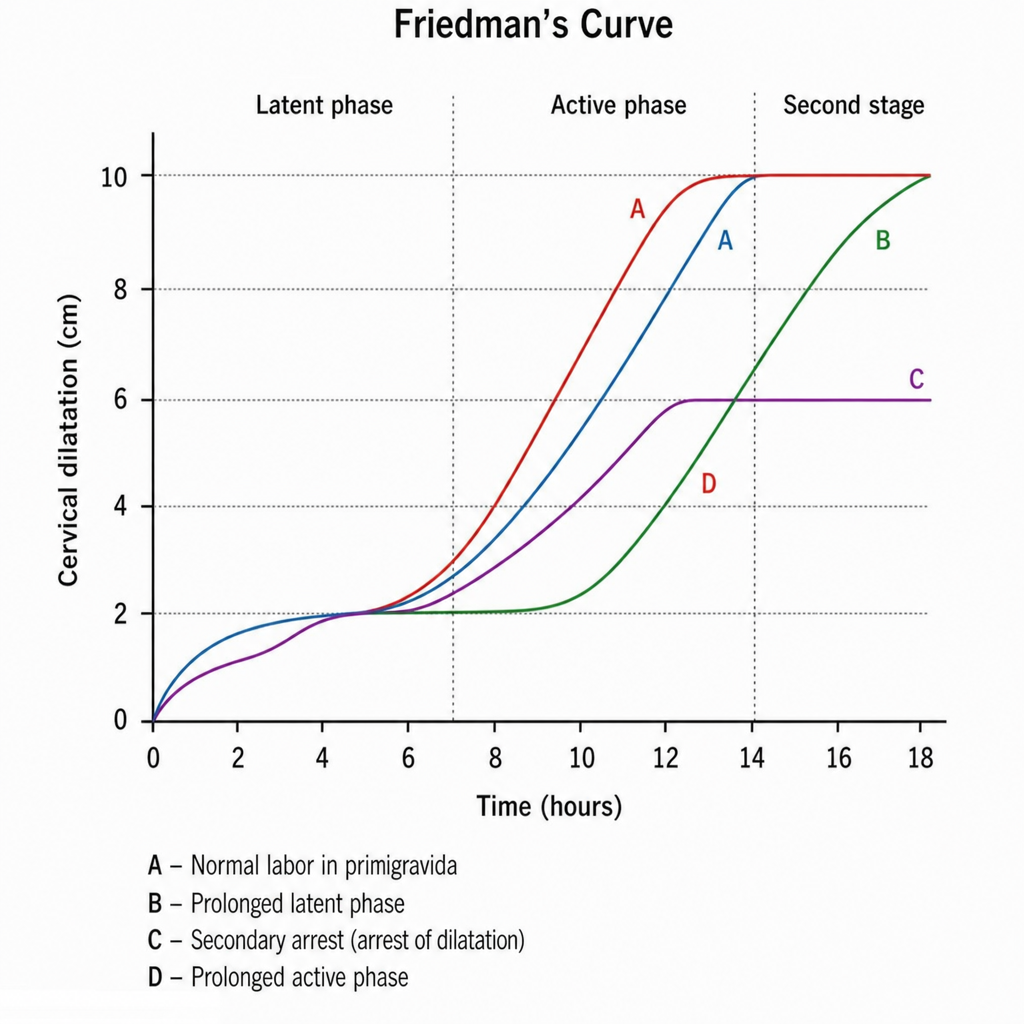
Explanation: The first stage of labor, also known as the **cervical stage**, begins with the onset of true labor pains and concludes with the **full dilatation of the cervix (10 cm)**. This stage is primarily concerned with the effacement and dilatation of the cervix to allow the passage of the fetal head. ### Explanation of Options: * **C. Full dilatation of the cervix (Correct):** This is the physiological landmark that defines the end of the first stage and the beginning of the second stage. At this point, the cervix is no longer palpable on vaginal examination. * **A. Rupture of membranes:** While this often occurs during the first stage (spontaneous rupture), it is not a defining marker for the end of the stage. It can occur before labor starts (PROM) or be performed artificially (ARM). * **B. 3/5 dilatation of the cervix:** This is an arbitrary measurement. In the WHO Partograph, the "Active Phase" of the first stage traditionally began at 4 cm, though recent guidelines (ACOG/WHO) now suggest 6 cm. * **D. Crowning of the fetal head:** This occurs at the end of the **second stage** of labor, just before the delivery of the head. ### High-Yield Clinical Pearls for NEET-PG: * **Duration:** In primigravidae, the first stage lasts approximately 12 hours; in multigravidae, it lasts about 6 hours. * **Phases:** It is divided into the **Latent phase** (slow dilatation) and the **Active phase** (rapid dilatation). * **Friedman’s Curve:** Traditionally used to plot labor progress; however, the **Zhang’s Curve** is now more widely recognized for modern labor patterns. * **Second Stage:** Starts from full dilatation and ends with the delivery of the fetus. * **Third Stage:** Starts from the delivery of the fetus and ends with the delivery of the placenta and membranes.
Explanation: **Explanation:** The patient is experiencing **uterine tachysystole** (hyperstimulation), defined as >5 contractions in 10 minutes, which has led to fetal bradycardia (FHR in the 90s) due to impaired placental perfusion during the lack of uterine relaxation. **Why Prostaglandin (PGE2) is the cause:** Prostaglandins (like Dinoprostone/PGE2 and Misoprostol/PGE1) are used for cervical ripening in patients with an unfavorable Bishop score (long, thick, closed cervix). A known and significant side effect of exogenous prostaglandins is **uterine hyperstimulation**. Because PGE2 gel is administered vaginally, its absorption can sometimes trigger excessive myometrial activity. The temporal relationship here—symptoms starting 60 minutes after administration—strongly points to the PGE2 gel as the causative agent. **Why other options are incorrect:** * **Infection:** While chorioamnionitis can cause uterine irritability, it usually presents with maternal fever, fetal tachycardia (not bradycardia), and foul-smelling liquor. * **IV fluids:** Lactated Ringer’s is an isotonic crystalloid used for hydration and does not affect uterine contractility. * **Postdates pregnancy:** While post-term pregnancy (≥42 weeks) increases the risk of placental insufficiency and oligohydramnios, it does not inherently cause uterine tachysystole. **NEET-PG Clinical Pearls:** * **Management of PGE2-induced tachysystole:** The first step is to **remove the insert/gel** (if possible) and place the patient in the left lateral position. If fetal distress persists, **Tocolytics** (e.g., Terbutaline) may be administered. * **Bishop Score:** A score of **≤6** indicates an unfavorable cervix, necessitating ripening agents like PGE2 before starting Oxytocin. * **Contraindication:** Prostaglandins should be avoided in patients with a history of previous Cesarean section due to the increased risk of uterine rupture.
Explanation: **Explanation:** The correct answer is **C: Orientation of the fetus in relation to the maternal pelvis before delivery.** In obstetrics, **Fetal Position** is defined as the relationship of an arbitrarily chosen point on the fetal presenting part (the **denominator**) to the specific quadrants of the maternal pelvis (e.g., Left Occipito-Anterior or LOA). The maternal pelvis is divided into eight segments (Anterior, Posterior, Left/Right Lateral, and four oblique quadrants) to precisely describe how the fetus is situated. **Analysis of Incorrect Options:** * **Options A and B:** These describe **Fetal Presentation** (the part of the fetus that occupies the lower pole of the uterus, such as vertex, breech, or shoulder), not position. Presentation is a component used to determine position, but it is not the definition of position itself. * **Option D:** The orientation of the uterus in relation to the maternal pelvis refers to uterine version or flexion (e.g., anteverted, retroverted), which is a maternal anatomical description and unrelated to the fetal orientation during labor. **High-Yield NEET-PG Clinical Pearls:** * **Denominators to Remember:** Vertex = Occiput; Breech = Sacrum; Face = Mentum; Brow = Frontal bone; Shoulder = Acromion. * **Most Common Position:** Left Occipito-Anterior (**LOA**) is the most common position at the onset of labor. * **Direct Occipito-Anterior (OA):** This is the ideal position for delivery as it presents the smallest diameters of the fetal head to the pelvic outlet. * **Malposition:** Any position other than OA is considered a malposition (e.g., Persistent Occipito-Posterior), which can lead to prolonged labor.
Explanation: **Explanation:** The diagnosis of **Arrest of Descent** is a critical component of managing the second stage of labor. According to standard obstetric guidelines (ACOG and Williams Obstetrics), in a **nulliparous woman**, arrest of descent is defined as the failure of the fetal head to descend for **2 hours** without regional anesthesia (epidural). If an epidural is present, an additional hour is allowed (total 3 hours). **Why Option B is Correct:** The second stage of labor is characterized by the active descent of the fetus through the birth canal. A period of 2 hours without progress indicates that the mechanical forces of labor (contractions and maternal pushing) are failing to overcome the resistance of the birth canal or that there is cephalopelvic disproportion (CPD). **Analysis of Incorrect Options:** * **Option A (1 hour):** This is too short a duration to diagnose arrest. Many women require more than an hour of active pushing to navigate the pelvic curves, especially in the first pregnancy. * **Option C (3 hours):** This is the threshold for arrest in a **nulliparous woman with an epidural**. It is not the standard definition for a general population without anesthesia. * **Option D (4 hours):** This exceeds the recommended time limits for the second stage and significantly increases the risk of maternal exhaustion, postpartum hemorrhage, and fetal distress. **NEET-PG High-Yield Pearls:** * **Second Stage Limits (Nullipara):** 2 hours (no epidural), 3 hours (with epidural). * **Second Stage Limits (Multipara):** 1 hour (no epidural), 2 hours (with epidural). * **Protraction vs. Arrest:** Protraction is slow progress; Arrest is **zero** progress. * **Friedman’s Curve:** While historically used, modern guidelines (Zhang’s criteria) allow for a longer first stage, but the 2-hour rule for arrest of descent remains a standard benchmark for intervention.
Explanation: **Explanation:** **Fracture of the clavicle** is the most common birth-related bone injury in neonates. It typically occurs during a difficult vaginal delivery, most frequently associated with **shoulder dystocia** or a high birth weight (macrosomia). The injury occurs when the anterior shoulder is compressed against the maternal symphysis pubis during delivery. * **Clinical Presentation:** The neonate may present with a palpable crepitus, localized edema, or an absent Moro reflex on the affected side (pseudoparalysis). However, many cases are asymptomatic and diagnosed only when a callus forms at the site 7–10 days later. **Analysis of Incorrect Options:** * **Fracture of the humerus (A):** This is the second most common long bone fracture. It usually occurs during breech extractions or when an arm is extended in a cephalic presentation, but it is significantly less frequent than clavicular fractures. * **Fracture of the scapula (C):** This is extremely rare in neonates due to the bone's protected anatomical position and the surrounding musculature. * **Fracture of the femur (D):** This typically occurs during a difficult breech delivery when traction is applied to the lower extremities. While serious, its incidence is much lower than that of the clavicle. **NEET-PG High-Yield Pearls:** * **Most common bone fractured:** Clavicle. * **Management:** Most clavicular fractures are "greenstick" and require no specific treatment other than gentle handling and pinning the sleeve to the chest for immobilization (if painful). * **Risk Factors:** Macrosomia, instrumental delivery (forceps/vacuum), and shoulder dystocia. * **Differential Diagnosis:** Always rule out **Erb’s Palsy** (C5-C6) if the arm is not moving, as both can occur simultaneously following shoulder dystocia.
Explanation: **Explanation:** The ideal timing for surgical intervention (specifically **Closed Mitral Valvotomy** or Balloon Mitral Valvoplasty) in a pregnant woman with Mitral Stenosis is **14 weeks** of gestation. **Why 14 weeks is the correct answer:** 1. **Organogenesis Completion:** By 14 weeks, the first trimester is over, and fetal organogenesis is complete, significantly reducing the risk of teratogenicity from anesthesia and surgical stress. 2. **Hemodynamic Stability:** The physiological increase in cardiac output and blood volume begins early but reaches its peak stress between 28–32 weeks. Performing the surgery at 14 weeks allows the valve to be corrected *before* the maximum hemodynamic load occurs. 3. **Uterine Size:** The uterus is still relatively small and has not yet reached the level of the umbilicus, making surgical positioning easier and reducing the risk of uterine irritability or preterm labor compared to later stages. **Why the other options are incorrect:** * **20 weeks:** While safer than the third trimester, the cardiac output has already risen significantly by this stage, increasing the baseline surgical risk. * **28 & 32 weeks:** These represent the period of **maximum hemodynamic stress** in pregnancy. Surgery during this window carries a high risk of acute heart failure, pulmonary edema, and triggers preterm labor or fetal demise due to placental hypoperfusion. **High-Yield Clinical Pearls for NEET-PG:** * **Most common heart disease in pregnancy:** Rheumatic Heart Disease (Mitral Stenosis is the most common lesion). * **Critical Period:** The most common time for a patient with MS to develop heart failure is **28–32 weeks** and the **immediate postpartum** period (due to autotransfusion from the contracting uterus). * **Drug of Choice:** Beta-blockers (Propranolol/Metoprolol) are used to control heart rate and increase diastolic filling time. * **Mode of Delivery:** Vaginal delivery with a shortened second stage (using forceps/ventouse) is preferred over C-section unless there are obstetric indications.
Explanation: **Explanation:** In a **transverse lie**, the long axis of the fetus is perpendicular to that of the mother. For a primipara in active labor, the treatment of choice is an **Emergency Cesarean Section**. This is because a transverse lie is an unstable lie that cannot be delivered vaginally. If labor continues, it can lead to serious complications such as cord prolapse (common due to the poorly applied presenting part), hand prolapse, or a "neglected transverse lie" resulting in uterine rupture. **Analysis of Options:** * **Internal Cephalic Version (A):** This is contraindicated in a singleton pregnancy and a live fetus. It is generally only reserved for the delivery of a **second twin** in a malpresentation. * **Wait and Watch (C):** This is dangerous. As labor progresses, the membranes are likely to rupture, leading to cord prolapse or an impacted shoulder, making surgery more difficult and increasing maternal-fetal morbidity. * **External Cephalic Version (D):** While ECV can be attempted before the onset of labor (usually around 36–37 weeks), it is **contraindicated once labor has commenced** and the membranes have potentially ruptured or the cervix has dilated significantly. **Clinical Pearls for NEET-PG:** * **Most common cause** of transverse lie in multipara is abdominal wall laxity; in primipara, it is often due to pelvic contraction or placenta previa. * **Dorso-superior** is the most common variety of transverse lie. * **The "Spontaneous Evolution"** (Denman’s or Douglas’ method) is a rare mechanism where a dead, small fetus is expelled doubled-up, but it should never be anticipated in clinical practice. * **Management Rule:** If the patient is in labor with a transverse lie, the answer is almost always **Cesarean Section**.
Physiology of Labor
Practice Questions
Stages of Labor and Normal Progression
Practice Questions
Fetal Monitoring Techniques
Practice Questions
Pain Management in Labor
Practice Questions
Induction and Augmentation of Labor
Practice Questions
Operative Delivery (Forceps and Vacuum)
Practice Questions
Cesarean Section: Indications and Techniques
Practice Questions
Dystocia and Abnormal Labor Patterns
Practice Questions
Obstetric Emergencies
Practice Questions
Postpartum Hemorrhage Management
Practice Questions
Get full access to all questions, explanations, and performance tracking.
Start For Free