Physiological chill in labour is typically seen in which stage?
What is the most common cause of vulval hematoma?
During PPH, internal iliac ligation is performed at which anatomical location?
What is the most common cause of postpartum hemorrhage?
In the Bishop score, which of the following components is NOT included?
What is the first sign of magnesium sulfate toxicity?
Which of the following is a sign of placental separation in stage III of labor?
The usual site of spontaneous rupture of the intact uterus during pregnancy is the:
A 32-week pregnant female with preterm contractions was treated with tocolytic agents. She further developed pulmonary edema. Which of the following tocolytic agents is most likely to have caused pulmonary edema in this patient?
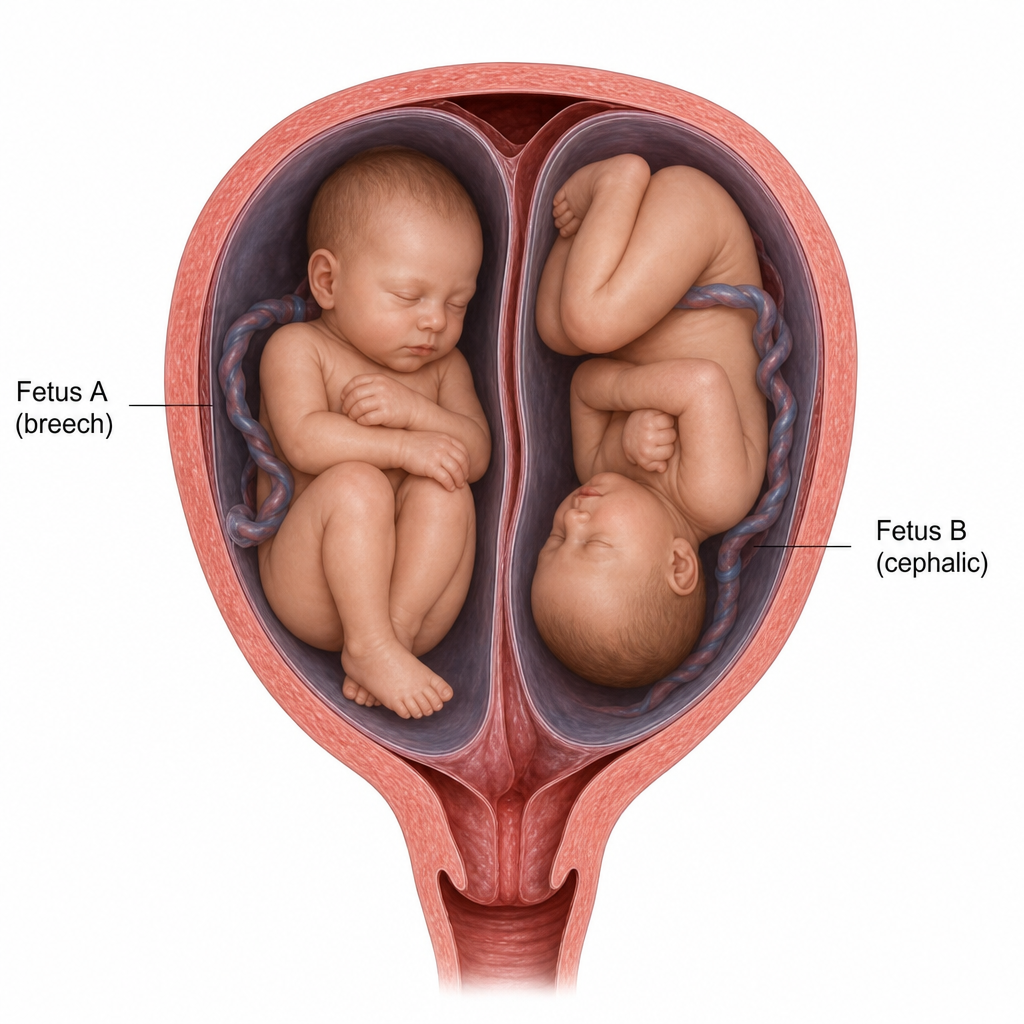
What is the most common presentation in twin pregnancies?
Explanation: **Explanation:** The correct answer is **C. Third stage**. **Physiological Chill in Labour:** A physiological chill (shivering) is a common, non-pathological phenomenon observed in approximately 25–50% of women immediately following the delivery of the fetus, which marks the beginning of the **third stage of labor**. The underlying medical mechanism is multifactorial: 1. **Fetomaternal Transfusion:** Small amounts of fetal blood enter the maternal circulation during placental separation, causing a mild immunological reaction. 2. **Thermal Loss:** Rapid loss of body heat occurs due to the delivery of the warm fetus and amniotic fluid, alongside the evaporation of sweat. 3. **Hormonal/Neurological Shift:** The sudden decrease in intra-abdominal pressure and the rapid shift in fluid compartments (autotransfusion from the uterus) trigger a sympathetic nervous system response. **Analysis of Incorrect Options:** * **First Stage (A):** This stage involves cervical effacement and dilation. While maternal exhaustion or anxiety may occur, the specific "physiological chill" related to placental separation is not characteristic here. * **Second Stage (B):** This is the stage of fetal expulsion. The mother is usually physically active ("pushing"), which generates metabolic heat, making a chill unlikely during this phase. * **Fourth Stage (D):** This is the hour following placental delivery (observation period). While shivering can persist into this stage, it typically *originates* in the third stage. **NEET-PG High-Yield Pearls:** * **Management:** Reassurance and warm blankets are sufficient. It does not require antibiotics unless accompanied by a high-grade fever (suggestive of chorioamnionitis). * **Third Stage Duration:** Usually lasts 5–15 minutes; it is considered "prolonged" if it exceeds 30 minutes. * **Most Common Cause of PPH:** Atony of the uterus (occurs in the third/fourth stage).
Explanation: **Explanation:** Vulval hematomas are localized collections of blood in the pelvic soft tissues, typically resulting from trauma to the pelvic vasculature during childbirth. **1. Why Episiotomy is the Correct Answer:** **Episiotomy** is the most common cause of vulval hematoma. It occurs due to inadequate hemostasis during the repair of the incision, particularly when the apex of the vaginal incision is not properly secured or when a deep vessel (such as a branch of the internal pudendal artery) continues to bleed beneath the sutured mucosa. This leads to the formation of an infralevator hematoma, which presents as a painful, tense, and bluish swelling in the perineum. **2. Analysis of Incorrect Options:** * **Vaginal vault rupture:** This is a rare, severe complication usually associated with instrumental delivery or previous surgery. It typically leads to intraperitoneal hemorrhage or broad ligament hematomas rather than localized vulval swelling. * **Lower segment uterine rupture:** This is a life-threatening obstetric emergency. While it causes massive internal bleeding and shock, the blood accumulates intra-abdominally or within the broad ligament, not in the vulval tissues. * **Rupture of paravaginal sinuses:** While spontaneous rupture of these veins can occur during the second stage of labor due to pressure, it is significantly less common than hematomas resulting from surgical trauma (episiotomy). **Clinical Pearls for NEET-PG:** * **Classic Presentation:** Severe, excruciating perineal pain out of proportion to the clinical findings, often accompanied by a "rectal pressure" sensation. * **Management:** Small, stable hematomas (<5 cm) are managed conservatively with ice packs and analgesics. Large or expanding hematomas require **incision, evacuation of clots, and ligation of the bleeding vessel.** * **Anatomical Boundary:** Vulval hematomas are usually **infralevator** (below the levator ani muscle). If the hematoma is supralevator, it can lead to concealed hemorrhage and rapid hemodynamic collapse.
Explanation: **Explanation:** Internal Iliac Artery Ligation (IIAL), also known as Hypogastric Artery Ligation, is a life-saving surgical procedure used to control intractable Postpartum Hemorrhage (PPH). **Why Option B is Correct:** The internal iliac artery divides into an anterior and a posterior division. The **anterior division** provides the primary blood supply to the pelvic viscera, including the **uterine, vaginal, and middle rectal arteries**. By ligating the anterior division (distal to the origin of the posterior division), the pelvic arterial pulse pressure is reduced by approximately 85%, converting a high-pressure arterial system into a low-pressure venous-like system. This facilitates clot formation at the site of hemorrhage. **Why Other Options are Incorrect:** * **Option A & D:** Ligating at the origin of the internal iliac or the common iliac artery is dangerous as it would compromise blood flow to the **posterior division** (supplying the gluteal region and musculoskeletal pelvis) and the lower limbs, potentially leading to ischemia or necrosis. * **Option C:** The posterior division does not supply the uterus; ligating it would be ineffective for PPH and could cause gluteal ischemia. **High-Yield Clinical Pearls for NEET-PG:** * **Anatomical Landmark:** The ligation is performed **2-3 cm distal to the bifurcation** of the common iliac artery to avoid injuring the posterior division. * **Ureter Safety:** The ureter crosses the common iliac artery at its bifurcation; it must be identified and retracted medially before ligation. * **Effect on Fertility:** IIAL does **not** cause pelvic necrosis or infertility due to extensive collateral circulation (e.g., ovarian artery, lumbar arteries). * **Success Rate:** It is successful in approximately 40-50% of cases; if it fails, the next step is often a subtotal or total hysterectomy.
Explanation: **Explanation:** Postpartum Hemorrhage (PPH) is defined as blood loss ≥500 mL after vaginal delivery or ≥1000 mL after a Cesarean section. To remember the causes of PPH, the **"4 Ts"** mnemonic is used: **Tone, Tissue, Trauma, and Thrombin.** **1. Why Uterine Atony (Tone) is correct:** Uterine atony is the **most common cause of PPH**, accounting for approximately **70-80% of cases**. After delivery, the primary mechanism to prevent hemorrhage is the contraction of the myometrium, which compresses the spiral arteries (the "living ligatures" of the uterus). If the uterus fails to contract (atony), these vessels remain open, leading to rapid and massive blood loss. **2. Why other options are incorrect:** * **Retained products (Tissue):** This is the second most common cause. Pieces of the placenta or membranes prevent the uterus from fully contracting, leading to persistent bleeding. * **Trauma:** This includes lacerations of the cervix, vagina, or perineum, and uterine rupture. It is suspected when the uterus is firm and well-contracted, but bleeding continues. * **Bleeding disorders (Thrombin):** Coagulopathies (like vWD or DIC) are the rarest cause of primary PPH but must be considered if bleeding is refractory to standard management. **High-Yield Clinical Pearls for NEET-PG:** * **Risk Factors for Atony:** Overdistended uterus (polyhydramnios, multiple gestations, macrosomia), prolonged labor, and grand multiparity. * **First-line Management:** Uterine massage and Oxytocin (Drug of Choice). * **Active Management of Third Stage of Labor (AMTSL):** The most important step in preventing PPH. * **Surgical Step-ladder:** If medical management fails, the sequence is: Uterine artery ligation $\rightarrow$ Internal iliac artery ligation $\rightarrow$ Hysterectomy (last resort).
Explanation: The **Bishop Score** (also known as the Pelvic Score) is a clinical tool used to assess the "ripeness" of the cervix and predict the likelihood of a successful vaginal delivery following the induction of labor. ### Why "Interspinal Diameter" is the Correct Answer The Bishop score evaluates five specific parameters related to the **cervix** and the **position of the fetus** within the birth canal. **Interspinal diameter** refers to the distance between the ischial spines (part of the pelvic outlet assessment) and is a fixed anatomical measurement of the maternal pelvis. It does not change during the onset of labor and is therefore not a component of the Bishop score. ### Explanation of Incorrect Options The five components of the Bishop score are: * **Dilatation of the cervix (Option B):** Measures how open the cervix is (0 to >5 cm). * **Effacement of the cervix (Option A):** Measures the thinning/shortening of the cervix (0 to >80%). * **Station of the fetal head (Option C):** Measures the descent of the fetal presenting part relative to the ischial spines (-3 to +2). * **Consistency of the cervix:** Categorized as firm, medium, or soft. * **Position of the cervix:** Categorized as posterior, mid-position, or anterior. ### High-Yield Clinical Pearls for NEET-PG * **Mnemonic:** To remember the components, use **"St. Bishop's CPD"** (Station, Consistency, Position, Dilatation, Effacement). * **Scoring:** Each component is scored 0–2 or 0–3, with a maximum total score of **13**. * **Interpretation:** * A score of **≥8** suggests a "ripe" cervix with a high probability of successful induction (similar to spontaneous labor). * A score of **≤6** suggests an "unripe" cervix, often requiring cervical ripening agents (e.g., Dinoprostone/PGE2) before induction. * **Modified Bishop Score:** Often replaces effacement (in %) with **cervical length (in cm)** for easier clinical measurement.
Explanation: **Explanation:** Magnesium sulfate ($MgSO_4$) is the drug of choice for seizure prophylaxis in pre-eclampsia and control of seizures in eclampsia. It acts as a CNS depressant and a neuromuscular blocker by inhibiting acetylcholine release at the motor endplate. Toxicity occurs when serum magnesium levels exceed the therapeutic range (4–7 mEq/L). **Why Option A is correct:** The **loss of deep tendon reflexes (patellar reflex/knee jerk)** is the **earliest clinical sign** of toxicity, typically occurring at serum levels of **7–10 mEq/L**. This serves as a vital "warning sign" because it precedes more life-threatening complications. **Why other options are incorrect:** * **B. Cardiac arrest:** This is the terminal event of magnesium toxicity, occurring at very high levels, usually **>25 mEq/L**. * **C. Respiratory depression:** This occurs after the loss of reflexes but before cardiac arrest, typically at levels of **11–15 mEq/L**. * **D. Decreased urinary output:** This is not a *sign* of toxicity itself, but rather a **predisposing factor**. Since magnesium is excreted solely by the kidneys, oliguria leads to magnesium accumulation and subsequent toxicity. **NEET-PG High-Yield Pearls:** 1. **Monitoring:** Before every dose, check for: (1) Presence of patellar reflex, (2) Respiratory rate >12-14/min, and (3) Urine output >30 ml/hr (or 100 ml/4hrs). 2. **Antidote:** 10 ml of **10% Calcium Gluconate** IV (administered slowly over 10 minutes). 3. **Therapeutic Range:** 4–7 mEq/L (or 4.8–8.4 mg/dL). 4. **Sequence of Toxicity:** Loss of Patellar Reflex → Respiratory Depression → Cardiac Arrest.
Explanation: ### Explanation The third stage of labor begins after the delivery of the fetus and ends with the expulsion of the placenta. Placental separation occurs due to the sudden reduction in uterine size, leading to a shearing force at the decidua-placental interface. **Why Option A is Correct:** As the placenta detaches from the uterine wall, the retroplacental hematoma (formed between the decidua and the placenta) escapes through the cervix. This results in a **sudden gush of blood**, which is one of the classic clinical signs of separation. **Analysis of Incorrect Options:** * **B. Discoid uterus:** Upon separation, the uterus changes from a flat, **discoid shape** to a firm, **globular shape**. It also rises in the abdomen (Schroeder’s sign) because the placenta moves into the lower uterine segment. * **C. Filling of placenta in vagina:** While the placenta eventually enters the vagina, the clinical sign of separation is the **lengthening of the umbilical cord** at the vulva (modified Brandt-Andrews maneuver), indicating the placenta has descended from the uterus. * **D. Increase in blood pressure:** Hemodynamic changes in the third stage are usually minimal unless there is significant postpartum hemorrhage (PPH), which would cause a *decrease* in blood pressure, not an increase. **High-Yield Clinical Pearls for NEET-PG:** * **Classic Signs of Placental Separation:** 1. **Globular shape** of the uterus (most reliable). 2. **Gush of blood.** 3. **Permanent lengthening of the cord** (does not retract when the uterus is pushed up). 4. **Suprapubic bulge** (due to placenta in the lower segment). * **Management:** Active Management of Third Stage of Labor (AMTSL) is the gold standard to prevent PPH, involving prophylactic oxytocin, controlled cord traction (CCT), and uterine massage.
Explanation: **Explanation:** The correct answer is **C. Body of the uterus.** **1. Why "Body of the uterus" is correct:** Spontaneous rupture of an **intact** (unscarred) uterus during pregnancy most commonly occurs in the upper segment or the **body of the uterus**. This is because, during labor, the upper segment is the active contractile portion that thickens and exerts maximum pressure. In cases of obstructed labor, the upper segment continues to contract and retract vigorously against an obstruction, leading to pathological thinning and eventual rupture. This is distinct from scar dehiscence, which typically occurs at the site of a previous surgical incision. **2. Why the other options are incorrect:** * **A & B (Anterior/Posterior lower uterine segment):** While the lower uterine segment is the most common site for rupture in a **scarred uterus** (e.g., previous Cesarean section), it is not the primary site for spontaneous rupture in an intact uterus. In an unscarred uterus, the lower segment undergoes extreme thinning (forming a Bandl’s ring), but the actual tear often extends into or originates from the muscular body. * **D (Level of internal os):** This area is part of the cervix/lower segment junction. While tears can extend here (especially traumatic ones from forceps or manual rotation), it is not the primary site for spontaneous rupture of the uterine body. **3. Clinical Pearls for NEET-PG:** * **Most common cause of uterine rupture overall:** Dehiscence of a previous Cesarean section scar (usually in the lower segment). * **Most common cause in an unscarred uterus:** Obstructed labor (often due to CPD or malpresentation). * **Bandl’s Ring:** A pathognomonic sign of impending rupture; it is a visible ridge between the thickened upper segment and the overstretched lower segment. * **Clinical Presentation:** Sudden cessation of contractions, "tearing" abdominal pain, recession of the presenting part, and easily palpable fetal parts under the maternal abdominal wall.
Explanation: **Explanation:** The correct answer is **Ritodrine**. **1. Why Ritodrine is correct:** Ritodrine is a **Beta-2 adrenergic agonist**. While it works as a tocolytic by relaxing the uterine smooth muscle, it also has significant Beta-1 stimulatory effects. This leads to tachycardia, increased cardiac output, and sodium/water retention. When administered intravenously (especially alongside corticosteroids for fetal lung maturity or large volumes of IV fluids), it can lead to **pulmonary edema**. This occurs due to a combination of fluid overload and increased capillary permeability. **2. Why the other options are incorrect:** * **Nifedipine (Calcium Channel Blocker):** Currently the first-line tocolytic. Its main side effects are hypotension, flushing, and headache. While rare cases of pulmonary edema are reported, it is significantly less common than with Beta-mimetics. * **Indomethacin (NSAID):** Works by inhibiting prostaglandin synthesis. Its primary concerns are fetal (premature closure of the ductus arteriosus and oligohydramnios), not maternal pulmonary edema. * **Atosiban (Oxytocin Receptor Antagonist):** Known for having the fewest maternal side effects. It is highly specific to the uterus and does not typically cause cardiovascular or pulmonary complications. **Clinical Pearls for NEET-PG:** * **Drug of Choice (DOC):** Nifedipine is the current DOC for tocolysis (24–34 weeks). * **Beta-mimetics (Ritodrine/Terbutaline) Contraindications:** Maternal cardiac disease, uncontrolled hyperthyroidism, and uncontrolled diabetes (due to risk of hyperglycemia and hypokalemia). * **Magnesium Sulfate:** Used for neuroprotection (<32 weeks); toxicity presents with loss of knee jerk reflex (first sign) and respiratory depression. * **Atosiban:** Though expensive, it is the safest tocolytic for patients with multiple pregnancies or cardiac comorbidities.
Explanation: **Explanation:** In twin pregnancies, the presentation of the fetuses depends on their orientation within the uterine cavity. The most common combination is **Vertex-Vertex (both presentations are vertex)**, occurring in approximately **40–50%** of all twin deliveries. This is primarily because the longitudinal lie is the most stable and space-efficient orientation for two fetuses in the late third trimester. **Analysis of Options:** * **Option B (Correct):** Vertex-Vertex is the most frequent presentation. It is the most favorable for a trial of vaginal delivery, provided there are no other contraindications. * **Option C:** Vertex-Breech is the second most common presentation (approx. 30–35%). In this scenario, the first twin is cephalic and the second is breech. * **Option A:** Vertex-Transverse is less common (approx. 10%). While the first twin is longitudinal, the second occupies a transverse lie. * **Option D:** Breech-Breech (or any combination where the first twin is non-vertex) occurs in about 20% of cases. **High-Yield NEET-PG Pearls:** 1. **Delivery Rule:** If the **first twin (Twin A) is non-vertex** (breech or transverse), a Cesarean section is generally indicated regardless of the second twin's presentation. 2. **Vaginal Delivery:** If Twin A is vertex, vaginal delivery is usually attempted. If Twin B is non-vertex, options include external cephalic version, internal podalic version, or breech extraction. 3. **Locked Twins:** A rare but serious complication occurring most often when Twin A is breech and Twin B is vertex; their chins hook together, preventing descent.
Physiology of Labor
Practice Questions
Stages of Labor and Normal Progression
Practice Questions
Fetal Monitoring Techniques
Practice Questions
Pain Management in Labor
Practice Questions
Induction and Augmentation of Labor
Practice Questions
Operative Delivery (Forceps and Vacuum)
Practice Questions
Cesarean Section: Indications and Techniques
Practice Questions
Dystocia and Abnormal Labor Patterns
Practice Questions
Obstetric Emergencies
Practice Questions
Postpartum Hemorrhage Management
Practice Questions
Get full access to all questions, explanations, and performance tracking.
Start For Free