Which maneuver is being shown below?

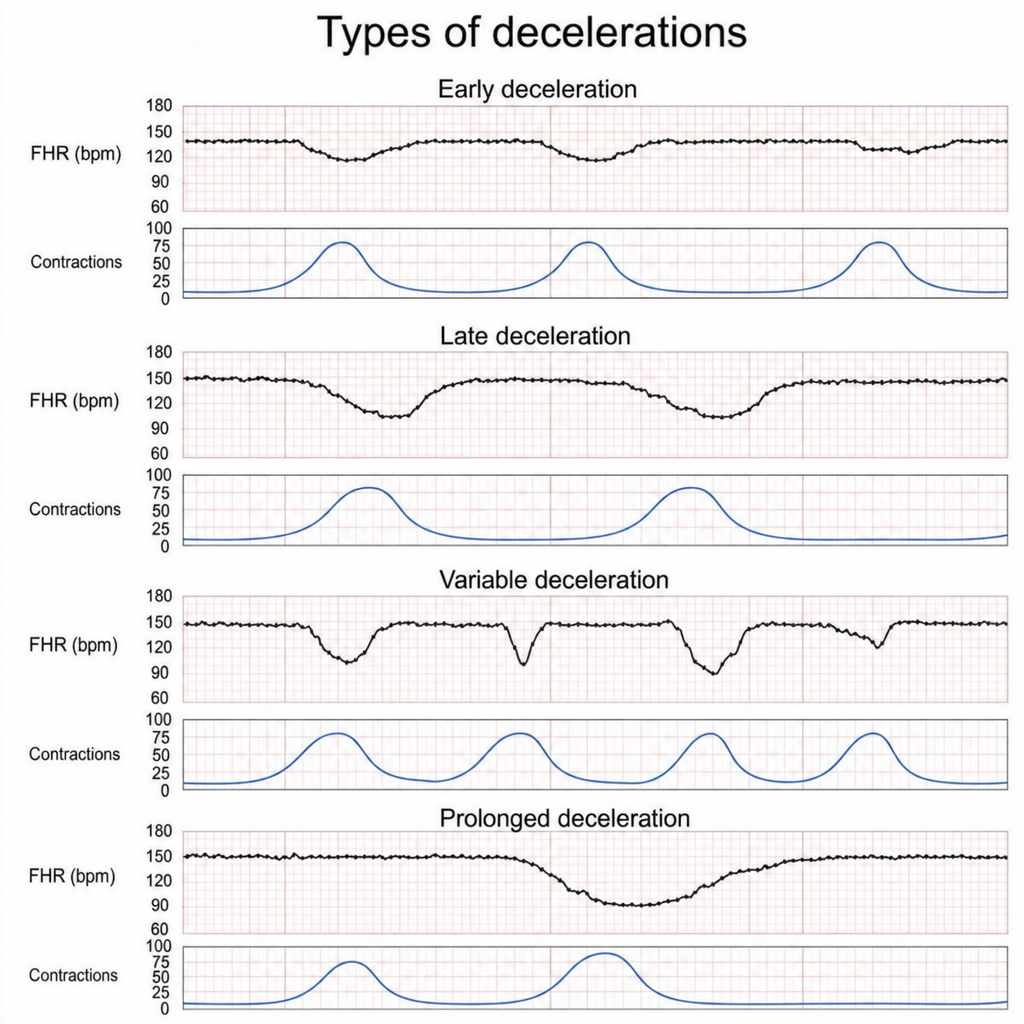
Variable deceleration indicates:
What is the recommended initial management for bleeding vulvar varices during pregnancy?
Which of the following is NOT a cause of prolonged first stage of labor?
What is the best regimen for eclampsia?
Internal podalic version is done:
While assessing fetal well-being by cardiotocography, which of the following findings indicates cord compression?
A 16-year-old female presents with severe abdominal pain and fever. Laboratory findings include an elevated white blood cell count and a positive pregnancy test. Colpocentesis is performed to identify pelvic blood, potentially from a ruptured ectopic pregnancy. Through which of the following structures is the needle inserted?
The distance from the upper end of sacrum to the lower border of the pubis corresponds to which conjugate?
What is the largest transverse diameter of the fetal head?
Explanation: ***Ritgen maneuver*** - The **Ritgen maneuver** involves applying **upward pressure** on the fetal chin through the **perineum** during crowning to control delivery of the head. - This technique helps **protect the perineum** from tearing and allows for **controlled extension** of the fetal head during the second stage of labor. *Wood's maneuver* - **Wood's screw maneuver** is used specifically for **shoulder dystocia**, involving rotation of the posterior shoulder to disimpact it. - This maneuver requires inserting fingers into the vagina to rotate the fetus, not external perineal pressure as shown. *Burns Marshall maneuver* - The **Burns Marshall maneuver** is used during **breech delivery** to assist delivery of the aftercoming head. - This technique involves **flexion and traction** on the fetal legs and body, not perineal pressure during vertex delivery. *Zavanelli maneuver* - The **Zavanelli maneuver** involves **replacing the fetal head** back into the uterus when shoulder dystocia cannot be resolved. - This is an **emergency procedure** followed by **cesarean delivery**, not a routine delivery technique as depicted.
Explanation: **Explanation:** **Variable decelerations** are defined as abrupt decreases in fetal heart rate (FHR) that vary in onset, depth, and duration. They are the most common type of deceleration seen during labor. **1. Why Cord Compression is Correct:** Variable decelerations are caused by **umbilical cord compression**. When the cord is compressed, the umbilical vein is occluded first, causing a transient drop in fetal cardiac output and a compensatory rise in FHR (the "shoulder"). Subsequently, the umbilical artery is occluded, leading to a sudden increase in fetal peripheral resistance and baroreceptor-mediated vagal stimulation, which results in the characteristic sharp "V-shaped" drop in heart rate. **2. Why Other Options are Incorrect:** * **A. Head compression:** This causes **Early decelerations**, which are symmetrical, gradual, and mirror the uterine contraction. * **C. Fetal hypoxemia:** While severe or prolonged variable decelerations can lead to hypoxia, the primary cause of **Late decelerations** is uteroplacental insufficiency, which is the hallmark of fetal hypoxia/acidosis. * **D. Maternal sedation:** This typically causes a **decrease in FHR variability** (a "flat" baseline) rather than periodic decelerations. **Clinical Pearls for NEET-PG:** * **VEAL CHOP Mnemonic:** * **V**ariable = **C**ord compression * **E**arly = **H**ead compression * **A**ccelerations = **O**kay (Fetal oxygenation) * **L**ate = **P**lacental insufficiency * **Management:** Initial steps for variable decelerations include maternal position change (left lateral), oxygen administration, and stopping oxytocin. If persistent and severe, **amnioinfusion** may be considered to relieve cord pressure. * **Rule of 15:** Variable decelerations are defined as a decrease of $\ge$ 15 bpm, lasting $\ge$ 15 seconds but < 2 minutes.
Explanation: **Explanation:** **Vulvar varices** occur in approximately 4% of pregnancies, typically due to increased pelvic venous pressure, progesterone-induced vasodilation, and the compressive effect of the gravid uterus on the inferior vena cava. **Why "Observation only" is correct:** The management of vulvar varices during pregnancy is almost exclusively **conservative**. These veins are highly engorged and thin-walled; however, they are under low pressure. Most importantly, they characteristically **regress spontaneously** within 6–8 weeks postpartum once the mechanical obstruction (the fetus) is removed. Active intervention is rarely required because the risk of significant hemorrhage is low, and surgical sites in this region heal poorly during pregnancy due to high vascularity and edema. **Why the other options are incorrect:** * **Pressure:** While local pressure (using a sanitary pad or specialized support garment) is used to relieve *discomfort* or heaviness, it is not the definitive management for the condition itself. * **Cautery:** Attempting to cauterize or suture these veins is contraindicated during pregnancy. The tissue is extremely friable, and intervention often leads to further bleeding, hematoma formation, and secondary infection. * **Simple vulvectomy:** This is a radical surgical procedure reserved for malignancies. It is never indicated for benign, pregnancy-related venous changes. **High-Yield Clinical Pearls for NEET-PG:** * **Mode of Delivery:** Vulvar varices are **not** an indication for Cesarean section. Vaginal delivery is safe; even if a varix bleeds during labor, it is easily controlled with direct pressure. * **Episiotomy:** If varices are extensive, avoid episiotomy if possible, or perform it mediolaterally on the contralateral side to avoid the engorged vessels. * **Symptomatic Relief:** Recommend pelvic floor exercises (Kegels), side-lying positions, and vulvar compression garments.
Explanation: **Explanation:** The **first stage of labor** begins with the onset of true labor pains and ends with full cervical dilatation (10 cm). Any factor that hinders uterine efficiency or fetal descent through the birth canal can prolong this stage. **Why "Rigid Perineum" is the correct answer:** The perineum is the anatomical structure involved in the **second stage of labor** (from full dilatation to delivery of the fetus). A rigid perineum offers resistance only when the fetal head is on the pelvic floor, potentially causing a prolonged second stage or requiring an episiotomy. It has no physiological impact on cervical dilatation or the first stage of labor. **Analysis of Incorrect Options:** * **Weak uterine contractions (Hypotonic Uterine Inertia):** This is the most common cause of a prolonged first stage. Without adequate frequency and intensity of contractions, the cervix fails to dilate. * **Cephalopelvic Disproportion (CPD):** If the fetal head is too large for the maternal pelvis, it cannot descend to apply pressure on the cervix. This lack of "form-fitting" pressure leads to poor cervical effacement and dilatation. * **Transverse presentation:** Malpresentations prevent the presenting part from engaging in the pelvis. This results in an irregular application of the fetus against the cervix, leading to slow or arrested dilatation. **Clinical Pearls for NEET-PG:** * **Friedman’s Curve:** Used to track labor progress. A prolonged latent phase is defined as >20 hours in primigravida and >14 hours in multigravida. * **Active Phase Arrest:** Diagnosed if there is no cervical change for ≥4 hours with adequate contractions or ≥6 hours with inadequate contractions. * **Management:** For weak contractions, the treatment of choice is **Oxytocin** augmentation and/or **Amniotomy** (ARM).
Explanation: **Explanation:** **Magnesium Sulfate (MgSO₄)** is the gold standard and drug of choice for both the prevention (pre-eclampsia) and treatment (eclampsia) of seizures. The landmark **Pritchard Regimen** and the **Collaborative Eclampsia Trial** established its superiority over other anticonvulsants. It works by increasing the seizure threshold through NMDA receptor antagonism and causing cerebral vasodilation, thereby reducing cerebral ischemia. Unlike other sedatives, it does not cause significant respiratory depression in the fetus at therapeutic levels. **Why other options are incorrect:** * **Lytic Cocktail:** (Chlorpromazine, Promethazine, and Pethidine) was used historically but is now obsolete due to high maternal mortality and excessive sedation. * **Phenytoin:** While an effective antiepileptic, it is less effective than MgSO₄ in preventing recurrent seizures in eclampsia and carries risks of hypotension and cardiac arrhythmias. * **Diazepam:** Though it can control an acute seizure, it is associated with a higher rate of seizure recurrence and causes significant neonatal respiratory depression and "floppy infant syndrome." **High-Yield Clinical Pearls for NEET-PG:** * **Therapeutic Level:** 4–7 mEq/L. * **Monitoring:** Always check for **Patellar reflex** (first to disappear at 8–10 mEq/L), **Respiratory rate** (>12/min), and **Urine output** (>30 ml/hr). * **Antidote:** 10 ml of 10% **Calcium Gluconate** IV (administered slowly). * **Loading Dose (Pritchard):** 4g IV (slowly) + 10g IM (5g in each buttock).
Explanation: **Explanation:** **Internal Podalic Version (IPV)** is an obstetric maneuver where the fetus is turned into a breech presentation by reaching inside the uterus, grasping the feet, and pulling them down into the birth canal. **Why Option B is Correct:** The primary indication for IPV in modern obstetrics is the **delivery of the second twin in a transverse lie**. Once the first twin is delivered, the uterus remains relatively relaxed, and the cervix is fully dilated, providing a brief window to manually rotate the second twin to a breech presentation for immediate extraction. **Why Other Options are Incorrect:** * **Option A:** IPV is never performed at 32 weeks for a transverse lie. External Cephalic Version (ECV) is the preferred method for malpresentation, but it is typically attempted after 36–37 weeks. Performing IPV at 32 weeks would be invasive and risk preterm labor or uterine rupture. * **Option C:** Adequate amniotic fluid is a **prerequisite** for IPV. If there is minimal fluid (oligohydramnios) or the membranes have been ruptured for a long time, the uterus contracts tightly around the fetus. Attempting a version in a "dry labor" carries a high risk of **uterine rupture**. **High-Yield Clinical Pearls for NEET-PG:** * **Prerequisites for IPV:** Fully dilated cervix, intact membranes (or recently ruptured), relaxed uterus (often under GA), and an empty bladder. * **Contraindications:** Ruptured membranes with a drained liquor, contracted pelvis, or a scarred uterus (previous C-section). * **Complication:** The most serious complication of IPV is **uterine rupture**. * **Current Status:** Due to the high risk of birth trauma, IPV has largely been replaced by Cesarean section, except in the specific case of the second twin.
Explanation: The correct answer is **D. Variable deceleration**. *(Note: The question prompt incorrectly marks 'Late deceleration' as correct. In standard obstetric teaching, Variable decelerations are the hallmark of cord compression.)* ### **Explanation of Findings** **1. Variable Deceleration (Correct Answer):** These are abrupt decreases in fetal heart rate (FHR) that vary in timing, shape, and duration in relation to uterine contractions. They are caused by **umbilical cord compression**, which triggers a baroreceptor-mediated vagal response. This is the most common type of deceleration seen in labor. **2. Late Deceleration (Option A):** These are gradual decreases in FHR where the nadir occurs *after* the peak of the contraction. They indicate **uteroplacental insufficiency** and fetal hypoxia. This is a "non-reassuring" sign requiring immediate attention. **3. Early Deceleration (Option B):** These are symmetrical, gradual decreases where the nadir coincides with the peak of the contraction ("mirror image"). They are caused by **fetal head compression**, which leads to vagal stimulation. They are considered physiological and benign. **4. Sinusoidal Pattern (Option C):** A smooth, sine-wave-like pattern indicating **severe fetal anemia** (e.g., Rh isoimmunization, massive feto-maternal hemorrhage) or severe fetal distress. --- ### **High-Yield Clinical Pearls (NEET-PG)** To remember the etiologies of FHR patterns, use the mnemonic **VEAL CHOP**: * **V**ariable = **C**ord Compression * **E**arly = **H**ead Compression * **A**ccelerations = **O**k (Fetal Well-being) * **L**ate = **P**lacental Insufficiency * **Management of Variable Decelerations:** Change maternal position (left lateral), provide oxygen, and consider amnioinfusion if persistent. * **Reassuring CTG:** Baseline 110–160 bpm, moderate variability (6–25 bpm), and presence of accelerations.
Explanation: **Explanation:** **1. Why the Correct Answer is Right:** Culdocentesis (or colpocentesis) is a diagnostic procedure used to check for abnormal fluid (blood, pus, or peritoneal fluid) in the **Rectouterine Pouch (Pouch of Douglas)**. This pouch is the most dependent (lowest) part of the peritoneal cavity in the upright or supine position. Anatomically, the Pouch of Douglas lies immediately posterior to the uterus and is separated from the vaginal canal only by the thin wall of the **posterior vaginal fornix**. By inserting a needle through the posterior fornix, a clinician can directly access this space to aspirate blood, which is a hallmark sign of a ruptured ectopic pregnancy. **2. Why the Incorrect Options are Wrong:** * **Option A:** The perineal body is a fibromuscular mass between the vagina and anus; piercing it would not provide access to the peritoneal cavity. The vesicouterine space is located anteriorly between the bladder and uterus and is not the most dependent area for fluid collection. * **Option C:** The anterior fornix is related to the bladder and the vesicouterine pouch. Entering the endocervical canal would lead into the uterine cavity, not the peritoneal space. * **Option D:** The introitus is the external vaginal opening, and the vestibular glands (Bartholin’s glands) are superficial structures. Neither provides access to the pelvic cavity. **3. High-Yield Clinical Pearls for NEET-PG:** * **Gold Standard:** While culdocentesis was historically vital, **Transvaginal Ultrasound (TVUS)** is now the primary diagnostic tool for suspected ectopic pregnancy. * **Interpretation:** A "positive" culdocentesis for ruptured ectopic pregnancy yields **non-clotting blood** (due to fibrinolysis in the peritoneum). If the blood clots, it likely indicates a traumatic tap (vessel puncture). * **Anatomy:** The Pouch of Douglas is bounded anteriorly by the uterus/posterior fornix and posteriorly by the rectum.
Explanation: ### Explanation The pelvic inlet (brim) has three critical anteroposterior diameters. Understanding the specific landmarks for each is essential for assessing pelvic adequacy for labor. **1. Why Diagonal Conjugate is Correct:** The **Diagonal Conjugate** is the distance from the **sacral promontory (upper end of the sacrum) to the lower border of the symphysis pubis**. It is the only anteroposterior diameter that can be measured clinically during a per-vaginal (PV) examination. Its normal value is approximately **12 cm**. **2. Analysis of Incorrect Options:** * **True Conjugate (Anatomical Conjugate):** This is the distance from the sacral promontory to the **upper border** of the symphysis pubis. It measures about 11 cm but cannot be measured clinically. * **Obstetric Conjugate:** This is the shortest diameter through which the fetal head must pass. It extends from the sacral promontory to a point on the **inner surface** of the symphysis pubis (about 1 cm below the upper border). It measures approximately 10.5 cm. * **Transverse Conjugate:** This is the widest distance between the two iliopectineal lines, measuring about 13 cm. It is a lateral measurement, not an anteroposterior one. **3. NEET-PG High-Yield Pearls:** * **Calculation:** Obstetric Conjugate = Diagonal Conjugate minus 1.5 to 2 cm. * **Clinical Significance:** If the diagonal conjugate is >11.5 cm, the pelvis is likely adequate for a normal delivery. * **Contracted Pelvis:** A diagonal conjugate of less than 11.5 cm suggests a contracted pelvic inlet. * **Landmark Tip:** Always remember: **U**pper border = Tr**u**e; **L**ower border = Diagona**l**; **I**nner surface = Obstetr**i**c.
Explanation: **Explanation:** The fetal skull is characterized by various diameters that determine its passage through the birth canal. These are categorized into longitudinal (anteroposterior) and transverse diameters. **Correct Option: D. Bitemporal diameter** The **Bitemporal diameter** measures approximately **8.0 cm** to **8.5 cm**. It represents the distance between the furthest points of the coronal suture. While it is a significant transverse diameter, it is actually **smaller** than the Biparietal diameter. *Note on the provided key:* In standard obstetric textbooks (e.g., Williams, Dutta), the **Biparietal diameter (9.5 cm)** is documented as the largest transverse diameter. However, in some specific competitive exam contexts or variations in question phrasing regarding "the diameter between the temples," Bitemporal is listed. If the question asks for the *largest* transverse diameter, **Biparietal (9.5 cm)** is the gold standard. **Analysis of Incorrect Options:** * **A. Biparietal diameter (9.5 cm):** This is the distance between the two parietal eminences. It is the largest transverse diameter of the fetal head and is the diameter that must pass through the pelvic inlet in a well-flexed vertex presentation. * **B. Suboccipito-Bregmatic (9.5 cm):** This is a **longitudinal (anteroposterior)** diameter, not a transverse one. It is the diameter of engagement in a fully flexed head. * **C. Suboccipito-Frontal (10 cm):** This is also a **longitudinal** diameter, measured from the suboccipital region to the anterior end of the anterior fontanelle. **High-Yield NEET-PG Pearls:** 1. **Largest Transverse Diameter:** Biparietal (9.5 cm). 2. **Smallest Transverse Diameter:** Bimastoid (7.5 cm). 3. **Largest Longitudinal Diameter:** Mento-vertical (14 cm), seen in brow presentation. 4. **Smallest Longitudinal Diameter:** Suboccipito-bregmatic (9.5 cm), seen in well-flexed vertex presentation. 5. **Super-subparietal diameter (8.5 cm):** Measured from below one parietal eminence to above the other; relevant in asynclitism.
Physiology of Labor
Practice Questions
Stages of Labor and Normal Progression
Practice Questions
Fetal Monitoring Techniques
Practice Questions
Pain Management in Labor
Practice Questions
Induction and Augmentation of Labor
Practice Questions
Operative Delivery (Forceps and Vacuum)
Practice Questions
Cesarean Section: Indications and Techniques
Practice Questions
Dystocia and Abnormal Labor Patterns
Practice Questions
Obstetric Emergencies
Practice Questions
Postpartum Hemorrhage Management
Practice Questions
Get full access to all questions, explanations, and performance tracking.
Start For Free