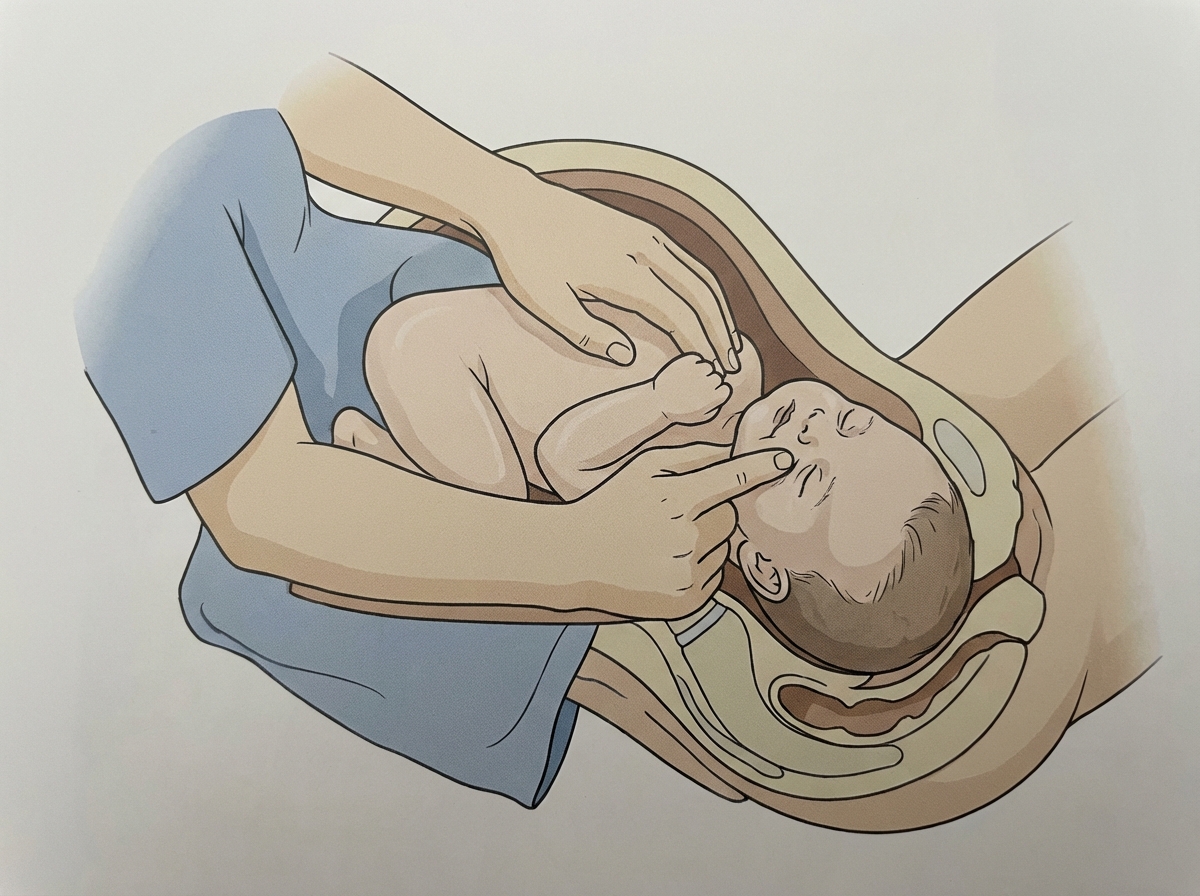
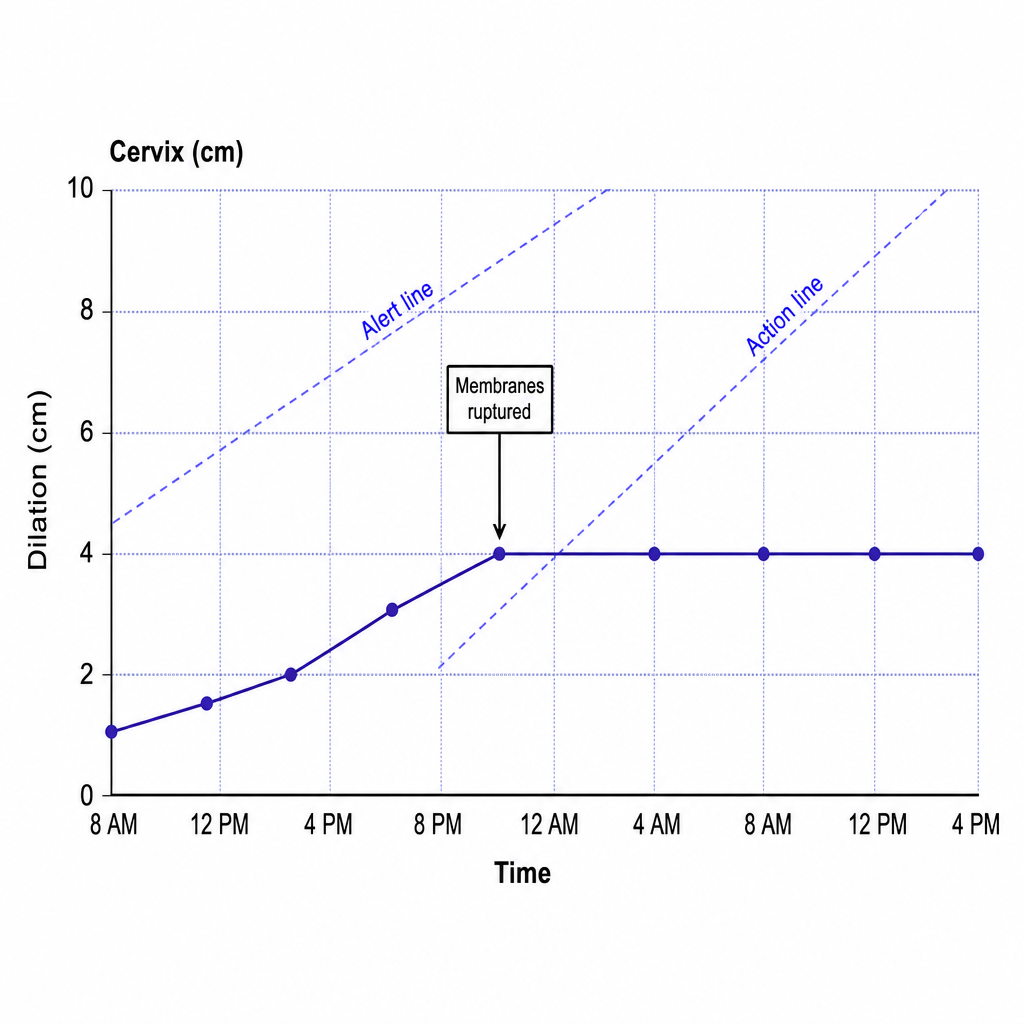
In a case of prolonged labor with persistent occiput posterior presentation, what is the recommended management?
Rupture of membranes is said to be premature when it occurs:
What is the recommended treatment for deep transverse arrest?
A 37-week pregnant female presents with grade 3 placenta previa, vaginal bleeding, and uterine contractions. What is the most appropriate management?
Couvelaire uterus is a condition associated with which of the following?
What is the most common twin presentation?
A woman presents with obstructed labor and is grossly dehydrated. Investigations reveal fetal demise. What is the most appropriate management for this patient?
What is true about a frank breech presentation?
Which of the following is a component of active management of the third stage of labor?
Which of the following describes sonological findings of Placenta accreta?
Explanation: **Explanation:** In **Persistent Occiput Posterior (POP)**, the fetal head fails to rotate anteriorly and remains in the posterior quadrant of the pelvis. This often leads to a "prolonged labor" due to the larger diameters (occipito-frontal) presenting at the pelvic outlet. **Why Option A is Correct:** When the second stage of labor is prolonged but the head is engaged and the cervix is fully dilated, the goal is to facilitate delivery. **Manual rotation** (using the hand to turn the occiput anteriorly) or **instrumental rotation** (using Kielland’s forceps) followed by extraction is the standard intervention. This converts the malposition into an occiput anterior position, allowing for a safer and easier vaginal delivery. **Why Other Options are Incorrect:** * **B. Oxytocin drip:** While oxytocin can correct secondary uterine inertia, it will not resolve a mechanical malposition. If the head is stuck in POP, simply increasing contractions without rotation can lead to maternal exhaustion or fetal distress. * **C. Cesarean section:** While a C-section is performed if there is cephalopelvic disproportion or fetal distress, it is not the *first* recommendation if the head is low and instrumental rotation is feasible. * **D. Artificial rupture of membranes (ARM):** ARM is typically used to augment the first stage of labor; it does not address the positional issue in the second stage of prolonged labor. **High-Yield Clinical Pearls for NEET-PG:** * **Commonest cause of POP:** Anthropoid or Android pelvis. * **Clinical sign:** "Anthropoid" or "Face-to-pubes" delivery occurs if the head delivers without rotation. * **Key Diameter:** The presenting diameter in POP is the **Occipito-frontal (11.5 cm)**, which is larger than the Sub-occipitobregmatic (9.5 cm) of a flexed OA position. * **Management Rule:** If the head is engaged and the cervix is fully dilated, attempt rotation; if the head is high or there is arrest, proceed to C-section.
Explanation: ### Explanation **1. Understanding the Correct Answer (Option C)** The definition of **Premature Rupture of Membranes (PROM)** is strictly clinical and relates to the **timing of labor onset**, not the gestational age. It is defined as the spontaneous rupture of the amniotic membranes **prior to the onset of labor** (i.e., before the start of the 1st stage of labor). If labor does not begin within one hour of rupture, it is classified as PROM. **2. Analysis of Incorrect Options** * **Options A & B:** These refer to gestational ages. While rupture before 37 weeks is specifically called **Preterm PROM (PPROM)**, the term "Premature" in PROM refers to the "pre-labor" status. A patient at 38 weeks (Term) can still have PROM if her membranes rupture before contractions begin. * **Option D:** Rupture during the 2nd stage of labor is considered late. Normal rupture typically occurs at the end of the 1st stage (full cervical dilatation). **3. NEET-PG High-Yield Pearls** * **PPROM:** Rupture occurring before 37 completed weeks of gestation. * **Diagnosis:** The gold standard is clinical visualization of fluid pooling in the posterior fornix via a **sterile speculum exam**. Avoid digital exams to reduce infection risk. * **Confirmatory Tests:** * **Nitrazine Test:** Paper turns blue (pH > 6.0-6.5). * **Fern Test:** Arborization pattern on microscopy (most reliable). * **Latency Period:** The time interval between the rupture of membranes and the onset of labor. * **Major Complication:** Chorioamnionitis (indicated by maternal fever, fetal tachycardia, and uterine tenderness).
Explanation: **Explanation:** **Deep Transverse Arrest (DTA)** occurs when the fetal head is arrested at the level of the ischial spines (deep in the pelvic cavity) in the transverse position. This is typically due to a failure of internal rotation, often associated with an android or anthropoid pelvis. **1. Why LSCS is the Correct Answer:** In modern obstetric practice, **Lower Segment Cesarean Section (LSCS)** is the safest and most recommended treatment for DTA. While historical textbooks mentioned manual rotation or Kielland’s forceps, these procedures carry high risks of maternal trauma (vaginal tears, bladder injury) and neonatal morbidity (intracranial hemorrhage). Because DTA often signifies a **relative cephalopelvic disproportion (CPD)** or a contracted mid-pelvis, LSCS ensures the best outcome for both mother and fetus. **2. Why Other Options are Incorrect:** * **Induction of Labour:** This is used to initiate labor, not to manage an arrest that occurs during the second stage. * **Trial of Labour:** DTA is a diagnosis made *during* labor when progress has already ceased; therefore, the "trial" has effectively failed. * **Craniotomy:** This is a destructive procedure only performed on a **dead fetus** to facilitate delivery. It is never the first-line treatment for a live fetus. **Clinical Pearls for NEET-PG:** * **Definition:** Arrest of the fetal head at the level of ischial spines for >1 hour in the transverse position. * **Commonest Cause:** Android pelvis (due to its narrow mid-pelvis and straight side walls). * **Prerequisites for Forceps:** If instrumental delivery is attempted (rarely), the cervix must be fully dilated, the head must be engaged, and there must be no CPD. * **High-Yield Fact:** If the question specifies a **dead fetus** in DTA, the answer changes to **Craniotomy**. For a **live fetus**, the answer is always **LSCS**.
Explanation: **Explanation:** The management of placenta previa depends on the **gestational age**, the **severity of bleeding**, and the **presence of labor**. **1. Why Option D is Correct:** The patient is at **37 weeks (term)** and is symptomatic with **vaginal bleeding and uterine contractions**. In placenta previa, uterine contractions cause cervical effacement and dilatation, which leads to further separation of the placenta and life-threatening hemorrhage. Since the pregnancy has reached term and the patient is in active labor/bleeding, immediate delivery is mandatory. For **Grade 3 (total/major)** placenta previa, vaginal delivery is contraindicated; therefore, an **Emergency Lower Segment Cesarean Section (LSCS)** is the definitive management to save both mother and fetus. **2. Why Other Options are Incorrect:** * **Option A & B:** These are components of **Macafee and Johnson’s expectant management**. This protocol is only indicated if the fetus is preterm (<37 weeks), bleeding is not life-threatening, and the patient is not in labor. * **Option C:** "Wait and watch" is dangerous in the presence of active contractions and major placenta previa at term, as it risks sudden, massive maternal hemorrhage and fetal distress. **Clinical Pearls for NEET-PG:** * **Macafee Protocol Goal:** To carry the pregnancy to 37 weeks (term). * **Contraindication:** Never perform a **per-vaginal (PV) examination** in a suspected case of placenta previa outside the operating theater ("Double Setup"), as it can provoke torrential bleeding. * **Stallworthy’s Sign:** A drop in fetal heart rate when the fetal head is pressed into the pelvis (common in posterior placenta previa). * **Gold Standard Diagnosis:** Transvaginal Ultrasound (TVS) is more accurate than transabdominal ultrasound for locating the placental edge.
Explanation: **Explanation:** **Couvelaire uterus** (also known as uteroplacental apoplexy) is a classic complication of **Abruptio placentae**, specifically the concealed variety. It occurs when retroplacental blood penetrates through the uterine musculature (myometrium) into the subserosal space. This massive extravasation of blood causes the uterus to appear bluish or purplish and mottled, often losing its ability to contract effectively (uterine atony). **Why the other options are incorrect:** * **Placenta Previa:** This involves the placenta being implanted in the lower uterine segment. Bleeding is typically painless and external; it does not involve the intramural sequestration of blood seen in Couvelaire uterus. * **Vasa Previa:** This is a condition where fetal vessels run through the membranes over the internal os. Bleeding here is fetal in origin and occurs upon rupture of membranes, without myometrial infiltration. **High-Yield Clinical Pearls for NEET-PG:** * **Diagnosis:** It is a **per-operative diagnosis** (usually seen during a Cesarean section). * **Management:** The primary treatment is the administration of **oxytocics** to manage the resulting uterine atony. Hysterectomy is rarely required and is only a last resort if bleeding cannot be controlled. * **Key Feature:** Despite the alarming appearance of the uterus, it is **not** an absolute indication for hysterectomy. * **Association:** It is most commonly associated with severe, concealed placental abruption and pre-eclampsia.
Explanation: **Explanation:** In twin pregnancies, the presentation of the fetuses depends on their orientation relative to the maternal pelvis. The most common presentation, occurring in approximately **40–45% of cases**, is **Vertex-Vertex** (both twins presenting by the head). This is followed by Vertex-Breech (approx. 35%) and Breech-Breech (approx. 10%). **Why Vertex-Vertex is correct:** The fetal head is the heaviest part of the body, and gravity naturally encourages a cephalic (vertex) position. In a twin gestation, the uterine cavity is most efficiently occupied when both fetuses align longitudinally. Since the vertex position is the most common for singletons (95%), it remains the statistically dominant presentation for both Twin A (the leading twin) and Twin B. **Analysis of Incorrect Options:** * **Vertex-Brow & Vertex-Face:** These represent malpresentations of the second twin. While they can occur, they are rare (less than 1%) and do not constitute a standard "common" pattern for twin delivery. * **Vertex-Breech:** This is the **second most common** presentation. It is clinically significant because while Twin A can be delivered vaginally, the delivery of Twin B (breech) requires specific obstetric maneuvers or a possible internal podalic version. **NEET-PG High-Yield Pearls:** * **Management:** Vertex-Vertex twins are almost always managed via a trial of vaginal delivery. * **The "Rule of 50":** Roughly 50% of twins are Vertex-Vertex, and in nearly 80% of all twin pregnancies, Twin A is Vertex. * **Contraindication:** If Twin A is Non-Vertex (e.g., Breech or Transverse), a Cesarean Section is generally indicated to avoid "locked twins," a rare but serious complication where the chins of both fetuses interlock.
Explanation: **Explanation:** The management of obstructed labor has evolved significantly in modern obstetrics. Even in the presence of **fetal demise**, **Cesarean Section (CS)** is now considered the safest and most appropriate management for the mother. **1. Why Cesarean Section is Correct:** In obstructed labor, the lower uterine segment is thinned out and pathological retraction rings (Bandl’s ring) may be present. The mother is often dehydrated, ketoacidotic, and at high risk of uterine rupture. Performing destructive procedures (like craniotomy) on a friable, overstretched uterus carries a high risk of maternal trauma, bladder injury, and uncontrollable hemorrhage. CS allows for better visualization, controlled delivery, and immediate assessment of uterine integrity. **2. Why Other Options are Incorrect:** * **Craniotomy & Decapitation (Destructive Procedures):** While historically used for dead fetuses in obstructed labor, these are now largely obsolete in modern settings. They are technically difficult, carry a high risk of maternal soft tissue injury, and can trigger uterine rupture if the uterus is already compromised. * **Forceps Extraction:** This is strictly contraindicated in obstructed labor. Forceps require a fully dilated cervix, engaged head, and no cephalopelvic disproportion (CPD). Attempting forceps in obstructed labor leads to extensive vaginal tears and uterine rupture. **Clinical Pearls for NEET-PG:** * **Gold Standard:** CS is the management of choice for obstructed labor, regardless of fetal viability, to ensure maternal safety. * **Signs of Obstructed Labor:** Bandl’s ring, ballooning of the lower uterine segment, and maternal exhaustion/dehydration. * **Pre-operative Care:** Always rehydrate the patient and correct electrolyte imbalances before surgery to reduce anesthetic risks.
Explanation: **Explanation:** **1. Why Option C is Correct:** External Cephalic Version (ECV) is the preferred procedure to convert a breech presentation to a cephalic one to facilitate vaginal delivery. According to standard guidelines (RCOG/ACOG), ECV is ideally performed at **36 weeks in nulliparous women** and **37 weeks in multiparous women**. Performing it at this stage balances the success rate (adequate liquor and a mobile fetus) against the risk of preterm labor, as the fetus is near term if an emergency delivery becomes necessary. **2. Why the Other Options are Incorrect:** * **Option A:** While breech presentation generally has a higher association with anomalies (e.g., hydrocephalus) than cephalic presentation, **frank breech** specifically is the most common type and is frequently associated with mechanical factors (e.g., uterine cornual implantation) rather than a specific congenital anomaly. * **Option B:** A footling presentation is a type of **incomplete breech** where one or both feet are the presenting part below the buttocks. Frank breech is distinct from footling. * **Option D:** In a frank breech, the **hips are flexed** and the **knees are extended** (the legs act as a splint against the trunk). This is the most common variety of breech (60-70%). **Clinical Pearls for NEET-PG:** * **Types of Breech:** * **Frank:** Hips flexed, Knees extended (Most common). * **Complete:** Hips flexed, Knees flexed. * **Footling:** Hips extended, Knees extended (Highest risk of cord prolapse). * **Prerequisites for ECV:** Reactive NST, adequate liquor (AFI >5), and no contraindications (like placenta previa or previous classical CS). * **Tocolysis:** Use of Beta-mimetics (e.g., Terbutaline) increases the success rate of ECV.
Explanation: **Explanation:** The **Active Management of the Third Stage of Labor (AMTSL)** is a globally recommended intervention designed to prevent Postpartum Hemorrhage (PPH), the leading cause of maternal mortality. According to WHO and FIGO guidelines, AMTSL consists of three primary components: 1. **Administration of a Uterotonic:** Oxytocin is the drug of choice. 2. **Controlled Cord Traction (CCT):** To facilitate placental delivery. 3. **Uterine Massage:** Performed after placental delivery to ensure the uterus remains contracted. **Why Option B is correct:** The gold standard for AMTSL is the administration of **10 units of Oxytocin IM within 1 minute** of the delivery of the baby (after ruling out the presence of a second twin). This timing is critical to stimulate effective uterine contractions immediately, facilitating placental separation and minimizing blood loss from the placental site. **Why other options are incorrect:** * **Option A (30 seconds):** While earlier administration is not harmful, the standard clinical definition and guideline-specified window is "within 1 minute." * **Options C & D (2 and 5 minutes):** These timeframes are considered delayed. Delaying the uterotonic increases the risk of uterine atony and subsequent PPH. **High-Yield Clinical Pearls for NEET-PG:** * **Drug of Choice:** Oxytocin (10 IU IM or 5 IU slow IV) is preferred over Methylergometrine due to fewer side effects (no hypertension) and faster onset. * **Delayed Cord Clamping:** Current guidelines recommend waiting **1–3 minutes** before clamping the cord (to benefit the neonate), but the **uterotonic should still be given within 1 minute.** * **Misoprostol:** If Oxytocin is unavailable, 600 mcg of oral Misoprostol is the alternative. * **AMTSL vs. Expectant Management:** AMTSL reduces the risk of PPH by approximately 60%.
Explanation: **Explanation:** **Placenta accreta** is a clinical condition where there is an abnormal adherence of the placenta to the underlying myometrium due to the partial or total absence of the **Decidua basalis** and the imperfect development of the **Nitabuch’s layer**. **Why Option B is correct:** The presence of **large, irregular intraplacental lacunae** (often described as a "moth-eaten" appearance) is the most predictive sonographic sign of placenta accreta. These lacunae represent areas of high-velocity blood flow within the placental substance, resulting from the abnormal invasion of chorionic villi into the myometrium and its vasculature. **Why other options are incorrect:** * **Option A (Ring of fire appearance):** This is a classic Doppler finding in **Ectopic Pregnancy** (representing hypervascularity around the gestational sac) or a Corpus Luteum cyst. * **Option C (Thickening of retroplacental myometrium with clots):** This describes **Abruptio Placentae**. In Placenta accreta, the retroplacental myometrial zone is typically **thinned or absent** (<1 mm), rather than thickened. **High-Yield Clinical Pearls for NEET-PG:** * **Most important risk factor:** Previous Cesarean section + Placenta previa. * **Other USG findings:** Loss of the "retroplacental hypoechoic zone," bladder wall interruption, and "bridging vessels" on color Doppler. * **Gold Standard Diagnosis:** Histopathology (post-hysterectomy). * **Management:** Planned Cesarean hysterectomy is the standard of care to prevent life-threatening postpartum hemorrhage.
Physiology of Labor
Practice Questions
Stages of Labor and Normal Progression
Practice Questions
Fetal Monitoring Techniques
Practice Questions
Pain Management in Labor
Practice Questions
Induction and Augmentation of Labor
Practice Questions
Operative Delivery (Forceps and Vacuum)
Practice Questions
Cesarean Section: Indications and Techniques
Practice Questions
Dystocia and Abnormal Labor Patterns
Practice Questions
Obstetric Emergencies
Practice Questions
Postpartum Hemorrhage Management
Practice Questions
Get full access to all questions, explanations, and performance tracking.
Start For Free