What is the commonest site for a fibroid?
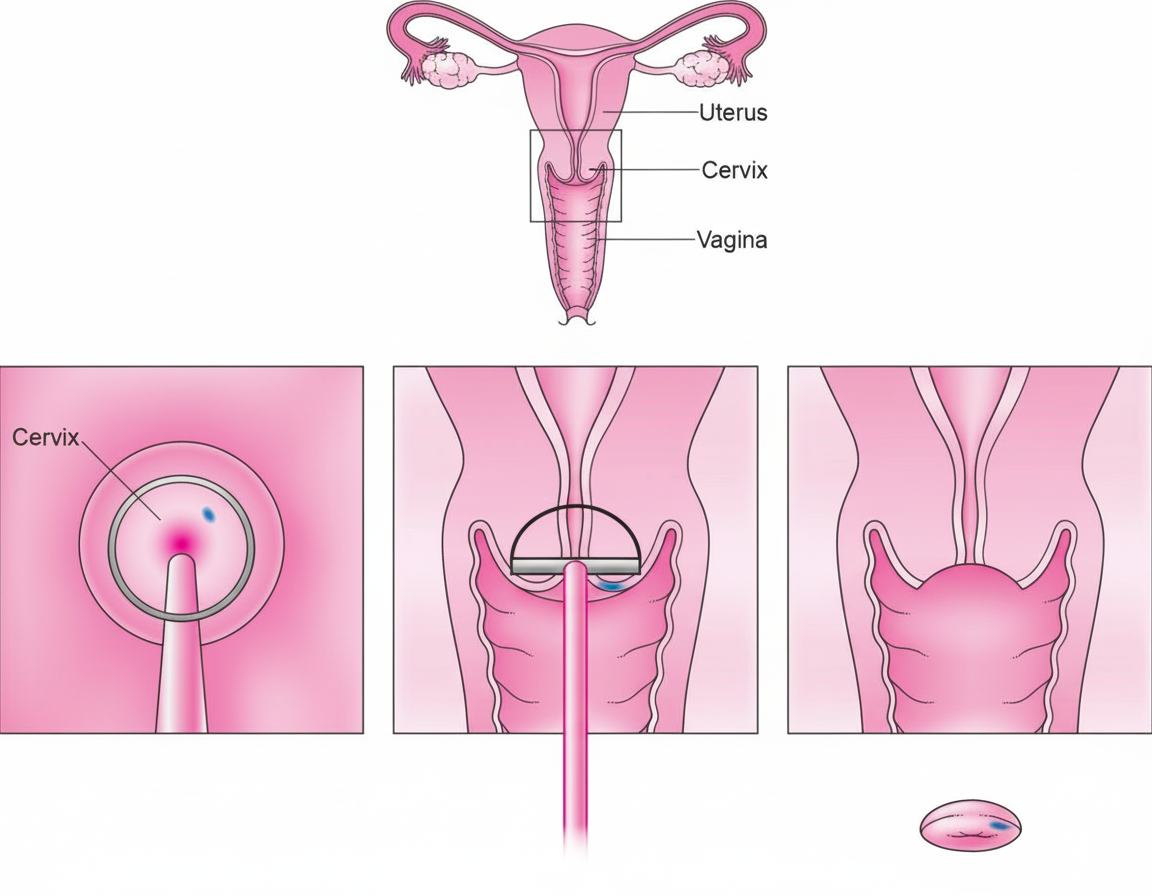
The procedure shown below is
A 28-week pregnant patient presents with abdominal pain and fever. Ultrasonography reveals the presence of a fibroid. What is the next line of management?
Fothergill's repair is also known as:
During pregnancy, fibroid may have all of the following complications except:
What is the primary treatment for endometriosis in a younger age group?
Which of the following findings is suggestive of a Bicornuate uterus?
Which of the following is the most widely accepted theory explaining the development of endometriosis?
Which of the following is NOT a risk factor for acute pelvic inflammatory disease (PID)?
All of the following are included in Amsler's criteria, EXCEPT:
Explanation: **Explanation:** Uterine fibroids (leiomyomas) are the most common benign tumors of the female reproductive tract, arising from the smooth muscle cells of the myometrium. **Why Intramural is the correct answer:** **Intramural (Interstitial) fibroids** are located within the thick muscular wall of the uterus. Statistically, they are the most common type, accounting for approximately **70-75%** of all cases. Because the myometrium constitutes the bulk of the uterine volume, most fibroids originate and remain within this layer. **Analysis of Incorrect Options:** * **Submucous:** These are located just beneath the endometrium and bulge into the uterine cavity. While they are the most likely to cause heavy menstrual bleeding (HMB) and infertility, they are the **least common** type (approx. 5-10%). * **Subserous:** These develop near the outer surface (serosa) and project into the peritoneal cavity. They are the second most common type but occur less frequently than intramural ones. * **Cervical:** Fibroids in the cervix are rare, occurring in only about **1-2%** of cases. **High-Yield Clinical Pearls for NEET-PG:** * **Most common symptom:** Menorrhagia (Heavy Menstrual Bleeding). * **Most common degeneration:** Hyaline degeneration. * **Most common degeneration during pregnancy:** Red degeneration (due to rapid growth and ischemia). * **Most common type to undergo malignant change:** While rare (<0.5%), it is usually the intramural or subserous types that progress to leiomyosarcoma. * **Parasitic Fibroid:** A subserous fibroid that loses its uterine blood supply and attaches to the omentum or other pelvic organs.
Explanation: ***Large loop excision of transformation zone*** - **LLETZ** uses a **wire loop electrode** with electrical current to excise abnormal cervical tissue at the **transformation zone**. - It is the standard procedure for treating **cervical intraepithelial neoplasia (CIN)** and obtaining tissue for histological diagnosis. *Radical trachelectomy* - This is a **fertility-sparing surgery** for **early cervical cancer** that removes the cervix and upper vagina while preserving the uterus. - It requires **open surgical approach** or **laparoscopy**, not a simple outpatient electrosurgical procedure. *Partial hysterectomy* - Involves **surgical removal** of the **uterine body** while leaving the cervix intact (also called supracervical hysterectomy). - This is a **major surgical procedure** requiring general anesthesia, not an office-based cervical treatment. *Dilatation and curettage* - **D&C** involves **dilating the cervix** and **scraping the endometrial lining** using a curette for diagnostic or therapeutic purposes. - This procedure targets the **uterine cavity**, not the cervical transformation zone where CIN occurs.
Explanation: ### Explanation The correct management for a fibroid during pregnancy, even when symptomatic, is **Conservative Management**. **Why it is correct:** The clinical presentation of abdominal pain and fever in a pregnant patient with a known fibroid strongly suggests **Red Degeneration** (Necrobiosis). This occurs most commonly in the second or third trimester when the fibroid outgrows its blood supply, leading to ischemia and infarction. This is a self-limiting condition. Management focuses on hospitalization, bed rest, intravenous hydration, and analgesia (usually NSAIDs like Ibuprofen, though used with caution near term). Symptoms typically resolve within 4–7 days. **Why the other options are incorrect:** * **Hysterectomy:** This is contraindicated during pregnancy due to the extreme risk of life-threatening hemorrhage from the hypervascular gravid uterus. * **Termination:** Fibroids are not an indication for termination of pregnancy. Most pregnancies with fibroids proceed to a successful term delivery. * **Myomectomy:** Surgical removal of a fibroid is generally avoided during pregnancy due to the risk of uncontrollable bleeding and miscarriage/preterm labor. It is only considered in rare, extreme cases (e.g., a pedunculated fibroid with torsion). **High-Yield Clinical Pearls for NEET-PG:** * **Most common change** in a fibroid during pregnancy: **Asymptomatic** (though size may increase due to estrogen). * **Most common complication** of fibroid in pregnancy: **Red Degeneration**. * **Ultrasound finding:** A "flesh-colored" or "beefy red" appearance is seen pathologically; sonographically, it shows cystic changes or internal echoes. * **Delivery:** Fibroids are not an absolute indication for C-section unless they obstruct the birth canal (Previa fibroid).
Explanation: **Explanation:** **Fothergill’s repair**, also known as the **Manchester operation**, is a classic surgical procedure used for the management of **uterine prolapse**, specifically in women who wish to preserve their uterus (e.g., young patients or those avoiding hysterectomy) and where there is associated elongation of the cervix. The procedure involves three key steps: 1. **Dilation and Curettage (D&C):** To rule out any uterine pathology. 2. **Amputation of the elongated cervix:** To reduce the anatomical descent. 3. **Plication of the Mackenrodt’s (Cardinal) ligaments:** The ligaments are shortened and sutured to the anterior aspect of the remaining cervical stump. This provides structural support and pulls the cervix upwards and backwards, effectively anteverting the uterus. **Analysis of Incorrect Options:** * **Khanna’s sling operation:** A nulliparous prolapse repair using a synthetic sling (Mersilene tape) to suspend the uterus to the anterior abdominal wall. * **Le Fort’s repair:** A **colpocleisis** (obliterative) procedure used for total uterine prolapse in elderly women who are no longer sexually active. It involves denuding the vaginal walls and suturing them together. * **Shirodkar’s abdominal sling:** A procedure for uterine prolapse where the cervix is anchored to the sacral promontory using a strip of fascia lata or synthetic material. **High-Yield Clinical Pearls for NEET-PG:** * **Prerequisite:** Fothergill’s repair should only be performed if the patient has completed her family, as cervical amputation increases the risk of **mid-trimester miscarriage** and **cervical dystocia** during labor. * **Ideal Candidate:** A woman with 2nd-degree prolapse and cervical elongation who desires uterine preservation. * **Key Ligament:** The **Mackenrodt’s ligament** is the primary support addressed in this surgery.
Explanation: **Explanation:** The correct answer is **A. Metastasis**. **Why Metastasis is the correct choice:** Uterine fibroids (leiomyomas) are **benign** smooth muscle tumors. By definition, benign tumors do not metastasize. While rare variants like *Benign Metastasizing Leiomyoma* exist, they are not a standard complication of pregnancy. Fibroids are estrogen-dependent; during pregnancy, they may grow due to high hormonal levels, but they do not undergo malignant transformation into leiomyosarcomas more frequently than in the non-pregnant state. **Why the other options are incorrect:** * **Pain:** This is the most common complication of fibroids during pregnancy, often due to **Red Degeneration** (carneous degeneration). This occurs when the fibroid outgrows its blood supply, leading to ischemia and necrosis. * **Postpartum Hemorrhage (PPH):** Fibroids interfere with the effective contraction and retraction of the uterine musculature (uterine atony) after delivery, which is a major cause of PPH. * **Preterm Labor:** Large or multiple fibroids can reduce the intrauterine space and increase uterine irritability, leading to premature contractions and preterm birth. **NEET-PG High-Yield Pearls:** * **Red Degeneration:** Most common in the 2nd trimester; presents with acute pain, fever, and localized tenderness. Treatment is strictly **conservative** (analgesics like NSAIDs). * **Most common change:** Most fibroids (50-60%) actually remain unchanged in size during pregnancy, though some increase in the first trimester. * **Myomectomy:** Generally **contraindicated** during pregnancy and cesarean section due to the risk of intractable hemorrhage, except for pedunculated subserosal fibroids.
Explanation: **Explanation:** The management of endometriosis is guided by the patient's age, symptom severity, and desire for future fertility. In the **younger age group**, the primary goal is conservative management to alleviate pain and suppress endometrial tissue while preserving reproductive potential. **1. Why Progestin therapy is correct:** Progestins (e.g., Medroxyprogesterone acetate, Dienogest, or Levonorgestrel-IUS) are considered the first-line medical treatment. They work by causing **decidualization and eventual atrophy** of the ectopic endometrial tissue. They also inhibit the hypothalamic-pituitary-ovarian axis, leading to anovulation. Progestins are preferred in younger patients because they are cost-effective, have a manageable side-effect profile, and do not cause the profound bone mineral density loss associated with other treatments. **2. Why other options are incorrect:** * **Danazol:** While effective, it is rarely used now due to significant **androgenic side effects** (weight gain, acne, hirsutism, and voice deepening), which are poorly tolerated by young patients. * **GnRH analogues:** These are highly effective but induce a "pseudomenopausal" state. In younger patients, they are generally reserved for second-line therapy due to risks of **bone mineral density loss** and severe vasomotor symptoms (hot flashes). * **Hysterectomy with bilateral oophorectomy:** This is a **definitive/radical surgical treatment**. It is contraindicated as a primary treatment in young patients as it results in permanent infertility and surgical menopause. **Clinical Pearls for NEET-PG:** * **Gold Standard Diagnosis:** Laparoscopy (visualizing "powder-burn" lesions). * **First-line for Pain:** NSAIDs combined with Combined Oral Contraceptive Pills (COCPs) or Progestins. * **Dienogest:** A specific progestin increasingly favored for long-term management of endometriosis. * **CA-125:** May be elevated in endometriosis but is non-specific; used more for monitoring recurrence than primary diagnosis.
Explanation: **Explanation:** The **Bicornuate Uterus** is a lateral fusion defect of the Mullerian ducts, characterized by an external indentation of the fundus. **1. Why "Diverging Horns" is correct:** In a bicornuate uterus, the two uterine horns are physically separated at the fundal level, leading to a "heart-shaped" appearance. On imaging (like 3D Ultrasound or MRI), these horns appear to **diverge** from each other. The hallmark diagnostic feature is a deep **external fundal cleft > 1 cm**. **2. Why other options are incorrect:** * **Intercornual angle < 75°:** This is characteristic of a **Septate uterus**. In a Bicornuate uterus, the angle between the horns is typically wider, usually **> 105°**. * **Intrafundal downward cleft < 1 cm:** A cleft depth of < 1 cm (or an external contour that is straight/convex) is diagnostic of a **Septate uterus**. A Bicornuate uterus requires a cleft **> 1 cm**. * **Hysteroscopic resection:** This is the treatment of choice for a **Septate uterus** (septoplasty). For a Bicornuate uterus, surgery is rarely indicated unless there is recurrent pregnancy loss, in which case a **Strassman Metroplasty** (an open/laparoscopic procedure) is performed. **Clinical Pearls for NEET-PG:** * **Gold Standard Diagnosis:** MRI is the non-invasive gold standard; however, 3D Ultrasound is the first-line investigation to differentiate between Septate and Bicornuate. * **Differentiating Feature:** The key difference is the **external fundal contour**. Septate = flat/convex; Bicornuate = indented (>1cm). * **Renal Anomalies:** Always screen for renal anomalies (e.g., renal agenesis) in patients with Mullerian duct malformations.
Explanation: **Explanation:** The most widely accepted theory for the development of endometriosis is **Sampson’s Theory of Retrograde Menstruation**. This theory proposes that during menstruation, menstrual blood containing viable endometrial cells flows backward through the Fallopian tubes into the peritoneal cavity. These cells then implant on pelvic organs (like the ovaries and peritoneum), proliferate, and respond to hormonal cycles. **Analysis of Options:** * **Retrograde Menstruation (Sampson’s Theory):** Correct. It explains the most common sites of involvement (dependent areas of the pelvis) and is supported by the high prevalence of retrograde flow observed during laparoscopy. * **Coelomic Metaplasia (Meyer’s Theory):** Suggests that the peritoneal lining (coelomic epithelium) undergoes transformation into endometrial tissue. This is often used to explain endometriosis in women without a uterus or in rare cases in males. * **Lymphatic/Hematogenous Spread (Halban’s Theory):** Explains the presence of endometriosis in distant, extra-pelvic sites like the lungs, brain, or skin. * **Mullerian Remnants (Russell’s Theory):** Proposes that embryonic remnants of the Mullerian duct system persist and differentiate into endometrial tissue later in life. **High-Yield Clinical Pearls for NEET-PG:** * **Most common site:** Ovary (often presenting as a "Chocolate Cyst" or Endometrioma). * **Most common site for deep infiltrating endometriosis:** Pouch of Douglas (POD) / Uterosacral ligaments. * **Classic Triad:** Dysmenorrhea (congestive), Dyspareunia, and Infertility. * **Gold Standard Diagnosis:** Laparoscopy with biopsy (visual confirmation of "powder-burn" or "gunshot" lesions). * **Tumor Marker:** CA-125 is often elevated but lacks specificity.
Explanation: **Explanation:** Acute Pelvic Inflammatory Disease (PID) is an ascending infection of the female upper genital tract. The risk of PID is directly proportional to the risk of acquiring a Sexually Transmitted Infection (STI). **Why Option C is the correct answer:** A woman in a **monogamous relationship** with a partner who has had a **vasectomy** has the lowest risk profile for PID. Monogamy significantly reduces exposure to new pathogens (like *N. gonorrhoeae* or *C. trachomatis*). While a vasectomy prevents pregnancy, it does not prevent STIs; however, in the context of a stable, monogamous relationship, the risk of ascending infection is negligible. **Analysis of Incorrect Options:** * **Option A:** Teenagers are at high risk due to biological vulnerability (larger zone of cervical ectopy) and behavioral factors (multiple partners), which increase exposure to STIs. Menstruation also facilitates the upward spread of bacteria. * **Option B:** The risk of PID in IUD users is highest during the **first 20 days** following insertion due to the introduction of vaginal flora into the uterus. After this period, the risk returns to baseline. * **Option D:** A previous history of PID is a major risk factor because the initial infection often causes endosalpingeal damage and loss of ciliary function, making the fallopian tubes more susceptible to reinfection. **High-Yield Clinical Pearls for NEET-PG:** * **Most common organism:** *Chlamydia trachomatis* (overall), though PID is often polymicrobial. * **Protective factors:** Barrier contraceptives (condoms) and **Oral Contraceptive Pills (OCPs)**. OCPs protect by thickening cervical mucus and reducing retrograde menstruation. * **Gold Standard Diagnosis:** Laparoscopy (shows tubal edema and exudates). * **Fitz-Hugh-Curtis Syndrome:** A complication of PID involving peri-hepatitis and "violin-string" adhesions.
Explanation: **Explanation:** The diagnosis of **Bacterial Vaginosis (BV)** is clinically established using **Amsel’s Criteria**. To confirm a diagnosis, at least **three out of the four** following criteria must be present: 1. **Homogenous, thin, white-grey discharge** that smoothly coats the vaginal walls. 2. **Vaginal pH > 4.5** (The normal vaginal pH is 3.8–4.5; in BV, the loss of Lactobacilli leads to increased alkalinity). 3. **Positive Amine Test (Whiff Test):** A fishy odor is released upon adding 10% KOH to the vaginal discharge due to the release of volatile amines (putrescine and cadaverine). 4. **Clue Cells:** Presence of vaginal epithelial cells studded with coccobacilli, obscuring the cell borders. These must comprise **>20%** of the total epithelial cells on a wet mount. **Why Option A is the Correct Answer (The "Except"):** The question asks for the exception. However, based on standard medical literature (Dutta, Williams), **Vaginal pH > 4.5 is a core component of Amsel’s criteria.** In the context of this specific question format, if "pH > 4.5" is marked as the "Except," it is likely a technical error in the question's key or a distractor regarding the specific numerical value (e.g., some sources emphasize it must be *strictly greater* than 4.5). *Note: In standard exams, all four options listed are actually part of the criteria.* **Clinical Pearls for NEET-PG:** * **Gold Standard Diagnosis:** Nugent’s Scoring (Gram stain scoring of vaginal flora). * **Most Common Organism:** *Gardnerella vaginalis*. * **Treatment of Choice:** Oral Metronidazole (500 mg twice daily for 7 days). * **Key Feature:** BV is a non-inflammatory condition (absence of pus cells/leukocytes), distinguishing it from Trichomoniasis or Candidiasis.
Abnormal Uterine Bleeding
Practice Questions
Endometriosis
Practice Questions
Adenomyosis
Practice Questions
Uterine Fibroids
Practice Questions
Ovarian Cysts
Practice Questions
Pelvic Inflammatory Disease
Practice Questions
Vulvovaginitis
Practice Questions
Pelvic Organ Prolapse
Practice Questions
Vulvar Disorders
Practice Questions
Benign Breast Diseases
Practice Questions
Get full access to all questions, explanations, and performance tracking.
Start For Free