Which of the following drugs are used in the management of endometriosis?
A young female with 2 months of amenorrhea presents with sudden abdominal pain and an adnexal mass. Urine pregnancy test is positive. What is the most likely diagnosis?
A 35-year-old woman presents with vaginal itching and discharge. Pelvic examination reveals abundant white, curdy material in the vagina. Microscopic examination of the material demonstrates fungal hyphae and yeast forms. Which of the following systemic diseases can predispose to this condition?
Endometrial hyperplasia is typically associated with which of the following conditions?
A 28-year-old female with a P3 status presents with a second-degree utero-vaginal prolapse. What is the management of choice?
Which of the following is NOT a criterion for the diagnosis of ovarian pregnancy?
Which of the following is NOT true about fibroids?
Sling operations include all except:
Which of the following is NOT a concern when using mifepristone for the treatment of uterine fibroid?
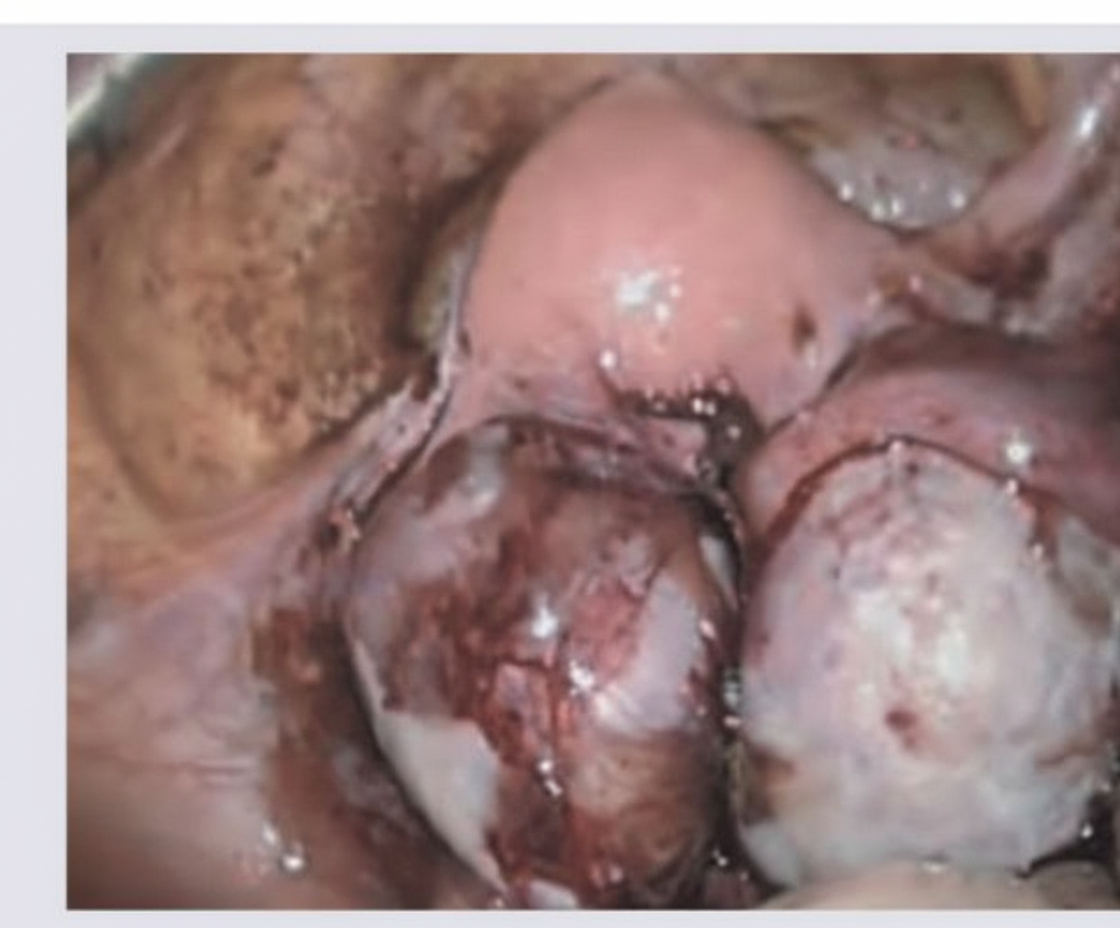
In the following laparoscopic view of the uterus and pelvis, what is the likely diagnosis?
Explanation: **Explanation:** The primary goal in the medical management of endometriosis is to induce a state of **"pseudomenopause"** or **"pseudo-pregnancy,"** thereby suppressing the estrogen-dependent growth of ectopic endometrial tissue. **Why GnRH Analogs are the Correct Choice:** GnRH analogs (e.g., Leuprolide, Goserelin) are considered highly effective. While they initially cause a "flare-up" of gonadotropins, continuous administration leads to the **downregulation of GnRH receptors** in the pituitary. This results in profound hypogonadotropic hypogonadism, creating a low-estrogen environment that causes atrophy of the endometriotic implants. **Analysis of Other Options:** * **Danazol (B):** While historically used, it is an androgenic steroid that inhibits the mid-cycle LH surge. It is now a second-line treatment due to significant virilizing side effects (acne, hirsutism, weight gain). * **Progesterone (D):** Progestogens (like Medroxyprogesterone acetate or Dienogest) are used to induce a "pseudo-pregnancy" state and decidualization of the implants. * **Testosterone (A):** Pure testosterone is **not** used in endometriosis management due to severe virilization and the availability of more targeted hormonal therapies. **Note on Question Context:** In many competitive exams, if multiple options are technically used (like Danazol, Progestins, and GnRH analogs), **GnRH analogs** are often selected as the "best" or "standard" answer for severe cases, though modern guidelines often favor **Dienogest** or **OCPs** as first-line due to the side-effect profile of GnRH analogs. **High-Yield Clinical Pearls for NEET-PG:** * **Add-back Therapy:** When using GnRH analogs for >6 months, small doses of estrogen/progesterone are added to prevent bone mineral density loss and vasomotor symptoms. * **Drug of Choice for Pain:** NSAIDs are first-line for symptomatic relief. * **Gold Standard Diagnosis:** Laparoscopy (visualizing "powder-burn" or "gunshot" lesions). * **Dienogest:** A specific progestin now widely considered the first-line medical therapy due to its efficacy and safety profile.
Explanation: ### **Explanation** The clinical presentation of **amenorrhea, sudden-onset abdominal pain, and an adnexal mass** in a woman of reproductive age is the classic triad for **Ectopic Pregnancy**. **Why Ectopic Pregnancy is Correct:** The positive urine pregnancy test (UPT) confirms a gestational state. In a patient with amenorrhea (typically 6–8 weeks), sudden sharp pain usually indicates a **ruptured or tubal abortion**, leading to hemoperitoneum. The adnexal mass represents the gestational sac, blood clots, or the affected fallopian tube. In NEET-PG, any "pregnancy + pain + mass" scenario must be considered an ectopic pregnancy until proven otherwise, as it is a life-threatening emergency. **Why Other Options are Incorrect:** * **Ovarian tumor:** While it can present as an adnexal mass, it does not typically cause a positive pregnancy test or sudden amenorrhea unless coincidental. * **Pelvic tumor:** This is a non-specific term (e.g., fibroids). While they cause masses, they do not explain the positive UPT or the acute nature of the pain. * **Ovarian cyst:** A corpus luteum cyst is common in early pregnancy, but a simple cyst wouldn't explain the acute "sudden" pain unless it underwent torsion or rupture. However, given the triad, ectopic pregnancy is the more definitive and high-stakes diagnosis. **Clinical Pearls for NEET-PG:** * **Gold Standard Investigation:** Transvaginal Ultrasound (TVS). * **Discriminatory Zone:** If serum β-hCG is >1,500–2,000 mIU/mL and the uterus is empty on TVS, suspect ectopic pregnancy. * **Most Common Site:** Ampulla of the Fallopian tube (80%). * **Most Common Site for Rupture:** Isthmus (due to its narrow lumen). * **Arias-Stella Reaction:** Hypersecretory endometrium seen on histology, characteristic of (but not pathognomonic for) ectopic pregnancy.
Explanation: ### Explanation The clinical presentation of white, curdy (cottage cheese-like) vaginal discharge accompanied by itching and the presence of fungal hyphae and yeast forms on microscopy is diagnostic of **Vulvovaginal Candidiasis (VVC)**, most commonly caused by *Candida albicans*. **Why Diabetes Mellitus is correct:** Diabetes mellitus is a major systemic predisposing factor for recurrent and severe VVC. Hyperglycemia leads to increased glycogen content in the vaginal epithelium. *Candida* species utilize this glucose for growth and adherence to the vaginal mucosa. Furthermore, poorly controlled diabetes can impair local immune responses (neutrophil function), facilitating fungal overgrowth. **Why the other options are incorrect:** * **Crohn’s Disease:** While it can cause gynecological complications like rectovaginal fistulas, it is not a direct systemic risk factor for fungal vaginitis. * **Disseminated Gonococcal Infection:** This presents with a triad of tenosynovitis, dermatitis, and polyarthralgia. It is a bacterial complication of *Neisseria gonorrhoeae* and does not predispose to fungal infections. * **Rheumatoid Arthritis:** This is an autoimmune inflammatory condition. While the immunosuppressants used to treat it (like steroids) might increase risk, the disease itself is not a classic predisposing factor for VVC. **High-Yield Clinical Pearls for NEET-PG:** * **Risk Factors for VVC:** Pregnancy (high estrogen), Diabetes Mellitus, broad-spectrum antibiotic use, and immunosuppression (HIV/Steroids). * **Diagnosis:** pH is typically **normal (<4.5)**. KOH mount shows pseudohyphae and spores. * **Treatment:** Topical imidazoles (Clotrimazole) or oral Fluconazole (150 mg single dose). Note: Oral Fluconazole is contraindicated in pregnancy. * **Recurrent VVC:** Defined as $\geq$4 episodes per year; always screen for underlying Diabetes or HIV in these patients.
Explanation: **Explanation:** **Correct Answer: C. Polycystic ovarian disease (PCOS)** The underlying pathophysiology of endometrial hyperplasia is **unopposed estrogen** stimulation. In PCOS, patients experience chronic anovulation. Without ovulation, there is no corpus luteum formation and, consequently, no progesterone production. The endometrium is subjected to continuous, prolonged estrogen stimulation (primarily from the peripheral conversion of androgens to estrone in adipose tissue) without the stabilizing effect of progesterone. This leads to excessive proliferation of the endometrial glands, resulting in hyperplasia and an increased risk of endometrial carcinoma. **Analysis of Incorrect Options:** * **A. Endodermal Sinus Tumor (Yolk Sac Tumor):** This is a highly malignant germ cell tumor characterized by elevated **Alpha-fetoprotein (AFP)** and Schiller-Duval bodies. It does not produce estrogen and is not associated with endometrial changes. * **B. Dysgerminoma:** This is the most common malignant germ cell tumor in young women. It is associated with elevated **LDH** and sometimes hCG, but it does not secrete estrogen. * **D. Carcinoma of the Cervix:** This is primarily caused by high-risk **Human Papillomavirus (HPV)** infection (Types 16 and 18). It involves the squamous or glandular cells of the cervix and is unrelated to systemic estrogen levels or endometrial proliferation. **High-Yield Clinical Pearls for NEET-PG:** * **Classification:** The WHO (2014) classifies hyperplasia into two types: Hyperplasia without atypia and Atypical hyperplasia (Endometrial Intraepithelial Neoplasia). * **Risk Factors:** Obesity, Nulliparity, Early menarche/Late menopause, and Estrogen-secreting tumors (e.g., **Granulosa cell tumor**). * **Management:** Progestogens (like Mirena/LNG-IUS) are the mainstay for hyperplasia without atypia, while Hysterectomy is preferred for atypical hyperplasia due to the high risk of coexisting malignancy.
Explanation: **Explanation:** The management of utero-vaginal prolapse in a young woman who wishes to preserve her uterus is primarily surgical, focusing on uterine conservation. **Why Fothergill’s Repair is correct:** Fothergill’s operation (also known as Manchester operation) is the treatment of choice for young women with prolapse who desire to retain their uterus. The procedure involves: 1. Dilation and Curettage (D&C). 2. Amputation of the elongated cervix. 3. **Plication of the Mackenrodt’s (cardinal) ligaments** in front of the uterus to provide support and antevert the uterus. 4. Anterior colporrhaphy and posterior colpoperineorrhaphy. **Why other options are incorrect:** * **Wertheim’s hysterectomy:** This is a radical hysterectomy used for Stage IA2-IIA cervical cancer, not for pelvic organ prolapse. * **Perineal exercises:** While Kegel exercises help in very mild (first-degree) prolapse or as a preventive measure, they are insufficient for correcting a second-degree utero-vaginal prolapse. * **Vaginal hysterectomy with vault repair:** This is the treatment of choice for post-menopausal women or those who have completed their family and do not wish to preserve the uterus. In a 28-year-old, uterine preservation is prioritized. **Clinical Pearls for NEET-PG:** * **Uterine sparing surgeries:** Fothergill’s is preferred if the cervix is elongated. If the cervix is normal, **Shirodkar’s Sling operation** (Ventro-suspension) is often considered. * **Le Fort’s Colpocleisis:** Reserved for very elderly patients who are not sexually active and are unfit for major surgery. * **Ward-Mayo Operation:** Another name for Vaginal Hysterectomy with pelvic floor repair.
Explanation: ### Explanation The diagnosis of an ovarian pregnancy is based on the **Spiegelberg Criteria**, established to differentiate a primary ovarian pregnancy from a tubal pregnancy that has secondary involvement of the ovary. **Why Option D is the Correct Answer:** According to Spiegelberg’s criteria, the gestational sac must occupy the **position of the ovary**; it is typically embedded within the ovarian stroma. Stating that the sac is "lateral to the ovary" implies it is a separate entity (likely tubal), which contradicts the definition of an ovarian pregnancy. **Analysis of Other Options (Spiegelberg Criteria):** * **Option A (The tube must be intact):** This is a mandatory criterion. The fallopian tube on the affected side must be anatomically normal and separate from the gestational sac to rule out a tubal ectopic pregnancy. * **Option B (Ovarian tissue in the sac wall):** Histopathological confirmation is required. Ovarian tissue must be present in the wall of the gestational sac to prove the pregnancy originated within the ovary. * **Option C (Connection via the ovarian ligament):** The gestational sac/ovary must occupy the normal anatomical position and be attached to the uterus by the utero-ovarian ligament. **High-Yield Clinical Pearls for NEET-PG:** * **Incidence:** Ovarian pregnancy accounts for approximately 0.5% to 3% of all ectopic pregnancies. * **Risk Factor:** Unlike tubal pregnancies (linked to PID), ovarian pregnancies are strongly associated with the use of **Intrauterine Devices (IUDs)**. * **Management:** Surgical management (cystectomy or wedge resection) is preferred over oophorectomy to preserve fertility. Medical management with Methotrexate can be considered if the patient is hemodynamically stable. * **Mnemonic for Spiegelberg Criteria:** **T**ube intact, **O**vary position, **O**varian ligament attachment, **H**istology (ovarian tissue in wall).
Explanation: **Explanation:** Uterine fibroids (leiomyomas) are benign monoclonal tumors of smooth muscle cells. Understanding their vascular supply and growth patterns is crucial for NEET-PG. **Why Option C is the correct answer (False statement):** Fibroids receive their blood supply from the **periphery**. The arteries form a vascular plexus in the pseudocapsule, and the vessels then penetrate inward toward the center. Consequently, the **center of the fibroid is the least vascular part**, making it the most susceptible to ischemia and subsequent degeneration (e.g., hyaline or cystic degeneration). **Analysis of other options:** * **A. Pseudo-encapsulated:** Fibroids do not have a true anatomical capsule. Instead, they are surrounded by a **pseudocapsule** formed by the compression of surrounding myometrium and areolar tissue. This plane allows for easy enucleation during a myomectomy. * **B. Typically slow-growing:** Fibroids are estrogen-dependent and generally grow slowly during the reproductive years. Rapid growth, especially post-menopause, should raise suspicion for leiomyosarcoma (though this is rare). * **D. Calcifications begin from the periphery:** Calcification (calcareous degeneration) is a late-stage change, often seen in post-menopausal women. It typically starts in the peripheral vessels and moves inward, sometimes creating a "womb stone" appearance on X-ray. **Clinical Pearls for NEET-PG:** * **Most common degeneration:** Hyaline degeneration (65%). * **Degeneration during pregnancy:** Red degeneration (necrobiosis) due to rapid growth and venous thrombosis. * **Most common symptom:** Menorrhagia (heavy menstrual bleeding). * **Medical Management:** GnRH agonists (used pre-operatively to reduce size and vascularity).
Explanation: **Explanation:** The question asks to identify which procedure is **not** a sling operation. Sling operations are used to treat **nulliparous prolapse** or cases where the cervix needs to be preserved, by anchoring the cervix/isthmus to a fixed bony or ligamentous structure using synthetic or biological mesh. **1. Why Le Fort repair is the correct answer:** **Le Fort repair (Partial Colpocleisis)** is an **obliterative procedure**, not a sling operation. It involves denuding the anterior and posterior vaginal walls and suturing them together to close the vaginal canal. It is indicated for elderly women with advanced pelvic organ prolapse who are no longer sexually active and are medically unfit for major reconstructive surgery. **2. Analysis of Incorrect Options (Sling Operations):** * **Khanna’s Procedure:** A posterior sling operation where the cervix is attached to the **sacrospinous ligament** using a synthetic tape (Mersilene). * **Shirodkar’s Procedure:** An abdominal sling operation where the cervix is anchored to the **sacral promontory** (sacropexy) using a strip of fascia lata or synthetic material. * **Abdominocervicopexy:** A general term for abdominal sling procedures (like the Shirodkar or Purandare procedures) where the cervix is fixed to the abdominal wall or sacrum to provide support. **Clinical Pearls for NEET-PG:** * **Nulliparous Prolapse:** The treatment of choice is a sling operation to preserve fertility. * **Manchester Operation (Fothergill’s):** Indicated for mobile uterine prolapse with elongated cervix; it is *not* a sling operation but a reconstructive one involving shortening of Mackenrodt’s ligaments. * **Purandare’s Sling:** Anchors the cervix to the **rectus sheath** (anterior abdominal wall). * **Shout-out Fact:** Always check if the patient is sexually active before recommending Le Fort repair, as it permanently closes the vagina.
Explanation: **Explanation:** Mifepristone is a **Selective Progesterone Receptor Modulator (SPRM)**. Since uterine fibroids are progesterone-dependent tumors, mifepristone effectively reduces their size and associated heavy menstrual bleeding (HMB). **Why Hirsutism is the correct answer:** Hirsutism is a side effect associated with **androgenic** medications (like Danazol). Mifepristone does not have androgenic activity; in fact, it has weak anti-androgenic properties. Therefore, hirsutism is not a concern during its clinical use. **Analysis of other options:** * **Endometrial Hyperplasia:** This is a significant concern. Mifepristone causes "Progesterone Receptor Modulator Associated Endometrial Changes" (**PAEC**). Due to the unopposed action of estrogen on the endometrium (while progesterone receptors are blocked), there is a theoretical risk of endometrial hyperplasia without atypia. * **Vasomotor Symptoms:** While less severe than with GnRH agonists, some patients experience hot flashes due to the alteration of the hypothalamic-pituitary-ovarian axis. * **Early Pregnancy Termination:** Mifepristone is a potent abortifacient (used in medical abortion up to 63–70 days). Since many women seeking fibroid treatment are of reproductive age, unintended termination of an undiagnosed early pregnancy is a critical clinical concern. **High-Yield Clinical Pearls for NEET-PG:** * **Mechanism in Fibroids:** It inhibits ovulation and causes direct shrinkage of the leiomyoma by inducing apoptosis. * **Dose for Fibroids:** Usually 5–10 mg daily (much lower than the 200 mg used for abortion). * **Amenorrhea:** It is highly effective at inducing amenorrhea (up to 90% of cases), which helps in correcting anemia pre-operatively. * **Key Contraindication:** Known suspected pregnancy and renal failure.
Explanation: ***Genital tuberculosis*** - Laparoscopic findings typically show **miliary tubercles**, **peritubal adhesions**, and **caseous nodules** on peritoneal surfaces and fallopian tubes. - Often presents with **chronic pelvic pain**, **menstrual irregularities**, and **infertility** due to tubal obstruction and pelvic adhesions. *Pyogenic infection* - Usually presents with **acute symptoms** like fever, severe pelvic pain, and purulent discharge rather than chronic findings. - Laparoscopic appearance shows **hyperemic tissues** and **purulent collections** without the characteristic tubercles seen in TB. *Fungal infection* - Rarely causes significant **pelvic inflammatory disease** or extensive adhesions visible on laparoscopy. - More commonly presents as **vulvovaginal candidiasis** with localized symptoms rather than deep pelvic involvement. *Fitz Hugh Curtis syndrome* - Specifically involves **perihepatic adhesions** ("violin string" adhesions around the liver) due to chlamydial or gonococcal infection. - Does not typically cause the **miliary pattern** and **caseous lesions** characteristic of genital tuberculosis.
Abnormal Uterine Bleeding
Practice Questions
Endometriosis
Practice Questions
Adenomyosis
Practice Questions
Uterine Fibroids
Practice Questions
Ovarian Cysts
Practice Questions
Pelvic Inflammatory Disease
Practice Questions
Vulvovaginitis
Practice Questions
Pelvic Organ Prolapse
Practice Questions
Vulvar Disorders
Practice Questions
Benign Breast Diseases
Practice Questions
Get full access to all questions, explanations, and performance tracking.
Start For Free