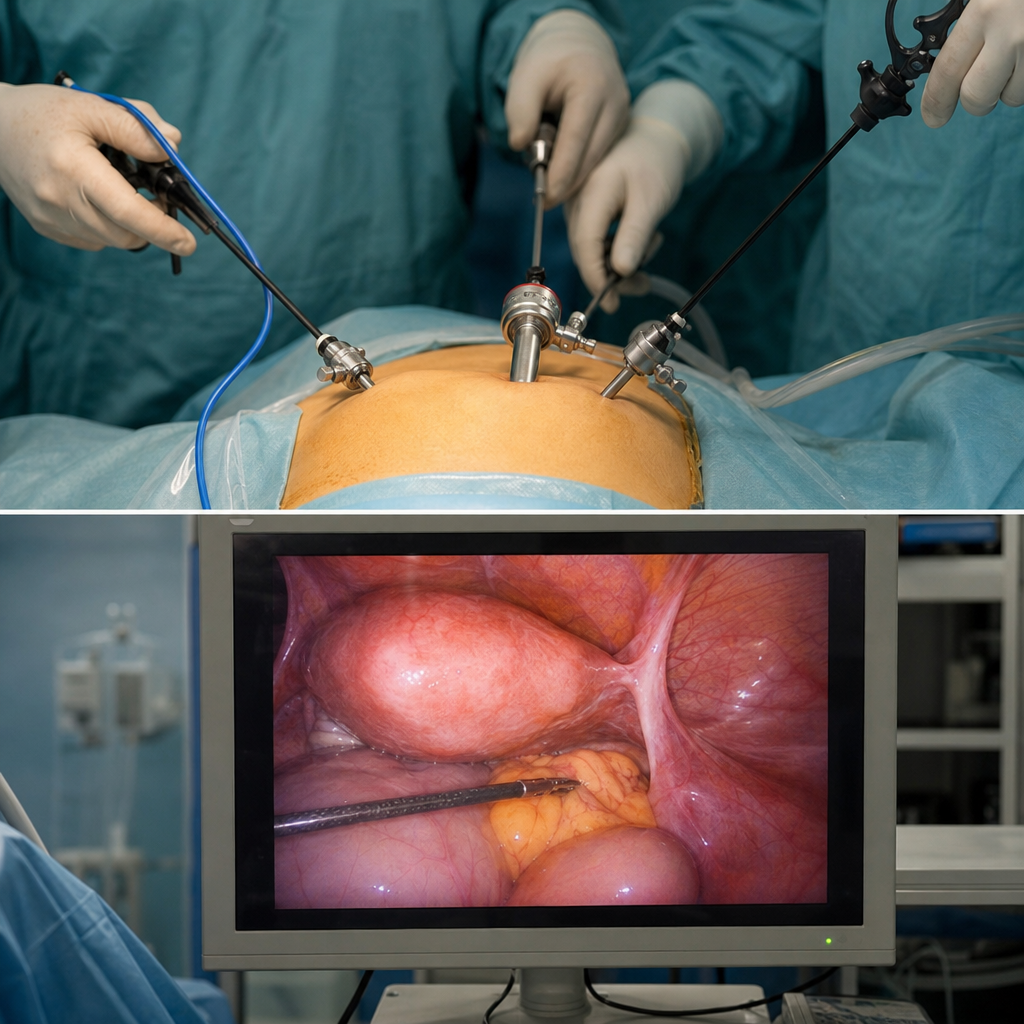
Hysteroscopy is used in the management of all of the following conditions EXCEPT:
Secondary hemorrhage after hysterectomy usually occurs:
Vaginal atresia is associated with which of the following?
A 31-year-old woman has had vulvar pruritus along with a thick, whitish, odorless, globular vaginal discharge for the past week. On pelvic examination, the cervix appears erythematous, but there are no erosions or masses. A Pap smear shows budding cells and pseudo hyphae. No dysplastic cells are present. Which of the following infectious agents is most likely to produce these findings?
Which of the following is NOT a common complication or presentation of uterine fibroids?
Which diagnostic modality is used to detect a submucosal fibroid?
What is the initial management for acute Pelvic Inflammatory Disease (PID)?
Contact bleeding is seen in all of the following conditions EXCEPT?
Posterior colpotomy is indicated for which of the following conditions?
What is the treatment of choice for Asherman's syndrome?
Explanation: **Explanation:** Hysteroscopy is the "gold standard" for the direct visualization of the uterine cavity. It serves both **diagnostic** and **therapeutic** (operative) purposes in modern gynecology. The correct answer is **"None of the above"** because hysteroscopy is actively used in the management of all three listed conditions. * **Uterine Synechiae (Asherman Syndrome):** Hysteroscopy is the definitive treatment. Under direct vision, adhesions are lysed (hysteroscopic adhesiolysis) to restore the cavity's shape and volume. * **Abnormal Uterine Bleeding (AUB):** It is used to diagnose intrauterine pathology (polyps, submucosal fibroids, or endometrial hyperplasia) and perform targeted biopsies. Operative hysteroscopy (endometrial ablation or polypectomy) is a common management strategy for AUB. * **Infertility:** Hysteroscopy is a crucial part of the infertility workup to rule out structural anomalies (septate uterus), tubal ostia blockage, or chronic endometritis that may interfere with implantation. **Why the other options are incorrect:** Options A, B, and C are all primary indications for hysteroscopy. Since the question asks for an exception, and all listed conditions utilize hysteroscopy for management, "None of the above" is the only logical choice. **Clinical Pearls for NEET-PG:** * **Distension Media:** CO2 is used for diagnostics; Glycine 1.5% or Sorbitol is used for monopolar electrosurgery (risk of hyponatremia/TURP syndrome); Normal Saline is used for bipolar surgery. * **Gold Standard:** Hysteroscopy is superior to Hysterosalpingography (HSG) for evaluating the uterine cavity. * **Contraindications:** Acute pelvic inflammatory disease (PID), profuse uterine bleeding, and known cervical/endometrial malignancy.
Explanation: **Explanation:** Post-hysterectomy hemorrhage is classified based on the timing of the bleed. **Secondary hemorrhage** is defined as bleeding that occurs 24 hours or more after the surgery, most commonly between **5 to 10 days** postoperatively. **1. Why Option C is Correct:** The underlying pathophysiology of secondary hemorrhage is typically **infection (vault sepsis)** or the premature sloughing of a necrotic tissue/ligature. Around the 5th to 10th day, the inflammatory process or local infection can erode a small vessel at the vaginal vault before complete healing has occurred, leading to fresh vaginal bleeding. **2. Why the other options are incorrect:** * **Option A (Immediately):** This describes **Primary Hemorrhage**, which occurs during the surgery or within the first few hours due to technical issues like a slipped ligature or an unligated vessel. * **Option B (Within 2 days):** Bleeding within the first 24 hours is often termed **Reactionary Hemorrhage**. It occurs as the patient’s blood pressure recovers from anesthesia or due to the failure of a small vessel that was initially constricted. * **Option D (Between 10-14 days):** While secondary hemorrhage can rarely occur up to 14 days, the peak incidence and classic textbook window for NEET-PG is the 5-10 day period. **Clinical Pearls for NEET-PG:** * **Management:** Most cases of secondary vault hemorrhage are minor and managed with vaginal packing and antibiotics. If bleeding is profuse, exploration under anesthesia is required. * **Prophylaxis:** Proper hemostasis and preoperative vaginal cleansing (to reduce sepsis) are key to prevention. * **High-Yield Distinction:** * *Primary:* On the OT table. * *Reactionary:* Within 24 hours (due to rise in BP). * *Secondary:* 5–10 days (due to infection/sloughing).
Explanation: **Explanation:** **Vaginal atresia** is a congenital anomaly resulting from the failure of the **Müllerian ducts** to canalize or develop properly. Because the upper two-thirds of the vagina and the uterus share a common embryological origin (the fused paramesonephric/Müllerian ducts), a defect in one often coexists with a defect in the other. 1. **Why Uterine Atresia is Correct:** In cases of vaginal atresia (specifically Müllerian agenesis or MRKH syndrome), there is a failure of the Müllerian ducts to develop. This leads to the absence or hypoplasia of both the vagina and the uterus (**Uterine atresia**). Since the ovaries develop from the primitive germ cells and the urogenital ridge (not the Müllerian ducts), they remain functional. 2. **Why other options are incorrect:** * **Exstrophy of bladder:** This is a ventral body wall defect involving the specialized cloacal membrane; while it can be associated with bifid clitoris or displaced labia, it is not a primary association of isolated vaginal atresia. * **Ovarian atrophy:** Ovaries have a different embryological origin than the Müllerian ducts. In patients with vaginal/uterine atresia, ovarian function and secondary sexual characteristics are typically **normal**. * **Imperforate hymen:** This is a failure of the canalization of the **urogenital sinus** (where it meets the Müllerian bulbs), not a failure of the Müllerian ducts themselves. In this condition, the uterus and vagina are fully formed but obstructed. **NEET-PG High-Yield Pearls:** * **MRKH Syndrome (Mayer-Rokitansky-Küster-Hauser):** The most common cause of vaginal atresia. Characterized by 46,XX karyotype, normal ovaries, and primary amenorrhea. * **Associated Anomalies:** Always screen for **Renal anomalies** (e.g., renal agenesis, ectopic kidney) in 30-40% of cases and **Skeletal anomalies** (e.g., Klippel-Feil syndrome). * **Differential:** In **Androgen Insensitivity Syndrome (AIS)**, there is also a short/absent vagina, but the karyotype is 46,XY and ovaries are absent (testes are present).
Explanation: ### Explanation The clinical presentation and laboratory findings are classic for **Vulvovaginal Candidiasis (VVC)**, most commonly caused by *Candida albicans*. **Why the correct answer is right:** * **Clinical Features:** The "thick, whitish, odorless, globular" discharge is often described as **curd-like** or **cottage cheese-like**. Vulvar pruritus (itching) is the hallmark symptom. * **Microscopy:** The Pap smear (or a KOH mount) showing **budding yeast cells and pseudohyphae** is the definitive diagnostic feature for *Candida*. While Pap smears are for cytology, they frequently incidentally detect fungal elements. * **Physical Exam:** Erythema of the cervix and vaginal walls is common due to inflammation, but unlike other infections, the discharge remains odorless. **Why the incorrect options are wrong:** * **Chlamydia trachomatis:** Typically causes a mucopurulent cervicitis. It is an obligate intracellular bacterium and would not show pseudohyphae on microscopy. * **Neisseria gonorrhoeae:** Causes purulent cervical discharge and pelvic inflammatory disease. Diagnosis is via Gram stain (Gram-negative diplococci) or NAAT, not fungal elements. * **Trichomonas vaginalis:** Characterized by a **foul-smelling, greenish-yellow, frothy** discharge. On examination, one would expect a "strawberry cervix" (punctate hemorrhages) and motile flagellated organisms on a wet mount. **High-Yield Pearls for NEET-PG:** * **Risk Factors:** Pregnancy, Diabetes Mellitus, recent antibiotic use, and immunosuppression (HIV). * **pH Level:** In Candidiasis, the vaginal pH is typically **normal (<4.5)**, whereas in Trichomoniasis and Bacterial Vaginosis, the pH is >4.5. * **Treatment:** First-line treatment is topical or oral azoles (e.g., **Fluconazole** 150mg single dose). Note: Oral fluconazole is contraindicated in pregnancy; use topical clotrimazole instead.
Explanation: **Explanation:** Uterine fibroids (leiomyomas) are benign monoclonal tumors of smooth muscle cells. The hallmark of fibroids is **increased menstrual bleeding**, not the absence of it. **Why Amenorrhea is the correct answer:** Amenorrhea (absence of menstruation) is **not** a feature of fibroids. In fact, fibroids typically cause the opposite: **Menorrhagia** (heavy menstrual bleeding). This occurs due to an increased endometrial surface area, increased vascularity of the uterus, and interference with normal uterine contractility. If a patient with known fibroids presents with amenorrhea, the most likely cause is a co-existing pregnancy or menopause, rather than the fibroid itself. **Analysis of Incorrect Options:** * **Menorrhagia (Option D):** This is the most common symptom. Submucosal and intramural fibroids distort the uterine cavity and prevent effective vasoconstriction of endometrial vessels. * **Pelvic Mass (Option C):** Large intramural or subserosal fibroids can be palpated as a firm, non-tender, irregular mass arising from the pelvis (dull to percussion). * **Infertility (Option A):** Fibroids can cause infertility by distorting the uterine cavity (preventing implantation), obstructing the fallopian tube ostia, or causing chronic endometritis. **High-Yield Clinical Pearls for NEET-PG:** * **Most common symptom:** Menorrhagia. * **Most common type:** Intramural. * **Most symptomatic type:** Submucosal (causes significant bleeding even if small). * **Degeneration during pregnancy:** Red degeneration (due to rapid growth and ischemia). * **Most common degeneration overall:** Hyaline degeneration. * **Medical Management:** GnRH agonists (used pre-operatively to shrink the tumor) or Ulipristal acetate.
Explanation: **Explanation:** **Submucosal fibroids** are leiomyomas that develop just beneath the uterine mucosa (endometrium) and protrude into the uterine cavity. Because they distort the endometrial contour, they are a leading cause of heavy menstrual bleeding (AUB-L) and infertility. **Why Hysteroscopy is the Correct Answer:** Hysteroscopy is considered the **gold standard** for diagnosing submucosal fibroids. It allows for direct visualization of the uterine cavity, enabling the clinician to assess the size, location, and degree of protrusion (FIGO Type 0, 1, or 2) of the fibroid. Its primary advantage is that it is both **diagnostic and therapeutic**, as hysteroscopic myomectomy can often be performed in the same setting. **Analysis of Incorrect Options:** * **B. Hysterosalpingography (HSG):** While HSG can show filling defects in the uterine cavity, it is primarily used to assess tubal patency in infertility workups. It cannot distinguish between a fibroid, a polyp, or a synechiae as accurately as hysteroscopy. * **C. Transabdominal Ultrasonography (TAS):** TAS is useful for mapping large intramural or subserosal fibroids but has low sensitivity for small submucosal lesions. **Saline Infusion Sonohysterography (SIS)** is the preferred ultrasound technique for submucosal pathology, not standard TAS. * **D. Laparoscopy:** This modality visualizes the serosal surface of the uterus and the peritoneal cavity. It is excellent for diagnosing **subserosal fibroids** but cannot "see" inside the uterine cavity to detect submucosal ones. **High-Yield Clinical Pearls for NEET-PG:** * **Gold Standard for Submucosal Fibroids:** Hysteroscopy. * **Best Initial Screening Tool for Fibroids:** Transvaginal Ultrasound (TVS). * **Most Accurate Imaging for Mapping Multiple Fibroids:** MRI (used for surgical planning). * **FIGO Classification:** Submucosal fibroids are categorized as Type 0 (entirely intracavitary), Type 1 (<50% intramural), and Type 2 (≥50% intramural).
Explanation: **Explanation:** The management of acute Pelvic Inflammatory Disease (PID) follows a tiered approach based on severity. While medical management is the standard for most cases, the question asks for the definitive management in specific severe scenarios often tested in exams. **Why Abdominal Hysterectomy is the Correct Answer:** In the context of advanced or refractory acute PID—specifically when there is a **ruptured tubo-ovarian abscess (TOA)** or when the patient fails to respond to conservative medical therapy—the definitive surgical management is a total abdominal hysterectomy with bilateral salpingo-oophorectomy (TAH + BSO). This is indicated to remove the source of overwhelming sepsis and prevent life-threatening peritonitis. **Analysis of Incorrect Options:** * **A. Intravenous antibiotics:** While IV antibiotics are the *first-line* medical treatment for hospitalized patients, they are considered "conservative management." If the question implies a surgical context or a non-responsive case, surgery becomes the "initial" definitive step. * **B. Drainage of a tubo-ovarian mass:** Simple drainage is often insufficient for acute, widespread PID and carries a high risk of recurrence or incomplete resolution compared to definitive surgery. * **D. Laparoscopic exploration:** While useful for diagnosis (the gold standard) and minor adhesiolysis, it is not the definitive management for severe, acute PID cases requiring radical clearance. **NEET-PG High-Yield Pearls:** * **Gold Standard Diagnosis:** Laparoscopy (visualizing hyperemic, edematous tubes with purulent discharge). * **Most Common Organism:** *Chlamydia trachomatis* (overall), though PID is typically polymicrobial. * **CDC Regimen (Inpatient):** Ceftriaxone (or Cefotetan/Cefoxitin) + Doxycycline + Metronidazole. * **Indications for Surgery:** Ruptured TOA (surgical emergency), failure of medical therapy (48–72 hours), or presence of an abscess >8cm.
Explanation: **Explanation:** The core concept behind **contact bleeding** (post-coital bleeding) is the presence of a lesion on the **ectocervix or vaginal vault** that is friable, vascular, or ulcerated. When these tissues are touched—typically during sexual intercourse or a clinical examination—the fragile surface breaks, leading to spotting. **Why Option D is Correct:** A **Mucinous cyst of the ovary** is an adnexal mass located deep within the pelvic cavity. Since it is an internal ovarian pathology and not part of the lower genital tract (cervix or vagina), it does not come into direct contact with external stimuli during intercourse. Therefore, it cannot cause contact bleeding. **Analysis of Incorrect Options:** * **Cervical Cancer (A):** This is the most critical diagnosis to rule out in any patient presenting with contact bleeding. Malignant neovascularization and tissue friability make the cervix bleed easily upon touch. * **Erosion of the Cervical Mucus/Ectropion (B):** This occurs when the delicate columnar epithelium of the endocervix replaces the stratified squamous epithelium of the ectocervix. This thin, vascular layer is prone to bleeding when touched. * **Contact Ulcer of the Cervix (C):** Any ulceration (traumatic, syphilitic, or due to a long-standing pessary) disrupts the mucosal integrity, leading to immediate bleeding upon contact. **NEET-PG High-Yield Pearls:** * **Most common cause of contact bleeding:** Cervical Ectropion (Erosion). * **Most serious cause to rule out:** Carcinoma of the Cervix. * **Other causes:** Cervical polyps, Trichomonas vaginalis (strawberry cervix), and Atrophic vaginitis. * **Management:** Any patient with contact bleeding must undergo a **speculum examination** followed by a **Pap smear** or **Colposcopy** to exclude malignancy.
Explanation: **Explanation:** Posterior colpotomy (also known as culdocentesis or vaginal drainage) involves making an incision through the posterior vaginal fornix into the **Pouch of Douglas (POD)**. This procedure is primarily indicated for the drainage of infected or hemorrhagic fluid collections that have gravitated to the most dependent part of the pelvic cavity. **Why "All of the Above" is Correct:** * **Pelvic Abscess:** This is the most common indication. When pus collects in the POD (often following PID), posterior colpotomy allows for immediate surgical drainage and symptom relief. * **Pelvic Haematocele:** In cases of ruptured ectopic pregnancy where blood collects and clots in the POD (forming a pelvic haematocele), colpotomy can be used to evacuate the collection, provided the patient is hemodynamically stable. * **Ovarian Abscess:** If an ovarian abscess (or a Tubo-ovarian abscess) prolapses into the Pouch of Douglas and becomes adherent to the vaginal vault, it can be safely drained via the posterior fornix. **Clinical Pearls for NEET-PG:** 1. **Prerequisite:** For a successful colpotomy, the collection must be **fluctuant**, **pointing** into the posterior fornix, and **filling the Pouch of Douglas**. 2. **Diagnostic vs. Therapeutic:** While largely replaced by ultrasound-guided aspiration, colpotomy remains a rapid therapeutic intervention in resource-limited settings. 3. **Anatomy:** The incision pierces the vaginal mucosa, pelvic fascia, and the peritoneum of the Pouch of Douglas, passing between the two uterosacral ligaments. 4. **Contraindication:** It should not be performed if the mass is not midline or if there is a risk of bowel interposition.
Explanation: **Explanation:** Asherman’s syndrome is characterized by the presence of intrauterine adhesions (synechiae), usually following over-zealous curettage. The management is multi-modal, aiming to restore the uterine cavity, prevent re-adhesion, and regenerate the endometrium. **Why "All of the above" is correct:** The treatment of choice is a combination of surgical and medical management: 1. **Hysteroscopy and Adhesiolysis (Option B):** This is the **gold standard surgical step**. Under direct visualization, adhesions are lysed (preferably using cold scissors or laser to avoid thermal damage) to restore the normal anatomy of the uterine cavity. 2. **IUCD (Option C):** Post-surgery, a physical barrier is required to keep the uterine walls apart and prevent the raw surfaces from fusing again. While a Foley’s catheter can be used, an **IUCD (specifically Lippes Loop)** is a classic method to maintain the cavity patency. 3. **Hormones (Option A):** High-dose **Estrogen** (e.g., Conjugated equine estrogen 2.5 mg/day) is administered for 2–3 cycles to stimulate rapid re-epithelialization of the denuded endometrium, followed by a progestogen to induce withdrawal bleeding. **High-Yield Clinical Pearls for NEET-PG:** * **Most common cause:** Post-traumatic (post-curettage for abortion or postpartum hemorrhage). * **Gold Standard Diagnosis:** Hysteroscopy (HSG shows "honeycomb" or "filling defects"). * **Clinical Presentation:** Secondary amenorrhea or hypomenorrhea with cyclic pelvic pain. * **Prognostic Factor:** The extent of fibrosis and the amount of healthy endometrium remaining are the most significant predictors of reproductive outcome.
Abnormal Uterine Bleeding
Practice Questions
Endometriosis
Practice Questions
Adenomyosis
Practice Questions
Uterine Fibroids
Practice Questions
Ovarian Cysts
Practice Questions
Pelvic Inflammatory Disease
Practice Questions
Vulvovaginitis
Practice Questions
Pelvic Organ Prolapse
Practice Questions
Vulvar Disorders
Practice Questions
Benign Breast Diseases
Practice Questions
Get full access to all questions, explanations, and performance tracking.
Start For Free