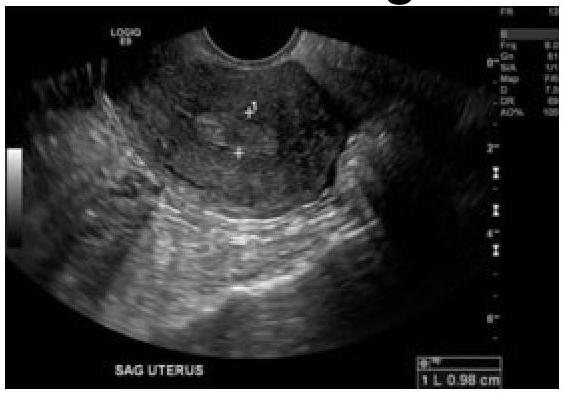
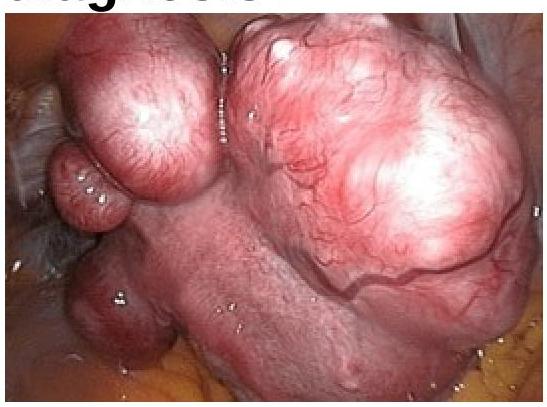
A 29-year-old nulliparous woman complains of severe menorrhagia and lower abdominal pain for the past 3 months. On examination, her uterus is enlarged to 14 weeks' size with a fundal fibroid. What is the treatment of choice?
Lutein cysts are associated with all except?
What is the management of choice for a 30-year-old multipara presenting with uterine prolapse?
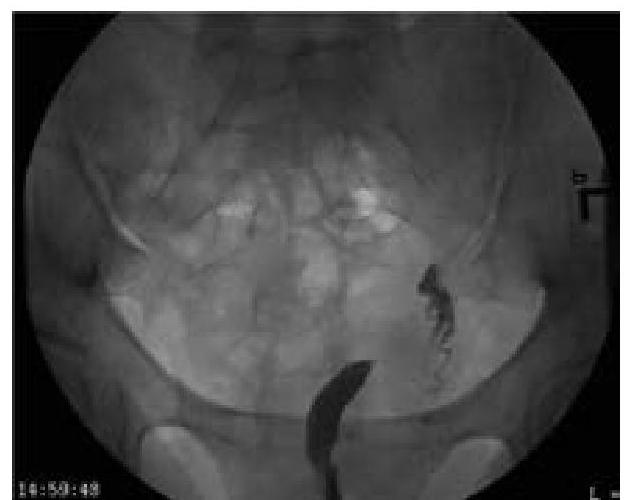
A "beaded" appearance of the fallopian tube on hysterosalpingography (HSG) is typically seen in which condition?
A 65-year-old female presents with postmenopausal bleeding. On examination, senile vaginitis is noted. The patient requires immediate:
What is the most common type of genital tuberculosis?
A 30-year-old multiparous hypertensive woman complains of menorrhagia. What is the best treatment for her?
What is the treatment for intrahepatic cholestasis of pregnancy?
In a non-pregnant uterus, which of the following is the treatment for cervical incompetence?
A 45-year-old lady presented with dysfunctional uterine bleeding. On transvaginal ultrasound, the thickness of the endometrium was found to be 8 mm. What should be the next step in the management of this patient?
Explanation: ### Explanation **Correct Answer: A. Myomectomy** The patient is a **29-year-old nulliparous woman** presenting with symptomatic uterine fibroids (menorrhagia and pain). In gynecological management, the choice of treatment is heavily dictated by the patient's age and desire for future fertility. 1. **Why Myomectomy is correct:** Myomectomy is the surgical removal of fibroids while preserving the uterus. It is the **treatment of choice** for symptomatic women who are young, nulliparous, or desire to retain their reproductive potential. Given her age (29) and nulliparity, preserving the uterus is the clinical priority. 2. **Why Hysterectomy is incorrect:** While hysterectomy is the definitive treatment for fibroids, it is reserved for women who have completed their family or are perimenopausal/postmenopausal. Performing a hysterectomy on a 29-year-old nulliparous woman is inappropriate unless there is a life-threatening malignancy. 3. **Why GnRH analogues are incorrect:** These are medical therapies used to shrink fibroids temporarily (usually for 3–6 months) before surgery to reduce blood loss or to bridge a patient to menopause. They are not a definitive "treatment of choice" as the fibroids typically regrow once the medication is stopped. 4. **Why Wait and watch is incorrect:** This approach (expectant management) is only suitable for small, asymptomatic fibroids. This patient is symptomatic (severe menorrhagia and pain) and has a significantly enlarged uterus (14 weeks' size), necessitating active intervention. **Clinical Pearls for NEET-PG:** * **Size Criteria:** Fibroids larger than 12–14 weeks' size are generally considered an indication for surgical intervention, even if symptoms are moderate. * **Medical Management:** Tranexamic acid or NSAIDs are first-line for symptom control, but they do not reduce the size of the fibroid. * **Red Flags:** Rapid increase in size (especially post-menopause) should raise suspicion for **Leiomyosarcoma** (though rare, <0.5%). * **Most common type:** Intramural fibroids are the most common; however, **Submucosal fibroids** are most likely to cause heavy menstrual bleeding (menorrhagia).
Explanation: **Explanation:** The correct answer is **D. Use of oral contraceptive pills.** **Medical Concept:** Lutein cysts (specifically **Theca Lutein Cysts**) are functional ovarian cysts caused by **excessive stimulation of the ovaries by high levels of Human Chorionic Gonadotropin (hCG)** or hypersensitivity to gonadotropins. Oral contraceptive pills (OCPs) actually **suppress** the hypothalamic-pituitary-ovarian axis, reducing FSH and LH levels and preventing ovulation. Therefore, OCPs are used to *prevent* functional cysts rather than cause them. **Analysis of Options:** * **A. Gestational Trophoblastic Tumors:** Conditions like Hydatidiform mole or Choriocarcinoma produce massive amounts of hCG, which leads to the hyperplasia of theca interna cells and the formation of multiple theca lutein cysts. * **B. Clomiphene Administration:** Clomiphene citrate is an ovulation-inducing agent. It increases endogenous gonadotropins, which can lead to ovarian hyperstimulation and the development of lutein cysts. * **C. Bilaterality:** A hallmark feature of theca lutein cysts is that they are almost always **bilateral and multiple**. They give the ovary a "soap bubble" appearance on ultrasound. **Clinical Pearls for NEET-PG:** * **Hyperreactio Luteinalis:** This is a benign condition where bilateral theca lutein cysts occur during a normal singleton pregnancy (usually in the third trimester) due to increased sensitivity to hCG. * **Management:** Theca lutein cysts are physiological. They usually **regress spontaneously** once the source of hCG is removed (e.g., evacuation of a mole or delivery). Surgery is only indicated in cases of torsion or rupture. * **Triad of Ovarian Hyperstimulation Syndrome (OHSS):** Bilateral theca lutein cysts, ascites, and hemoconcentration.
Explanation: **Explanation:** The management of uterine prolapse depends on three key factors: the patient's age, her desire for future fertility, and the completion of her family. **Why Option B is Correct:** The patient is a **30-year-old multipara**. In young women who wish to preserve their uterus (avoid hysterectomy), the **Fothergill’s operation** (Manchester operation) is the treatment of choice. It involves cervical amputation and plication of the Mackenrodt’s (cardinal) ligaments to provide support. Since she is a multipara and likely has completed her family, **tubal ligation** is added to prevent future pregnancies. This is crucial because cervical amputation increases the risk of mid-trimester abortions and cervical dystocia in subsequent pregnancies. **Analysis of Incorrect Options:** * **A. Fothergill's repair:** While correct in technique, in a multipara who has completed her family, concurrent sterilization (tubal ligation) is the standard of care to avoid obstetric complications. * **C. Sling operation:** These (e.g., Shirodkar or Purandare sling) are preferred for **nulliparous** women or young women who specifically desire **future childbearing**, as they do not involve cervical amputation. * **D. Vaginal hysterectomy:** This is the treatment of choice for women **above 40 years** or those who have completed their family and do not wish to preserve the uterus (Ward-Mayo’s operation). **NEET-PG High-Yield Pearls:** * **Manchester Operation Components:** Dilatation and Curettage (D&C), Amputation of the cervix, Plication of Mackenrodt’s ligaments, and Anterior/Posterior Colporrhaphy. * **Contraindication:** Fothergill’s is contraindicated in cases of procidentia (4th-degree prolapse) or if there is suspected uterine pathology. * **Key Landmark:** The cardinal ligaments (Mackenrodt’s) are the primary support of the uterus.
Explanation: **Explanation:** The correct answer is **Tuberculosis (TB)**. Genital Tuberculosis is a major cause of infertility in developing countries, and the fallopian tubes are affected in almost 90-100% of cases. **Why Tuberculosis is correct:** The "beaded" appearance on HSG is a classic radiological sign of **Tuberculous Salpingitis**. It occurs due to multiple strictures and segments of scarring along the fallopian tube, interspersed with small pockets of contrast. As the disease progresses, the tubes may also show a "lead pipe" appearance (rigid tubes) or a "tobacco pouch" appearance (due to fimbrial phimosis). **Why other options are incorrect:** * **Chlamydia and Gonococcal infections:** These are common causes of Pelvic Inflammatory Disease (PID). While they lead to tubal damage, they typically present on HSG as **hydrosalpinx** (dilated, fluid-filled tubes) or complete tubal occlusion, rather than the specific beaded pattern of granulomatous inflammation. * **Syphilis:** This is primarily a systemic and ulcerative disease. It rarely involves the fallopian tubes and does not produce the characteristic scarring seen in TB. **High-Yield Clinical Pearls for NEET-PG:** * **Most common site** of Genital TB: Fallopian Tubes (1st), followed by Endometrium (2nd). * **Gold Standard Diagnosis:** Endometrial biopsy/aspirate for TB-PCR or Culture (Lowenstein-Jensen medium). * **Other HSG Signs of TB:** "Golf-hole" appearance of the ostia, calcified lymph nodes in the pelvis, and Asherman’s syndrome (due to endometrial destruction). * **Key Symptom:** Infertility and menstrual irregularities (most commonly oligomenorrhea or amenorrhea).
Explanation: **Explanation:** In a postmenopausal woman presenting with bleeding, the primary goal is to rule out malignancy while addressing clinical findings. This patient has **senile (atrophic) vaginitis**, a condition where estrogen deficiency leads to thin, friable vaginal epithelium that can bleed easily. **1. Why Option B is Correct:** The presence of senile vaginitis makes the vaginal and cervical epithelium extremely fragile and prone to inflammation. Performing a colposcopy or cytology in this state often yields "unsatisfactory" results or false positives due to inflammatory changes. **Estrogen therapy** (local or systemic) is administered for 1–2 weeks to "mature" the epithelium, making it thicker and healthier. This allows for an accurate **colposcopic evaluation** to rule out cervical pathology and ensures any subsequent biopsy is representative. **2. Why Other Options are Incorrect:** * **Option A:** Cytology (Pap smear) in the presence of severe atrophy often shows inflammatory atypia, leading to diagnostic confusion. Estrogen priming is required first. * **Options C & D:** While **Fractional Curettage** (or endometrial biopsy) is the gold standard to rule out endometrial carcinoma in postmenopausal bleeding, it is not the *immediate* next step when a visible local cause like senile vaginitis is present. The clinical priority is to treat the atrophy and perform a visual/colposcopic assessment of the lower genital tract first. **Clinical Pearls for NEET-PG:** * **Most common cause** of postmenopausal bleeding: **Senile Atrophy** (Vaginal/Endometrial). * **Most serious cause** to rule out: **Endometrial Carcinoma**. * **Investigation of choice** for postmenopausal bleeding: **Transvaginal Ultrasound (TVS)**. If endometrial thickness (ET) is **>4 mm**, fractional curettage or Pipelle biopsy is mandatory. * **Estrogen Priming:** Always consider estrogen therapy before diagnostic procedures in cases of suspected atrophic vaginitis to improve diagnostic yield.
Explanation: **Explanation:** Genital tuberculosis (TB) is almost always secondary to a primary focus elsewhere (usually lungs or lymph nodes), reaching the genital tract via **hematogenous spread**. **Why Endosalpingitis is Correct:** The **fallopian tubes** are the most common site of involvement in genital TB, affected in approximately **90-100%** of cases. Within the tube, the infection typically starts in the **mucosa (endosalpinx)**, leading to **endosalpingitis**. The bacilli settle in the subepithelial layers, causing chronic inflammation, which often results in the characteristic "tobacco pouch" appearance or "lead pipe" rigidity of the tubes. **Analysis of Incorrect Options:** * **Exosalpingitis:** This refers to inflammation of the outer serosal layer. While the serosa can be involved (especially in the "peritoneal" type with tubercles), the infection primarily originates and flourishes in the internal mucosal lining (endosalpinx). * **Endometritis:** The endometrium is the second most common site (50-60% of cases). It is almost always secondary to tubal TB. In NEET-PG, if the question asks for the *most common organ*, it is the fallopian tube; if it asks for the *most common site within the tube*, it is the endosalpinx. * **Interstitial salpingitis:** This refers to infection within the muscular wall of the tube. While the infection can spread transmurally, it is not the primary or most common site of initial involvement. **High-Yield Clinical Pearls for NEET-PG:** * **Order of frequency:** Fallopian tubes (100%) > Endometrium (50-60%) > Ovaries (20-30%) > Cervix (5-15%) > Vagina/Vulva (1%). * **Infertility:** Genital TB is a major cause of tubal factor infertility in developing countries. * **Gold Standard Diagnosis:** Endometrial biopsy/aspirate for **culture (Lowenstein-Jensen medium)** or GeneXpert. Histology shows characteristic acid-fast bacilli or caseating granulomas. * **Hysterosalpingography (HSG) findings:** "Beaded tube," "Golf-hole ostium," or "Leaden pipe" appearance. Note: HSG should be avoided in acute phases.
Explanation: **Explanation:** The patient is a 30-year-old multiparous woman with **menorrhagia** (Heavy Menstrual Bleeding) and a co-morbidity of **hypertension**. **Why Option B is Correct:** The **Levonorgestrel-releasing intrauterine system (LNG-IUS/Mirena)** is currently the first-line medical management for heavy menstrual bleeding (NICE guidelines). It works by releasing progestogen locally, causing endometrial atrophy and reducing menstrual blood loss by up to 90%. In this specific case, the patient is **hypertensive**; LNG-IUS is safe as it lacks the systemic estrogenic effects that can worsen blood pressure. Being multiparous, she is also an ideal candidate for an intrauterine device. **Why Other Options are Incorrect:** * **Option A (COCPs):** Combined oral contraceptive pills are generally **contraindicated** in women with hypertension (especially if poorly controlled) due to the risk of stroke, myocardial infarction, and further elevation of blood pressure caused by the estrogen component. * **Option C (Hysterectomy):** This is a major surgical intervention. It is reserved for patients who have completed their family and failed medical management. At age 30, conservative medical management is preferred first. * **Option D (TCRE):** Endometrial ablation/resection is a second-line surgical option for those who fail medical therapy. It is generally avoided in younger women due to higher failure and regeneration rates. **Clinical Pearls for NEET-PG:** * **First-line for Menorrhagia:** LNG-IUS (Mirena). * **Mechanism of LNG-IUS:** Local endometrial decidualization and atrophy. * **Hypertension & Contraception:** Avoid Estrogen (COCPs); Progesterone-only methods (LNG-IUS, POPs, DMPA) are preferred. * **Non-hormonal first-line:** Tranexamic acid (antifibrinolytic) is the preferred non-hormonal treatment for menorrhagia.
Explanation: **Explanation:** **Intrahepatic Cholestasis of Pregnancy (ICP)** is a reversible type of hormone-influenced cholestasis occurring typically in the third trimester. It is characterized by intense pruritus (starting on palms and soles) and elevated serum bile acids. **Why Ursodiol (Ursodeoxycholic Acid) is the Correct Answer:** Ursodeoxycholic acid (UDCA) is the **first-line drug of choice** for ICP. It works by: 1. Increasing the hydrophilic bile acid pool and stimulating bile acid excretion. 2. Reducing the concentration of toxic hydrophobic bile acids in the maternal and fetal circulation. 3. **Clinical Benefit:** It is the most effective agent for reducing maternal pruritus and improving liver function tests. Crucially, it may reduce the risk of adverse fetal outcomes (though its role in preventing stillbirth is still debated in recent trials like PITCHES, it remains the standard of care). **Why Other Options are Incorrect:** * **A. Cholestyramine:** An anion-exchange resin that sequesters bile acids in the gut. While it may help with itching, it is less effective than UDCA and can cause Vitamin K deficiency, increasing the risk of postpartum hemorrhage. * **C. Steroids:** Dexamethasone was previously used to suppress fetoplacental estrogen production, but it is no longer recommended as it is less effective than UDCA and carries risks of steroid side effects. * **D. Antihistamines:** These may provide mild symptomatic relief for itching (sedative effect) but do not treat the underlying pathology or lower bile acid levels. **High-Yield NEET-PG Pearls:** * **Diagnosis:** Elevated **Total Serum Bile Acids (TSBA) >10 µmol/L** is the most sensitive marker. * **Fetal Risks:** Increased risk of meconium-stained liquor, preterm labor, and sudden intrauterine fetal death (IUFD). * **Management:** Delivery is usually recommended between **36 0/7 to 39 0/7 weeks**, depending on bile acid levels (levels >100 µmol/L warrant earlier delivery). * **Recurrence:** High rate of recurrence (60–70%) in subsequent pregnancies.
Explanation: **Explanation:** The management of cervical incompetence (cervical insufficiency) is strictly dependent on the timing of the intervention—whether the patient is currently pregnant or in the interval (non-pregnant) period. **Why Counselling is the Correct Answer:** In a **non-pregnant uterus**, the primary approach is **counselling** regarding future pregnancies. While surgical procedures like the Lash or Mann operation exist for the non-pregnant state, they are rarely performed today due to potential fertility complications. Therefore, in the context of standard management protocols, active surgical cerclage (Shirodkar or McDonald) is deferred until the patient is pregnant (usually between 12–14 weeks). The patient is advised on the necessity of early booking and planned cerclage for the next pregnancy. **Analysis of Incorrect Options:** * **Shirodkar and McDonald Cerclage (Options B & C):** These are **transvaginal** procedures performed during pregnancy (prophylactic, urgent, or emergency). They cannot be performed on a non-pregnant uterus as they require the presence of the gestational sac to guide placement and are designed to support the growing pregnancy. * **Abdominal Cerclage (Option D):** While a pre-conception abdominal cerclage is a recognized procedure, it is reserved for cases where transvaginal cerclage has failed or is anatomically impossible (e.g., amputated cervix). It is not the first-line "standard" treatment for a general case of incompetence in a non-pregnant state. **High-Yield Clinical Pearls for NEET-PG:** * **Diagnosis:** Best made by history (painless mid-trimester abortions) or in the non-pregnant state using a **Hegar dilator No. 8** (if it passes easily, incompetence is suspected) or HSG showing "funneling." * **Timing of Cerclage:** Ideally performed at **12–14 weeks** of gestation. * **McDonald vs. Shirodkar:** McDonald is more common and easier to remove; Shirodkar is more invasive, placed higher at the internal os, and often requires a C-section. * **Suture Material:** Non-absorbable (e.g., Mersilene tape).
Explanation: **Explanation:** The primary concern in a perimenopausal woman (age >40–45 years) presenting with Abnormal Uterine Bleeding (AUB) is excluding **Endometrial Hyperplasia or Malignancy**. **1. Why Histopathology is Correct:** In women over 45 years, any case of dysfunctional uterine bleeding (now classified under AUB) requires a tissue diagnosis as the first-line investigation. While Transvaginal Ultrasound (TVUS) is a screening tool, an endometrial thickness (ET) of **>4 mm** in postmenopausal women or persistent bleeding in perimenopausal women (regardless of ET, though 8 mm is significantly thickened) necessitates **Endometrial Biopsy** or Fractional Curettage for histopathological examination. This is the "Gold Standard" to rule out premalignant or malignant lesions before starting medical or surgical therapy. **2. Why Other Options are Incorrect:** * **Hysterectomy:** This is a definitive surgical treatment, not a diagnostic step. It should only be performed after a confirmed diagnosis and if medical management fails or malignancy is detected. * **Progesterone / Oral Contraceptive Pills (OCPs):** These are medical management options for hormonal regulation. Starting these without a biopsy in a 45-year-old is dangerous, as they may temporarily mask the symptoms of an underlying endometrial carcinoma, leading to a delayed diagnosis. **Clinical Pearls for NEET-PG:** * **Cut-off for Postmenopausal bleeding:** ET >4 mm requires biopsy. * **Age Factor:** Any woman **>45 years** with AUB needs histopathology. * **AUB in <45 years:** Biopsy is indicated only if there are risk factors (obesity, PCOS, family history) or failure of medical management. * **Gold Standard for AUB diagnosis:** Hysteroscopy-guided biopsy (more accurate than blind D&C).
Abnormal Uterine Bleeding
Practice Questions
Endometriosis
Practice Questions
Adenomyosis
Practice Questions
Uterine Fibroids
Practice Questions
Ovarian Cysts
Practice Questions
Pelvic Inflammatory Disease
Practice Questions
Vulvovaginitis
Practice Questions
Pelvic Organ Prolapse
Practice Questions
Vulvar Disorders
Practice Questions
Benign Breast Diseases
Practice Questions
Get full access to all questions, explanations, and performance tracking.
Start For Free