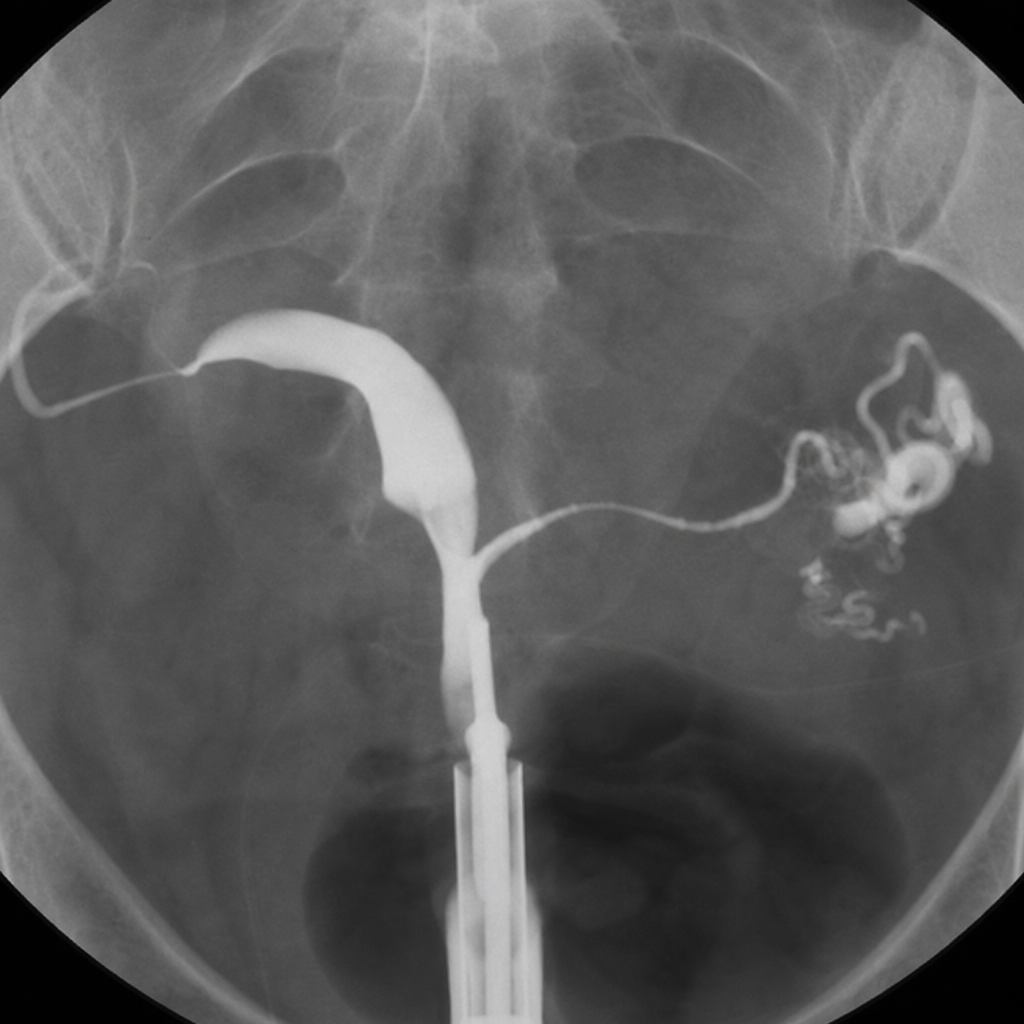
Which type of uterine fibroid is most likely to cause pressure symptoms?
Regarding a unicornuate uterus, which statement is true?
What is true regarding testicular feminization syndrome?
Which of the following statements is true regarding benign ovarian tumors?
All of the following are true about Meig's syndrome except?
What is the most common site of genital tuberculosis?
A vaginal smear from an elderly woman shows atrophic changes. Which type of cells are predominantly seen in such a smear?
What is the prevalence of malignancy in uterine fibroids?
Which of the following infections is most likely associated with a vaginal pH of 4?
Frozen pelvis is seen in?
Explanation: **Explanation:** The clinical presentation of uterine fibroids (leiomyomas) is primarily determined by their **anatomical location** rather than just their size. **Why Subserous Fibroid is Correct:** Subserous fibroids are located just beneath the serosa and grow outward into the peritoneal cavity. Because they have space to expand away from the uterine cavity, they often reach a **massive size** before becoming symptomatic. Their large volume and external position allow them to exert direct mechanical pressure on adjacent pelvic organs. Common pressure symptoms include: * **Bladder:** Urinary frequency, urgency, or retention. * **Rectum:** Constipation or tenesmus. * **Pelvic Vessels:** Edema or varicose veins in the lower limbs. **Analysis of Incorrect Options:** * **Submucous Fibroid (A):** These grow just beneath the endometrium and distort the uterine cavity. Even when very small, they typically present with **menorrhagia** (heavy menstrual bleeding) or infertility. They rarely grow large enough to cause pressure symptoms because their clinical symptoms (bleeding) lead to earlier diagnosis and intervention. * **Options C & D:** These are incorrect as the physiological impact of fibroids is highly specific to their location. **High-Yield Clinical Pearls for NEET-PG:** * **Most Common Symptom of Fibroids:** Menorrhagia (especially in intramural and submucous types). * **Most Common Type of Fibroid:** Intramural. * **Fibroid most likely to undergo torsion:** Pedunculated subserous fibroid (presents as acute abdomen). * **Degeneration during pregnancy:** Red degeneration (due to rapid growth and venous obstruction). * **Best Initial Investigation:** Transvaginal Ultrasound (TVUS).
Explanation: ### Explanation **Correct Answer: C. One Müllerian duct is completely absent** **Understanding the Concept:** A **unicornuate uterus (Class II AFS classification)** results from the **agenesis or failure of development** of one of the two Müllerian ducts. While the other duct develops normally to form a single-horned uterus, the affected side may be completely absent or exist as a "rudimentary horn." This is a defect of **lateral fusion and development**, not just fusion alone. **Analysis of Options:** * **Option A (Incorrect):** A defect in the fusion of Müllerian ducts typically leads to a **bicornuate uterus** (partial fusion failure) or **uterus didelphys** (complete fusion failure). In a unicornuate uterus, the primary issue is the *absence* of one duct, not the failure of two existing ducts to merge. * **Option B (Incorrect):** Since one Müllerian duct is absent or rudimentary, there is only **one functional fallopian tube** attached to the single uterine horn. * **Option D (Incorrect):** Unicornuate uteri are associated with **poor reproductive outcomes**, including high rates of infertility, recurrent pregnancy loss (miscarriage), preterm labor, and malpresentation. The "best" reproductive outcome among Müllerian anomalies is generally associated with a **septate uterus** (after resection) or an **arcuate uterus**. **High-Yield Clinical Pearls for NEET-PG:** * **Renal Anomalies:** Unicornuate uterus has the highest association with **ipsilateral renal agenesis** (up to 40% of cases). Always screen the renal system with an ultrasound. * **Rudimentary Horn:** If a rudimentary horn contains functional endometrium but does not communicate with the main cavity (non-communicating), it can lead to **hematometra** and cyclic pelvic pain. * **Obstetric Emergency:** Pregnancy in a non-communicating rudimentary horn is a surgical emergency as it carries a high risk of **rupture** during the second trimester. * **Gold Standard Diagnosis:** Combined **Laparoscopy and Hysteroscopy** is the gold standard for differentiating between various Müllerian anomalies.
Explanation: **Explanation:** **Testicular Feminization Syndrome**, now more commonly known as **Complete Androgen Insensitivity Syndrome (CAIS)**, is an X-linked recessive condition where there is a total resistance to androgen action due to a defect in androgen receptors. 1. **Why Option A is correct:** In CAIS, the individual has a **46,XY genotype** (male) and possesses **testes** (gonads). These testes produce testosterone; however, because the body’s receptors cannot respond to it, the external genitalia default to the female pathway during development. Consequently, the individual presents with a **female phenotype**, including well-developed breasts (due to peripheral conversion of testosterone to estrogen) and a blind-ending vagina. 2. **Why other options are incorrect:** * **Option B & C:** These are incorrect because the **phenotype is female**, not male. While the genotype (46,XY) and gonads (testes) are male, the external physical appearance is distinctly feminine. * **Option D:** This is incorrect because the **genotype is 46,XY** (male) and the **gonads are testes**, not ovaries. **High-Yield Clinical Pearls for NEET-PG:** * **Karyotype:** 46, XY. * **Gonads:** Undescended or inguinal testes (risk of gonadoblastoma/dysgerminoma; orchidectomy is usually performed after puberty). * **Clinical Presentation:** Primary amenorrhea in a girl with normal breast development but **absent/scanty axillary and pubic hair** (due to androgen resistance). * **Internal Structures:** Uterus, fallopian tubes, and upper 1/3rd of the vagina are **absent** (due to normal secretion of Anti-Müllerian Hormone by the testes). * **Differential Diagnosis:** Mayer-Rokitansky-Küster-Hauser (MRKH) syndrome (MRKH has 46,XX karyotype and normal pubic/axillary hair).
Explanation: **Explanation:** In gynecological oncology, distinguishing between benign and malignant ovarian masses is crucial for surgical planning. **1. Why the Correct Answer is Right:** The hallmark of a **benign ovarian tumor** is that it remains confined within its anatomical boundaries. The **capsule is intact**, and there is no surface excrescence or extracapsular growth. This lack of capsular penetration is a key diagnostic feature that differentiates it from malignant tumors, which often exhibit capsular breach and seeding into the peritoneal cavity. **2. Analysis of Incorrect Options:** * **A. Torsion is uncommon:** This is incorrect. Torsion is actually the **most common complication** of benign ovarian tumors (especially dermoid cysts). Because benign tumors are often mobile and pedunculated, they are highly prone to twisting on their pedicle. * **C. Ascites can occur:** While Meigs' Syndrome (fibroma + ascites + hydrothorax) is a rare exception, ascites is generally a **strong indicator of malignancy**. In benign cases, the peritoneal lining remains uninvolved, so fluid accumulation is typically absent. * **D. Size is typically less than 10 cm:** This is incorrect. Benign tumors, particularly **Mucinous Cystadenomas**, can reach massive sizes (sometimes filling the entire abdomen) without showing any signs of malignancy. **NEET-PG High-Yield Pearls:** * **Most common benign tumor:** Serous Cystadenoma (overall); Dermoid cyst (in women <30 years). * **IOTA Rules:** Benign tumors are characterized by unilocular cysts, presence of acoustic shadows, and no blood flow on Doppler (Color Score 1). * **Meigs' Syndrome:** A triad of Benign Ovarian Fibroma, Ascites, and Right-sided Pleural Effusion that resolves after tumor removal.
Explanation: **Explanation:** Meig’s syndrome is a classic clinical triad characterized by a **benign ovarian tumor** (classically an ovarian fibroma), **ascites**, and **pleural effusion**. The hallmark of this syndrome is that both the ascites and pleural effusion resolve spontaneously after the surgical removal of the tumor. **Why Option C is the Correct Answer (The False Statement):** The exact pathophysiology of ascites in Meig’s syndrome is not fully understood, but it is **not** caused by lymphatic dysplasia. The most accepted theories suggest that the ascites results from either the transudation of fluid from the surface of a large, edematous fibroma that exceeds the peritoneum's resorptive capacity or from pressure on the pelvic lymphatics. Lymphatic dysplasia is associated with conditions like Milroy disease or certain congenital lymphedemas, not Meig’s syndrome. **Analysis of Other Options:** * **Option A:** Ovarian fibroma is the most common tumor associated with Meig’s syndrome (seen in ~1-10% of fibromas). Other associated tumors include thecomas and granulosa cell tumors. * **Option B:** Ascites and pleural effusion (usually right-sided) are the defining clinical features of the syndrome. * **Option D:** The ascites and pleural effusion are reactive and benign; they do not require separate drainage or treatment (like pleurodesis) because they resolve completely once the primary ovarian tumor is excised. **High-Yield Clinical Pearls for NEET-PG:** * **Pseudo-Meig’s Syndrome:** When the triad occurs with other pelvic masses (e.g., leiomyomas, ovarian metastasis, or other benign/malignant germ cell tumors). * **Pleural Effusion:** It is typically **right-sided** (70% of cases) because fluid travels from the peritoneum to the pleural space via transdiaphragmatic lymphatics or the Foramina of Bochdalek. * **Tumor Marker:** CA-125 levels can be elevated in Meig's syndrome, mimicking ovarian malignancy; however, the prognosis remains excellent as the tumor is benign.
Explanation: **Explanation:** Genital tuberculosis (TB) is almost always a secondary infection, spreading primarily via the **hematogenous route** from a primary focus, usually the lungs. **1. Why Fallopian Tubes are the Correct Answer:** The **fallopian tubes** are the most common site of involvement in female genital TB, affected in **90–100% of cases**. The infection typically starts in the endosalpinx and spreads to other pelvic organs. It is a significant cause of tubal factor infertility and ectopic pregnancy due to the chronic inflammatory damage and "lead pipe" appearance of the tubes. **2. Why the Other Options are Incorrect:** * **Lungs (A):** While the lungs are the most common site for *primary* tuberculosis in the body, they are not a part of the *genital* tract. The question specifically asks for the site of genital TB. * **Uterus (C):** The endometrium is the second most common site, involved in **50–60% of cases**. It is usually infected secondary to downward spread from the fallopian tubes. * **Ovary (D):** The ovaries are involved in approximately **20–30% of cases**, typically through direct extension from the tubes (perioophoritis). **3. NEET-PG High-Yield Pearls:** * **Order of involvement:** Fallopian tubes (100%) > Endometrium (50%) > Ovaries (25%) > Cervix (5%) > Vagina/Vulva (1%). * **Key Clinical Sign:** Infertility is the most common presenting symptom. * **Hysterosalpingography (HSG) findings:** "Beaded tube," "Lead pipe tube," or "Tobacco pouch" appearance. * **Laparoscopy:** May show "Millet seeds" (tubercles) on the peritoneal surface. * **Gold Standard Diagnosis:** Endometrial biopsy/aspirate for TB-PCR or culture (taken in the premenstrual phase).
Explanation: **Explanation:** The maturation of the vaginal epithelium is directly dependent on **estrogen levels**. Estrogen promotes the proliferation and maturation of squamous cells from the basal layer up to the superficial layer. **1. Why Basal and Parabasal cells are correct:** In elderly women (postmenopausal), there is a significant decline in estrogen production. Without estrogenic stimulation, the vaginal epithelium fails to mature. The superficial and intermediate layers are lost, leaving only the **basal and parabasal cells** (the least mature layers). These cells are small, round-to-oval, with a high nuclear-to-cytoplasmic (N:C) ratio, characteristic of an **atrophic smear**. **2. Why other options are incorrect:** * **Atrophic cells:** This is a descriptive term for the overall smear pattern, not a specific histological cell type. * **Superficial cells:** These are large, flat cells with pyknotic nuclei. They predominate under high estrogen influence (e.g., mid-cycle/ovulation). * **Intermediate cells:** These represent moderate estrogenic or high progesterone influence (e.g., pregnancy or the luteal phase). While a few may be present in early menopause, they are not the predominant feature of a fully atrophic smear. **High-Yield Clinical Pearls for NEET-PG:** * **Maturation Index (MI):** Expressed as a ratio of (Parabasal : Intermediate : Superficial cells). * **Atrophy (Postmenopausal):** Shift to the left (e.g., 100:0:0). * **Ovulatory phase:** Shift to the right (e.g., 0:40:60). * **Pregnancy:** Shift to the middle (e.g., 0:95:5). * **Fern Test:** Negative in atrophic states due to lack of estrogen. * **Vaginal pH:** In menopause, the lack of glycogen (due to lack of superficial cells) leads to decreased *Lactobacillus* and an **increase in vaginal pH (>5.0)**, predisposing to atrophic vaginitis.
Explanation: **Explanation:** Uterine fibroids (leiomyomas) are the most common benign tumors of the female reproductive tract. The correct prevalence of malignancy—specifically the transformation into **leiomyosarcoma**—is approximately **0.50%** (often cited in literature as ranging between 0.1% and 0.5%). This low risk is a critical clinical factor when deciding between conservative management and surgical intervention. * **Option A (0.50%) is correct:** Large-scale epidemiological studies and histopathological reviews confirm that the risk of an incidental leiomyosarcoma in a presumed fibroid is extremely low, typically around 1 in 200 to 1 in 400 cases. * **Options B, C, and D are incorrect:** These values (1%, 5%, and 10%) significantly overestimate the risk. If the malignancy rate were as high as 1% or more, conservative management (watchful waiting) would be clinically unjustifiable, and routine screening for malignancy in all fibroids would be mandatory. **High-Yield Clinical Pearls for NEET-PG:** 1. **Transformation:** Leiomyosarcomas are generally thought to arise *de novo* rather than from the malignant transformation of a pre-existing benign leiomyoma. 2. **Red Flags:** Rapid growth of a "fibroid," especially in **postmenopausal women**, is a significant warning sign for leiomyosarcoma. 3. **Diagnosis:** Definitive diagnosis of malignancy cannot be made via ultrasound or MRI; it requires **histopathological examination** (looking for cellular atypia, high mitotic index, and coagulative tumor necrosis). 4. **Management:** In perimenopausal women with rapidly enlarging masses, total hysterectomy is preferred over myomectomy to avoid morcellation, which can spread malignant cells if a sarcoma is present.
Explanation: The normal vaginal pH in a reproductive-age woman is acidic, typically ranging between **3.8 and 4.5**. This acidity is maintained by *Lactobacillus* species, which convert glycogen into lactic acid. ### **Explanation of the Correct Answer** **B. Candidal vaginitis:** This is the only common vaginal infection where the **pH remains normal (<4.5)**. *Candida albicans* thrives in an acidic environment. Therefore, a patient presenting with thick, curd-like discharge and intense pruritus with a pH of 4.0 is classic for Vulvovaginal Candidiasis (VVC). ### **Why Other Options are Incorrect** * **A. Atrophic vaginitis:** Occurs due to estrogen deficiency (post-menopausal). Lack of estrogen leads to decreased glycogen and fewer Lactobacilli, causing the pH to rise above **5.0**. * **C. Trichomonas vaginitis:** This protozoal infection typically presents with a "strawberry cervix" and a thin, frothy discharge. It is associated with a significantly elevated pH, usually **>5.0**. * **D. Gardnerella vaginitis (Bacterial Vaginosis):** Characterized by a shift in flora from Lactobacilli to anaerobes. This loss of acidity results in a pH **>4.5** (one of the Amsel criteria). ### **High-Yield NEET-PG Clinical Pearls** * **Whiff Test (KOH 10%):** Positive (fishy odor) in Bacterial Vaginosis and Trichomoniasis; **Negative** in Candidiasis. * **Microscopy:** Look for **Pseudohyphae** in Candidiasis, **Clue cells** in BV, and **Pear-shaped flagellated motile organisms** in Trichomoniasis. * **Drug of Choice:** Oral Fluconazole for Candidiasis; Metronidazole for both BV and Trichomoniasis (Note: Treat the partner only in Trichomoniasis).
Explanation: **Explanation:** **Potts disease (Tuberculous Spondylitis)**, specifically in the context of **Genital Tuberculosis**, is a classic cause of a "Frozen Pelvis." In pelvic tuberculosis, chronic inflammation leads to dense, "plaster-like" adhesions between the pelvic organs (uterus, ovaries, tubes), the omentum, and the bowel loops. This results in a rigid, fixed pelvic mass where planes of cleavage are completely obliterated, making surgical dissection extremely difficult. **Analysis of Options:** * **Potts disease (Correct):** While Potts disease refers to spinal TB, the term "Frozen Pelvis" in gynecology is most strongly associated with **Pelvic Tuberculosis** and **Endometriosis**. In the context of this question, TB is the primary infectious etiology leading to this pathology. * **Osteoarthritis (Incorrect):** This is a degenerative joint disease affecting articular cartilage; it does not involve the pelvic soft tissues or cause internal adhesions. * **Actinomycosis (Incorrect):** While *Actinomyces israelii* (often associated with long-term IUD use) can cause "woody" induration and pelvic abscesses, it is less classically associated with the specific term "Frozen Pelvis" compared to TB or Endometriosis. * **Reiter’s disease (Incorrect):** Now known as Reactive Arthritis, it presents with the triad of urethritis, conjunctivitis, and arthritis. It does not cause pelvic fibrosis. **Clinical Pearls for NEET-PG:** * **Commonest causes of Frozen Pelvis:** 1. Endometriosis (most common non-infectious), 2. Pelvic Tuberculosis, 3. Advanced Pelvic Malignancy, 4. Chronic Pelvic Inflammatory Disease (PID). * **Genital TB:** The Fallopian tube is the most common site affected (90-100%), usually leading to infertility. * **Key Sign:** On bimanual examination, the uterus and adnexa feel fixed and immobile.
Abnormal Uterine Bleeding
Practice Questions
Endometriosis
Practice Questions
Adenomyosis
Practice Questions
Uterine Fibroids
Practice Questions
Ovarian Cysts
Practice Questions
Pelvic Inflammatory Disease
Practice Questions
Vulvovaginitis
Practice Questions
Pelvic Organ Prolapse
Practice Questions
Vulvar Disorders
Practice Questions
Benign Breast Diseases
Practice Questions
Get full access to all questions, explanations, and performance tracking.
Start For Free