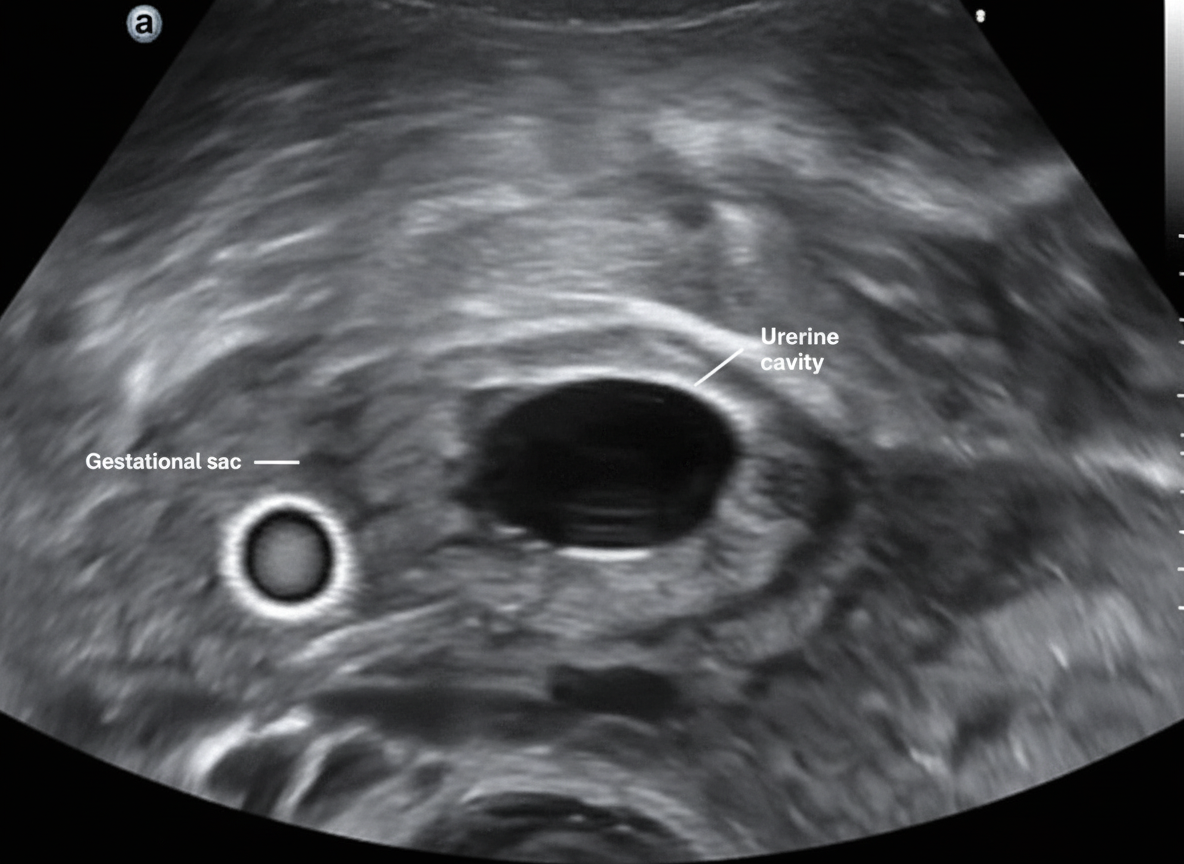
What is the spot diagnosis for the given image/description?

A six-year-old girl presents with spotting and no secondary sexual characteristics. What is the most likely cause?
Pain in endometriosis correlates with:
A 28-year-old female with a history of 6 weeks of amenorrhea presents with abdominal pain. Ultrasound shows fluid in the pouch of Douglas. Aspiration yields dark-colored blood that fails to clot. What is the most probable diagnosis?
Which drugs are used for the treatment of ectopic pregnancy?
A 20-year-old woman presents with a 2-3 day history of lower abdominal pain occurring cyclically each month, starting approximately 3 days before her menses. What is the most probable etiology?
Which type of fibroid is associated with the maximum symptoms?
What is the most common benign tumor of the uterus?
Which of the following drugs used for endometriosis can cause an increase in hepatic enzymes and an adverse lipid profile?
A young multigravida presents with postcoital bleeding. Physical examination reveals a normal vagina and a hypertrophied cervix. What is the next step in management?
Explanation: ***Bicornuate uterus*** - Shows classic **heart-shaped external contour** with a **fundal cleft >1cm** and **intercornual angle >105°** on imaging - **HSG** demonstrates two separate uterine horns with **divergent lateral walls** and **MRI** confirms external fundal indentation *Unicornuate uterus* - Appears as a **single horn** with **banana-shaped** or **comma-shaped** configuration on imaging - Associated with **renal agenesis** on the same side and **rudimentary horn** may be present *Arcuate uterus* - Shows **minimal external fundal indentation <1cm** with **broad fundal impression** on imaging - **Intercornual angle <105°** and considered a **mild variant** with minimal clinical significance *Septate uterus* - Demonstrates **normal external uterine contour** with **internal septum** dividing the cavity - **MRI** shows **low signal intensity septum** and **intercornual angle <75°** differentiating from bicornuate
Explanation: **Explanation:** The presentation of vaginal bleeding in a prepubertal girl **without secondary sexual characteristics** (no breast development or pubic hair) is a classic clinical scenario for a **vaginal foreign body**. 1. **Why Foreign Body is correct:** In the pediatric age group, small objects (like toilet paper, beads, or toys) are the most common cause of persistent vaginal spotting or foul-smelling discharge. These objects cause local irritation, pressure necrosis, and secondary infection, leading to spotting. Since there are no signs of puberty, the bleeding is local/mechanical rather than hormonal. 2. **Why other options are incorrect:** * **Menarche:** This is the first menstrual period. It occurs late in the pubertal sequence (usually Tanner Stage 4) and must be preceded by secondary sexual characteristics like thelarche (breast development). * **Gonococcal infection:** While it can cause discharge, it is less common than non-specific vulvovaginitis or foreign bodies in children. Its presence in a child should always raise a high suspicion of sexual abuse. * **Hemorrhagic disease:** Systemic bleeding disorders (like VWD or leukemia) would typically present with bleeding from other sites (epistaxis, bruising) rather than isolated vaginal spotting. **Clinical Pearls for NEET-PG:** * **Most common cause** of prepubertal vaginal bleeding: **Foreign body** (if foul-smelling) or **Vulvovaginitis** (most common overall). * **Precocious Puberty:** Defined as secondary sexual characteristics before age 8. If bleeding occurs *without* these signs, it is "Prepubertal Vaginal Bleeding," not menstruation. * **Diagnosis:** In children, a foreign body is best visualized via **vaginoscopy** (using a small endoscope or cystoscope) or sometimes palpated via rectal examination. * **Sarcoma Botryoides:** A high-yield differential for "grape-like masses" and bleeding in a young girl.
Explanation: **Explanation:** In endometriosis, the severity of pain is primarily determined by the **depth of invasion** of the implants into the underlying tissues (peritoneum or organs), rather than the surface area or the number of lesions. Deeply infiltrating endometriosis (DIE), defined as lesions penetrating >5 mm, involves dense innervation and often affects the uterosacral ligaments or the rectovaginal septum, leading to severe dysmenorrhea and chronic pelvic pain. **Analysis of Options:** * **A. Depth of invasion (Correct):** Studies consistently show that the deeper the lesion penetrates, the higher the correlation with pain symptoms due to the involvement of subperitoneal nerves. * **B. Multiple sites:** Having implants in many locations does not necessarily mean the patient will experience more pain; a single deep lesion can be more painful than multiple superficial ones. * **C. CA 125 levels:** While CA 125 is often elevated in endometriosis (especially in endometriomas), it is a marker of disease activity and surface area, not a reliable indicator of pain intensity. * **D. Stage of disease:** This is a common pitfall. The ASRM staging system is based on the extent of adhesions and the size of implants to predict **fertility outcomes**, not pain. A patient with Stage I (minimal) disease may have debilitating pain, while a patient with Stage IV (severe) disease may be asymptomatic. **High-Yield Clinical Pearls for NEET-PG:** * **Gold Standard Diagnosis:** Laparoscopy with biopsy (visual confirmation). * **Most Common Site:** Ovary. * **Staging vs. Symptoms:** There is a **poor correlation** between the ASRM stage and the severity of pain or the risk of infertility. * **Classic Triad:** Dysmenorrhea (congestive), Dyspareunia, and Infertility.
Explanation: ### Explanation **Correct Answer: B. Ruptured ectopic pregnancy** The clinical presentation of **amenorrhea (6 weeks)**, **acute abdominal pain**, and **fluid in the Pouch of Douglas (POD)** is a classic triad for a ruptured ectopic pregnancy. The definitive diagnostic clue here is the aspiration of **dark-colored, non-clotting blood** via culdocentesis. **Medical Concept:** In a ruptured ectopic pregnancy, blood collects in the peritoneal cavity (hemoperitoneum). This blood undergoes **defibrination** due to the action of the peritoneal surfaces, which strips the fibrin from the blood. Consequently, the blood becomes "incoagulable" (fails to clot). --- ### Why the other options are incorrect: * **A. Ruptured ovarian cyst:** While this can cause fluid in the POD and pain, it usually occurs mid-cycle (Mittelschmerz) or in the luteal phase and is rarely associated with amenorrhea. The fluid is typically serous or contains fresh blood that may clot. * **C. Red degeneration of fibroid:** This typically occurs during the **second or third trimester of pregnancy** due to rapid growth and venous obstruction. It presents with localized pain and fever, but not with hemoperitoneum or non-clotting blood in the POD. * **D. Pelvic abscess:** Aspiration would yield **pus** (purulent fluid) rather than blood. The patient would also typically present with high-grade fever and elevated inflammatory markers. --- ### NEET-PG High-Yield Pearls: * **Culdocentesis:** Aspiration of non-clotting blood from the POD is highly suggestive of a ruptured ectopic pregnancy or a ruptured corpus luteum. * **Golden Rule:** In any woman of reproductive age presenting with amenorrhea and abdominal pain, **Ectopic Pregnancy** must be ruled out first via a urine pregnancy test or serum β-hCG. * **Most common site:** The **Ampulla** of the Fallopian tube is the most common site for ectopic pregnancy. * **Most common site for rupture:** The **Isthmus** (due to its narrow lumen, it ruptures early, around 6–8 weeks).
Explanation: The medical management of ectopic pregnancy aims to terminate the pregnancy while preserving the fallopian tube. The correct answer is **All of the above** because each of these drugs plays a specific role in inhibiting trophoblastic growth. ### **Explanation of Options:** * **Methotrexate (MTX):** This is the **drug of choice** and the most commonly used agent. It is a folic acid antagonist that inhibits the enzyme dihydrofolate reductase, thereby arresting DNA synthesis in rapidly dividing trophoblastic cells. * **Actinomycin-D:** This is a potent cytotoxic antibiotic. While not the first-line treatment, it is used as an alternative or adjunct in cases resistant to Methotrexate or in specific protocols for cervical or interstitial pregnancies. * **Mifepristone (RU-486):** An anti-progestogen that blocks progesterone receptors. Since progesterone is essential for maintaining early pregnancy, Mifepristone sensitizes the trophoblast to destruction. It is often used in combination with Methotrexate to increase the success rate of medical management. ### **Clinical Pearls for NEET-PG:** 1. **Selection Criteria for MTX:** To qualify for medical management, the patient must be hemodynamically stable, the ectopic mass should be **< 3.5 - 4 cm**, and baseline **Serum β-hCG should be < 5000 mIU/mL** (ideally < 3000). 2. **Absolute Contraindications:** Ruptured ectopic pregnancy (hemodynamic instability), breastfeeding, and immunodeficiency. 3. **Monitoring:** Success is defined by a **≥ 15% drop** in β-hCG levels between Day 4 and Day 7 of treatment. 4. **High-Yield Fact:** Potassium Chloride (KCl) or Hypertonic glucose can also be used via local injection (ultrasound-guided) for live ectopic pregnancies to induce fetal cardiac arrest.
Explanation: **Explanation:** The clinical presentation of cyclical lower abdominal pain occurring **2–3 days prior to menstruation** is a classic hallmark of **Endometriosis**. **Why Endometriosis is correct:** In endometriosis, ectopic endometrial tissue undergoes the same hormonal changes as the uterine lining. During the late luteal phase, as progesterone levels drop, these ectopic implants bleed and release inflammatory mediators (prostaglandins). Because this blood is trapped within the peritoneal cavity or organs, it causes chemical peritonitis and pelvic pressure *before* the actual menstrual flow begins. This is known as **premenstrual/congestive dysmenorrhea**. **Analysis of Incorrect Options:** * **A. Mittelschmerz:** This refers to mid-cycle ovulatory pain (typically day 14). It is sudden, sharp, and occurs 2 weeks before menses, not 2–3 days prior. * **B. Fibroid:** While fibroids can cause pain, they typically present with heavy menstrual bleeding (menorrhagia) or pressure symptoms. Pain is usually associated with "red degeneration" (during pregnancy) or torsion of a pedunculated fibroid, rather than cyclical premenstrual pain. * **C. Pelvic Tuberculosis:** This usually presents with chronic pelvic pain, infertility, and menstrual irregularities (often oligomenorrhea or amenorrhea). The pain is typically constant rather than strictly cyclical and premenstrual. **NEET-PG High-Yield Pearls:** * **Classic Triad of Endometriosis:** Dysmenorrhea (congestive), Dyspareunia (deep), and Infertility. * **Gold Standard Diagnosis:** Laparoscopy ("Powder-burn" or "Gunshot" lesions). * **Most Common Site:** Ovary (forming "Chocolate cysts" or Endometriomas). * **Definitive Management:** Total Laparoscopic Hysterectomy with Bilateral Salpingo-oophorectomy (TLH with BSO).
Explanation: **Explanation:** The clinical presentation of uterine fibroids (leiomyomas) depends more on their **location** than their size. **Submucous fibroids (Option A)** are the most symptomatic because they distort the uterine cavity and increase the surface area of the endometrium. This leads to significant disruption of the uterine vasculature and interference with normal myometrial contractions. Consequently, even small submucous fibroids cause severe **menorrhagia** (heavy menstrual bleeding), intermenstrual spotting, and are the most common type associated with **infertility** and recurrent pregnancy loss due to implantation failure. **Analysis of Incorrect Options:** * **Subserous (Option B):** These grow on the outer surface of the uterus. They are often asymptomatic until they reach a large size, at which point they may cause pressure symptoms on the bladder or rectum. * **Intramural (Option C):** These are the most common type overall. While they cause heavy bleeding and bulk symptoms, they typically require a larger size to become as symptomatic as a small submucous fibroid. * **Cervical (Option D):** These are rare (1-2%). While they can cause pressure symptoms or dyspareunia, they are not the "most symptomatic" category in general practice. **NEET-PG High-Yield Pearls:** * **Most common symptom of fibroid:** Menorrhagia (specifically in intramural and submucous types). * **Most common type of fibroid:** Intramural. * **Most common fibroid to undergo red degeneration:** Large fibroids during pregnancy (usually intramural). * **Best initial investigation:** Transvaginal Ultrasound (TVS). * **Gold standard for submucous fibroids:** Hysteroscopy.
Explanation: **Explanation:** **Leiomyoma (Option A)**, commonly known as a uterine fibroid, is the most common benign solid tumor of the female pelvis and the uterus. These are monoclonal tumors arising from the smooth muscle cells of the myometrium. Their growth is highly dependent on estrogen and progesterone, which is why they are most prevalent during reproductive years and typically regress after menopause. **Why other options are incorrect:** * **Cervical fibroid (Option B):** While these are leiomyomas, they are rare, accounting for only 1–2% of all uterine fibroids. The majority (95%) are corporal (located in the body of the uterus). * **Endometrial polyp (Option C):** These are localized overgrowths of endometrial glands and stroma. While common, their incidence is significantly lower than that of leiomyomas. * **Adenomyosis (Option D):** This is a condition characterized by the presence of endometrial glands and stroma within the myometrium. It is often referred to as "endometriosis interna" and is considered a distinct pathological entity rather than a true neoplastic tumor. **High-Yield Clinical Pearls for NEET-PG:** * **Most common site:** Intramural (within the myometrium). * **Most common symptom:** Menorrhagia (heavy menstrual bleeding). * **Most common secondary change:** Hyaline degeneration. * **Degeneration during pregnancy:** Red degeneration (due to rapid growth and venous thrombosis). * **Risk of malignancy:** Transformation into Leiomyosarcoma is extremely rare (<0.1%). * **Investigation of choice:** Transvaginal Ultrasound (TVS); however, MRI is the most accurate for mapping.
Explanation: **Explanation:** **Correct Option: A (Oral contraceptive pills)** Combined Oral Contraceptive Pills (COCPs) contain both estrogen and progestogen. The estrogen component (usually ethinyl estradiol) undergoes significant first-pass metabolism in the liver. This process stimulates the production of hepatic enzymes and alters lipid metabolism, typically leading to an increase in total cholesterol, triglycerides, and VLDL levels. While they are a first-line treatment for endometriosis-associated pain, their systemic metabolic impact on the liver and lipid profile is a well-documented side effect compared to other targeted hormonal therapies. **Incorrect Options:** * **B. Levonorgestrel-releasing intrauterine device (LNG-IUD):** This provides localized progestogen delivery to the endometrium. Systemic absorption is minimal, resulting in negligible effects on hepatic enzymes or the lipid profile. * **C. Gonadotropin-releasing hormone (GnRH) analogues:** These drugs (e.g., Leuprolide) work by creating a "pseudomenopausal" state. Their primary side effects are related to hypoestrogenism (bone mineral density loss and vasomotor symptoms) rather than direct hepatic enzyme induction. * **D. Dienogest:** This is a fourth-generation selective progestin. Unlike older 19-nortestosterone derivatives, Dienogest has no androgenic activity and minimal impact on metabolic and lipid parameters, making it a preferred long-term option for endometriosis. **High-Yield Clinical Pearls for NEET-PG:** * **First-line treatment for Endometriosis:** COCPs or Progestogens (Dienogest is highly effective). * **Gold Standard Diagnosis:** Laparoscopy (Visualizing "powder-burn" or "mulberry" lesions). * **GnRH Analogues:** Cannot be used for more than 6 months without "Add-back therapy" (low-dose estrogen/progestogen) to prevent osteoporosis. * **Danazol:** An older treatment (androgenic steroid) that also causes significant lipid profile derangement (decreased HDL) and hepatic dysfunction, but it is rarely used today due to virilization.
Explanation: **Explanation:** The clinical presentation of **postcoital bleeding** in a multigravida with a **hypertrophied cervix** is highly suspicious for cervical malignancy or high-grade cervical intraepithelial neoplasia (CIN). In clinical practice, any symptomatic patient with a visible cervical abnormality or persistent postcoital bleeding requires a definitive diagnosis. **Why Colposcopy with Biopsy is correct:** While a Pap smear is a screening tool for asymptomatic women, it has a significant false-negative rate (up to 20-40%). In a patient who is already **symptomatic** (postcoital bleeding) and has a **clinical finding** (hypertrophied cervix), the diagnostic "gold standard" is Colposcopy. This allows for a magnified view of the cervix to identify abnormal vascular patterns or acetowhite areas, followed by a directed biopsy to obtain a histopathological diagnosis. **Analysis of Incorrect Options:** * **A. Pap smear:** This is a screening test. If a lesion is clinically visible or the patient is symptomatic, a negative Pap smear should not delay a biopsy, as it may miss an invasive cancer. * **C. Cryotherapy:** This is an ablative treatment for confirmed low-grade CIN. It should never be performed without a tissue diagnosis (biopsy) first, as it could mask an underlying invasive cancer. * **D. Pelvic examination:** The question states a physical examination has already been performed (revealing the hypertrophied cervix), making this a redundant step. **Clinical Pearls for NEET-PG:** * **Postcoital bleeding** is the most common presenting symptom of cervical cancer. * **Hypertrophied cervix** in a multiparous woman often suggests chronic cervicitis or malignancy. * **Rule of Thumb:** If the cervix looks suspicious on speculum examination, proceed directly to biopsy regardless of the Pap smear result. * **Bethesda System:** Remember that Colposcopy is indicated for HSIL, ASC-H, and persistent LSIL/ASCUS.
Abnormal Uterine Bleeding
Practice Questions
Endometriosis
Practice Questions
Adenomyosis
Practice Questions
Uterine Fibroids
Practice Questions
Ovarian Cysts
Practice Questions
Pelvic Inflammatory Disease
Practice Questions
Vulvovaginitis
Practice Questions
Pelvic Organ Prolapse
Practice Questions
Vulvar Disorders
Practice Questions
Benign Breast Diseases
Practice Questions
Get full access to all questions, explanations, and performance tracking.
Start For Free