Which of the following treatments is used for vulvar atrophy and itching?
Green frothy vaginal discharge is produced by –
60-year-old female with a history of intermittent bleeding. What is the diagnosis based on the ultrasound image?

A mother brought her 16-year-old daughter to Gynaecology OPD with a complaint of not attending menarche. She gives a history of cyclic abdominal pain. On further examination, a midline abdominal swelling is seen. Per rectal examination reveals a bulging mass in the vaginal area. Which of the following can be most commonly seen?
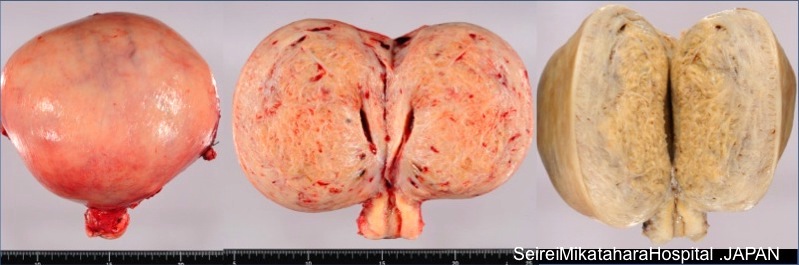
A 30-year-old woman presents with complaints of dysmenorrhea and dyspareunia, accompanied by chronic pelvic pain. She undergoes a hysterectomy. Based on the cut section of the hysterectomy specimen provided, identify the condition.
What is the most reliable method to confirm the correct placement of a ring pessary in a patient with uterine prolapse?
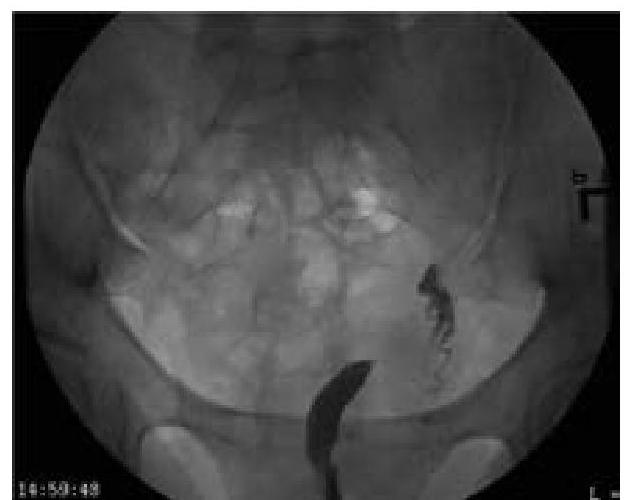
What type of uterine anomaly is shown in this X-ray HSG image?

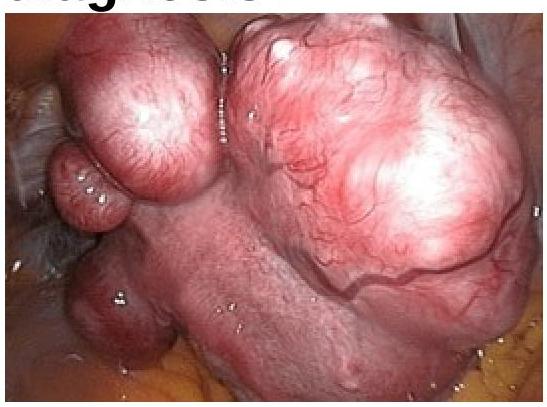
In a woman complaining of AUB following image was seen in endoscopic examination of uterus. What will be the diagnosis?
Dilatation & curettage (D&C) is contraindicated in-
Long-standing pelvic inflammatory disease (PID) may lead to which of the following complications?
Explanation: ***Estrogen ointment*** * **Estrogen ointment** is the primary treatment for vulvar atrophy and itching because it directly addresses the underlying cause of these symptoms, which is the decline in estrogen levels after **menopause**. * By restoring estrogen to the vulvar tissues, it helps to **thicken the epithelium**, improve blood flow, and increase lubrication, thereby alleviating dryness, itching, and discomfort. *Antihistamines* * **Antihistamines** are used to treat allergic reactions and reduce itching associated with conditions like hives or insect bites, but they do not address the hormonal deficiency causing vulvar atrophy. * While they might temporarily relieve some itching, they do not treat the underlying **tissue thinning** and dryness characteristic of vulvar atrophy. *Tamoxifen* * **Tamoxifen** is a selective estrogen receptor modulator (SERM) primarily used in the treatment and prevention of breast cancer, as it blocks estrogen's effects in breast tissue. * However, in vulvovaginal tissues, **tamoxifen can actually worsen atrophy and dryness** due to its anti-estrogenic effects, making it an inappropriate treatment for vulvar atrophy. *None of the options* * This option is incorrect because **estrogen ointment** is a well-established and effective treatment specifically designed to address vulvar atrophy and associated itching, by restoring estrogen levels to the affected tissues.
Explanation: ***Trichomonas vaginalis*** - **Trichomoniasis**, caused by *Trichomonas vaginalis*, classically presents with a **yellowish-green, frothy, malodorous vaginal discharge**. - It is a **sexually transmitted infection** that can also cause vaginal itching, burning, and dyspareunia. *Herpes simplex* - Herpes simplex virus typically causes **painful genital ulcers** or sores, not a frothy discharge. - The discharge, if present, is usually clear or serous and associated with the open lesions. *Candida albicans* - *Candida albicans* (yeast infection) commonly produces a **thick, white, "cottage cheese-like" discharge** that is often associated with intense itching. - It does not typically cause a frothy, green discharge. *Normal vaginal flora* - Normal vaginal flora maintains a healthy vaginal environment and produces a **clear to whitish, non-irritating discharge** with no strong odor. - It does not cause a green, frothy discharge, which indicates an infection.
Explanation: ***Endometrial polyp*** - The ultrasound image shows a well-defined, **echogenic focal lesion within the endometrial cavity**, which is characteristic of an endometrial polyp. - In a 60-year-old female with intermittent bleeding, a polyp is a common cause of **postmenopausal bleeding** and is often identified as an intracavitary mass on ultrasound. - Endometrial polyps appear as **focal, hyperechoic or isoechoic masses** with a smooth contour projecting into the endometrial cavity. *Ca endometrium* - **Endometrial carcinoma** typically appears as diffuse endometrial thickening (>4-5 mm in postmenopausal women), irregular endometrial-myometrial interface, or heterogeneous endometrial echoes, often with evidence of myometrial invasion. - While bleeding is a cardinal symptom of endometrial carcinoma, the distinct **focal, well-circumscribed nature** of the lesion on ultrasound is less typical for carcinoma, which tends to be more diffuse and irregular. *Submucosal fibroid* - A **submucosal fibroid** (leiomyoma) is a benign smooth muscle tumor originating from the myometrium that protrudes into the endometrial cavity. - While it can appear as an intracavitary mass and cause abnormal bleeding, fibroids often have a more **heterogeneous or hypoechoic appearance** with posterior acoustic shadowing, compared to the isoechoic to hyperechoic appearance of a polyp. - The feeding vessel sign (blood flow at the base) is more characteristic of polyps than fibroids. *Endometrial hyperplasia* - **Endometrial hyperplasia** presents as **diffuse, uniform endometrial thickening** rather than a focal intracavitary mass. - It typically shows homogeneous increased echogenicity of the entire endometrium without a discrete, well-defined lesion as seen with a polyp. - While it can cause postmenopausal bleeding, the focal nature of the lesion in this case makes hyperplasia less likely.
Explanation: ***Congenital obstruction of the vaginal opening due to hymenal anomaly*** - This is the most common cause of **congenital vaginal outflow obstruction** presenting in adolescent girls - The classic triad of **primary amenorrhea**, **cyclic abdominal pain**, and **palpable pelvic/abdominal mass** points to **imperforate hymen with hematocolpos** - The **bulging mass on per rectal examination** is pathognomonic, representing accumulated menstrual blood distending the vagina - Cyclic pain occurs due to uterine contractions against the obstruction during attempted menstruation - Treatment involves **cruciate incision of the hymen** to release the accumulated blood *Congenital transverse partition in the vaginal canal* - Transverse vaginal septum can present similarly but is **much less common** than imperforate hymen - The septum is typically located at the **junction of upper and middle third** of the vagina - The bulging mass on per rectal examination is **more characteristic of distal obstruction** (imperforate hymen) rather than a mid-vaginal septum - Would require **surgical excision** rather than simple cruciate incision *Congenital absence of uterus and upper vagina* - **Mayer-Rokitansky-Küster-Hauser (MRKH) syndrome** presents with primary amenorrhea but **NO cyclic pain** - Absence of functional uterus means **no menstrual blood production**, hence no hematocolpos or bulging mass - Patients have normal ovaries and secondary sexual characteristics but absent uterus and upper 2/3 of vagina - Per rectal examination would reveal **absent uterus**, not a bulging mass *Absence of vaginal development* - **Vaginal agenesis** is usually part of MRKH syndrome spectrum - Would **NOT present with cyclic abdominal pain** as there is no functional endometrium to shed - **No accumulation of menstrual blood** occurs, so no palpable mass or vaginal bulging - The presence of cyclic symptoms indicates a **patent uterus with obstructed outflow**, ruling out this diagnosis
Explanation: ***Adenomyosis*** - The image depicts a **thickened uterine wall** with poorly demarcated, **whorled or trabeculated areas** within the myometrium, often containing small blood or fluid-filled cysts, which are characteristic macroscopic findings in adenomyosis. - The clinical presentation of **dysmenorrhea**, **dyspareunia**, and **chronic pelvic pain** is highly consistent with adenomyosis, where endometrial tissue invades the muscular wall of the uterus. - The diffuse involvement of the myometrium without discrete masses is pathognomonic for adenomyosis. *Endometrial hyperplasia* - Endometrial hyperplasia involves **excessive proliferation of endometrial glands** and stroma within the endometrial cavity, not invasion into the myometrium. - It typically presents with **abnormal uterine bleeding** rather than the dysmenorrhea and pelvic pain seen here. - The cut section would show a **thickened endometrium** rather than myometrial involvement. *Uterine leiomyoma* - Uterine leiomyomas (fibroids) are benign smooth muscle tumors that present as **discrete, well-demarcated, firm, rubbery masses** within or protruding from the myometrium. - The macroscopic appearance in the image, characterized by a diffuse, poorly circumscribed involvement of the myometrial wall, is inconsistent with leiomyoma. - Leiomyomas have a **whorled, white-tan cut surface** that is sharply demarcated from surrounding tissue. *Endometriosis* - Endometriosis involves the presence of **endometrial tissue outside the uterus**, such as on the ovaries, peritoneum, or other pelvic organs. - While it can cause similar symptoms (dysmenorrhea, dyspareunia, chronic pelvic pain), the image provided shows the **cut section of a hysterectomy specimen**, indicating a condition *within* the uterine wall, not external implants. - Endometriosis would not show the characteristic myometrial thickening and trabeculation seen in adenomyosis.
Explanation: ***If it remains in place after increased abdominal pressure*** - The most reliable method to confirm correct placement is to ensure the pessary **stays in position** when the patient coughs, strains, or performs a Valsalva maneuver, mimicking increased **intra-abdominal pressure**. - This maneuver confirms that the pessary is adequately supported by the **levator ani muscles** and the vaginal walls, preventing expulsion during daily activities. *If there is no bleeding observed* - While absence of bleeding is a good sign for immediate mucosal integrity, it does not confirm the **mechanical stability** of the pessary or its ability to support the prolapse long-term. - Bleeding can be a sign of improper fit or erosion, but its absence alone isn't a definitive indicator of correct placement. *If the patient reports discomfort* - Discomfort can indicate **improper fit**, too large a pessary, or even correct placement if the patient is unaccustomed to it. Therefore, discomfort is a poor indicator of correct placement. - A correctly placed pessary should generally be **unnoticeable** by the patient, though mild initial awareness can occur. *If the ring is not visible externally* - Not being visible externally indicates that the pessary is **internalized**, but this alone does not confirm that it is adequately supporting the uterus or that it will remain in place during activities that increase abdominal pressure. - A pessary can be inside the vagina but still be **improperly positioned** or sized to effectively manage the prolapse.
Explanation: ***Unicornuate uterus*** - The image shows a single, elongated uterine horn with a single fallopian tube arising from it, consistent with a **unicornuate uterus**. - This congenital anomaly results from the **failure of one Müllerian duct to develop**, leading to an abnormally shaped uterus. *Septate uterus* - A **septate uterus** would show a normal uterine fundus with an internal septum dividing the uterine cavity. - This image clearly depicts only **one rudimentary horn** and no visible septum. *Uterus didelphys* - **Uterus didelphys** involves two completely separate uteri, each with its own cervix and vagina. - The image does not show evidence of a **second, separate uterine structure**. *Bicornuate uterus* - A **bicornuate uterus** is characterized by two distinct uterine horns, which fuse at the cervix or lower uterine segment, creating a heart-shaped appearance of the fundus. - The image shows a **single, long horn** rather than two distinct horns.
Explanation: ***Leiomyoma*** - The image shows **well-circumscribed, smooth, rounded masses protruding into the uterine cavity**, which are characteristic of **submucous (intracavitary) leiomyomas (fibroids)** seen on hysteroscopy. - Submucous leiomyomas are benign smooth muscle tumors that project into the endometrial cavity and commonly cause **abnormal uterine bleeding (AUB)** due to increased endometrial surface area, distortion of the endometrial cavity, ulceration of overlying endometrium, and interference with normal uterine contractility. - On **hysteroscopic examination**, they appear as firm, pale, smooth-surfaced masses with overlying endometrium. *Adenomyosis* - Adenomyosis involves the presence of **endometrial tissue within the myometrium**, leading to diffuse uterine enlargement. - On hysteroscopy, it may show a **globally irregular endometrial surface** with small endometrial openings or cystic spaces, but not the discrete, well-circumscribed protruding masses seen in the image. - While it can cause AUB and dysmenorrhea, the appearance is distinctly different from submucous leiomyomas. *Ovarian neoplasm* - Ovarian neoplasms originate in the **ovaries**, which are separate from the uterus. - **Hysteroscopic examination** visualizes only the **endometrial cavity** and cannot directly visualize ovarian pathology. - Ovarian masses do not protrude into the uterine cavity. *Carcinoma of uterus* - Endometrial carcinoma typically presents on hysteroscopy as **irregular, friable, ulcerative, or fungating lesions** with abnormal vascularity and易出血 (easy bleeding). - The **smooth, well-defined, and rounded appearance** with intact overlying mucosa in the image is characteristic of benign leiomyomas, not malignant growths. - Uterine sarcomas are rare and would show more irregular, infiltrative features rather than well-circumscribed masses.
Explanation: ***Pelvic inflammatory disease (PID)*** - D&C is **contraindicated** in PID due to the high risk of **spreading pre-existing infection** from the cervix or vagina into the sterile uterine cavity and beyond. - This procedure can worsen the infection, potentially leading to **sepsis**, **tubo-ovarian abscesses**, or chronic pain. *Endometriosis* - D&C is not typically contraindicated in **endometriosis**, as it is sometimes used diagnostically to rule out other causes of abnormal uterine bleeding, though it isn't a treatment for endometriosis itself. - Endometriosis involves the presence of **endometrial tissue outside the uterus**, and a D&C performed on the uterus does not directly exacerbate this condition. *Ectopic pregnancy* - D&C is not contraindicated in **ectopic pregnancy**; however, it is not the primary treatment. - A D&C may be performed if the diagnosis of ectopic pregnancy is uncertain and to rule out an **intrauterine pregnancy** or retained products of conception. *Abnormal uterine bleeding* - D&C is frequently indicated and can be both **diagnostic and therapeutic** for abnormal uterine bleeding, especially to investigate causes like polyps, fibroids, or endometrial hyperplasia. - It helps in obtaining tissue for **histopathological examination** to guide further management.
Explanation: ***Hydrosalpinx*** - **Hydrosalpinx** is a condition where the fallopian tube is blocked and filled with serous fluid, representing the **end-stage of chronic pelvic inflammatory disease (PID)**. - Chronic inflammation from **repeated or inadequately treated PID** causes damage to the tubal epithelium, loss of fimbrial function, and **adhesions that seal the distal end of the tube**. - This leads to accumulation of sterile transudate within the obstructed tube, creating a **fluid-filled, dilated fallopian tube**. - It is a major cause of **tubal factor infertility** and increased risk of **ectopic pregnancy**. - Classic imaging finding: **sausage-shaped cystic structure** on ultrasound. *Uterine polyposis* - **Endometrial polyps** are benign growths arising from the endometrium, typically associated with **unopposed estrogen stimulation** or hormonal imbalances. - They are **not a complication of chronic PID** but rather a proliferative endometrial disorder. - Common causes include obesity, tamoxifen use, and perimenopause. *Asherman syndrome* - **Asherman syndrome** involves **intrauterine adhesions** (synechiae) causing partial or complete obliteration of the uterine cavity. - It typically results from **endometrial trauma** following procedures like **D&C (dilatation and curettage)**, particularly post-abortion or postpartum curettage. - While PID can cause adhesions, Asherman syndrome specifically refers to **intrauterine** adhesions, not a typical sequela of chronic PID, which primarily affects the **tubes and ovaries**. *Endometriosis* - **Endometriosis** is the presence of **endometrial tissue outside the uterine cavity**, most commonly on ovaries, pelvic peritoneum, and uterosacral ligaments. - It is thought to result from **retrograde menstruation** (Sampson's theory) and genetic/immune factors. - It is **not caused by PID** but is a distinct pathological entity with different etiology and pathophysiology.
Abnormal Uterine Bleeding
Practice Questions
Endometriosis
Practice Questions
Adenomyosis
Practice Questions
Uterine Fibroids
Practice Questions
Ovarian Cysts
Practice Questions
Pelvic Inflammatory Disease
Practice Questions
Vulvovaginitis
Practice Questions
Pelvic Organ Prolapse
Practice Questions
Vulvar Disorders
Practice Questions
Benign Breast Diseases
Practice Questions
Get full access to all questions, explanations, and performance tracking.
Start For Free