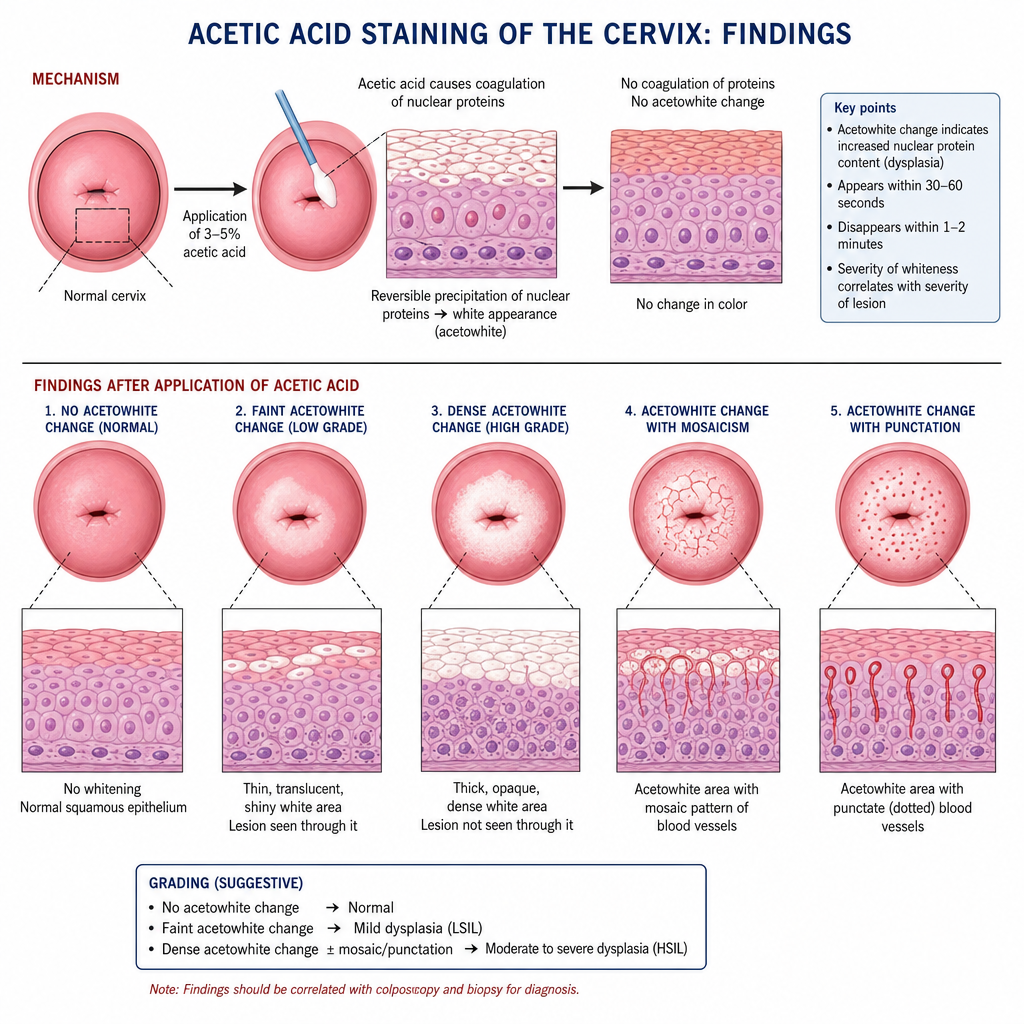
A 45-year-old patient presents to the Gynecology OPD with a history of postcoital bleeding. She underwent the procedure shown below. Name the instruments used.

For a woman with a history of two prior molar pregnancies, what is the risk of having a third molar pregnancy?
Conventional cytogenetics are difficult in solid tumors, especially in cases of carcinoma of the cervix, due to which of the following factors?
Regarding adenocarcinoma in situ, all are true, except:
A 25-year-old woman undergoes a Pap smear at a screening camp for cervical cancer. Her test report indicates inadequate cervical cytology. What is the appropriate follow-up for this patient?
A dermoid cyst of the ovary contains derivatives from which germ layer(s)?
A patient with carcinoma of the cervix, who has completed radiotherapy, presents with uremia. What is the most common cause of this presentation?
What is the characteristic color of the vulva in Paget's disease?
Carcinoma of the cervix extends to the lateral pelvic wall. What is the clinical stage?
A 52-year-old postmenopausal woman presents with vaginal bleeding for 3 weeks. She is concerned this could be cancer, similar to her sister's condition. Transvaginal ultrasound reveals an endometrial thickness of 8.0 mm. What is the next step in management?
Explanation: ***Ayre's spatula, Cusco's speculum*** - **Ayre's spatula** is the standard instrument for collecting **ectocervical cells** during a Pap smear, essential for screening cervical cancer in patients with postcoital bleeding. - **Cusco's speculum** provides optimal **visualization** and **access** to the cervix, allowing proper sample collection from the transformation zone. *Cervical pipette, Sim's speculum* - **Cervical pipette** is primarily used for **endometrial sampling**, not for routine cervical cytology screening. - **Sim's speculum** is a **single-blade speculum** that provides limited visualization compared to the bivalve Cusco's speculum. *Endocervical brush, Sim's speculum* - **Endocervical brush** alone is insufficient as it only samples the **endocervical canal**, missing the important **ectocervical** transformation zone. - **Sim's speculum** offers **inadequate exposure** of the cervix for proper cytological sampling. *Cusco's speculum, Endocervical brush* - While **Cusco's speculum** is correct, using only an **endocervical brush** misses the **ectocervical** cells from the transformation zone. - **Ayre's spatula** is essential for collecting cells from the **squamocolumnar junction** where most cervical cancers originate.
Explanation: **Explanation:** The risk of recurrent gestational trophoblastic disease (GTD) increases significantly with each subsequent molar pregnancy. This question tests the candidate's knowledge of the specific statistical progression of recurrence risk. **1. Why 20% is Correct:** The baseline risk of a molar pregnancy in the general population is approximately **0.1% (1 in 1000)**. * After **one** molar pregnancy, the risk of recurrence rises to **1%** (a 10-fold increase). * After **two** prior molar pregnancies, the risk jumps significantly to **15–20%**. This exponential increase is likely due to underlying genetic predispositions or oocyte defects that favor abnormal fertilization. **2. Analysis of Incorrect Options:** * **A (1%):** This is the risk of recurrence after only **one** prior molar pregnancy. * **B (5%) & C (10%):** These values underestimate the risk. While recurrence risks for many obstetric complications (like preeclampsia) fall in this range, molar pregnancy recurrence follows a much steeper trajectory after the second event. **3. Clinical Pearls & High-Yield Facts for NEET-PG:** * **Most Common Type:** The most common karyotype for a **Complete Mole** is 46,XX (androgenetic), while a **Partial Mole** is typically 69,XXX or 69,XXY (triploid). * **Management of Future Pregnancies:** For patients with a history of mole, an early ultrasound (6–10 weeks) is mandatory in all subsequent pregnancies to confirm normalcy. * **Post-Evacuation Monitoring:** After evacuation, serum β-hCG should be monitored weekly until three consecutive negative results are obtained, then monthly (6 months for complete mole). * **Contraception:** Combined Oral Contraceptive Pills (OCPs) are the preferred method once hCG levels become undetectable; they do not increase the risk of post-molar trophoblastic neoplasia.
Explanation: **Explanation:** Conventional cytogenetics (karyotyping) involves the study of chromosomes during the metaphase stage of cell division. While highly effective for hematological malignancies, it faces significant challenges in solid tumors like cervical carcinoma. **Why "Inadequate biopsy specimen" is correct:** The primary hurdle in cervical cancer cytogenetics is obtaining a high-quality, viable sample. Biopsies from cervical tumors often contain a high proportion of **necrotic tissue, inflammatory cells, and stromal elements** rather than pure, viable malignant cells. Furthermore, solid tumor cells have a **low growth fraction** in vitro; they are difficult to culture and often fail to yield enough high-quality metaphase spreads required for accurate chromosomal analysis. **Analysis of Incorrect Options:** * **A. High mitotic rate:** A high mitotic rate would actually *facilitate* cytogenetics, as it increases the number of cells entering metaphase for study. * **B. Bacterial contamination:** While the cervix is a non-sterile site, contamination is a technical challenge that can be managed with antibiotics in culture media; it is not the primary biological limiting factor compared to specimen adequacy. * **C. Good metaphase activity:** This is incorrect because solid tumors typically exhibit **poor** metaphase activity and a low mitotic index when cultured, making it difficult to visualize chromosomes. **High-Yield Clinical Pearls for NEET-PG:** * **Molecular Alternative:** Due to the difficulty of conventional cytogenetics, **FISH (Fluorescence In Situ Hybridization)** and **CGH (Comparative Genomic Hybridization)** are preferred as they do not require actively dividing cells. * **Key Genetic Finding:** The most common genetic alteration in cervical cancer is the integration of **HPV DNA (Types 16 and 18)** into the host genome, leading to the overexpression of E6 and E7 oncoproteins. * **Chromosomal Change:** Deletions in the short arm of **chromosome 3 (3p)** are frequently observed in cervical carcinoma.
Explanation: **Explanation:** Adenocarcinoma in situ (AIS) of the cervix is the precursor to invasive adenocarcinoma. Unlike squamous lesions, AIS is characterized by "skip lesions"—multifocal areas of disease separated by normal tissue. **Why Option D is the correct answer (the false statement):** Due to the presence of **skip lesions** (found in up to 15% of cases), negative margins on a Cold Knife Cone (CKC) biopsy do **not** guarantee that the disease has been completely eradicated. There may be occult foci of AIS or even invasive cancer higher up in the endocervical canal despite clear margins at the excision site. **Analysis of other options:** * **Option A:** Colposcopy and punch biopsies have low sensitivity for AIS because the lesion originates within the endocervical crypts. A diagnostic excisional procedure (preferably CKC) is mandatory to rule out occult invasive adenocarcinoma. * **Option B:** Hysterectomy is the definitive treatment of choice for women who have completed childbearing because of the high risk of recurrence and the unreliability of follow-up cytology/colposcopy for glandular lesions. * **Option C:** AIS typically arises at the transformation zone but frequently extends deep into the endocervical canal, necessitating a "long" cone biopsy for diagnosis. **High-Yield Clinical Pearls for NEET-PG:** * **Gold Standard Diagnosis:** Cold Knife Cone (CKC) biopsy is preferred over LEEP because it provides intact margins and prevents thermal artifact, which is crucial for glandular assessment. * **Management in Pregnancy:** If AIS is suspected during pregnancy, re-evaluation is done postpartum unless invasive cancer is strongly suspected. * **Follow-up:** If a patient desires fertility and margins are negative, she can be followed with co-testing (Pap + HPV) and endocervical curettage (ECC) every 6 months.
Explanation: **Explanation:** The management of an **inadequate (unsatisfactory) cervical cytology** report is a high-yield topic in cervical cancer screening guidelines (Bethesda System). **1. Why Option B is Correct:** When a Pap smear is reported as "unsatisfactory for evaluation" (due to reasons like insufficient squamous cells, obscuring blood, or inflammation), the test cannot reliably rule out pathology. According to the ASCCP guidelines, the preferred management for most women is to **repeat the cytology in 2–4 months (standardized as 3 months)**. This interval allows the cervical epithelium to regenerate, ensuring an adequate sample of cells for the repeat test. **2. Why Other Options are Incorrect:** * **Option A (Colposcopy):** Colposcopy is indicated for abnormal results (like HSIL, or persistent LSIL/ASCUS). It is not the first-line management for a single inadequate smear unless the patient is at high risk or has had repeated unsatisfactory results. * **Option C (6 months):** This interval is too long. If a high-grade lesion is present but missed due to an inadequate sample, a 6-month delay could lead to disease progression. * **Option D (3 years):** This is the routine screening interval for a *normal* Pap smear. An inadequate test is not a negative test; therefore, the patient cannot return to routine screening. **High-Yield Clinical Pearls for NEET-PG:** * **Adequacy Criteria:** A conventional Pap smear is considered "adequate" if it contains at least **8,000–12,000** well-visualized squamous cells. For Liquid-Based Cytology (LBC), the requirement is **5,000** squamous cells. * **Transformation Zone:** The presence of endocervical or squamous metaplastic cells (at least 10) indicates that the Transformation Zone (the site of most cancers) was sampled. * **Special Scenario:** If a patient is HPV-positive and has an unsatisfactory Pap, immediate colposcopy or repeat Pap in 2-4 months are both options, but for a general screening population (like this 25-year-old), repeat cytology is the standard.
Explanation: **Explanation:** A **Dermoid Cyst**, also known as a **Mature Cystic Teratoma**, is the most common germ cell tumor of the ovary. By definition, a teratoma is a tumor composed of tissues derived from more than one germ cell layer, and in the case of a dermoid cyst, it characteristically contains well-differentiated tissues from **all three germ layers**: 1. **Ectoderm:** This is the most prominent layer, giving rise to skin, hair follicles, sebaceous glands (producing the characteristic "cheesy" sebum), and neural tissue. 2. **Mesoderm:** Represented by bone, cartilage, teeth, muscle, and fat. 3. **Endoderm:** Represented by respiratory epithelium, gastrointestinal tract lining, and thyroid tissue. **Why other options are incorrect:** Options A, B, and C are incomplete. While a dermoid cyst does contain ectodermal, mesodermal, and endodermal elements, selecting only one would ignore its defining characteristic as a multi-germ layer tumor. **Clinical Pearls for NEET-PG:** * **Most Common Complication:** Torsion (due to its heavy weight and long pedicle). * **Most Common Malignant Transformation:** Squamous cell carcinoma (occurring in <2% of cases, usually in postmenopausal women). * **Radiological Sign:** Presence of teeth or calcification on X-ray/CT; "Rokitansky protuberance" (dermoid plug) on Ultrasound. * **Struma Ovarii:** A specialized teratoma composed predominantly of thyroid tissue (endoderm), which can lead to thyrotoxicosis. * **Chemical Peritonitis:** Occurs if the cyst ruptures and spills its sebaceous contents into the peritoneal cavity.
Explanation: **Explanation:** In advanced carcinoma of the cervix, the most common cause of death and a frequent cause of renal failure (uremia) is **bilateral ureteral obstruction**. **1. Why Option A is Correct:** Cervical cancer typically spreads laterally via the parametrium. As the tumor infiltrates the parametrial tissues, it can compress or directly invade the ureters at the point where they pass under the uterine artery ("water under the bridge"). When this occurs bilaterally, it leads to obstructive uropathy, hydronephrosis, and eventually uremia. Even after radiotherapy, persistent or recurrent disease is the most statistically likely cause of new-onset uremia in these patients. **2. Why Other Options are Incorrect:** * **Radiation Nephritis (B):** This occurs when the kidneys are directly in the radiation field (e.g., treating upper abdominal tumors). In cervical cancer, the radiation is focused on the pelvis, sparing the kidneys. * **Ureteral Stenosis due to Radiation (C):** While radiation-induced fibrosis can cause ureteral strictures, it is significantly less common than direct tumor invasion or recurrence. * **Unconnected Causes (D):** While possible, they are not the "most common" cause in the context of a known cervical malignancy. **Clinical Pearls for NEET-PG:** * **Most common cause of death in Cervical CA:** Uremia (Renal failure) due to bilateral ureteral obstruction. * **Staging Significance:** Ureteral involvement (hydronephrosis or non-functioning kidney) automatically classifies the disease as **Stage IIIB**, regardless of other findings. * **Triad of Advanced Pelvic Malignancy:** Leg edema, hydronephrosis, and sciatic pain (indicates lateral pelvic wall involvement).
Explanation: **Explanation:** **Extramammary Paget’s Disease (EMPD)** of the vulva is a rare intraepithelial neoplasia. While the classic clinical description often mentions a "cake-icing" appearance with red, eczematous patches, the characteristic finding emphasized in competitive exams like NEET-PG is the presence of **white, hyperkeratotic plaques** interspersed within these red areas. This creates a variegated, "red and white" map-like appearance. The "white" component is due to the presence of thickened, keratinized epithelium or the accumulation of Paget cells. **Analysis of Options:** * **White (Correct):** The hallmark of Paget’s is the "porcelain-white" or "cake-icing" plaque. In the context of standard PG entrance exams, "White" is the preferred answer to describe the characteristic leukoplakic patches. * **Blue:** This is incorrect. Blue/black lesions on the vulva are more characteristic of **Malignant Melanoma** or benign nevi. * **Red:** While the background of Paget’s is often erythematous (eczematoid), "Red" alone is non-specific and can mimic simple dermatitis or candidiasis. The diagnostic "clue" is the white plaque. * **Yellow:** This is not a feature of Paget’s; yellow discharge or crusting is more typical of secondary bacterial infections (impetiginization). **Clinical Pearls for NEET-PG:** * **Histology:** Pathognomonic **Paget cells** (large, pale cells with abundant granular cytoplasm and large nuclei) are found in the epidermis. * **Staining:** Paget cells are **PAS positive**, **Alcian Blue positive**, and **Mucicarmine positive** (indicating mucin production). * **Associated Malignancy:** Unlike mammary Paget’s, vulvar Paget’s is less frequently associated with an underlying adenocarcinoma (about 20-30%), but a thorough search for internal malignancy (rectal, bladder, or cervical) is mandatory. * **Treatment:** Wide local excision is the gold standard, though recurrence rates are high due to "skip lesions."
Explanation: **Explanation:** The clinical staging of cervical cancer follows the **FIGO (2018) classification**. The correct answer is **Stage III** because, by definition, this stage involves the lower third of the vagina, extension to the pelvic wall, and/or causes hydronephrosis or a non-functioning kidney. **Breakdown of the Correct Answer:** * **Stage IIIB:** Specifically refers to cases where the tumor extends to the **pelvic sidewall** and/or causes hydronephrosis or a non-functioning kidney. On rectal examination, there is no cancer-free space between the tumor and the pelvic wall. **Why the other options are incorrect:** * **Stage I:** The carcinoma is strictly confined to the cervix (neck of the uterus). It has not spread to the vagina or parametrium. * **Stage II:** The tumor extends beyond the uterus but has **not** reached the pelvic sidewall or the lower third of the vagina. Stage IIB involves the parametrium but spares the pelvic wall. * **Stage IV:** This represents advanced disease where the tumor has invaded the mucosa of the bladder or rectum (IVA) or has spread to distant organs (IVB). **High-Yield Clinical Pearls for NEET-PG:** * **Staging Method:** FIGO staging for cervical cancer is primarily **clinical** (physical exam, cystoscopy, proctoscopy), but the 2018 update now allows the use of **imaging** (MRI/CT/PET) and **pathology** to assign the stage. * **Parametrial Involvement:** If the parametrium is involved but the pelvic wall is free, it is **Stage IIB**. Once it hits the pelvic wall, it becomes **Stage IIIB**. * **Hydronephrosis:** Any patient with cervical cancer and hydronephrosis is automatically categorized as **Stage IIIB**, regardless of other findings. * **Lymph Nodes:** Under FIGO 2018, involvement of pelvic or para-aortic lymph nodes is classified as **Stage IIIC**.
Explanation: **Explanation:** The clinical presentation of **postmenopausal bleeding (PMB)** is a "red flag" that must be investigated to rule out endometrial carcinoma. In a postmenopausal woman, the gold standard for diagnosis is obtaining a tissue sample for histopathological examination. 1. **Why Option C is correct:** According to standard protocols, any postmenopausal woman with vaginal bleeding and an **endometrial thickness (ET) > 4 mm** on transvaginal ultrasound (TVS) requires a tissue biopsy. In this patient, the ET is 8.0 mm, significantly exceeding the threshold. Histopathological examination (via endometrial biopsy or fractional curettage) is essential to differentiate between endometrial hyperplasia, polyps, or malignancy. 2. **Why other options are incorrect:** * **Option A (Hysterectomy):** This is a definitive surgical treatment, not a diagnostic step. It should only be performed after a confirmed diagnosis of malignancy or premalignant lesions. * **Option B (Steroid hormone therapy):** Hormonal therapy (like progestogens) may be used for hyperplasia without atypia, but it is contraindicated before a tissue diagnosis is established. * **Option D (Observation):** An ET of 8.0 mm in the presence of PMB is highly suspicious. Observation would lead to a delayed diagnosis of potential cancer. **High-Yield Clinical Pearls for NEET-PG:** * **Cut-off for ET in PMB:** If ET is **≤ 4 mm**, the risk of malignancy is <1%, and biopsy may be deferred. If **> 4 mm**, biopsy is mandatory. * **Most common cause of PMB:** Senile (atrophic) vaginitis/endometritis. * **Most serious cause of PMB:** Endometrial carcinoma (found in ~10% of cases). * **Risk Factors:** Obesity, nulliparity, late menopause, and Lynch syndrome (relevant here due to the sister's history).
Cervical Cancer
Practice Questions
Endometrial Cancer
Practice Questions
Ovarian Cancer
Practice Questions
Vulvar and Vaginal Cancer
Practice Questions
Gestational Trophoblastic Disease
Practice Questions
Screening for Gynecologic Cancers
Practice Questions
Principles of Gynecologic Oncology Surgery
Practice Questions
Radiation Therapy in Gynecologic Malignancies
Practice Questions
Chemotherapy in Gynecologic Oncology
Practice Questions
Palliative Care in Gynecologic Oncology
Practice Questions
Get full access to all questions, explanations, and performance tracking.
Start For Free