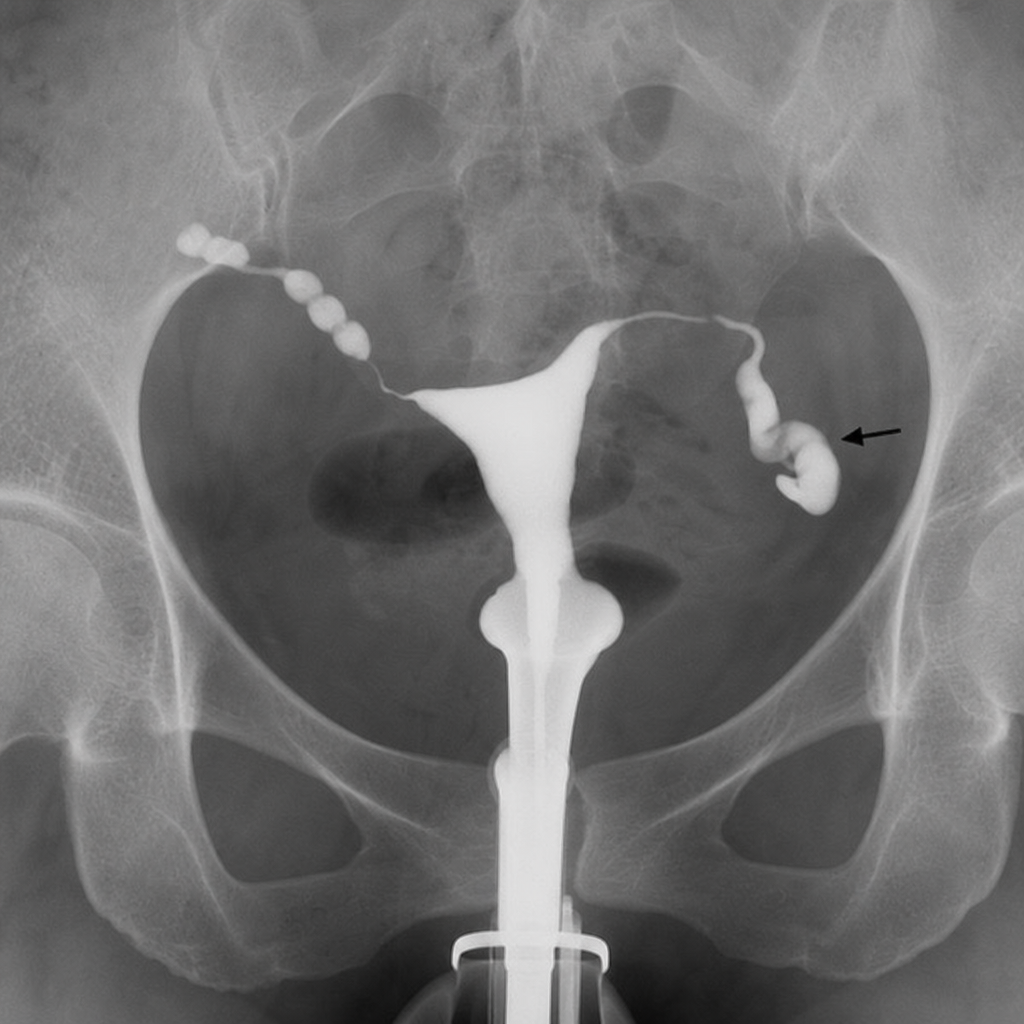
Infertility is a common feature of Swyer cell syndrome because:
In which assisted reproductive technique does fertilization occur outside the body?
A 29-year-old married woman, unable to conceive after 3 years of marriage, presents with regular menstrual cycles and mild dysmenorrhea. Her pelvic scan reveals a 3 cm intramural fibroid and a follicular ovarian cyst. Hysterosalpingography (HSG) shows normal fallopian tubes. Her husband's semen analysis and hormonal profile are normal. What is the most likely cause of her infertility?
Decreasing AMH (anti-Mullerian hormone) is a sign of which of the following?
What is the first-line treatment for infertility in Polycystic Ovarian Disease (PCOD)?
If a lifestyle factor causing infertility in a young male is identified, which of the following lifestyle modifications will have no effect?
What technique is used for aspiration of sperm directly from the testes for in vitro fertilization?
A patient experiencing infertility, treated with ovulation induction and an ovulation trigger with HCG injection, tests positive for pregnancy on the first day of her missed period. On the same day, she presents to the emergency department with complaints of abdominal distension, vomiting, and difficulty in breathing. Her blood pressure is 110/60 mmHg and pulse rate is 98/min. What is the most probable cause of her symptoms?
Which of the following helps to prevent premature LH surge during oocyte retrieval for in vitro fertilization?
What is the normal sperm concentration in semen analysis?
Explanation: **Explanation:** **Swyer Syndrome (Pure Gonadal Dysgenesis)** is a condition characterized by a **46,XY karyotype** in individuals who have a female phenotype. The underlying pathophysiology involves a failure of the primitive gonads to differentiate into testes, often due to mutations in the **SRY gene** or other sex-determining pathways (like SOX9). 1. **Why the correct answer is right:** In Swyer Syndrome, because the SRY gene fails to trigger testicular development, the bipotential gonads do not develop into testes or ovaries. Instead, they persist as non-functional, fibrous **"streak gonads."** These streak gonads lack follicles and **germ cells**. Without germ cells (oocytes), natural conception is impossible, leading to primary infertility. 2. **Why the incorrect options are wrong:** * **Options A, B, and D:** These options assume the presence of testicular tissue (Sertoli cells, blood-testis barrier, or spermatogenesis). In Swyer Syndrome, there is **no testicular development** despite the XY genotype. Therefore, these male-specific physiological processes never occur. **High-Yield Clinical Pearls for NEET-PG:** * **Phenotype:** Female external genitalia, well-developed Müllerian structures (uterus, fallopian tubes) because no Anti-Müllerian Hormone (AMH) is produced. * **Clinical Presentation:** Primary amenorrhea and delayed puberty (hypergonadotropic hypogonadism). * **Malignancy Risk:** There is a high risk (approx. 25-30%) of developing **Gonadoblastoma** or Dysgerminoma in the streak gonads; therefore, prophylactic **gonadectomy** is recommended upon diagnosis. * **Fertility Potential:** While naturally infertile, patients **can achieve pregnancy** through **Oocyte Donation** and IVF, as they have a functional uterus.
Explanation: **Explanation** The core concept in this question is distinguishing between **In-Vitro Fertilization (IVF)**, where fertilization occurs in a laboratory dish, and **In-Vivo Fertilization**, where fertilization occurs naturally inside the woman's body. **Why Option C is Correct:** In **Gamete Intrafallopian Transfer (GIFT)**, unfertilized oocytes and washed sperm are collected and immediately placed into the fallopian tubes via laparoscopy. Because the gametes are placed together inside the tube, **fertilization occurs naturally (in-vivo)**. This technique requires at least one functional, healthy fallopian tube. **Analysis of Incorrect Options:** * **A. Zygote Intrafallopian Transfer (ZIFT):** Fertilization occurs **outside** the body (IVF). The resulting zygote is then transferred into the fallopian tube. * **B. Intracytoplasmic Sperm Injection (ICSI):** This is a specialized form of IVF where a single sperm is injected directly into an egg. Fertilization occurs **outside** the body in a lab setting. * **D. In Vitro Fertilization (IVF):** By definition, "In Vitro" means "in glass." Fertilization occurs **outside** the body, and the resulting embryos are later transferred to the uterus. **NEET-PG High-Yield Pearls:** * **GIFT vs. IVF:** GIFT is often preferred by patients with religious or ethical objections to IVF, as fertilization happens inside the body. * **Prerequisite for GIFT:** Unlike IVF, GIFT **cannot** be performed in cases of bilateral tubal blockage. * **Success Rates:** Currently, IVF/ICSI are more commonly used than GIFT/ZIFT due to higher success rates and less invasive procedures (no laparoscopy required for transfer). * **Site of Fertilization:** In a normal pregnancy and GIFT, the site of fertilization is the **Ampulla** of the fallopian tube.
Explanation: ### Explanation The correct answer is **Endometriosis**. **Why Endometriosis is the most likely cause:** In a patient with primary infertility, regular menstrual cycles, and a normal semen analysis, the diagnosis is often narrowed down to pelvic factors. The presence of **mild dysmenorrhea** is a classic clinical pointer toward endometriosis. Even in the absence of large endometriomas, "minimal to mild" endometriosis can cause infertility by creating a pro-inflammatory peritoneal environment that impairs sperm motility, oocyte quality, and fertilization. While the scan shows a follicular cyst (physiological) and a small fibroid, these do not typically cause infertility in the presence of regular cycles and patent tubes. **Why the other options are incorrect:** * **Polycystic Ovarian Disease (PCOD):** This is characterized by irregular cycles (oligomenorrhea) and anovulation. The patient in the question has regular menstrual cycles, making PCOD unlikely. * **Fibroid Uterus:** Small (3 cm) **intramural** fibroids that do not distort the endometrial cavity generally do not cause infertility. Submucosal fibroids are the ones primarily associated with implantation failure. * **Tubal Factor:** This is ruled out by the **normal Hysterosalpingography (HSG)**, which confirmed bilateral tubal patency. **NEET-PG High-Yield Pearls:** * **Gold Standard Diagnosis:** Laparoscopy is the gold standard for diagnosing endometriosis (visualizing "powder-burn" lesions). * **Infertility Paradox:** There is a poor correlation between the stage of endometriosis and the degree of pain or infertility. * **Sampson’s Theory:** Retrograde menstruation is the most widely accepted theory for the pathogenesis of endometriosis. * **Management:** For infertility associated with minimal endometriosis, the treatment of choice is often Laparoscopic ablation followed by IUI or IVF, rather than medical management (which suppresses ovulation).
Explanation: **Explanation:** **Anti-Mullerian Hormone (AMH)** is a glycoprotein secreted by the **granulosa cells of pre-antral and small antral follicles** (less than 8mm). Because it is produced directly by the growing follicle pool, it serves as a biochemical marker of the **ovarian reserve**—the total quantity of remaining oocytes. * **Why Option D is correct:** As a woman ages or undergoes premature ovarian insufficiency, the number of primordial follicles decreases. Consequently, the number of small antral follicles recruited also drops, leading to a **decrease in serum AMH levels**. Unlike FSH, AMH levels remain relatively stable throughout the menstrual cycle, making it a superior and more convenient marker for assessing ovarian reserve. **Analysis of Incorrect Options:** * **Option A:** AMH production is **independent** of the hypothalamic-pituitary-ovarian axis. It is not regulated by FSH or LH, which is why it can be tested on any day of the cycle. * **Option B:** AMH indicates the *quantity* of follicles, not whether ovulation has occurred. The gold standard for confirming ovulation is a **Mid-luteal Progesterone** test. * **Option C:** While AMH is often *elevated* in PCOS (where androgens are high), a *decrease* in AMH specifically signifies follicular depletion, not androgenic activity. **High-Yield Clinical Pearls for NEET-PG:** * **Best Marker for Ovarian Reserve:** AMH (Biochemical) and Antral Follicle Count (AFC via Ultrasound). * **PCOS:** AMH levels are characteristically **increased** (2-3 times normal) due to the high number of small antral follicles. * **Stability:** AMH does not fluctuate with the menstrual cycle, pregnancy, or use of oral contraceptives. * **Cut-off:** An AMH level **< 1 ng/mL** typically indicates a diminished ovarian reserve and a poor response to controlled ovarian stimulation.
Explanation: **Explanation:** In Polycystic Ovarian Disease (PCOD/PCOS), infertility is primarily due to **chronic anovulation**. The goal of treatment is to induce ovulation. **Why Clomiphene is the correct answer:** Clomiphene Citrate is a Selective Estrogen Receptor Modulator (SERM). It acts as a competitive antagonist to estrogen receptors in the hypothalamus. By blocking these receptors, it prevents negative feedback, leading to an increase in endogenous **GnRH** and subsequently **FSH and LH** secretion from the pituitary. This "FSH surge" stimulates follicular development in the ovaries, making it the traditional first-line oral ovulation induction agent. **Analysis of Incorrect Options:** * **A. Cabergoline:** This is a dopamine agonist used to treat infertility caused by **Hyperprolactinemia**, not PCOD. * **B. GnRH:** Pulsatile GnRH is used for **Hypogonadotropic Hypogonadism** (e.g., Kallmann syndrome). In PCOD, GnRH levels are already high/dysregulated. * **D. FSH (Gonadotropins):** These are considered **second-line** treatments. They are used if the patient is "Clomiphene resistant" due to the higher risk of Ovarian Hyperstimulation Syndrome (OHSS) and multiple pregnancies. **High-Yield Clinical Pearls for NEET-PG:** * **Current Gold Standard:** While Clomiphene is the traditional answer, recent guidelines (ESHRE) now consider **Letrozole** (an Aromatase Inhibitor) as the first-line agent for PCOS due to higher live birth rates and lower risks of multiple gestations. However, if Letrozole is not an option, Clomiphene remains the standard choice. * **Mechanism of Letrozole:** It inhibits the conversion of androgens to estrogens, reducing systemic estrogen and triggering an FSH rise. * **Metformin:** It is not a primary ovulation induction agent but is used as an adjuvant in patients with insulin resistance.
Explanation: **Explanation:** The core concept tested here is the impact of lifestyle factors on male reproductive health, specifically spermatogenesis and hormonal balance. **1. Why "Vegetarian diet" is the correct answer:** Dietary patterns, specifically a vegetarian diet, have **no proven negative effect** on male fertility or semen parameters. While some studies suggest that high soy intake (common in vegetarian diets) contains phytoestrogens, clinical evidence shows that a balanced vegetarian diet does not significantly alter testosterone levels or sperm quality. In fact, diets rich in antioxidants, fruits, and vegetables (often found in vegetarian patterns) are generally associated with better sperm motility. **2. Why the other options are incorrect:** * **Weight gain & Weight loss (Options A & D):** Body Mass Index (BMI) has a U-shaped relationship with fertility. **Obesity (Weight gain)** leads to increased peripheral conversion of testosterone to estrogen in adipose tissue, causing hypogonadotropic hypogonadism and oxidative stress. Conversely, **extreme weight loss** or being underweight can disrupt the hypothalamic-pituitary-gonadal (HPG) axis, reducing sperm production. * **Less exercise (Option B):** A sedentary lifestyle is a known risk factor for infertility. Physical activity improves insulin sensitivity and reduces oxidative stress. However, it is a "double-edged sword"—while moderate exercise improves semen quality, excessive strenuous exercise (like long-distance cycling) can impair it due to scrotal hyperthermia. **Clinical Pearls for NEET-PG:** * **Scrotal Temperature:** The most critical lifestyle factor; a rise of even 1–2°C (due to tight underwear, hot baths, or laptops) can impair spermatogenesis. * **Smoking/Alcohol:** Smoking is strongly linked to **leukocytospermia** and DNA fragmentation. * **Sperm Cycle:** It takes approximately **72–74 days** for sperm to mature; therefore, lifestyle modifications must be maintained for at least 3 months to see improvements in a semen analysis.
Explanation: **Explanation:** The correct answer is **TESA (Testicular Sperm Aspiration)**. This technique is a form of surgical sperm retrieval used primarily in cases of obstructive azoospermia or non-obstructive azoospermia. In TESA, a fine needle is inserted through the scrotal skin directly into the **testis**, and suction is applied to aspirate seminiferous tubules and fluid, from which sperm are then extracted for use in Intracytoplasmic Sperm Injection (ICSI). **Analysis of Incorrect Options:** * **MESA (Microsurgical Epididymal Sperm Aspiration):** While this is a surgical retrieval method, sperm are collected from the **epididymis** using an operating microscope, not directly from the testis. It is the gold standard for Congenital Bilateral Absence of the Vas Deferens (CBAVD). * **GIFT (Gamete Intrafallopian Transfer):** This is an older assisted reproductive technique where eggs and sperm are placed directly into the **fallopian tube** for fertilization to occur *in vivo*. It does not involve sperm aspiration. * **IVF (In Vitro Fertilization):** This is a broad term for the process where fertilization occurs outside the body. TESA is a preparatory step *for* IVF/ICSI, not the aspiration technique itself. **High-Yield Clinical Pearls for NEET-PG:** * **PESA (Percutaneous Epididymal Sperm Aspiration):** The simplest method to retrieve sperm from the epididymis using a needle (no microscope). * **TESE (Testicular Sperm Extraction):** Involves a **biopsy/incision** to remove a piece of testicular tissue, whereas TESA uses a needle (aspiration). * **Indication:** Surgical sperm retrieval is mandatory in **Azoospermia** (absence of sperm in ejaculate). * **Success Tip:** Sperm retrieved via TESA/MESA are often immature or have low motility; therefore, **ICSI** is the preferred fertilization method over conventional IVF.
Explanation: **Explanation:** The patient is presenting with **Ovarian Hyperstimulation Syndrome (OHSS)**. This is an iatrogenic complication of ovulation induction, typically occurring after the administration of **hCG** (the "trigger" shot) or endogenous hCG from a resulting pregnancy. **Why OHSS is correct:** The underlying pathophysiology involves the overproduction of **VEGF** (Vascular Endothelial Growth Factor) by hyperstimulated ovaries. This leads to increased capillary permeability and a "third-space" fluid shift. Clinical features include abdominal distension (ascites), vomiting, and respiratory distress (due to pleural effusion or diaphragmatic splinting). The timing is classic: **Early OHSS** occurs 3–7 days after the hCG trigger, while **Late OHSS** (seen here) occurs 12–17 days later, triggered by rising hCG levels from an early pregnancy. **Why other options are incorrect:** * **Choriocarcinoma/Molar Pregnancy:** While these involve high hCG levels, they typically present with vaginal bleeding and much later in gestation. They do not acutely cause systemic fluid shifts on the first day of a missed period. * **Ruptured Ectopic Pregnancy:** This usually presents with acute-onset severe abdominal pain and signs of hemodynamic instability (hypotension/tachycardia). While this patient has a positive pregnancy test, her symptoms of distension and vomiting following ovulation induction are more characteristic of OHSS. **High-Yield Clinical Pearls for NEET-PG:** * **Risk Factors:** Young age, low BMI, PCOS, and high anti-Müllerian hormone (AMH) levels. * **Classification:** Based on severity (Mild, Moderate, Severe, Critical). Severe OHSS is marked by clinical ascites, hydrothorax, and hemoconcentration (Hct >45%). * **Management:** Primarily supportive (fluid/electrolyte balance). In severe cases, use **Cabergoline** (dopamine agonist) to reduce VEGF expression. * **Prevention:** Use of GnRH agonist triggers instead of hCG in high-risk patients.
Explanation: **Explanation:** In **Controlled Ovarian Hyperstimulation (COH)** for IVF, multiple follicles develop simultaneously, leading to high serum estradiol levels. These high levels can trigger a premature LH surge via positive feedback, causing ovulation before the scheduled oocyte retrieval. To prevent this, the pituitary gland must be suppressed. **Why Leuprolide is correct:** **Leuprolide** is a **GnRH agonist**. When administered continuously (the "long protocol"), it initially causes a "flare" but subsequently leads to the **downregulation and desensitization** of GnRH receptors in the pituitary. This effectively shuts down the production of endogenous LH, preventing a premature surge and allowing the clinician to control the timing of final oocyte maturation. (Note: GnRH antagonists like Cetrorelix are also used for this purpose with a more immediate onset). **Analysis of Incorrect Options:** * **A. HCG:** Human Chorionic Gonadotropin acts as an **LH analog**. It is used as a "trigger" to induce final follicular maturation and ovulation, not to prevent the surge. * **B. Oestrogen:** High levels of estrogen actually *trigger* the LH surge through positive feedback on the pituitary once a threshold is reached. * **C. Progesterone:** While progesterone can inhibit LH in the natural luteal phase, it is not the standard pharmacological agent used for pituitary suppression during the stimulation phase of IVF. **Clinical Pearls for NEET-PG:** * **GnRH Agonists (e.g., Leuprolide):** Cause initial flare followed by downregulation (takes ~7-10 days). * **GnRH Antagonists (e.g., Cetrorelix):** Cause immediate suppression by competitive blockade; no flare effect. * **The "Trigger":** Once follicles reach ~18mm, HCG or a GnRH agonist bolus is given to mimic the LH surge, with retrieval scheduled **34–36 hours** later.
Explanation: The correct answer is **B. Greater than or equal to 15 million/ml**. ### **Explanation** The reference values for semen analysis are based on the **WHO Laboratory Manual for the Examination and Processing of Human Semen (5th Edition, 2010)**, which remains the standard for most competitive exams like NEET-PG. According to these criteria, the lower reference limit for **sperm concentration** is **15 million spermatozoa per ml**. * **Sperm Concentration:** Refers to the number of sperm per unit volume (ml). * **Total Sperm Number:** Refers to the total count in the entire ejaculate (Lower limit: **39 million per ejaculate**). ### **Why other options are incorrect:** * **Option A:** Less than 15 million/ml is defined as **Oligozoospermia**, indicating a sub-fertile state. * **Option C:** 20 million/ml was the cutoff used in the older WHO 4th Edition (1999). While still seen in some clinical practices, it is no longer the standard for current examinations. * **Option D:** 25 million/ml is well above the minimum threshold for normalcy and does not represent a standard diagnostic cutoff. ### **High-Yield Clinical Pearls (WHO 5th Edition Criteria):** * **Volume:** ≥ 1.5 ml * **Total Motility (PR + NP):** ≥ 40% (Progressive Motility: ≥ 32%) * **Morphology (Kruger’s strict criteria):** ≥ 4% normal forms * **Vitality (Live sperm):** ≥ 58% * **pH:** ≥ 7.2 * **Azoospermia:** Absence of sperm in the ejaculate. * **Asthenozoospermia:** Reduced sperm motility. * **Teratozoospermia:** Increased abnormal forms of sperm.
Reproductive Physiology
Practice Questions
Evaluation of the Infertile Couple
Practice Questions
Male Factor Infertility
Practice Questions
Female Factor Infertility
Practice Questions
Ovulatory Disorders
Practice Questions
Tubal and Peritoneal Factors
Practice Questions
Uterine Factors
Practice Questions
Unexplained Infertility
Practice Questions
Assisted Reproductive Technologies
Practice Questions
Psychological Aspects of Infertility
Practice Questions
Get full access to all questions, explanations, and performance tracking.
Start For Free