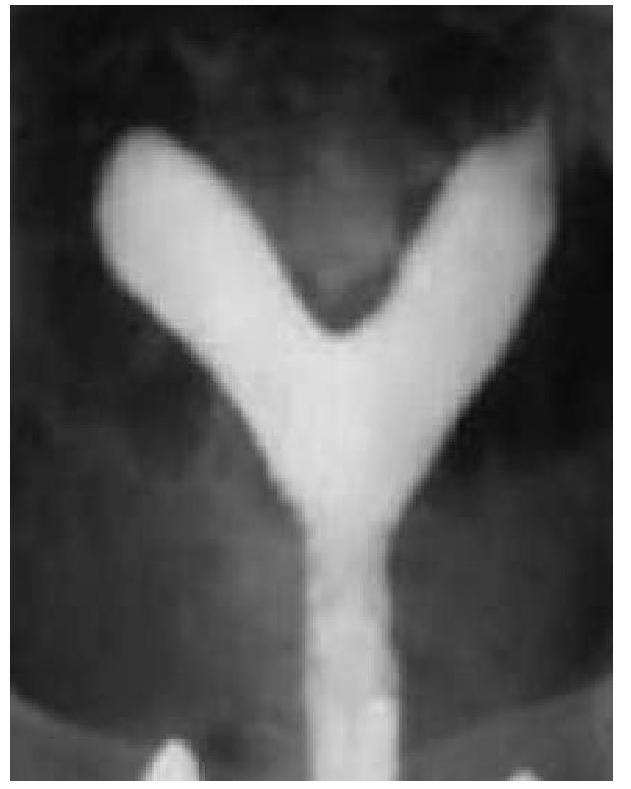
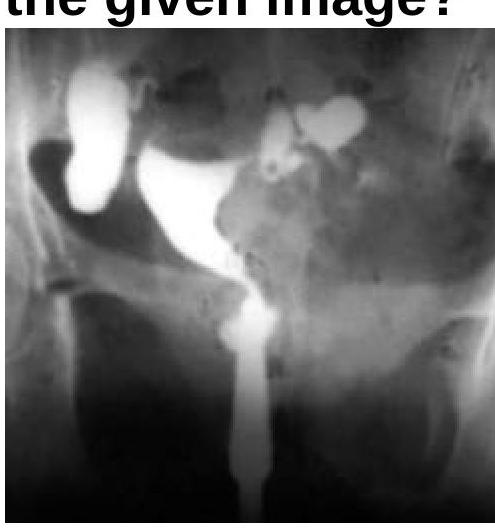
Which of the following statements about hysterosalpingography, as a diagnostic procedure, are correct? I. Tubal patency assessment following tuboplasty operation II. Diagnosis of uterine synechiae III. Detection of IUD IV. Diagnosis of subserosal fibroid Select the answer using the code given below :
A 27-year-old female married for 3 years regularly cohabiting with husband presents to Gynaecology OPD with complaints of inability to conceive for 2 years. During clinical evaluation hysterosalpingography was done which revealed irregular outline of uterine cavity and rigid fallopian tubes with nodulations. Most likely cause for this condition is :
Which of the following days of menstrual cycle is best for endometrial sampling to diagnose ovulation?
Which of the following are factors for poor outcome following tuboplasty? 1. Dense pelvic adhesions 2. Length of reconstructed tube less than 4 cm 3. Bilateral hydrosalpinx 4. Reversal after 5 years of sterilization procedure Select the correct answer using the code given below.
Which of the following are useful investigations for diagnosis of unresponsive endometrium as a cause of primary amenorrhoea? 1. Karyotype 2. Progesterone challenge test 3. Hormonal studies 4. Hysterosalpingography Select the correct answer using the code given below.
What is the most common first-line investigation used to assess the patency of fallopian tubes?
Which of the following is the marker of ovarian reserve?
Polycystic ovarian syndrome is associated with the following except
The "fern pattern" of cervical mucus seen in the first half of menstrual cycle is because of
Success of tubal re-canalization is best with :
Explanation: ***I, II and III*** Hysterosalpingography (HSG) is a radiological procedure that uses contrast material injected into the uterus to visualize the **uterine cavity** and **fallopian tubes** under fluoroscopy. It is specifically useful for: **Statement I - Tubal patency assessment following tuboplasty operation** ✓ - HSG is the standard procedure to evaluate whether fallopian tubes remain patent after reconstructive tubal surgery **Statement II - Diagnosis of uterine synechiae** ✓ - HSG excellently demonstrates intrauterine adhesions (Asherman's syndrome) as filling defects in the uterine cavity **Statement III - Detection of IUD** ✓ - Radiopaque IUDs are easily visualized on HSG, and the procedure can confirm proper IUD position within the uterine cavity **Statement IV - Diagnosis of subserosal fibroid** ✗ - **Subserosal fibroids** project outward from the uterine serosa into the peritoneal cavity - HSG only outlines the **endometrial cavity** and **tubal lumen**, not external uterine surfaces - These fibroids do not impinge on the uterine cavity and therefore cannot be visualized by HSG - Better diagnosed by **ultrasound** or **MRI** *I, II and IV* - While HSG is excellent for assessing tubal patency and diagnosing uterine synechiae (I and II), it cannot diagnose **subserosal fibroids** which are located on the outer surface of the uterus and do not affect the uterine cavity outline. *II, III and IV* - This option correctly identifies HSG's utility in diagnosing **uterine synechiae** and detecting **IUDs**, but incorrectly includes **subserosal fibroids** which cannot be visualized by this procedure. *I, III and IV* - This option accurately includes HSG's role in assessing **tubal patency** and detecting **IUDs**, but mistakenly includes diagnosis of **subserosal fibroids** which require imaging modalities that visualize the external uterine surface.
Explanation: ***Genital Tuberculosis*** - The combination of **infertility**, an **irregular uterine cavity outline**, and **rigid fallopian tubes with nodulations** on hysterosalpingography (HSG) is highly suggestive of genital tuberculosis. - **Tuberculosis** can cause significant scarring and obstruction in the female reproductive tract, leading to these characteristic HSG findings and impaired fertility. *Syphilis* - While syphilis is a sexually transmitted infection, it typically causes **chancre formation**, **rash**, and systemic symptoms; it does not typically lead to the described HSG findings of an irregular uterine cavity or rigid, nodulated fallopian tubes. - Infertility can be a consequence of untreated syphilis (e.g., through miscarriage), but the specific morphological changes seen in the uterus and tubes are not characteristic of this infection. *Genital Herpes* - Genital herpes is caused by the herpes simplex virus and is characterized by recurrent outbreaks of **painful blisters and ulcers** in the genital area. - It does not cause structural changes to the uterus or fallopian tubes that would result in an irregular uterine outline or rigid, nodulated tubes as seen on HSG. *Gonorrhoea* - Gonorrhoea can cause **pelvic inflammatory disease (PID)**, which can lead to tubal damage and infertility; however, the typical HSG findings are often **hydrosalpinx** or extensive peritubal adhesions, rather than rigid, nodulated tubes with an irregular uterine outline. - While it can result in tubal obstruction, the specific pattern described in the question (irregular uterine outline, rigid tubes with nodulations) is more characteristic of the chronic inflammatory and fibrotic changes associated with tuberculosis.
Explanation: ***16th - 20th day*** - Endometrial sampling during this period, specifically **around days 16-20** of a typical 28-day cycle, falls within the **early-to-mid secretory phase**, when the endometrium begins showing characteristic secretory changes indicative of ovulation. - After ovulation, the **corpus luteum** produces **progesterone**, which transforms the proliferative endometrium into a secretory one, with changes becoming evident by day 16 and progressively more pronounced. - This timeframe captures the **development of secretory changes** including subnuclear vacuolation, stromal edema, and glandular secretion, providing clear histological confirmation of ovulation. *8th - 10th day* - This period corresponds to the **early proliferative phase**, before ovulation has occurred, so the endometrium would not show any secretory changes indicative of ovulation. - Endometrial histology would primarily display **proliferative features** with mitotic activity and straight tubular glands, making it unsuitable for assessing post-ovulatory changes. *12th - 14th day* - This timeframe represents the **late proliferative phase** or the expected time of **ovulation itself**. - While ovulation may be occurring, the endometrium would not yet have developed the **secretory changes** necessary for histological diagnosis of past ovulation, as progesterone effect requires time to manifest. *21st - 23rd day* - This period falls into the **mid-to-late secretory phase**, which shows well-developed secretory changes. - While this would also demonstrate evidence of ovulation, the question specifically identifies the 16th-20th day range as the preferred timeframe for endometrial sampling in clinical practice for ovulation diagnosis.
Explanation: ***1, 2 and 3*** - **Dense pelvic adhesions** impair tubal motility and increase the risk of ectopic pregnancy, leading to poor outcomes after tuboplasty. - A **reconstructed tube length less than 4 cm** significantly reduces the available surface area for fertilization and embryo transport, negatively impacting fertility success rates. - **Bilateral hydrosalpinx** indicates severe tubal damage with impaired ciliary function and potentially toxic fluid accumulation, which drastically reduces the chances of successful pregnancy even after surgical repair. *1, 2 and 4* - This option incorrectly includes "Reversal after 5 years of sterilization procedure" while omitting bilateral hydrosalpinx, which is a more significant poor prognostic factor. - While duration since sterilization can influence outcomes, anatomical factors like hydrosalpinx are more critical predictors of tuboplasty failure. *2, 3 and 4* - This option incorrectly omits "Dense pelvic adhesions," which is one of the most important poor prognostic factors in tuboplasty. - Severe pelvic adhesions directly compromise tubal function and significantly increase ectopic pregnancy risk. *1, 3 and 4* - This option incorrectly omits "Length of reconstructed tube less than 4 cm," which is a critical anatomical factor directly influencing tuboplasty success. - Adequate tubal length is essential for proper gamete transport and fertilization; tubes shorter than 4 cm have significantly reduced success rates.
Explanation: ***1, 2 and 3*** - In the workup of primary amenorrhea with suspected **unresponsive endometrium**, a systematic approach is essential to differentiate between end-organ failure and central causes. - **Karyotyping** is important as chromosomal abnormalities like **Turner syndrome (45,X)** can present with primary amenorrhea due to **gonadal dysgenesis**, leading to hypoestrogenism and thus an endometrium that appears "unresponsive" due to lack of estrogen priming, not intrinsic endometrial pathology. - **Progesterone challenge test** is a key diagnostic tool: withdrawal bleeding indicates adequate estrogen and a responsive endometrium; **no bleeding despite adequate estrogen** suggests either true endometrial unresponsiveness (Asherman's syndrome, Müllerian agenesis) or estrogen deficiency. - **Hormonal studies** (FSH, LH, estradiol) are crucial to interpret the progesterone challenge test and distinguish between **hypergonadotropic hypogonadism** (ovarian failure with high FSH/LH), **hypogonadotropic hypogonadism** (low FSH/LH/estrogen), and eugonadal amenorrhea with endometrial factors. *2, 3 and 4* - While **hysterosalpingography (HSG)** can visualize structural uterine abnormalities (Asherman's syndrome, Müllerian anomalies), it is typically performed **after** initial hormonal assessment. - This option excludes **karyotyping**, which is essential in the initial evaluation of primary amenorrhea to rule out chromosomal causes that present with hypoestrogenism and secondary endometrial unresponsiveness. - The systematic approach starts with hormonal evaluation and progesterone challenge before proceeding to imaging studies. *1, 2 and 4* - This option excludes **hormonal studies**, which are fundamental to the diagnostic algorithm. - Without FSH, LH, and estradiol levels, it is impossible to properly interpret a progesterone challenge test or determine whether the "unresponsive endometrium" is due to estrogen deficiency, ovarian failure, or true endometrial pathology. - Hormonal studies guide the next steps in investigation and management. *1, 3 and 4* - This option excludes the **progesterone challenge test**, which is a simple, cost-effective screening test to assess estrogen status and endometrial responsiveness. - While HSG provides anatomical information, the progesterone challenge test is typically performed earlier in the diagnostic algorithm to determine if further invasive imaging is warranted. - A systematic hormonal evaluation with progesterone challenge should precede invasive procedures like HSG.
Explanation: ***Hysterosalpingogram (HSG)*** - **Hysterosalpingogram (HSG)** is the **most common first-line investigation** for assessing tubal patency in infertility workup. - It involves injecting a radio-opaque contrast dye through the cervix into the uterine cavity and fallopian tubes, followed by X-ray imaging. - HSG effectively visualizes the **uterine cavity anatomy** and **tubal patency**, detecting blockages or abnormalities. - It is **minimally invasive, outpatient-based**, and provides both diagnostic and potentially therapeutic benefit (flushing effect). *Sonohysterogram* - **Sonohysterogram (SIS)** primarily evaluates the **uterine cavity** for intrauterine pathology like polyps, fibroids, or septae using saline infusion and ultrasound. - A modified version (**HyCoSy** - hystero-salpingo-contrast sonography) can assess tubal patency but is **less commonly used** than HSG as a first-line test. - Standard sonohysterogram does not directly visualize tubal patency. *Laparoscopic chromopertubation* - **Laparoscopic chromopertubation** is the **gold standard invasive method** for directly visualizing tubal patency. - A colored dye (methylene blue) is injected through the cervix and observed flowing through the fimbriated ends of the tubes under direct laparoscopic visualization. - It is **reserved for cases** where non-invasive tests are inconclusive or when concurrent treatment of pelvic pathology (adhesions, endometriosis) is planned. - It is **not a first-line test** due to its invasive nature, cost, and need for anesthesia. *CT scan* - **CT scan** is not used for assessing fallopian tube patency. - While it provides excellent anatomical detail of pelvic organs, it cannot effectively demonstrate the patency or flow through the narrow fallopian tube lumen. - CT is useful for evaluating pelvic masses, malignancies, or complications but not for functional tubal assessment.
Explanation: ***Anti-Mullerian hormone*** - **Anti-Mullerian hormone (AMH)** is produced by the granulosa cells of small antral and pre-antral follicles in the ovary. - AMH levels correlate with the size of the **primordial follicle pool**, making it the **most reliable indicator of ovarian reserve**. - Unlike other markers, AMH remains relatively **constant throughout the menstrual cycle** and can be measured on any day. - AMH is the **preferred marker** in fertility assessment and IVF planning. *β-hCG* - **Beta-human chorionic gonadotropin (β-hCG)** is a hormone produced during pregnancy by the developing placenta. - Its presence indicates pregnancy and is not a marker for **ovarian reserve**. *Placental alkaline phosphatase* - **Placental alkaline phosphatase (PLAP)** is an enzyme produced by the placenta. - It serves as a biological marker for certain cancers (e.g., germ cell tumors) and sometimes for placental function, but not **ovarian reserve**. *Serum estradiol* - **Serum estradiol** levels fluctuate significantly throughout the menstrual cycle and are influenced by numerous factors. - While **Day 3 estradiol** combined with FSH was historically used for ovarian reserve assessment, elevated levels can indicate poor reserve (due to early follicular recruitment). - However, it is **not as reliable or cycle-independent as AMH** for assessing the overall **follicle pool**.
Explanation: ***Ovarian carcinoma*** - While polycystic ovarian syndrome (PCOS) increases the risk of **endometrial hyperplasia** and subsequently **endometrial carcinoma** due to unopposed estrogen, it is **not directly associated with an increased risk of ovarian carcinoma**. - Ovarian carcinoma is a distinct entity with different risk factors, and PCOS does not typically predispose to it. *Obesity* - **Obesity**, particularly central obesity, is highly prevalent in women with PCOS, affecting many metabolic and hormonal aspects of the syndrome. - It contributes to **insulin resistance**, which is a key feature of PCOS and exacerbates its symptoms. *Infertility* - **Anovulation** or oligo-ovulation, a hallmark of PCOS, directly leads to **infertility** in many affected women. - The hormonal imbalances in PCOS interfere with normal follicular development and ovulation. *Endometrial hyperplasia* - The **unopposed estrogen stimulation** resulting from chronic anovulation in PCOS leads to continuous endometrial proliferation without regular shedding. - This persistent stimulation increases the risk of developing **endometrial hyperplasia**, which can be a precursor to endometrial carcinoma.
Explanation: ***Low mucoprotein level*** - The **fern pattern** is formed by the crystallization of **sodium chloride** in the presence of **estrogen** and a relatively **low mucoprotein content** in cervical mucus. - During the proliferative phase, high estrogen levels increase the fluid and electrolyte content relative to mucoproteins, facilitating this distinct crystallization. - **Key concept**: While both high NaCl and low mucoprotein are present, it is the **low mucoprotein** that is the distinguishing factor allowing crystallization to occur. *Low sodium chloride level* - A low sodium chloride level would lead to **less crystallization**, not the characteristic fern pattern. - The presence of sodium chloride is crucial for forming the crystalline structure. *High sodium chloride level* - While sodium chloride is indeed **elevated during the follicular phase** and necessary for ferning, this alone is not the defining reason for the fern pattern. - Sodium chloride is present throughout the menstrual cycle; the key factor is the **reduced mucoprotein** that allows unimpeded crystallization. - Both high NaCl AND low mucoprotein work together, but the **low mucoprotein is the distinguishing feature** that permits the crystallization to manifest as ferning. *High mucoprotein level* - A high mucoprotein level would **interfere with the crystallization** of sodium chloride, preventing the formation of a clear fern pattern. - This occurs during the luteal phase when progesterone increases mucoproteins, inhibiting ferning.
Explanation: ***Laparoscopic ring application (Falope ring/Tubal clips)*** - Mechanical occlusion methods (clips and rings) cause **minimal tissue destruction**, typically affecting only **2-3 cm** of the fallopian tube. - The tubal segments remain relatively **healthy and undamaged**, with minimal scarring and fibrosis. - Reversal success rates are **highest at 70-90%** due to the preservation of tubal architecture and length. - These methods are considered the **most reversible** form of tubal sterilization. *Pomeroy's technique* - Involves excision of a tubal loop (approximately 3-4 cm) with ligation, causing moderate tissue damage. - The cut ends heal by scarring, and some tubal length is permanently lost. - Reversal success rates are moderate at **60-70%**. - More tissue damage than clip/ring methods but still reasonably reversible. *Uchida's technique* - Involves separating the serosa from the muscularis, ligating and excising a **larger segment** of the tube (4-5 cm). - Creates more extensive tissue damage with greater tubal length loss. - Reversal success rates are lower at **40-50%** due to the complexity and extent of tissue disruption. *Fimbriectomy* - Involves complete removal of the **fimbrial end** of the fallopian tube, which is essential for ovum pickup. - Even if re-anastomosis is technically successful, the **absence of fimbriae** results in extremely poor functional outcomes. - Reversal success rates are very poor at **<20%**, making this the least reversible sterilization method.
Reproductive Physiology
Practice Questions
Evaluation of the Infertile Couple
Practice Questions
Male Factor Infertility
Practice Questions
Female Factor Infertility
Practice Questions
Ovulatory Disorders
Practice Questions
Tubal and Peritoneal Factors
Practice Questions
Uterine Factors
Practice Questions
Unexplained Infertility
Practice Questions
Assisted Reproductive Technologies
Practice Questions
Psychological Aspects of Infertility
Practice Questions
Get full access to all questions, explanations, and performance tracking.
Start For Free