Absent fructose content in the seminal fluid suggests which of the following conditions?
Which of the following is true regarding obstructive azoospermia?
Aspermia is the term used to describe:
Fallopian tube dysmotility is seen in which of the following conditions?
What percentage of tubal infertility is constituted by tubal block?
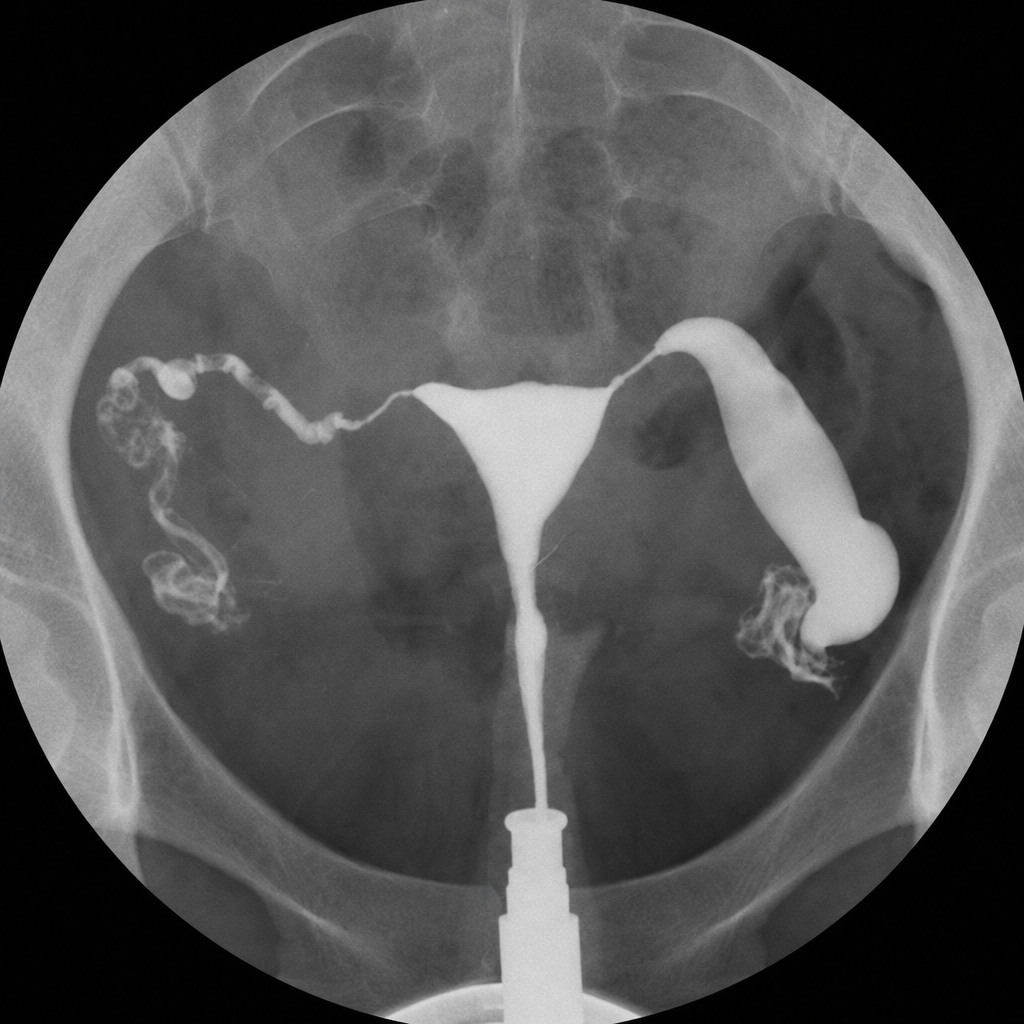
What is the best investigation to assess tubal patency?
What is the method of choice to monitor ovulation in a patient being treated with clomiphene for infertility?
Which of the following is not used to induce ovulation?
Which non-steroidal anti-hormonal substance is used to induce ovulation?
What is a marker of low ovarian reserve in a premenopausal female?
Explanation: **Explanation:** The presence of fructose in seminal fluid is a critical marker for the patency and functional integrity of the male reproductive tract. Fructose is exclusively produced and secreted by the **seminal vesicles**; its primary role is to provide an energy source for sperm motility. **Why the correct answer is D (Both A and B):** 1. **Congenital Absence of Seminal Vesicles (Option A):** Since the seminal vesicles are the sole source of fructose, their absence (often associated with Congenital Bilateral Absence of the Vas Deferens - CBAVD) results in a total lack of fructose in the ejaculate. 2. **Ductal Obstruction (Option B):** If there is an obstruction at the level of the **ejaculatory ducts** (where the seminal vesicle ducts join the vas deferens), the secretions from the seminal vesicles cannot reach the urethra. This leads to an ejaculate that is low in volume, acidic, and fructose-negative. **Why other options are incorrect:** * **Option C** is incorrect because both A and B are established clinical causes for azoospermia with absent fructose. **Clinical Pearls for NEET-PG:** * **Normal Fructose Level:** >13 µmol per ejaculate. * **The "Fructose Test":** It is the first-line investigation in patients with **Azoospermia** and **Low Ejaculate Volume (<1.5 ml)**. * **CBAVD Link:** Congenital absence of the vas deferens and seminal vesicles is strongly associated with mutations in the **CFTR gene** (Cystic Fibrosis). * **pH Correlation:** Seminal vesicle fluid is alkaline. Therefore, absent fructose is usually accompanied by an **acidic pH (<7.0)** of the semen.
Explanation: **Explanation:** In **Obstructive Azoospermia (OA)**, the primary pathology is a physical blockage in the reproductive tract (e.g., vas deferens, epididymis) despite normal sperm production in the testes. Because the hypothalamic-pituitary-gonadal (HPG) axis and the testicular parenchyma are intact, the hormonal feedback loops function normally. 1. **Why the correct answer is right:** * **FSH (Follicle Stimulating Hormone):** FSH levels are regulated by **Inhibin B**, which is produced by Sertoli cells. In OA, Sertoli cell function and spermatogenesis are preserved; therefore, Inhibin B remains normal, keeping FSH within the normal range. * **LH (Luteinizing Hormone):** LH stimulates Leydig cells to produce testosterone. Since the interstitial tissue of the testes is unaffected by the obstruction, LH and Testosterone levels remain normal. 2. **Why the incorrect options are wrong:** * **Low FSH and Low LH (Option A):** This pattern indicates **Hypogonadotropic Hypogonadism** (Pre-testicular azoospermia), where the pituitary fails to stimulate the testes (e.g., Kallmann syndrome). * **High FSH and Normal/High LH:** This would indicate **Non-Obstructive Azoospermia (NOA)** or primary testicular failure (e.g., Klinefelter syndrome), where the lack of feedback from damaged Sertoli cells causes FSH to rise. Options C and D do not represent standard clinical patterns for azoospermia. **High-Yield Clinical Pearls for NEET-PG:** * **Testis Size:** Usually normal in Obstructive Azoospermia but small/atrophic in Non-Obstructive Azoospermia. * **Fructose Test:** If the obstruction is at the level of the ejaculatory ducts or there is Congenital Bilateral Absence of the Vas Deferens (CBAVD), the semen analysis will show **low volume, acidic pH, and negative fructose**. * **CBAVD:** Strongly associated with mutations in the **CFTR gene** (Cystic Fibrosis). * **Management:** Sperm can be retrieved directly from the epididymis (MESA/PESA) or testes (TESA) for use in ICSI.
Explanation: **Explanation:** In the context of male infertility, precise terminology is crucial for diagnosis. **Aspermia** is defined as the complete **absence of semen** (ejaculate) upon orgasm. This is distinct from conditions where fluid is present but lacks sperm. Aspermia can be caused by retrograde ejaculation (where semen enters the bladder), ejaculatory duct obstruction, or neurological issues like spinal cord injuries or complications from retroperitoneal surgery. **Analysis of Options:** * **Option B (Absence of sperm in ejaculate):** This is termed **Azoospermia**. In this condition, the patient produces seminal fluid, but it contains no spermatozoa. It is categorized into obstructive (post-testicular) or non-obstructive (pre-testicular/testicular) types. * **Option C (Absence of sperm motility):** This is termed **Asthenozoospermia**. It refers to a state where sperm are present but have reduced or zero motility, hindering their ability to reach the oocyte. * **Option D (Occurrence of abnormal sperm):** This is termed **Teratozoospermia**. It refers to a high percentage of sperm with abnormal morphology (shape/structure) based on Kruger’s strict criteria. **High-Yield Clinical Pearls for NEET-PG:** * **Oligozoospermia:** Sperm count <15 million/ml (WHO 2010 criteria). * **Necrozoospermia:** All sperm in the ejaculate are dead (non-viable). * **Hematospermia:** Presence of blood in the semen, often associated with infections of the seminal vesicles or prostate. * **Globozoospermia:** A rare condition where sperm have round heads and lack an acrosome (cannot fertilize the egg).
Explanation: **Explanation:** **Correct Answer: C. Klinefelter syndrome** The correct answer is **Klinefelter syndrome (47, XXY)**. While traditionally associated with male infertility due to primary testicular failure and azoospermia, recent research and clinical observations have identified that the extra X chromosome affects ciliary function and smooth muscle motility. In the context of fertility, **Fallopian tube dysmotility** is a recognized feature in rare cases of mosaicism or when discussing the broader pathophysiology of ciliary dysfunction associated with the syndrome’s genetic profile. Specifically, the dysregulation of genes on the extra X chromosome can lead to impaired ciliary beat frequency and discoordinated tubal contractions, hindering gamete transport. **Analysis of Incorrect Options:** * **A. Noonan Syndrome:** This is an autosomal dominant disorder (often PTPN11 mutation) characterized by short stature, webbed neck, and pulmonary stenosis. While it causes gonadal dysgenesis (cryptorchidism in males), it does not specifically affect fallopian tube motility. * **B. Turner Syndrome (45, X):** The primary fertility issue here is **accelerated follicular atresia** leading to "streak ovaries" and premature ovarian failure. The fallopian tubes themselves are usually anatomically and functionally normal. * **C. Marfan Syndrome:** This is a connective tissue disorder (FBN1 mutation). While it can lead to uterine organoptosis or increased risk of aortic dissection during pregnancy, it has no known association with tubal dysmotility. **High-Yield Clinical Pearls for NEET-PG:** * **Kartagener Syndrome:** Always remember this as the classic cause of tubal dysmotility due to a dynein arm defect (Primary Ciliary Dyskinesia), leading to an increased risk of ectopic pregnancy. * **Klinefelter Phenotype:** Small firm testes, gynecomastia, increased height (long legs), and elevated FSH/LH with low testosterone. * **Tubal Factor Infertility:** The most common cause remains **Pelvic Inflammatory Disease (PID)**, which causes structural blockage rather than just dysmotility.
Explanation: ### Explanation **1. Why 30-35% is Correct:** Infertility affects approximately 10-15% of couples globally. Among the causes of female infertility, the **tubal factor** is one of the most significant. While tubal factors as a whole (including adhesions, salpingitis, and endometriosis) account for about 25-35% of female infertility cases, **tubal blockage** specifically (occlusion of the lumen) is identified in approximately **30-35%** of these patients. The most common etiology for such blockage is Pelvic Inflammatory Disease (PID), often secondary to *Chlamydia trachomatis* or *Neisseria gonorrhoeae*, leading to proximal or distal tubal occlusion. **2. Analysis of Incorrect Options:** * **A (5-7%):** This is too low. While specific conditions like congenital tubal agenesis are rare, acquired tubal blockage is far more prevalent in clinical practice. * **B (15-20%):** This range often represents the prevalence of ovulatory disorders (like PCOS) rather than structural tubal blockage. * **D (90-95%):** This is an overestimation. If 90% of infertility were due to tubal blocks, other major factors like male factor (30-40%), ovulatory dysfunction, and unexplained infertility would have no statistical room. **3. Clinical Pearls for NEET-PG:** * **Gold Standard Investigation:** Diagnostic **Laparoscopy with Chromopertubation** is the gold standard for diagnosing tubal patency. * **First-line Screening:** **Hysterosalpingography (HSG)** is the initial screening test, usually performed in the proliferative phase (Day 7-10). * **Maitland’s Classification:** Tubal blocks are classified into proximal (cornual) and distal (fimbrial). Distal blocks often lead to **Hydrosalpinx**. * **Management:** Proximal blocks may be treated with hysteroscopic cannulation; however, for bilateral distal blocks or failed surgery, **IVF (In Vitro Fertilization)** is the treatment of choice as it bypasses the tubes entirely.
Explanation: **Explanation:** **Laparoscopic Chromopertubation (Chromotubation)** is considered the **Gold Standard** investigation for assessing tubal patency. During this procedure, a dye (usually Methylene Blue) is injected through the cervix, and its spillage from the fimbrial ends of the fallopian tubes is directly visualized using a laparoscope. Its superiority lies in its ability to simultaneously diagnose peritubal adhesions, endometriosis, or pelvic inflammatory disease (PID) that might be causing infertility despite "patent" tubes. **Analysis of Options:** * **Rubin's Test:** This is an obsolete historical test involving the insufflation of $CO_2$ into the uterus. It has a high false-negative rate and provides no information about which tube is blocked or the status of the pelvic anatomy. * **Hysterosalpingography (HSG):** While HSG is the **best initial/screening test** for tubal patency due to its non-invasive nature, it carries a higher rate of false positives (due to cornual spasms) compared to laparoscopy. * **Laparotomy:** This involves a large surgical incision to open the abdomen. It is an invasive therapeutic procedure, not a primary diagnostic investigation for tubal patency. **Clinical Pearls for NEET-PG:** * **Gold Standard for Tubal Patency:** Laparoscopic Chromopertubation. * **Best Screening/First-line Test:** HSG (performed in the pre-ovulatory phase, Day 7–10). * **Therapeutic benefit of HSG:** The flushing action of the dye (especially oil-based) can sometimes clear minor debris, slightly increasing pregnancy rates post-procedure. * **Contraindication for HSG/Chromopertubation:** Active pelvic infection or pregnancy.
Explanation: **Explanation:** **1. Why Serial Ultrasound is the Correct Answer:** Transvaginal Sonography (TVS) is the gold standard for monitoring ovulation induction with Clomiphene Citrate (CC). It allows for **Follicular Tracking**, which measures the number and size of developing follicles. This is crucial for: * **Timing:** Identifying when the dominant follicle reaches maturity (typically 18–20 mm) to time intercourse or HCG "trigger" injections. * **Safety:** Assessing the risk of **Ovarian Hyperstimulation Syndrome (OHSS)** and multiple pregnancies by counting the number of maturing follicles. * **Endometrial Assessment:** Monitoring the thickness of the endometrium, which CC can sometimes thin due to its anti-estrogenic effect. **2. Why Incorrect Options are Wrong:** * **Chest X-ray:** This has no role in monitoring ovulation. It is irrelevant to reproductive endocrinology unless investigating systemic diseases like sarcoidosis or TB in infertility workups. * **Serial HCG:** Human Chorionic Gonadotropin is a hormone produced by the placenta. It is used to *diagnose* pregnancy or *trigger* ovulation, but serial levels are not used to monitor the growth of follicles during the induction phase. * **Note on Serum Progesterone:** While not an option here, remember that a single mid-luteal phase (Day 21) progesterone level confirms *that* ovulation occurred, but it cannot monitor the *process* or predict the timing. **3. High-Yield Clinical Pearls for NEET-PG:** * **Mechanism of CC:** It is a Selective Estrogen Receptor Modulator (SERM) that inhibits negative feedback at the hypothalamus, increasing endogenous FSH/LH. * **Ideal Follicle Size:** Ovulation is usually triggered when the lead follicle reaches **18–20 mm**. * **Step-up Protocol:** CC is usually started at 50 mg/day from Day 2 to Day 6 of the cycle. * **Thin Endometrium:** A common side effect of CC; if the endometrium is <6 mm, the chances of implantation decrease despite successful ovulation.
Explanation: **Explanation:** The goal of ovulation induction is to stimulate the development of ovarian follicles, typically by increasing the levels of Follicle Stimulating Hormone (FSH). **Why Danazol is the correct answer:** **Danazol** is a synthetic androgen (isoxazole derivative of ethisterone) that acts as a gonadotropin inhibitor. It suppresses the pituitary-ovarian axis, leading to a hypoestrogenic and hyperandrogenic state. Clinically, it is used to treat **endometriosis** and fibrocystic breast disease because it causes atrophy of the endometrium and inhibits ovulation. Therefore, it is an **anti-ovulatory** agent, not an induction agent. **Why the other options are incorrect:** * **Clomiphene Citrate:** A Selective Estrogen Receptor Modulator (SERM) and the first-line oral agent for ovulation induction. It blocks estrogen receptors in the hypothalamus, tricking the body into secreting more GnRH and FSH. * **HMG (Human Menopausal Gonadotropin):** Contains both FSH and LH. It directly stimulates the ovaries to produce multiple follicles and is used in patients who do not respond to Clomiphene. * **HCG (Human Chorionic Gonadotropin):** Due to its structural similarity to LH, HCG is used as a "trigger shot" to induce the final maturation of the oocyte and rupture of the follicle (ovulation) once the follicles are mature. **High-Yield Clinical Pearls for NEET-PG:** * **Letrozole** (Aromatase Inhibitor) is now increasingly preferred over Clomiphene as the first-line agent for PCOS-related infertility. * **Side effect of Danazol:** Weight gain, acne, hirsutism, and deepening of the voice (virilization). * **Monitoring:** Transvaginal Sonography (TVS) is the gold standard for monitoring follicular growth during induction. * **Risk:** The most serious complication of ovulation induction is **Ovarian Hyperstimulation Syndrome (OHSS)**.
Explanation: **Explanation:** **Clomiphene Citrate (CC)** is the correct answer because it is a **Selective Estrogen Receptor Modulator (SERM)** that acts as a non-steroidal competitive antagonist of estrogen receptors in the hypothalamus and pituitary gland. By blocking the negative feedback of endogenous estrogen, it triggers an increase in the secretion of **GnRH, FSH, and LH**. The rise in FSH stimulates follicular growth in the ovaries, making it the first-line drug for ovulation induction in patients with PCOS (WHO Group II infertility). **Analysis of Incorrect Options:** * **Mifepristone (A):** A competitive progesterone receptor antagonist (and glucocorticoid antagonist). It is primarily used for medical abortion and emergency contraception, not for inducing ovulation. * **Tamoxifen (C):** While also a SERM and occasionally used off-label for ovulation induction in clomiphene-resistant cases, Clomiphene remains the classic, primary "non-steroidal anti-hormonal" drug associated with this indication in standard medical curricula. * **Raloxifene (D):** A second-generation SERM used primarily for the prevention and treatment of osteoporosis in postmenopausal women and for reducing the risk of invasive breast cancer. It does not play a role in ovulation induction. **High-Yield Clinical Pearls for NEET-PG:** * **Mechanism:** Acts mainly by increasing **FSH** levels ("FSH window"). * **Administration:** Usually given as 50 mg/day for 5 days, starting on **Day 2 to Day 5** of the menstrual cycle. * **Side Effects:** Multiple pregnancy (10%, mostly twins), Ovarian Hyperstimulation Syndrome (OHSS), and anti-estrogenic effects on cervical mucus and endometrium. * **Hot Topic:** **Letrozole** (an Aromatase Inhibitor) is now considered superior to Clomiphene for ovulation induction in women with PCOS, though Clomiphene remains the classic textbook answer for this pharmacological category.
Explanation: **Explanation:** **Anti-Müllerian Hormone (AMH)** is considered the most sensitive and reliable biochemical marker for assessing ovarian reserve. It is produced by the granulosa cells of pre-antral and small antral follicles. Because its levels are independent of the hypothalamic-pituitary-ovarian axis, AMH remains relatively constant throughout the menstrual cycle, making it a superior "anytime" test compared to FSH. Low levels of AMH directly correlate with a depleted pool of primordial follicles. **Analysis of Incorrect Options:** * **Small antral follicle size:** It is the **Antral Follicle Count (AFC)**—the total number of follicles (2–10 mm)—that marks ovarian reserve, not the size of the follicles themselves. A low AFC is a hallmark of decreased reserve. * **Raised LH/FSH ratio:** This is a classic biochemical feature of **Polycystic Ovary Syndrome (PCOS)**, where the ratio is often >2:1 or 3:1. In low ovarian reserve, FSH typically rises higher than LH. * **Decreased inhibin A:** While **Inhibin B** (produced by early antral follicles) decreases in low ovarian reserve, Inhibin A is a marker of corpus luteum function and dominant follicle maturity; it is not a primary screening tool for ovarian reserve. **NEET-PG High-Yield Pearls:** * **Best Biochemical Marker:** AMH (earliest marker to change). * **Best Imaging/Biophysical Marker:** Antral Follicle Count (AFC) via TVS. * **Day 3 FSH:** Levels >10–12 mIU/mL suggest poor ovarian reserve (less sensitive than AMH). * **AMH Values:** <1 ng/mL indicates a diminished ovarian reserve; >3.5 ng/mL suggests PCOS.
Reproductive Physiology
Practice Questions
Evaluation of the Infertile Couple
Practice Questions
Male Factor Infertility
Practice Questions
Female Factor Infertility
Practice Questions
Ovulatory Disorders
Practice Questions
Tubal and Peritoneal Factors
Practice Questions
Uterine Factors
Practice Questions
Unexplained Infertility
Practice Questions
Assisted Reproductive Technologies
Practice Questions
Psychological Aspects of Infertility
Practice Questions
Get full access to all questions, explanations, and performance tracking.
Start For Free