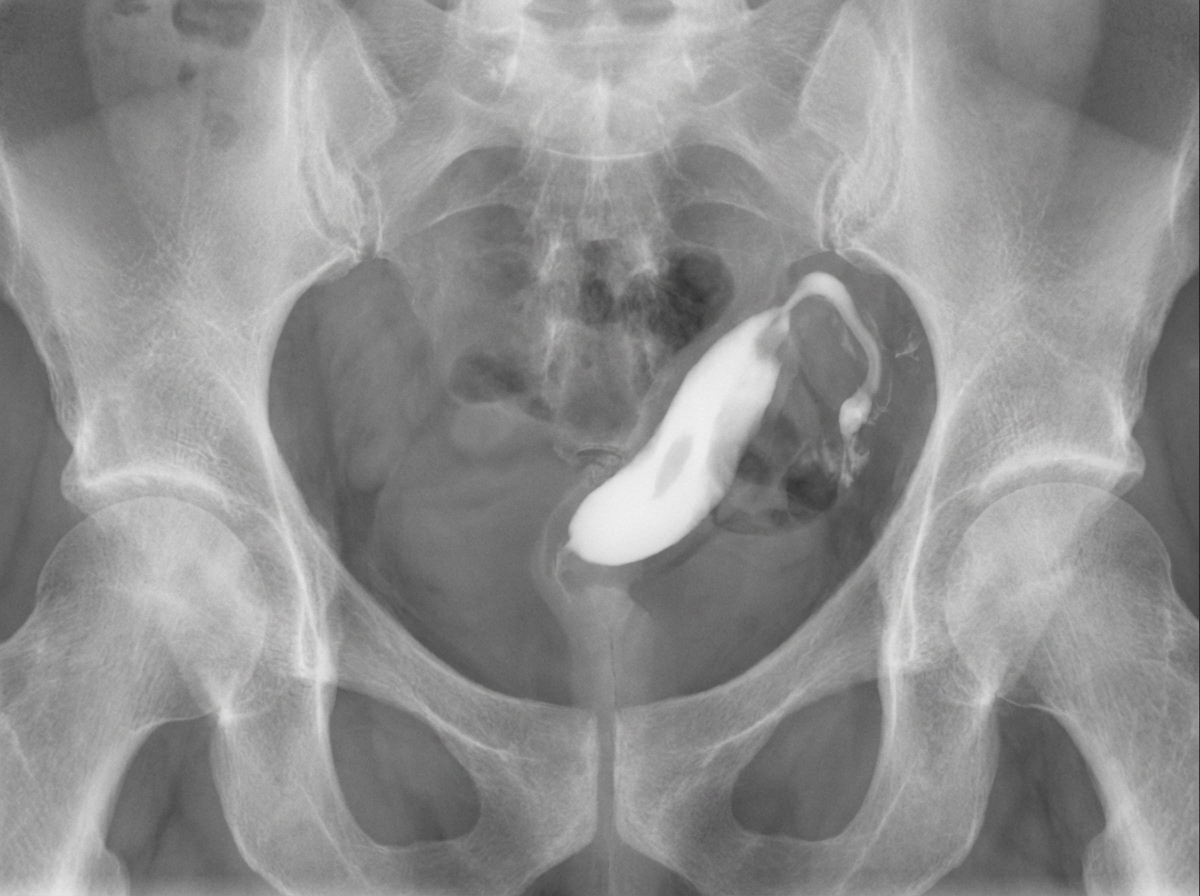
What is considered the best test for evaluating tubal function?
Endometrial biopsy for infertility evaluation in women should be performed during which phase of the menstrual cycle?
Infertility due to Polycystic Ovarian Disease (PCOD) is:
A 24-year-old female is unable to conceive after 15 months of trying. She has a history of recurrent pelvic inflammatory disease, but has normal menses and normal vaginal and cervical examinations. What is the next line investigation?
What is the most common cause of female infertility?
Which one of the following is a hereditary disease that may be associated with infertility?
What is the drug of choice for ovulation induction?
What is the cause of infertility in Kallmann syndrome?
Which of the following methods is the best predictor for ovulation in a female infertility patient during a menstrual cycle?
What is the most common chromosomal anomaly causing repeated abortions in a married middle-aged female?
Explanation: **Explanation:** The evaluation of tubal patency and function is a critical step in the infertility workup. While several tests exist, **Laparoscopy with Chromopertubation** is considered the **Gold Standard** (best test) for evaluating tubal function. **Why Laparoscopy is the Correct Answer:** Laparoscopy allows for direct visualization of the pelvic anatomy. By injecting a dye (like Methylene blue) through the cervix and observing its spill from the fimbrial ends, clinicians can confirm patency. More importantly, it is the only test that can evaluate **extratubal factors** such as peritubal adhesions, endometriosis, and fimbrial morphology, which significantly impact tubal motility and ovum pickup—functions that cannot be assessed by imaging alone. **Analysis of Incorrect Options:** * **Hysterosalpingography (HSG):** This is the **first-line screening test** for tubal patency. While excellent for viewing the internal architecture of the uterus and tube (e.g., salpingitis isthmica nodosa), it has a high false-positive rate due to tubal spasms and cannot detect pelvic adhesions. * **Rubin’s Test:** An obsolete test involving insufflation of $CO_2$ into the fallopian tubes. It is no longer used due to high failure rates, risk of air embolism, and lack of anatomical detail. * **X-ray Pelvis:** A plain X-ray has no role in evaluating tubal function as soft tissue structures like the fallopian tubes are not visible without contrast. **NEET-PG High-Yield Pearls:** * **Gold Standard for Tubal Patency:** Laparoscopy + Chromopertubation. * **First-line/Screening Test:** HSG (performed in the pre-ovulatory phase, Day 7–10). * **Best test for Uterine Cavity:** Hysteroscopy. * **Maitland’s Sign:** Presence of "oil droplets" on X-ray after HSG using oil-based contrast (historical significance).
Explanation: **Explanation:** The primary objective of an endometrial biopsy in infertility evaluation is to assess **luteal phase adequacy** and confirm **ovulation**. **Why the Premenstrual Period is Correct:** The biopsy is ideally performed during the late secretory phase (typically **days 21–26** of a 28-day cycle or 2–3 days before the expected menses). During this time, the endometrium is under the maximum influence of **progesterone** secreted by the corpus luteum. A "dated" biopsy allows the clinician to determine if the endometrial development is synchronized with the chronological day of the cycle. If the histological dating lags by more than 2 days, it indicates **Luteal Phase Deficiency (LPD)**, which can be a cause of infertility due to implantation failure. **Analysis of Incorrect Options:** * **A. Ovulatory phase:** At this stage, the endometrium is still proliferative or just beginning to transition. It cannot provide information about the corpus luteum's progesterone production. * **B. Menstrual phase:** The functional layer of the endometrium is shedding, making it histologically unsuitable for accurate dating or assessing secretory changes. * **C. Anytime during the cycle:** Endometrial morphology changes daily. A random biopsy lacks the specific secretory characteristics needed to confirm ovulation or receptivity. **NEET-PG High-Yield Pearls:** * **Noyes’ Criteria:** The classic histological criteria used for dating the endometrium. * **Gold Standard:** While biopsy was traditionally the gold standard for LPD, it has largely been replaced in modern practice by **Mid-luteal Serum Progesterone** levels (measured on Day 21; >10 ng/mL indicates ovulation). * **Safety:** To avoid disrupting a potential early pregnancy, the biopsy is often performed on the first day of menstruation or after a negative pregnancy test.
Explanation: ### Explanation **Correct Option: B. Treatable by ovulation-inducing drugs** Infertility in Polycystic Ovarian Syndrome (PCOS/PCOD) is primarily caused by **chronic anovulation**. The hormonal milieu—characterized by high LH:FSH ratios and peripheral conversion of androgens to estrone—suppresses the normal follicular development required for ovulation. Because the ovarian reserve is typically high (often reflected by high AMH levels), ovulation can be successfully triggered using pharmacological agents. **Analysis of Options:** * **A. Irreversible:** This is incorrect. PCOS is one of the most treatable causes of female infertility. Most patients achieve pregnancy through lifestyle modifications or medical intervention. * **C. Primarily due to hyperandrogenism:** While hyperandrogenism is a hallmark of PCOS and contributes to follicular atresia, the *direct* cause of infertility is the **lack of ovulation (anovulation)**. Hyperandrogenism is a clinical/biochemical feature, but anovulation is the functional mechanism of infertility. * **D. Resolves spontaneously with age:** While androgen levels may decline slightly as a woman nears menopause, infertility does not "spontaneously resolve." In fact, fertility naturally declines with age due to decreased oocyte quality, regardless of the underlying PCOS. **High-Yield NEET-PG Pearls:** 1. **First-line treatment:** **Letrozole** (Aromatase Inhibitor) is now considered the drug of choice for ovulation induction in PCOS, superior to Clomiphene Citrate. 2. **Second-line treatment:** Gonadotropins or **Laparoscopic Ovarian Drilling (LOD)**. 3. **Metformin:** Not a primary ovulation-inducing agent, but used as an adjuvant to improve insulin sensitivity. 4. **Rotterdam Criteria:** Diagnosis requires 2 out of 3: (1) Clinical/biochemical hyperandrogenism, (2) Oligo/anovulation, (3) Polycystic ovaries on ultrasound ("String of pearls" appearance).
Explanation: ### Explanation **Correct Answer: A. Hysterosalpingography (HSG)** **Why HSG is the correct choice:** The patient is a young woman (24 years old) with primary infertility (trying for >12 months) and a significant history of **recurrent Pelvic Inflammatory Disease (PID)**. In cases of PID, the most common cause of infertility is **tubal factor infertility** due to pelvic adhesions or tubal occlusion (salpingitis). Since her menstrual cycles are normal (suggesting regular ovulation) and physical exams are unremarkable, the next logical step is to assess **tubal patency**. HSG is the gold-standard screening test for evaluating the uterine cavity and tubal patency in an outpatient setting. **Why other options are incorrect:** * **B. Anti-Müllerian Hormone (AMH):** AMH is a marker of ovarian reserve. While useful in older patients or those with suspected Premature Ovarian Insufficiency, it is not the priority here as her menses are normal and her history strongly points toward a structural (tubal) issue. * **C. Hysteroscopy:** This allows direct visualization of the uterine cavity. While it can detect intrauterine pathology (like polyps or synechiae), it cannot evaluate the patency of the fallopian tubes. * **D. CA-125 level:** This is a non-specific marker for ovarian cancer and endometriosis. It has no routine role in the initial workup of infertility. **Clinical Pearls for NEET-PG:** * **Gold Standard for Tubal Patency:** Laparoscopy with Chromopertubation (but HSG is the initial screening test). * **Timing of HSG:** Performed in the **proliferative phase** (Day 6 to Day 10 of the cycle) to ensure the endometrium is thin and the patient is not pregnant. * **Therapeutic effect:** HSG can sometimes be therapeutic, as the flushing of dye may clear minor tubal debris or mucus plugs. * **Most common cause of Tubal Factor Infertility:** Chlamydia trachomatis infection (often silent PID).
Explanation: **Explanation:** Infertility affects approximately 10–15% of couples, with female factors contributing to about 40–50% of cases. Among these, **ovarian disorders**—specifically **ovulatory dysfunction**—are the most common cause of female infertility, accounting for approximately 30–40% of cases. The most frequent underlying condition within this category is **Polycystic Ovary Syndrome (PCOS)**, followed by premature ovarian insufficiency and hypothalamic-pituitary dysfunction. **Analysis of Options:** * **Ovarian disorders (Correct):** Ovulation is the most fundamental step in conception. Disruptions in the HPO (Hypothalamic-Pituitary-Ovarian) axis lead to anovulation or oligo-ovulation, making it the leading cause of primary and secondary infertility. * **Uterine disorders:** While conditions like submucosal fibroids, Asherman syndrome, or congenital anomalies (e.g., septate uterus) can cause infertility or recurrent pregnancy loss, they are statistically less common than ovulatory issues. * **Vaginal disorders:** These (e.g., vaginal atresia or severe vaginismus) are rare causes of infertility and usually present with primary amenorrhea or dyspareunia rather than isolated infertility. * **Cervical disorders:** Factors such as cervical stenosis or hostile cervical mucus account for less than 5% of infertility cases. **High-Yield Clinical Pearls for NEET-PG:** * **Most common cause of anovulatory infertility:** Polycystic Ovary Syndrome (PCOS). * **Most common cause of tubal factor infertility:** Pelvic Inflammatory Disease (PID), often due to *Chlamydia trachomatis*. * **Best screening test for ovarian reserve:** Anti-Müllerian Hormone (AMH) levels (can be done on any day of the cycle). * **Day 21 Progesterone:** Used to confirm that ovulation has occurred (levels >3 ng/mL suggest ovulation).
Explanation: **Explanation:** **Immotile Cilia Syndrome (Kartagener’s Syndrome)** is the correct answer because it is an autosomal recessive hereditary disorder characterized by a structural defect in the dynein arms of cilia and flagella. * **Mechanism of Infertility:** In males, the flagella of spermatozoa are structurally defective, leading to **asthenozoospermia** (total lack of motility). In females, the cilia lining the fallopian tubes are dysfunctional, which impairs the transport of the ovum toward the uterus, significantly increasing the risk of primary infertility and ectopic pregnancy. **Analysis of Incorrect Options:** * **A. Polycystic Ovaries (PCOS):** While PCOS has a strong genetic predisposition and is a leading cause of infertility due to anovulation, it is considered a **multifactorial** metabolic disorder rather than a classic hereditary (monogenic) disease. * **B. Bullous Pemphigoid:** This is an **acquired autoimmune** blistering skin disease. It is not hereditary and has no direct clinical association with infertility. * **C. Uterine Fibroids:** These are benign monoclonal tumors of the myometrium. While they may show familial clustering, they are primarily considered **hormone-dependent** (estrogen/progesterone) growths rather than a hereditary disease. **High-Yield Clinical Pearls for NEET-PG:** * **Kartagener’s Triad:** Situs inversus, chronic sinusitis, and bronchiectasis. * **Diagnosis:** The gold standard for diagnosing Immotile Cilia Syndrome is **Electron Microscopy** to visualize the absence of dynein arms. * **Management:** For males with this condition, **ICSI (Intracytoplasmic Sperm Injection)** is the treatment of choice for achieving pregnancy, as sperm viability is usually preserved despite the lack of motility.
Explanation: **Explanation:** **Clomiphene Citrate (CC)** is considered the first-line drug of choice for ovulation induction, particularly in women with WHO Group II anovulation (e.g., Polycystic Ovary Syndrome). **Why Clomiphene is the Correct Answer:** Clomiphene is a **Selective Estrogen Receptor Modulator (SERM)**. It acts as a competitive antagonist at the estrogen receptors in the hypothalamus and pituitary. By blocking the negative feedback of endogenous estrogen, it tricks the brain into perceiving low estrogen levels. This triggers an increase in the pulsatile secretion of **GnRH**, leading to increased production of **FSH and LH** from the anterior pituitary, which ultimately stimulates follicular development. **Why Other Options are Incorrect:** * **FSH (Follicle Stimulating Hormone):** Used as second-line therapy if Clomiphene fails or in WHO Group I (hypogonadotropic hypogonadism). It carries a higher risk of Ovarian Hyperstimulation Syndrome (OHSS) and multiple pregnancies. * **LH (Luteinizing Hormone):** Rarely used alone for induction; it is usually administered in combination with FSH (HMG) for specific cases of pituitary failure. * **hCG (human Chorionic Gonadotropin):** It is not an induction agent but a **triggering agent**. Due to its structural similarity to LH, it is injected to induce the final maturation of the follicle and rupture (ovulation) once the follicle reaches maturity. **High-Yield Clinical Pearls for NEET-PG:** * **Mechanism:** Estrogen receptor antagonist at the hypothalamus. * **Dose:** Usually started at 50 mg/day for 5 days (Day 2 to Day 6 or Day 3 to Day 7 of the cycle). * **Side Effects:** Multiple pregnancies (mostly twins ~8%), hot flashes, and anti-estrogenic effects on cervical mucus and endometrium. * **Note:** In obese PCOS patients, **Letrozole** (an Aromatase Inhibitor) is now increasingly preferred over Clomiphene due to higher live birth rates.
Explanation: **Explanation:** **Kallmann Syndrome** is a form of hypogonadotropic hypogonadism characterized by the failure of GnRH-secreting neurons to migrate from the olfactory placode to the hypothalamus. This results in a deficiency of GnRH, leading to low levels of FSH and LH. 1. **Why Asthenospermia is the correct answer:** In Kallmann syndrome, the lack of gonadotropins (FSH and LH) leads to secondary testicular failure. While spermatogenesis is severely impaired, the most characteristic finding in the context of this specific question is **asthenospermia** (reduced sperm motility) and oligospermia. However, clinical studies and standard PG textbooks often highlight that the sperm produced in these patients, even after hormonal replacement therapy, frequently exhibits poor motility due to the lack of prior priming of the seminiferous tubules during the prepubertal period. 2. **Analysis of Incorrect Options:** * **Oligospermia:** While patients do have low sperm counts, in competitive exams, if both are present, asthenospermia is often cited as the primary functional defect in the residual sperm. * **Undescended testis (Cryptorchidism):** This is a common *associated clinical feature* of Kallmann syndrome (due to lack of testosterone during fetal development), but it is a physical finding rather than the direct laboratory "cause" of infertility in the semen analysis. * **Epididymis obstruction:** This is a cause of obstructive azoospermia (e.g., in Cystic Fibrosis/CBAVD). Kallmann syndrome is a pre-testicular cause of infertility, not an obstructive one. **High-Yield Clinical Pearls for NEET-PG:** * **Classic Triad:** Hypogonadotropic hypogonadism + Anosmia/Hyposmia + Midline defects (e.g., cleft palate). * **Genetics:** Most commonly X-linked recessive (KAL-1 gene mutation). * **MRI Finding:** Absence or hypoplasia of olfactory bulbs and sulci. * **Treatment:** Pulsatile GnRH therapy or gonadotropin replacement (hCG/hMG) to induce fertility.
Explanation: **Explanation:** The **Hormonal study**, specifically the measurement of **Serum Progesterone levels** during the mid-luteal phase (Day 21 of a 28-day cycle), is considered the most reliable biochemical predictor of ovulation. A level >3 ng/mL confirms ovulation, while levels >10 ng/mL indicate adequate luteal function. Additionally, the **LH surge** (detected in urine or blood) is the best predictor for the *timing* of upcoming ovulation, occurring 24–36 hours before the egg is released. **Why other options are incorrect:** * **Basal Body Temperature (BBT):** While it shows a biphasic pattern due to progesterone's thermogenic effect, it is retrospective (the rise occurs *after* ovulation) and easily influenced by illness, stress, or sleep patterns, making it less reliable. * **Endometrial Biopsy:** Historically used to identify a "secretory endometrium," it is now rarely used for ovulation timing because it is invasive, expensive, and provides retrospective data. * **Fern Study:** This identifies the "ferning" pattern of cervical mucus under estrogen influence. It disappears after ovulation due to progesterone; however, it is a subjective test and lacks the precision of hormonal assays. **NEET-PG High-Yield Pearls:** * **Gold Standard for Ovulation Monitoring:** Serial Transvaginal Ultrasound (TVUS) to track follicular growth and disappearance (Folliculometry). * **Best Biochemical Marker:** Mid-luteal Serum Progesterone. * **Best Predictor of Ovarian Reserve:** Anti-Müllerian Hormone (AMH) – it is cycle-independent. * **Spinnbarkeit Test:** Refers to the elasticity of cervical mucus; it is maximal just before ovulation (estrogen peak).
Explanation: **Explanation:** The correct answer is **Down’s syndrome (Trisomy 21)**. **1. Why Down’s Syndrome is Correct:** Chromosomal abnormalities are the most common cause of spontaneous abortions in the first trimester (accounting for ~50-60% of cases). Among these, **Autosomal Trisomies** are the most frequent category. While Trisomy 16 is the most common specific trisomy found in abortuses overall, it is lethal and never results in a live birth. **Down’s syndrome (Trisomy 21)** is the most common autosomal trisomy encountered in clinical practice involving "middle-aged" (advanced maternal age) females. As maternal age increases, the risk of non-disjunction during meiosis increases significantly, leading to repeated aneuploid pregnancies and subsequent miscarriages. **2. Why Other Options are Incorrect:** * **Klinefelter’s Syndrome (47, XXY):** This is a sex chromosome anomaly affecting males, characterized by primary hypogonadism and infertility. It is not a cause of recurrent pregnancy loss in a female. * **Turner’s Syndrome (45, X):** While this is the single most common chromosomal abnormality found in spontaneous abortions (monosomy X), it is usually a sporadic event and not specifically linked to "middle-aged" maternal risk in the same way trisomies are. * **Patau’s Syndrome (Trisomy 13):** This is a severe autosomal trisomy that causes early miscarriage or severe malformations. However, it is statistically less common than Trisomy 21. **Clinical Pearls for NEET-PG:** * **Most common cause of 1st-trimester abortion:** Genetic/Chromosomal factors. * **Most common chromosomal anomaly in abortuses:** Autosomal Trisomy. * **Most common specific Trisomy in abortuses:** Trisomy 16 (always lethal). * **Most common single chromosomal anomaly:** Turner’s Syndrome (45, X). * **Recurrent Pregnancy Loss (RPL):** Defined as 2 or more consecutive spontaneous abortions. The most common "treatable" cause is Antiphospholipid Antibody Syndrome (APS).
Reproductive Physiology
Practice Questions
Evaluation of the Infertile Couple
Practice Questions
Male Factor Infertility
Practice Questions
Female Factor Infertility
Practice Questions
Ovulatory Disorders
Practice Questions
Tubal and Peritoneal Factors
Practice Questions
Uterine Factors
Practice Questions
Unexplained Infertility
Practice Questions
Assisted Reproductive Technologies
Practice Questions
Psychological Aspects of Infertility
Practice Questions
Get full access to all questions, explanations, and performance tracking.
Start For Free