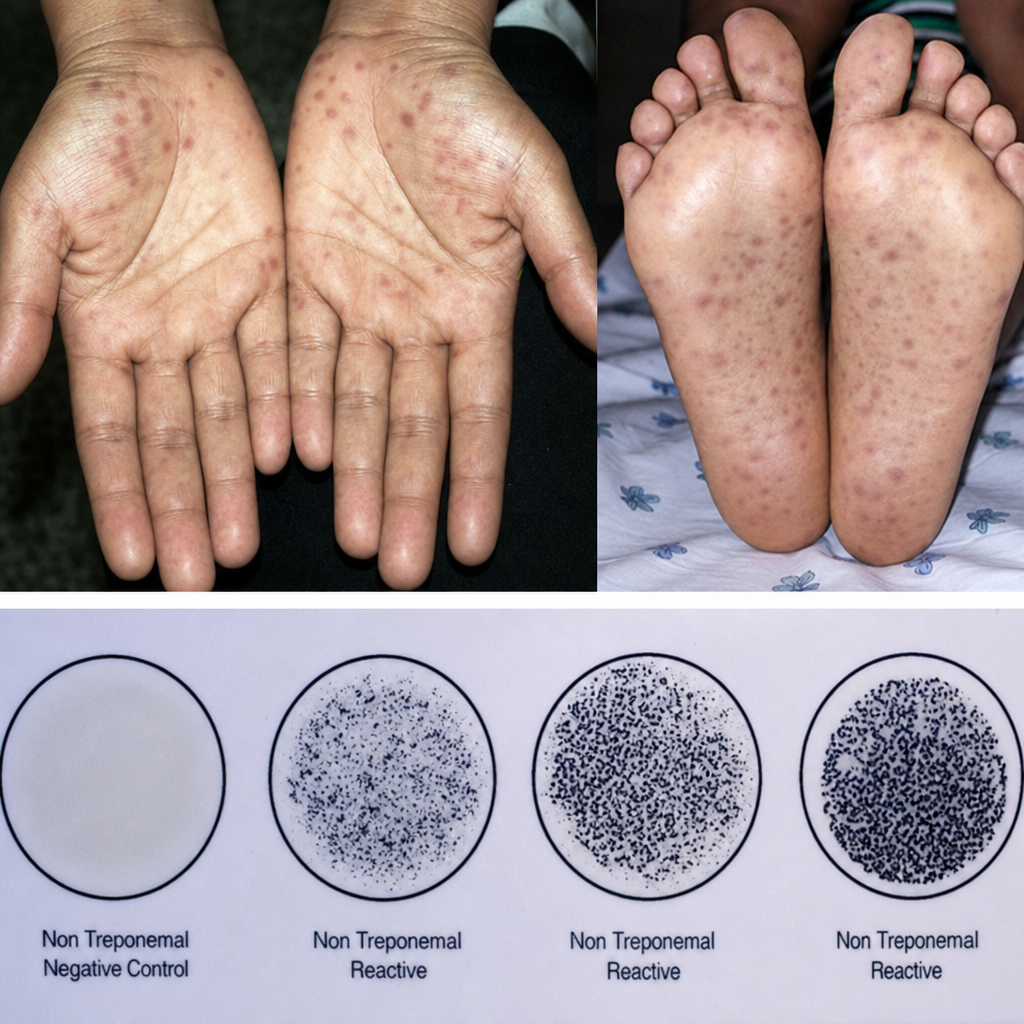
A patient presents with suspected primary syphilis. Which sequence of tests provides the most cost-effective screening approach?
Which spirochete is the causative agent of syphilis?
A man who has a penile chancre appears in a hospital's emergency service. The VDRL test is negative. The most appropriate course of action for the physician in charge would be to
Symptoms of secondary syphilis are all except:
A young female with asymptomatic macules and papules over trunk and reddish patch over palate with a flat, moist lesion on vulva. Patient has generalized lymphadenopathy. What is the line of management?
A 40-year-old man with a history of untreated syphilis presents with ataxia, diminished deep tendon reflexes, and impaired vibratory and position sense. He was recently diagnosed with HIV (CD4 count 450/μL). VDRL is 1:8, and TPHA is positive. CSF shows pleocytosis, elevated protein, and positive VDRL. Which form of neurosyphilis is most likely?
Which part of the aorta is most commonly involved in syphilitic aneurysms?
Jarish-Herxheimer reaction is seen in early cases of what?
Painless ulcer along with painless lymphadenopathy is characteristic of which STD:
Incubation period of syphilis is:
Explanation: ***Non-treponemal test followed by treponemal test if positive*** - This is the **traditional and most cost-effective screening approach** for suspected syphilis. Non-treponemal tests are inexpensive and good for screening, while treponemal tests confirm positive results [1]. - Initial positive non-treponemal results (e.g., **VDRL, RPR**) indicate active infection or recent treatment and require confirmation with a more specific treponemal test (e.g., **TP-PA, EIA, FTA-ABS**). [1] *Dark field microscopy only* - **Dark field microscopy** is useful for immediate detection of *Treponema pallidum* in primary lesions (chancres) but is **operator-dependent** and not suitable as a general screening tool. - It **lacks sensitivity** for later stages of syphilis or in the absence of an active lesion, making it unreliable for comprehensive screening. *Treponemal test followed by non-treponemal test if positive* - This is known as the **reverse sequence screening algorithm**. While sometimes used, it is generally **less cost-effective** for routine screening due to the higher upfront cost of treponemal tests [1]. - A positive treponemal test can indicate past treated infection, leading to a need for non-treponemal testing to differentiate **active from past infection**, which may lead to unnecessary follow-up for previously treated cases. *Both tests simultaneously* - Performing both tests simultaneously is **more expensive** and less efficient for initial screening than a sequential approach. - While it offers rapid confirmation, it's not the most cost-effective method for widespread screening, especially when considering the potential for discordant results that require further clarification.
Explanation: ***Correct: Treponema pallidum*** - **_Treponema pallidum_** is the specific spirochete responsible for causing **syphilis**, a sexually transmitted infection. - This bacterium is characterized by its **helical shape** and corkscrew-like motility, which helps it penetrate tissues. *Incorrect: Borrelia burgdorferi* - **_Borrelia burgdorferi_** is the causative agent of **Lyme disease**, transmitted by ticks. - Its clinical presentation involves **erythema migrans**, arthritis, and neurological symptoms, distinct from syphilis. *Incorrect: Leptospira interrogans* - **_Leptospira interrogans_** causes **leptospirosis**, a zoonotic disease typically acquired through contact with contaminated water or soil. - Symptoms can range from mild flu-like illness to severe forms like **Weil's disease**, involving liver and kidney failure. *Incorrect: Borrelia recurrentis* - **_Borrelia recurrentis_** is the bacterium responsible for **louse-borne relapsing fever**. - It is transmitted by the human body louse and causes recurrent febrile episodes due to **antigenic variation**.
Explanation: Perform dark-field microscopy for treponemes - A penile chancre is highly suggestive of primary syphilis, even with a negative VDRL, as the VDRL test can be negative early in the infection due to an insufficient antibody response. - Dark-field microscopy directly visualizes the spirochetes (Treponema pallidum) from the chancre and is the gold standard for diagnosing primary syphilis. Repeat the VDRL test in 10 days - While the VDRL test might become positive later due to seroconversion, waiting 10 days delays diagnosis and treatment, allowing the infection to progress. - Direct visualization methods like dark-field microscopy offer an immediate and definitive diagnosis for primary syphilis. Send the patient home untreated - This is an unacceptable course of action as the patient presents with a chancre, a classic sign of syphilis, which requires prompt diagnosis and treatment to prevent disease progression and transmission. - Untreated syphilis can lead to severe complications, including neurological and cardiovascular damage. Swab the chancre and culture on Thayer-Martin agar - Thayer-Martin agar is used to culture Neisseria gonorrhoeae, the causative agent of gonorrhea. - Treponema pallidum, the bacterium causing syphilis, cannot be cultured on artificial media, making this option inappropriate for diagnosing syphilis.
Explanation: **Generalized and tender lymphadenopathy** - Secondary syphilis typically presents with **generalized, non-tender lymphadenopathy** [1]. - **Tender lymphadenopathy** is more characteristic of acute infections or inflammatory conditions rather than the chronic inflammation seen in syphilis. *Localized or diffuse mucocutaneous lesion* - **Mucocutaneous lesions**, including **rashes on palms and soles**, are very common and characteristic manifestations of secondary syphilis [1]. - These lesions can be maculopapular, pustular, or ulcerative and are often widespread [1]. *Condyloma lata is seen* - **Condyloma lata** are moist, wart-like lesions that occur in intertriginous areas (e.g., groin, perianal region) [1]. - They are highly infectious and a classic sign of secondary syphilis, resulting from a proliferation of spirochetes [1]. *Self resolving* - The symptoms of secondary syphilis, if left untreated, typically **resolve spontaneously** within a few weeks to months [1]. - However, the disease then progresses to a latent stage, and without treatment, can lead to tertiary syphilis [1].
Explanation: ***Benzathine penicillin*** - This clinical presentation, including **asymptomatic macules and papules** on the trunk, a **reddish palatal patch**, a **flat, moist vulval lesion (condyloma lata)**, and **generalized lymphadenopathy**, is highly suggestive of **secondary syphilis** [1]. - **Benzathine penicillin G** is the *drug of choice* for treating all stages of syphilis, particularly effective for early syphilis like this manifestation. *Fluconazole* - **Fluconazole** is an **antifungal medication** primarily used to treat *candidiasis* and other fungal infections [1]. - The symptoms described are *not characteristic* of a fungal infection. *Ceftriaxone* - **Ceftriaxone** is a *beta-lactam antibiotic* used to treat a wide range of bacterial infections, especially *gonorrhea*, *meningitis*, and *respiratory tract infections*. - While a potent antibiotic, it is *not the primary treatment* for syphilis, which requires penicillin. *Acyclovir* - **Acyclovir** is an *antiviral drug* used to treat *herpes simplex virus* infections (e.g., genital herpes, cold sores) and *varicella-zoster virus* [1]. - The lesions described, particularly the *flat, moist condyloma lata* and *generalized maculopapular rash*, are *not typical manifestations of herpes* [1].
Explanation: ***Tabes dorsalis*** - This condition is characterized by **demyelination of the dorsal columns** and dorsal roots, leading to **ataxia**, **diminished deep tendon reflexes**, and impairment of **vibratory and position sense.** - These symptoms are classic for tabes dorsalis and are consistent with long-term, untreated syphilis. *Syphilitic meningitis* - This form typically presents with **meningeal signs** like headache, neck stiffness, and cranial neuropathies, which are not the primary symptoms described. - While present, the CSF findings are more broadly indicative of neurosyphilis rather than specifically localizing to meningitis as the dominant clinical picture. *General paresis* - This condition primarily affects the **cerebral cortex** and presents with symptoms of dementia, personality changes, and psychiatric disturbances. - The patient's symptoms are more focused on sensory and motor deficits rather than cognitive decline. *Meningovascular syphilis* - This involves inflammation of blood vessels in the brain or spinal cord, leading to **strokes** or transient ischemic attacks. - While a possibility with neurosyphilis, the patient's presentation of ataxia and sensory deficits [1] is less typical of a vascular event.
Explanation: ***Aortic arch*** - Syphilitic aneurysms typically result from **tertiary syphilis**, which causes **vasa vasorum endarteritis** in the aorta, leading to weakened vessel walls. - The **aortic arch** is most frequently affected due to its rich supply of vasa vasorum, predisposing it to damage in this stage of the disease. *Thoracic aorta (descending)* - While other parts of the thoracic aorta can be affected, the **descending thoracic aorta** is less commonly involved in syphilitic aneurysms compared to the aortic arch or ascending aorta. - Aneurysms in this segment are more often associated with **atherosclerosis** rather than syphilis. *Abdominal aorta (proximal to renal arteries)* - Aneurysms of the **abdominal aorta** are overwhelmingly due to **atherosclerosis**, not syphilis [1]. - These are typically located distal to the renal arteries and are less associated with the characteristic inflammatory changes seen in syphilis. *Abdominal aorta (distal to renal arteries)* - The vast majority of **abdominal aortic aneurysms (AAAs)** occur in the segment **distal to the renal arteries** and are primarily caused by **atherosclerosis** [1]. - **Syphilitic aneurysms** rarely affect the abdominal aorta, as the vasa vasorum supply, and thus the inflammatory process, predominantly targets the proximal great vessels.
Explanation: ***Syphilis*** - The **Jarisch-Herxheimer reaction** is an acute, self-limiting febrile reaction that occurs within a few hours of treatment initiation for spirochetal infections, most notably **syphilis** [1]. - It results from the release of **endotoxins** from dying spirochetes, leading to systemic inflammatory symptoms such as fever, chills, myalgia, headache, and exacerbation of existing skin lesions [1]. *Gonorrhea* - **Gonorrhea** is caused by the bacterium *Neisseria gonorrhoeae*, which is not a spirochete and does not typically trigger a Jarisch-Herxheimer reaction upon treatment. - Treatment for gonorrhea, usually with antibiotics like ceftriaxone, does not result in the rapid release of toxins associated with this specific immunologic response. *Lymphogranuloma venereum* - **Lymphogranuloma venereum (LGV)** is caused by specific serovars of *Chlamydia trachomatis* and is characterized by genital ulcers and prominent lymphadenopathy. - As it is not a spirochetal infection, treatment with antibiotics like doxycycline does not induce a Jarisch-Herxheimer reaction. *Granuloma inguinale* - **Granuloma inguinale**, also known as donovanosis, is caused by *Klebsiella granulomatis*. - This bacterial infection, characterized by progressive ulcerative lesions, is not a spirochetal disease, and thus, treatment does not lead to a Jarisch-Herxheimer reaction.
Explanation: ***Syphilis*** - The primary stage of syphilis is characterized by a **painless chancre**, which is a firm, round, and painless ulcer, along with painless regional **lymphadenopathy**. - This presentation is highly suggestive of infection with **Treponema pallidum**. *Chancroid* - Chancroid typically presents with **multiple, painful ulcers** that have ragged, undermined borders. - The associated lymphadenopathy is usually **painful** and may suppurate, forming a **bubo**. *Donovanosis* - Donovanosis (granuloma inguinale) is characterized by **painless, progressive ulcerative lesions** that are often beefy red and bleed easily. - While it causes ulceration, prominent and discreet **painless lymphadenopathy** is not a classic initial feature; rather, it can present with pseudobuboes or subcutaneous granulomas. *LGV* - Lymphogranuloma venereum (LGV) initially presents with a **small, often unnoticed, painless ulcer or papule**. - Its hallmark is pronounced, **painful inguinal lymphadenopathy** (buboes), which can rupture and drain, contrasting with the painless lymphadenopathy described.
Explanation: ***9-90 days*** - The incubation period for primary syphilis, from exposure to the appearance of a **chancre**, typically ranges from **9 to 90 days**, with an average of 21 days [1]. - This variability depends on the **inoculum size** and the host's immune response [1]. *10-14 days* - This period is generally **too short** for the typical development of a primary syphilitic lesion, the chancre. - Incubation periods for other infections, such as **gonorrhea**, might fall within this range. *3-6 months* - This duration is usually **too long** for the incubation period of primary syphilis, as chancres typically appear much sooner. - Syphilis may progress to secondary or latent stages within this timeframe if untreated [1]. *30-60 days* - While this period falls within the broader range, it is **not the complete or most accurate representation** of the full incubation period for syphilis. - It captures a common average but omits the earlier and later ends of the known range.
Get full access to all questions, explanations, and performance tracking.
Start For Free