A 50-year-old woman with schizophrenia who has been taking an antipsychotic drug for the past three years has begun to exhibit involuntary chewing and lip-smacking movements. Which is the most likely possibility?
Which condition is associated with periodic discharges on EEG at 4-second intervals?
A 32-year-old patient with Restless leg syndrome comes to the OPD. What is the most appropriate first line treatment?
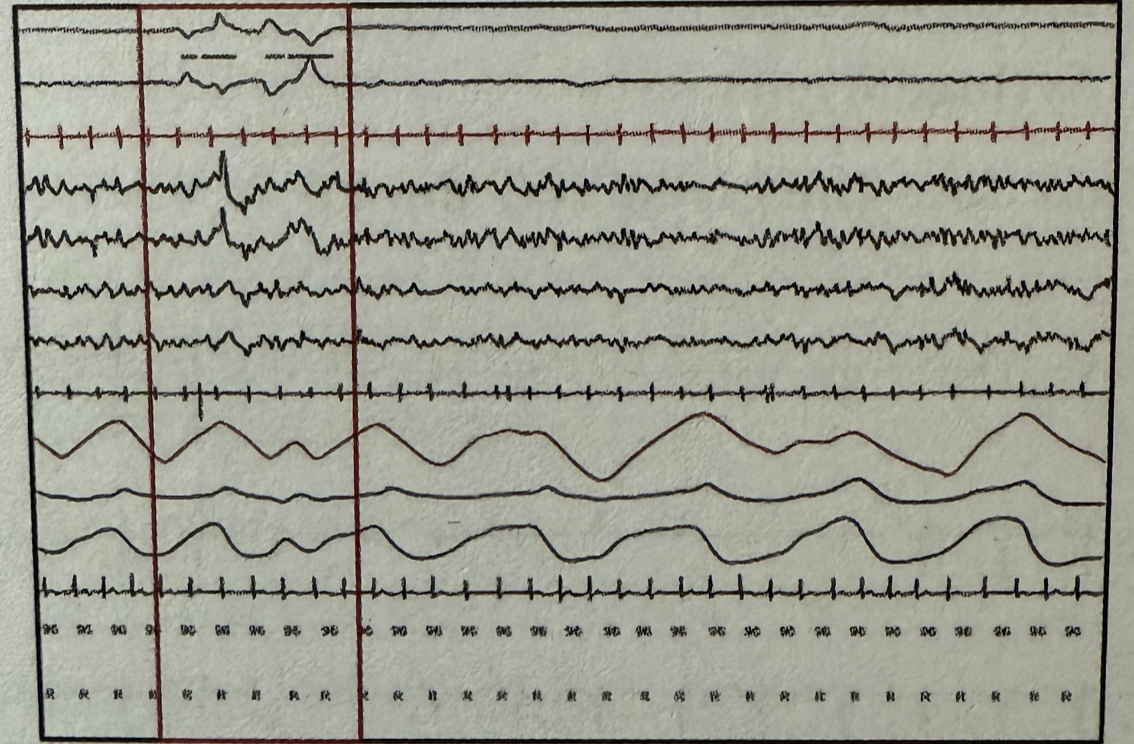
During polysomnography, which stage of sleep is represented by the marked areas when observing the following wave patterns? EOG (Electrooculography) EEG (Electroencephalography) EMG (Electromyography)
A 60-year-old man with Parkinson’s disease presents with visual hallucinations and cognitive decline over the past year. He is on levodopa. What is the most likely diagnosis?
A 55-year-old woman presents with widespread pain, fatigue, and sleep disturbances. Physical examination reveals multiple tender points. What is the most likely diagnosis?
In narcolepsy, the polysomnographic recording typically shows which of the following patterns?
Muller's manoeuvre is used to
A 55-year-old man presents with a tremor that occurs when his hands are at rest. He has a slow, shuffling gait and difficulty initiating movement. His symptoms improve with levodopa. What is the most likely diagnosis?
All of the following decrease in iron deficiency anemia except:
Explanation: ***Tardive Dyskinesia*** - This condition is characterized by **involuntary, repetitive movements**, often involving the face (e.g., **chewing, lip-smacking, grimacing**) and extremities, that develop after prolonged use of antipsychotic medications. - The delayed onset (after three years of antipsychotic use) and the specific nature of the movements are highly suggestive of **tardive dyskinesia**. *Akathisia* - Akathisia presents as a feeling of **inner restlessness** and an inability to sit still, leading to constant pacing or fidgeting. - While it is a common side effect of antipsychotics, the cardinal symptoms are motor restlessness rather than involuntary movements like chewing and lip-smacking. *Neuroleptic Malignant Syndrome* - This is a rare, life-threatening reaction to antipsychotics characterized by **fever, severe muscle rigidity, altered mental status, and autonomic dysfunction**. - The patient's symptoms of involuntary chewing and lip-smacking do not align with the acute and severe presentation of NMS. *Restless Legs Syndrome* - RLS involves an **uncontrollable urge to move the legs**, typically worse at night and relieved by movement, often accompanied by unpleasant sensations. - The patient's symptoms are in the face (chewing, lip-smacking) and not described as an urge to move the legs or worse at night.
Explanation: ***SSPE*** - **Subacute sclerosing panencephalitis (SSPE)** is a rare, fatal, progressive brain disorder characterized by inflammation and degeneration of the brain. - The distinctive EEG pattern consists of **periodic high-amplitude, slow-wave complexes** that recur every 4-15 seconds, often every 4-8 seconds, making 4-second intervals a key indicator. *Absence Seizure* - Absence seizures typically manifest as **brief staring spells** with impaired consciousness, lasting only a few seconds. - The EEG in absence seizures shows characteristic **generalized 3-Hz spike-and-wave discharges**, not 4-second interval periodic discharges. *REM sleep disorder* - **REM sleep behavior disorder** involves the acting out of vivid dreams due to the absence of normal muscle atonia during REM sleep [1]. - EEG in REM sleep behavior disorder shows normal sleep architecture but may include evidence of **muscle activity (EMG)** during REM sleep, not periodic discharges [1]. *Focal epilepsy* - **Focal epilepsy** originates in a specific area of the brain, causing seizures with symptoms dependent on the affected region [2]. - EEG findings in focal epilepsy typically show **interictal spikes or sharp waves** localized to the region of seizure onset, which are distinct from generalized periodic discharges [2].
Explanation: ***Gabapentin*** - **Gabapentin** and other alpha-2-delta ligands (e.g., pregabalin) are considered **first-line agents** for moderate to severe Restless Legs Syndrome (RLS), particularly when symptoms are bothersome and daily. - They work by modulating **calcium channels** and are effective in reducing RLS symptoms with a generally favorable side effect profile. *Iron Supplementation* - **Iron supplementation** is appropriate as first-line treatment only if **serum ferritin levels** are below 75 mcg/L, indicating iron deficiency. - While RLS is associated with **iron deficiency**, it's not the universal first-line treatment without biochemical confirmation [1]. *Pramipexole* - **Dopamine agonists** like pramipexole are effective for RLS but are generally **second-line treatments** due to concerns about augmentation (worsening of RLS symptoms) and impulse control disorders. - Augmentation is a significant side effect where symptoms worsen paradoxically with continued use, particularly with higher doses. *Vitamin B12* - **Vitamin B12 deficiency** can cause neurological symptoms, but it is **not a primary cause or treatment** for Restless Legs Syndrome. - Supplementation with **Vitamin B12** would only be considered if a confirmed deficiency exists, which is not stated as a contributing factor in this patient.
Explanation: ***NREM I sleep*** - This stage is characterized by a transition from wakefulness to sleep, identifiable by the appearance of **slow eye movements** in the EOG and a reduction in EEG frequency with the presence of **theta waves**. - The EMG shows a decrease in muscle tone but without the complete atonia seen in REM sleep. *REM sleep* - **Rapid eye movements** are characteristic in the EOG, and the EEG shows **low-amplitude, mixed-frequency waves** similar to wakefulness. - The EMG would display profound muscle atonia, which is not evident in the provided tracing. *NREM II sleep* - This stage is marked by the presence of **sleep spindles** and **K-complexes** in the EEG, which are absent in the marked area. - Eye movements are generally absent, and muscle activity continues to be low. *NREM III sleep* - This is the deepest stage of sleep, characterized by **high-amplitude, slow-delta waves** (20-50% of the epoch) in the EEG. - Eye movements are typically absent, and muscle tone is very low but not completely absent.
Explanation: No changes were made to the text as none of the provided references met the relevance criteria (score >= 7) for characterizing the differential diagnosis between Parkinson’s disease dementia and Lewy body dementia, specifically the 'one-year rule' or the pathological progression from established Parkinson's disease motor signs to cognitive decline.
Explanation: ***Fibromyalgia*** - The classic presentation of **widespread pain**, **fatigue**, **sleep disturbances**, and **multiple tender points** is characteristic of fibromyalgia [1]. - Diagnosis is primarily clinical, based on these symptoms and the exclusion of other conditions [1]. *Rheumatoid arthritis* - Characterized by **inflammatory arthritis** affecting primarily small joints, with swelling, morning stiffness, and systemic symptoms, but not widespread tender points as the primary feature [2]. - Laboratory tests often show elevated **ESR/CRP**, positive **rheumatoid factor (RF)**, and **anti-CCP antibodies**. *Systemic lupus erythematosus* - A multisystem autoimmune disease with varied manifestations, including rash, arthritis, serositis, and renal involvement, but not typically widespread tender points as the predominant symptom. - Associated with positive **antinuclear antibodies (ANA)**, DNA antibodies, and other autoantibodies. *Osteoarthritis* - A degenerative joint disease often affecting weight-bearing joints, characterized by **joint pain** that worsens with activity and improves with rest, typically without significant systemic symptoms or widespread tender points [2]. - Physical exam may reveal **crepitus** and limited range of motion, and X-rays show joint space narrowing and osteophytes.
Explanation: ***REM intrusion during inappropriate periods*** - In narcolepsy, the hallmark polysomnographic finding is **sleep-onset REM periods (SOREMPs)** - the occurrence of REM sleep within 15 minutes of sleep onset. - The **Multiple Sleep Latency Test (MSLT)** in narcolepsy typically shows **≥2 SOREMPs** along with a mean sleep latency of ≤8 minutes. - Clinically, this **REM sleep intrusion** manifests as **sudden, irresistible sleep attacks** during the day, **cataplexy** (sudden muscle weakness triggered by strong emotions), **sleep paralysis**, and **hypnagogic/hypnopompic hallucinations**. - These represent features of REM sleep (muscle atonia, dreams) occurring at inappropriate times. *An absence of REM sleep in midcycle* - This statement is incorrect as narcolepsy is characterized by an **abnormal presence and early onset of REM sleep**, not its absence. - Individuals with narcolepsy enter REM sleep much faster than normal (often within minutes rather than the typical 90 minutes). *Extreme muscular relaxation* - While **cataplexy** (present in Type 1 narcolepsy) involves sudden loss of muscle tone due to REM-related atonia during wakefulness, this is a clinical symptom rather than a continuous polysomnographic finding. - Polysomnography focuses on **sleep architecture** and the timing of **REM sleep onset**, not general muscle relaxation patterns. *Spike-and-wave EEG recording* - **Spike-and-wave patterns** on EEG are characteristic of **absence seizures** (a form of epilepsy), not narcolepsy. - Narcolepsy is a primary **sleep disorder** with distinct polysomnographic features related to **REM sleep dysregulation**, not epileptiform activity.
Explanation: ***To find degree of obstruction in sleep disordered breathing*** - **Muller's manoeuvre** is a diagnostic technique where the patient attempts to inspire forcefully against a **closed mouth and nostrils** while an endoscope observes the upper airway. - This maneuver helps to simulate the negative intraluminal pressure that occurs during sleep, making it useful in identifying the **site and severity of airway obstruction** in patients with sleep-disordered breathing. *To remove foreign body from ear* - Removing foreign bodies from the ear typically involves **irrigation**, specialized instruments (e.g., alligator forceps), or suction, not a breathing maneuver. - This option is unrelated to the physiological assessment of airway obstruction. *To remove laryngeal foreign body* - The primary methods for removing laryngeal foreign bodies are the **Heimlich maneuver** (abdominal thrusts) or direct laryngoscopy and removal. - Muller's manoeuvre is a diagnostic procedure, not a therapeutic one for foreign body extraction. *To find out opening of mouth* - Measuring the **opening of the mouth** is typically done with a ruler or specific instruments to assess jaw mobility (e.g., for temporomandibular joint disorders or trismus). - This is a simple measurement and does not involve the complex physiological assessment of the upper airway that Muller's manoeuvre provides.
Explanation: ***Parkinson’s disease*** - The classic triad of symptoms—**resting tremor**, **bradykinesia** (difficulty initiating movement, shuffling gait), and **rigidity**—is highly characteristic of Parkinson's disease [1, 5]. - Significant improvement with **levodopa** is a hallmark of dopaminergic responsiveness seen in Parkinson's disease. *Huntington’s disease* - Characterized by **chorea** (involuntary, jerky movements), cognitive decline, and psychiatric symptoms, which are not described in this patient. - The onset is typically earlier, and the tremor is not primarily a resting tremor. *Essential tremor* - Primarily an **action tremor** [1] that occurs during voluntary movement, unlike the resting tremor described in the patient. - While it can be debilitating, it typically does not present with **bradykinesia** or **shuffling gait**. *Multiple sclerosis* - A demyelinating disease presenting with a wide range of neurological symptoms depending on lesion location, such as sensory disturbances, weakness, visual problems, and **ataxia**. - While tremors can occur (often intention tremors), the clinical presentation of a **resting tremor**, **shuffling gait**, and **bradykinesia** is not typical of MS.
Explanation: ***TIBC*** - In **iron deficiency anemia**, the body attempts to maximize iron absorption and transport, leading to an **increase** in **Total Iron Binding Capacity (TIBC)** [1]. - TIBC reflects the amount of **transferrin** available to bind iron; more transferrin is produced when iron stores are low [1]. *Serum iron* - **Serum iron** measures the iron circulating in the blood bound to transferrin. - In **iron deficiency anemia**, the overall amount of circulating iron is **decreased** due to insufficient iron stores [1]. *Ferritin* - **Ferritin** is a storage protein for iron, reflecting the body's iron stores [2]. - In **iron deficiency anemia**, iron stores are depleted, resulting in a **decreased** serum ferritin level [1]. *Transferrin saturation* - **Transferrin saturation** is the percentage of transferrin binding sites occupied by iron. - In **iron deficiency anemia**, with low serum iron and increased TIBC, the percentage of binding sites occupied by iron is **lowered** [1].
Get full access to all questions, explanations, and performance tracking.
Start For Free