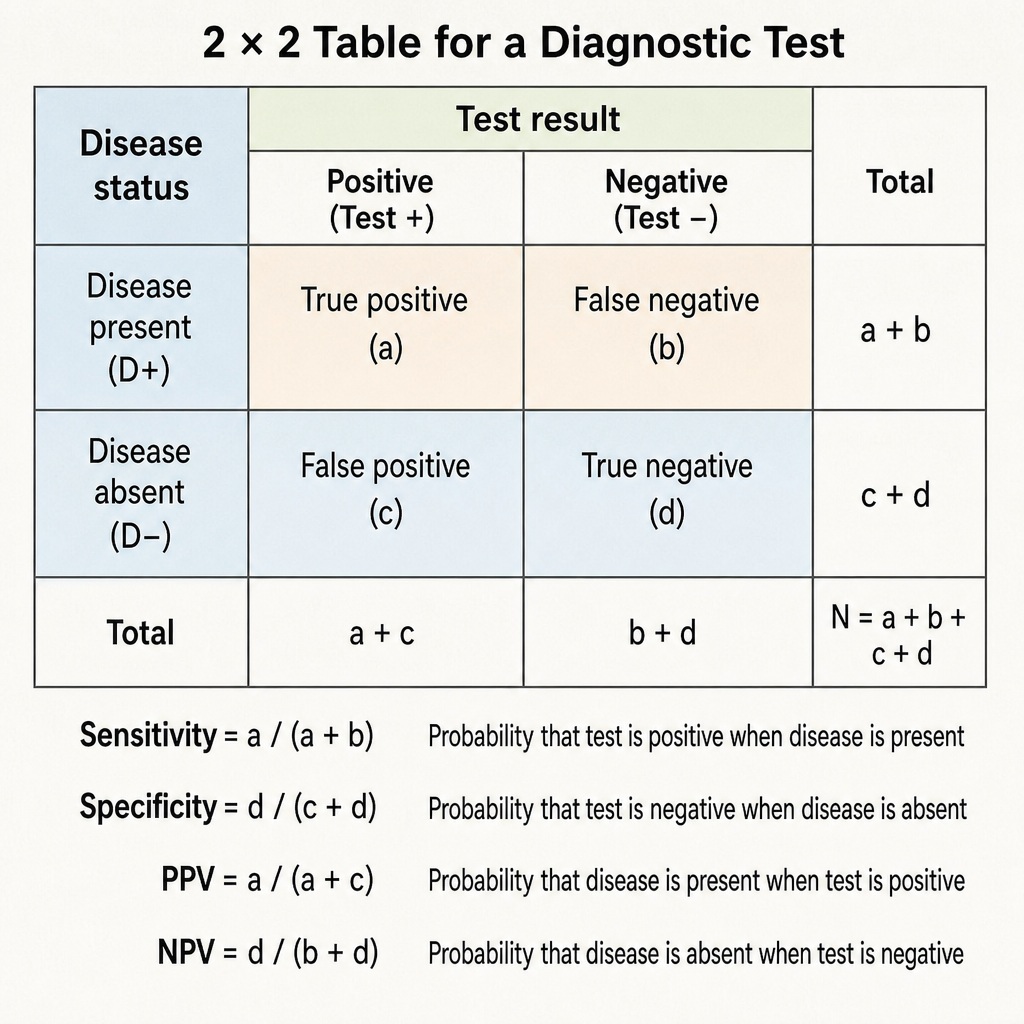
Calculate the sensitivity of a screening test: True Positives=80, False Negatives=20, True Negatives=90, False Positives=10
Specificity of a diagnostic test is defined as:
Which of the following is a type of observational study that analyzes population-level data?
Which of the following statements about screening for disease is false?
Match the following columns on Epidemiology Guidelines: | A. CARE | 1. RCT | | :-- | :-- | | B. CONSORT | 2. Case report | | C. PRISMA | 3. Observational study | | D. STROBE/MOOSE | 4. Systematic Review |
A study is to be conducted to compare the fat content in the expressed breast milk of pre-term infants with that of term infants. Which study design is best suited?
What type of evidence do medical certificates provide?
Which test is used for detecting gunshot residue?
Which of the following is not a characteristic of a systematic review?
In which type of study is selection bias most likely to occur?
Explanation: ***80%*** - Sensitivity is calculated as **True Positives / (True Positives + False Negatives)**. In this case, 80 / (80 + 20) = 80/100, which equals 0.8 or 80%. - This metric represents the proportion of **actual positive cases** that are correctly identified by the test. *90%* - This value might represent the **specificity** (True Negatives / (True Negatives + False Positives)) if calculated with the given numbers (90 / (90 + 10) = 90%). - However, the question specifically asks for **sensitivity**, which is a different measure. *85%* - This percentage would be obtained if the total number of true positives and false negatives was 94 (e.g., 80 / 94), which is not the case here. - It does not correspond to the correct formula for **sensitivity** using the provided data. *95%* - This result would occur if the test correctly identified 95 out of 100 actual positive cases (e.g., 95 TP and 5 FN). - The given data of **80 True Positives** and **20 False Negatives** leads to a lower sensitivity.
Explanation: ***0.95*** - **Specificity** is the proportion of individuals without disease who test negative, calculated as **TN/(TN+FP)**. - A specificity of 0.95 (95%) indicates an excellent test that correctly identifies 95% of healthy individuals as negative. *0.05* - This value represents the **false positive rate** (1 - specificity), not specificity itself. - A specificity of 0.05 would mean only 5% of healthy individuals test negative, indicating a very poor test. *0.4* - This value is too low for specificity and could represent other test parameters like **positive predictive value**. - A specificity of 0.4 would incorrectly classify 60% of healthy individuals as positive, making the test clinically unreliable. *0.8* - This value typically represents **sensitivity**, which is the proportion of diseased individuals who test positive. - **Sensitivity** is calculated as **TP/(TP+FN)**, which is different from specificity that focuses on healthy individuals.
Explanation: ***Ecological study*** - This type of study examines the relationship between an exposure and an outcome at the **population level** rather than the individual level. - It often uses aggregated data, such as incidence rates of disease in different geographic areas, to identify associations. *Case-control study* - This is an **individual-level observational study** that compares individuals with a disease (cases) to individuals without the disease (controls) and looks back retrospectively at their exposures. - It is used to investigate potential risk factors for a disease but does not analyze population-level data directly. *Randomized controlled trial* - This is an **experimental study design** where participants are randomly assigned to an intervention group or a control group. - It is considered the gold standard for establishing causality but does not analyze observational population-level data. *Longitudinal study* - This is an **individual-level observational study** that follows the same group of individuals over a period of time, collecting data at multiple points. - While it observes changes over time, it typically focuses on individual-level trends and outcomes, not aggregated population data.
Explanation: ***Arbitrary and final*** ✓ **FALSE Statement - Correct Answer** - Screening tests are **NOT arbitrary** - they use **established diagnostic criteria**, validated cutoff points, and standardized protocols - Screening is **NOT final** - positive screening results always require **confirmatory diagnostic tests** before treatment decisions - This statement is false because screening follows **evidence-based protocols** and serves as a **preliminary step** in disease detection, not a definitive diagnosis *Time consuming* - TRUE Statement - Mass screening programs are indeed **time-consuming** due to large population coverage, scheduling logistics, and follow-up requirements - The process includes **participant recruitment**, **test administration**, **result notification**, and **tracking** of screen-positive individuals *Rarely a basis for starting treatment without further confirmation* - TRUE Statement - Screening tests are designed to **identify high-risk individuals** who require further evaluation, not to make treatment decisions - **Confirmatory diagnostic tests** with higher specificity are required before initiating treatment - Starting treatment based solely on screening results risks **overdiagnosis** and **unnecessary interventions** in false-positive cases *Done on apparently healthy people* - TRUE Statement - Screening specifically targets **asymptomatic populations** to detect disease in **preclinical stages** - The goal is **early detection** before symptoms appear, when intervention may be most effective - Distinguishes screening from diagnostic testing, which is performed on symptomatic individuals
Explanation: ***A2-B1-C4-D3*** - **CARE Guidelines** provide essential reporting standards for **case reports** and case series to enhance their value and transparency. - **CONSORT (Consolidated Standards of Reporting Trials)** is specifically designed for the reporting of **Randomized Controlled Trials (RCTs)**. - **PRISMA (Preferred Reporting Items for Systematic reviews and Meta-Analyses)** provides a minimum set of items for reporting in **systematic reviews** and meta-analyses. - **STROBE (STrengthening the Reporting of OBservational studies in Epidemiology)** and **MOOSE (Meta-analysis Of Observational Studies in Epidemiology)** are reporting guidelines for **observational studies**, including cohort, case-control, and cross-sectional studies. *A2-B4-C1-D3* - Incorrectly pairs CONSORT with systematic reviews (should be RCTs) and PRISMA with RCTs (should be systematic reviews). - CONSORT is the gold standard for **reporting RCTs**, while PRISMA is designed for **systematic reviews and meta-analyses**. *A4-B1-C3-D2* - Incorrectly matches CARE with systematic reviews, PRISMA with observational studies, and STROBE/MOOSE with case reports. - CARE is specifically for **case reports and case series**, PRISMA for **systematic reviews**, and STROBE/MOOSE for **observational epidemiological studies**. *A4-B1-C2-D3* - Incorrectly pairs CARE with systematic reviews and PRISMA with case reports. - This reverses the actual purpose: CARE is designed for **case reports**, while PRISMA guides **systematic reviews and meta-analyses**.
Explanation: ***Prospective cohort*** - Among the given options, a **prospective cohort study** is the most appropriate design for this comparative study. - The study involves identifying two groups (mothers of pre-term vs. term infants) and **prospectively collecting breast milk samples** to measure and compare fat content between these groups. - This design allows for **standardized data collection** moving forward in time, ensuring consistent measurement protocols for both groups. - While this is essentially a comparative cross-sectional measurement, the prospective nature ensures proper sample collection and reduces recall bias. *Case control* - This design is used to compare **exposures** between those with and without an outcome (typically a disease). - Fat content in breast milk is a **continuous biological variable**, not a disease outcome, making case-control design inappropriate. - Case-control studies work backward from outcome to exposure, which doesn't fit this scenario where we're comparing groups defined by infant term status. *Longitudinal study* - While **prospective cohort** is a type of longitudinal study, this term is too broad and non-specific. - Longitudinal studies involve repeated measurements over time, but this question asks for a specific study design for comparing two groups. - Simply stating "longitudinal study" doesn't specify the comparative framework needed. *Ambispective* - An **ambispective (or ambi-directional) study** combines retrospective and prospective components, using existing historical data plus new follow-up. - This design is unnecessary here as there's no indication of existing historical data to utilize. - The study can be conducted entirely prospectively by identifying mothers and collecting fresh breast milk samples for analysis.
Explanation: ***Documentary evidence of a patient's condition*** - Medical certificates are formal written documents prepared by a healthcare professional that provide **objective information** regarding a patient's medical status, diagnosis, treatment, and fitness for work or other activities. - Under the **Indian Evidence Act, 1872 (Section 3)**, medical certificates are classified as **documentary evidence** - they serve as verifiable written records offering **factual proof** of a patient's health situation at a specific time. - They are considered **direct evidence** that can be produced in court to establish medical facts. *Testimonial evidence* - This involves **oral statements** made under oath, typically in a court of law, by a witness who has direct knowledge of the facts. - While a doctor might provide testimonial evidence when called as a witness, the certificate itself is not a spoken testimony but a **written document**. *Indirect evidence* - Also known as **circumstantial evidence**, this refers to facts that, when proven, suggest the existence of another fact without directly proving it. - Medical certificates directly state the patient's condition, making them **direct documentary evidence**, not indirect or circumstantial evidence. *Conditional release documentation* - This type of document pertains to the **release of a patient from a hospital** or facility under certain conditions, such as follow-up appointments or medication adherence. - While a medical certificate might be part of a discharge process, its primary legal classification is as **documentary evidence**, not a specific type of release documentation.
Explanation: ***Neutron activation analysis for firearm use*** - **Neutron activation analysis (NAA)** is a highly sensitive and reliable method for detecting specific elements characteristic of **gunshot residue (GSR)**, such as **barium**, **antimony**, and **lead**. - This technique works by irradiating samples with neutrons, causing them to emit gamma rays that are unique to each element, allowing for precise identification and quantification of GSR particles. *Lie test for Firearm injury* - A "lie test" typically refers to a **polygraph test**, which assesses physiological responses to detect deception, not physical evidence like gunshot residue. - Polygraph tests are not used for identifying **firearm injury** or the presence of actual physical traces. *Toluidine blue test* - The **Toluidine blue test** is primarily used in dentistry to detect and delineate **dysplastic or malignant lesions** in the oral mucosa. - It has no application in the forensic analysis of gunshot residue or firearm use. *Benzidine test for blood stain* - The **Benzidine test** was historically used as a preliminary test for the presence of **blood stains**, as it reacts with the heme component of hemoglobin. - It is not used for detecting **gunshot residue** and has largely been replaced by safer and more specific tests due to its carcinogenic properties.
Explanation: ***Meta-analysis is always performed*** - While **meta-analysis** is frequently a component of a systematic review, it is not always performed; it is only feasible when the included studies are sufficiently homogeneous and quantitative synthesis is appropriate. - A systematic review can identify, appraise, and synthesize evidence without statistically combining results, especially when studies are too **heterogeneous**. *Search for literature is compulsory using explicit search strategy* - A **comprehensive and explicit search strategy** is a defining characteristic of a systematic review, ensuring all relevant literature is included and bias is minimized. - This systematic approach helps to identify all studies on a given topic, regardless of their outcome. *Research questions always focused* - Systematic reviews are driven by **clearly defined and focused research questions** (often in PICO format: Population, Intervention, Comparison, Outcome) to guide the search, selection, and analysis processes. - A focused question ensures the review has a narrow scope, allowing for a thorough and relevant synthesis of the evidence. *Critical appraisal is always criteria-based* - **Critical appraisal** using predefined criteria (e.g., risk of bias tools) is a mandatory step in a systematic review to evaluate the methodological quality and validity of the included studies. - This systematic assessment helps to determine the strength of the evidence and its applicability.
Explanation: ***Case-control study*** - **Selection bias** is a common concern as cases and controls are often selected based on their disease status, making it difficult to ensure they represent the underlying population's exposure distribution. - This study design inherently involves **retrospective data collection**, increasing the risk of differential selection of participants based on their exposure history. - The retrospective nature and non-random selection of cases and controls makes this study type **most vulnerable** to selection bias. *Cohort study* - While selection bias can occur (e.g., participants lost to follow-up), it is generally **less pronounced** than in case-control studies because subjects are selected based on **exposure status** before disease development, minimizing bias related to outcome. - The prospective nature of many cohort studies reduces the risk of selecting participants based on a known outcome. *Cross-sectional study* - Selection bias can occur if the sample is not representative of the target population. - However, since both exposure and outcome are measured **simultaneously**, there is no temporal selection based on outcome status as seen in case-control studies. - The risk is lower than case-control studies as participants are typically selected from a defined population at one point in time. *Randomized controlled trial (RCT)* - **Randomization** is specifically designed to minimize selection bias by ensuring that exposure (intervention) assignment is independent of participant characteristics. - The process of randomly assigning participants to treatment or control groups reduces the likelihood of systemic differences between groups at baseline.
Get full access to all questions, explanations, and performance tracking.
Start For Free