A patient presented with edema, oliguria and frothy urine. He has no past history of similar complaints. On examination, his urine was positive for 3+ proteinuria, no RBCs/WBCs and no casts. His serum albumin was 2.5 gm/L and serum creatinine was 0.5 mg/dL. The most likely diagnosis is:
A skin condition unique to Chronic Kidney Disease patients:
Which of the following is NOT a feature of type 4A renal tubular acidosis?
In reflux nephropathy, which type of glomerular lesion is typically observed?
What is the most likely diagnosis in a patient presenting with hypertension, proteinuria, and renal failure?
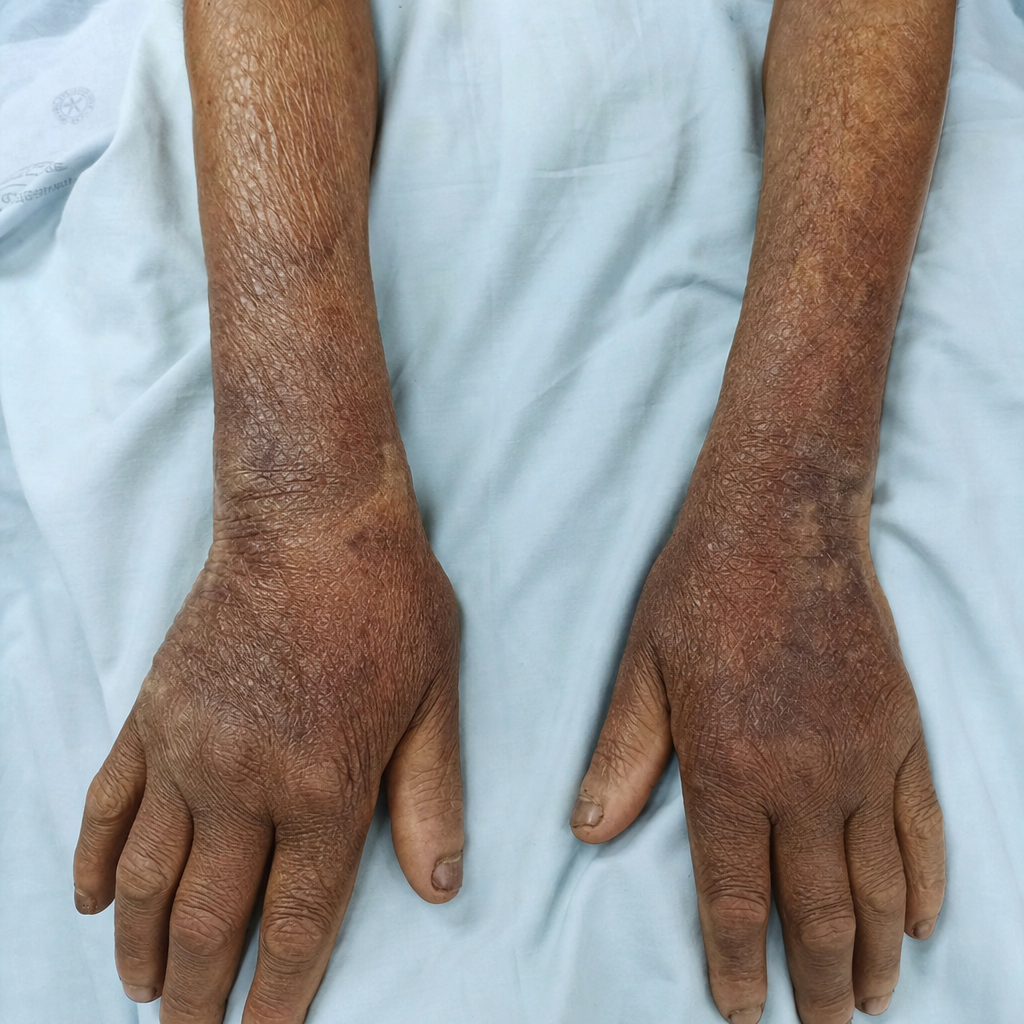
What is the diagnosis for this patient with end-stage renal disease who developed skin changes after an imaging procedure?
Hyperkalemia aciduria is seen in
Which of these conditions is classified as a nephritic syndrome?
What is the most common presentation for IgA nephropathy?
Which stain is used to identify heart failure cells?
Explanation: ***Minimal change disease*** - The classic presentation of **edema**, **oliguria**, and **frothy urine** (due to heavy proteinuria), along with **isolated proteinuria** (no RBCs/WBCs/casts) and **low serum albumin**, points to **nephrotic syndrome** [1]. **Minimal change disease** is the most common cause of nephrotic syndrome in children and a significant cause in adults, often presenting acutely without prior history [1]. - The **normal serum creatinine** (0.5 mg/dL) indicates preserved renal function, which is typical in early minimal change disease before significant complications arise [2]. *Interstitial nephritis* - This condition is characterized by **inflammation of the renal interstitium**, often leading to **acute kidney injury** with an elevation in serum creatinine. It's typically associated with a history of **drug exposure** or **systemic autoimmune diseases**. - Urinalysis usually reveals **white blood cells**, **eosinophils**, and sometimes **WBC casts**, which are absent in this patient. *Membranous nephropathy* - While it causes **nephrotic syndrome** with heavy proteinuria, it often presents more **insidiously** and is more common in older adults. - Urinalysis typically shows **microscopic hematuria** in a significant proportion of cases, secondary to glomerular injury, which is not noted here. *IgA nephropathy* - This is a common cause of **glomerulonephritis**, primarily characterized by **recurrent macroscopic or microscopic hematuria**, often following an upper respiratory or gastrointestinal infection. - While proteinuria can occur, it's typically **not in the nephrotic range** (3+ proteinuria suggests heavy proteinuria), and prominent edema is usually absent unless severe renal failure has developed.
Explanation: ***Nephrogenic fibrosing dermopathy*** - Also known as **Nephrogenic Systemic Fibrosis (NSF)**, this condition is **exclusively seen in patients with renal insufficiency**, particularly those exposed to gadolinium-based contrast agents - Presents with **painful, woody induration and thickening of the skin**, often accompanied by joint contractures - This is the **only skin condition uniquely associated with chronic kidney disease** *Scleromyxedema* - A rare chronic skin disease characterized by **generalized papular and sclerodermoid skin lesions**, often associated with **monoclonal gammopathy** - **Not uniquely associated with renal disease**, although it may rarely occur in patients with kidney dysfunction *Calcinosis cutis* - Involves **deposition of calcium salts in the skin and subcutaneous tissues** - Can occur in various conditions causing hypercalcemia or tissue damage - While seen in patients with **end-stage renal disease** due to mineral and bone disorders, it is **not exclusive** to CKD (also occurs in CREST syndrome, dermatomyositis, hyperparathyroidism) *Norwegian scabies* - Also known as **crusted scabies**, a severe form characterized by widespread **hyperkeratotic crusts** and massive mite infestation - Primarily affects **immunocompromised individuals**, elderly, or those with neurological impairments - **Not specific to chronic kidney disease**
Explanation: Type 4 renal tubular acidosis (RTA) is characterized by **hyperkalemia**, not hypokalemia, due to impaired aldosterone function or renal tubular insensitivity to aldosterone [1]. The primary defect in Type 4 RTA is a disordered ammonia production and hydrogen ion secretion, aggravated by **hyperkalemia**, all of which impair kaliuresis and acid excretion. Type 4 RTA often occurs in the context of **mild to moderate chronic kidney disease** [3], as impaired GFR can contribute to aldosterone deficiency or resistance. While not the direct cause, renal impairment sets the stage for the specific tubular defects seen in Type 4 RTA [2]. A defining feature of type 4 RTA is **hyperkalemia**, resulting from either inadequate aldosterone production or tubular resistance to aldosterone's effects on potassium excretion. This leads to decreased potassium secretion in the principal cells of the collecting duct [1]. Type 4 RTA is frequently seen in patients with **diabetic nephropathy**, often termed **hyporeninemic hypoaldosteronism**. This condition involves damage to the juxtaglomerular apparatus, leading to reduced renin and subsequently reduced aldosterone levels [1].
Explanation: ***Focal segmental glomerulosclerosis*** - **Focal segmental glomerulosclerosis (FSGS)** is the most common glomerular lesion found in patients with **reflux nephropathy** progressing to end-stage renal disease. - This lesion is thought to develop as a result of **glomerular hyperfiltration** and hypertrophy in remaining healthy nephrons, leading to adaptive changes that ultimately cause podocyte injury and sclerosis. *Membranous glomerulonephritis* - **Membranous glomerulonephritis** is characterized by subepithelial immune complex deposits and is most commonly associated with **autoimmune diseases** or certain infections, not reflux nephropathy. - It typically presents with **nephrotic syndrome** but does not have a direct causal link to chronic vesicoureteral reflux. *Membranoproliferative glomerulonephritis* - **Membranoproliferative glomerulonephritis (MPGN)** is characterized by mesangial and endothelial cell proliferation and thickening of the glomerular basement membrane. - It is often associated with **chronic infections** (e.g., hepatitis C), autoimmune disorders, or complement abnormalities, rather than anatomical urinary tract abnormalities. *Minimal change disease* - **Minimal change disease** is characterized by diffuse effacement of podocyte foot processes on electron microscopy, with minimal changes visible on light microscopy. - It is the most common cause of **nephrotic syndrome in children** and is typically idiopathic, unrelated to structural kidney defects like reflux nephropathy.
Explanation: ***Wegener's granulomatosis*** - This condition, now known as **Granulomatosis with Polyangiitis (GPA)**, classically presents as a triad of **upper respiratory tract disease**, **lower respiratory tract disease**, and **renal disease** [1]. - The renal involvement often manifests as **glomerulonephritis**, leading to **hypertension**, **proteinuria**, and potentially rapid progression to **renal failure** [2]. *Mycosis fungoides* - This is a **cutaneous T-cell lymphoma** primarily affecting the skin, presenting with patches, plaques, and tumors. - It typically does not involve the kidneys in a manner that would cause **hypertension**, **proteinuria**, and **renal failure**. *Invasive aspergillosis* - This is a serious **fungal infection** most commonly seen in **immunocompromised individuals**, affecting the lungs and other organs. - While it can cause systemic illness, it does not typically present with the classic triad of **hypertension**, **proteinuria**, and **renal failure** as a primary finding. *Sarcoidosis* - This is a **multisystem inflammatory disease** characterized by the formation of **non-caseating granulomas** in various organs, most commonly the lungs and lymph nodes. - While renal involvement can occur, it's less common and doesn't typically present with the acute, severe combination of **hypertension**, **proteinuria**, and **renal failure** seen in GPA.
Explanation: **Nephrogenic systemic fibrosis** * This condition is strongly associated with exposure to **gadolinium-based contrast agents** in patients with severe **renal insufficiency** or **end-stage renal disease (ESRD)**. * It presents with **skin thickening** and hardening, often involving the extremities and trunk, which can progress to joint contractures and immobility. *Porphyria cutanea tarda* * This is a **disorder of heme synthesis** characterized by **fragile skin**, **blistering**, and **hypertrichosis** in sun-exposed areas [1]. * While it can be associated with liver disease and sometimes seen in patients with ESRD, it is not directly linked to contrast media exposure [1]. *Calciphylaxis* * This severe and rare syndrome involves **vascular calcification** and **skin necrosis**, predominantly seen in patients with ESRD. * It typically presents as painful, violaceous skin lesions that progress to ulcers, and while connected to ESRD, it is not triggered by imaging procedures. *Actinic elastosis* * This condition refers to **degeneration of elastic tissue in the skin** due to chronic and excessive **sun exposure**. * It is characterized by thickened, wrinkled, and yellowed skin and is not related to kidney disease or contrast agent exposure.
Explanation: Type IV Renal Tubular Acidosis - This condition is characterized by **hyperkalemia** and **aciduria**, often due to a deficiency in aldosterone or a renal tubular insensitivity to aldosterone [1]. - The impaired aldosterone action leads to reduced potassium excretion and decreased ammonium production, both contributing to **hyperkalemia** and metabolic acidosis [1]. *Type I Renal Tubular Acidosis* - Type I RTA (distal RTA) is characterized by a defect in acid secretion in the distal tubule, leading to **hypokalemia** and metabolic acidosis with persistently high urine pH [2]. - Patients typically excrete an alkaline urine despite systemic acidosis, contrasting with the aciduria seen with hyperkalemia [2]. *Sigmoidocolostomy procedure* - A sigmoidocolostomy can lead to **hyperchloremic metabolic acidosis** due to the reabsorption of chloride and excretion of bicarbonate by the colonic mucosa. - However, it typically causes **hypokalemia** as potassium is secreted into the colonic lumen from the blood. *Type II Renal Tubular Acidosis* - Type II RTA (proximal RTA) involves a defect in bicarbonate reabsorption in the proximal tubule, resulting in **hypokalemia** and metabolic acidosis. - The kidney's ability to acidify urine is still largely intact in the distal nephron once the bicarbonate buffer system is overwhelmed.
Explanation: ***Post infectious Glomerulonephritis*** - Characterized by **hematuria, hypertension, and edema**, typically following an infection, such as streptococcal pharyngitis [2]. - Immune-mediated response leads to **decreased GFR** and signs of nephritic syndrome [1][2]. *Focal segmental glomerulosclerosis* - Primarily causes **nephrotic syndrome**, characterized by proteinuria and edema rather than hematuria [2]. - Often associated with **secondary causes** like obesity or HIV, not typically post-infectious. *Membranous Glomerulopathy* - Results in significant **proteinuria** and is classified as a **nephrotic syndrome** rather than a nephritic one [2][3]. - It presents with **edema and hypoalbuminemia**, lacking the hallmark features of hematuria. *Minimal change disease* - Predominantly causes **nephrotic syndrome** with heavy proteinuria and little to no hematuria [2]. - Young children are commonly affected, and it responds well to **corticosteroid therapy** [1].
Explanation: ***Repeated gross hematuria*** - The hallmark of **IgA nephropathy** is recurrent episodes of **gross hematuria**, particularly following **respiratory infections** [1]. - It is often associated with **renal impairment** but can present initially with **visible blood** in the urine [1]. *Nephritic syndrome* - While IgA nephropathy can lead to nephritic features, it does not commonly present primarily as **nephritic syndrome**, which includes hypertension and edema. - Nephritic syndrome is characterized by significant **proteinuria** and acute renal failure, rather than the classic presentation of hematuria [2]. *Microscopic hematuria* - Although **microscopic hematuria** can occur in IgA nephropathy, it is not the most common and noticeable presentation; **gross hematuria** is more characteristic [1]. - Microscopic hematuria lacks the acute visual symptoms seen in cases proving the diagnosis. *Nephritic syndrome* - This option is a repetition of and does not provide any additional unique characteristics specific to **IgA nephropathy**. - It shares the same clinical features discussed previously and is thus not representative of the most common presentation.
Explanation: ***Prussian blue*** - **Heart failure cells** are actually **siderophages**, which are macrophages that have phagocytosed red blood cells and subsequently processed the hemoglobin into **hemosiderin**. - **Prussian blue stain** reacts with the iron in hemosiderin, turning it blue, thereby identifying these cells in the sputum or lung tissue of patients with **pulmonary edema secondary to heart failure**. *Alcian blue* - This stain is used to detect **acidic mucopolysaccharides** and **acidic glycoproteins**, typically seen in conditions involving abnormal mucin production or accumulation. - It does not specifically stain or identify **iron deposits** or **siderophages** associated with heart failure. *Silver stains* - **Silver stains** (e.g., Gomori methenamine silver) are primarily used to highlight **fungi**, **basement membranes** in kidney tissue, and **reticulin fibers**. - They are not employed for the identification of **iron-laden macrophages** or **heart failure cells**. *PAS* - The **Periodic Acid-Schiff (PAS) stain** is used to detect **glycogen**, **mucins**, and **glycoproteins**, staining them magenta. - It is often utilized in diagnosing conditions like **Whipple's disease**, **glycogen storage diseases**, or kidney diseases with **thickened basement membranes**, but not for iron detection.
Get full access to all questions, explanations, and performance tracking.
Start For Free