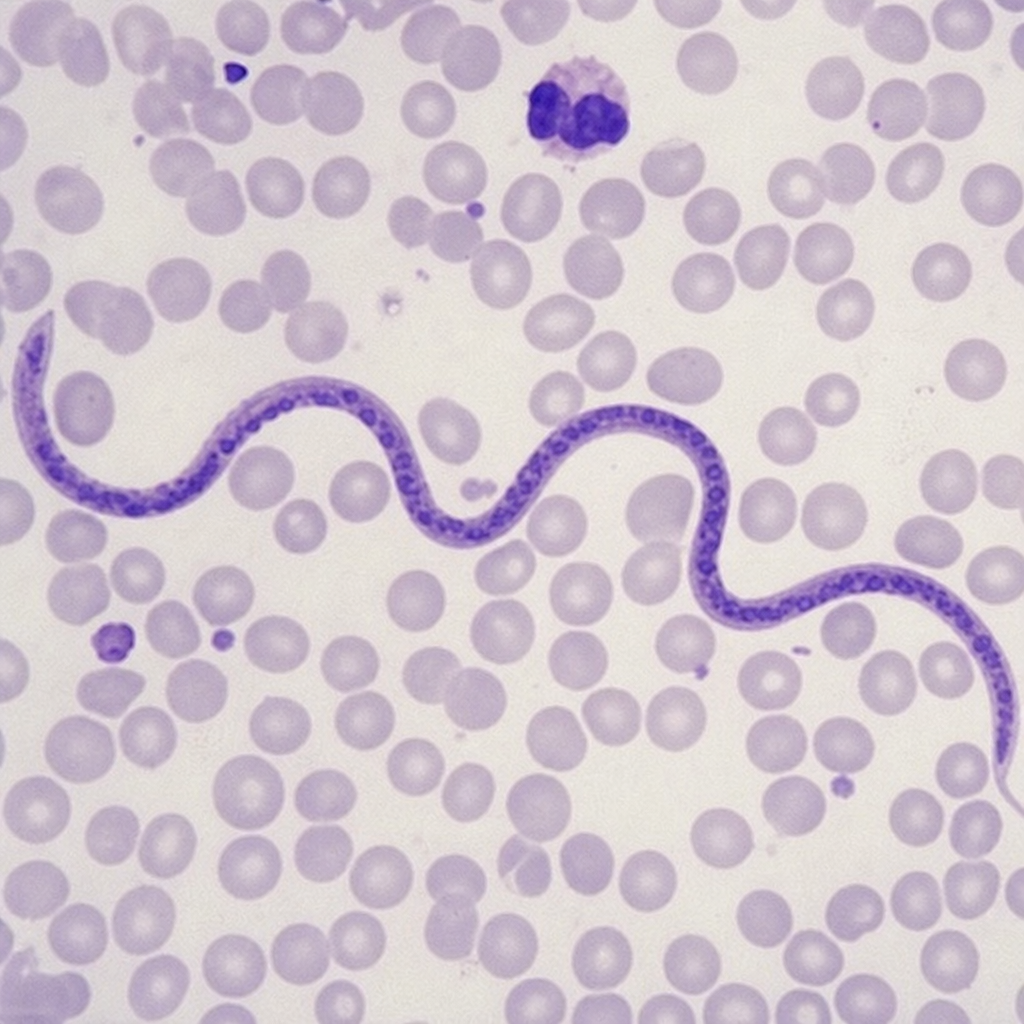
Name the parasite whose microfilariae have a sheath and no nuclei at the tail end.
National Leprosy Eradication Programme was started in -
A patient from Bihar is admitted with splenomegaly and clinical features suggestive of leishmaniasis. What is the vector responsible for transmitting this disease?
True regarding Japanese encephalitis is except -
Diseases under surveillance by WHO under International Health Regulations are all, EXCEPT:
DEC (diethylcarbamazine) is used for the treatment of:
Kala azar is transmitted by:
GET strategy is for which disease?
25-year-old male having fever and malaise for 2 weeks, arthritis of the ankle joint, and tender erythematous nodules over the shin. What is the diagnosis?
A 46 year old lady on vegan diet for a decade presents with chief complaints of tingling and numbness in lower limbs for two months and a history of swaying while walking through narrow corridors. Which one of the following blood tests is advisable for diagnosis in this patient?
Explanation: **Wuchereria bancrofti** - **Wuchereria bancrofti** microfilariae are characterized by the presence of a **sheath** and a **clear tail end** that is devoid of nuclei. - This morphology is a key feature used in the microscopic differentiation of W. bancrofti from other filarial species. *Brugia malayi* - **Brugia malayi** microfilariae also have a **sheath**, but their tail end typically contains **two distinct nuclei** that are spaced apart. - They are generally shorter and have more kinky curves than W. bancrofti. *Loa loa* - **Loa loa** microfilariae possess a **sheath** but are distinguished by their **nuclei extending to the tip** of the tail, often in a more continuous pattern. - They are also known for their diurnal periodicity, which aids in diagnosis. *Onchocerca volvulus* - **Onchocerca volvulus** microfilariae are **unsheathed** and have nuclei that do **not extend to the tail tip**, leaving a distinct clear space. - They are typically found in the skin and subcutaneous tissue, rather than the blood.
Explanation: **Correct: 1983** - The **National Leprosy Eradication Programme (NLEP)** was launched in India in **1983** - Its goal was to eliminate leprosy as a public health problem by reducing its prevalence rate to less than 1 case per 10,000 population - This marked the shift from control to eradication strategy with the introduction of **Multi-Drug Therapy (MDT)** *Incorrect: 1949* - This year is not associated with the inception of a national leprosy eradication program in India - While efforts against leprosy existed, a comprehensive national program was not established at this time *Incorrect: 1955* - The **National Leprosy Control Programme (NLCP)** was launched in India in **1955** - This was a control program, preceding the eradication program, focusing on diagnosis and treatment with Dapsone monotherapy - NLCP was later upgraded to NLEP in 1983 *Incorrect: 1973* - This year is not cited as the start date for the national leprosy eradication program in India - The focus shifted from control to eradication in 1983 with the adoption of WHO-recommended MDT
Explanation: ***Phlebotomus*** - **Phlebotomus** (sandfly), specifically ***Phlebotomus argentipes*** in India, is the principal vector for transmitting **Leishmania donovani** parasites causing **visceral leishmaniasis (kala-azar)**. - Bihar is a highly endemic region for kala-azar in India. - The sandfly transmits the parasite when it takes a blood meal from an infected host and then bites an uninfected individual. *Rat flea* - The **rat flea** (**Xenopsylla cheopis**) is the primary vector for diseases like **bubonic plague** and **murine typhus**, not leishmaniasis. - It transmits bacteria such as *Yersinia pestis* and *Rickettsia typhi*. *Black fly* - **Black flies** (**Simulium species**) are vectors for **onchocerciasis** (river blindness), caused by the parasitic worm *Onchocerca volvulus*. - They transmit the microfilariae when biting humans. *Chrysops fly* - The **Chrysops fly** (deer fly or mango fly) is the vector for **Loa loa filariasis** (African eye worm). - It transmits *Loa loa* eyeworm larvae when it bites humans.
Explanation: ***Mortality is 80-90%.*** - The **mortality rate** for Japanese encephalitis is generally reported between **20-30%** among symptomatic cases, particularly in children. - A mortality rate of 80-90% is excessively high and **inaccurate** for Japanese encephalitis. *The iceberg phenomenon is observed.* - The **iceberg phenomenon** is characteristic of Japanese encephalitis, meaning that for every symptomatic case, there are many **asymptomatic infections** that go undetected. - Only a small proportion of infected individuals develop severe neurological disease, while the majority remain subclinical. *Human-to-human transmission is not reported.* - Japanese encephalitis is a **vector-borne disease** transmitted primarily by mosquitoes; it is **not transmitted directly** from person to person. - The virus circulates between mosquitoes, amplifying hosts (like pigs), and humans are typically dead-end hosts. *Culicine mosquitoes are zoophilic.* - **Culicine mosquitoes**, particularly *Culex tritaeniorhynchus*, are the primary vectors and are indeed **zoophilic**, meaning they prefer to feed on animals (like pigs and wading birds). - This zoophilic nature contributes to the amplification cycle of the virus in animal reservoirs before humans are incidentally bitten.
Explanation: ***Leprosy*** - **Leprosy** is considered a **neglected tropical disease** and is not currently listed among the diseases under *mandatory surveillance* by the WHO under the International Health Regulations (IHR). - While it remains a public health concern, particularly in endemic areas, its *global surveillance requirements* differ from those diseases deemed to have immediate international public health implications. *Malaria* - **Malaria** is a disease under *mandatory surveillance* by the WHO, as it has a high epidemic potential and can quickly spread across borders, posing a significant public health risk. - Countries are required to report outbreaks and implement control measures under the IHR. *Smallpox* - Although **smallpox** has been *eradicated*, it remains on the list of diseases that must be notified under IHR due to the potential threat of its re-emergence by accident or bioterrorism. - Any suspected case would trigger an immediate international health response. *Louse-borne typhus fever* - **Louse-borne typhus fever**, caused by *Rickettsia prowazekii*, is listed as a disease requiring notification under the IHR due to its potential for *epidemic spread*, especially in conditions of overcrowding and poor hygiene. - Its ability to cause *severe illness* and its *historical impact* on populations make it a disease of international concern.
Explanation: ***Filariasis (Wuchereria bancrofti and Brugia malayi)*** - **Diethylcarbamazine (DEC)** is the drug of choice for treating **lymphatic filariasis** caused by *Wuchereria bancrofti* and *Brugia malayi*. - DEC works by killing the **microfilariae** and adult worms in the lymphatic system. *Dracunculiasis (Dracunculus medinensis)* - Treatment for **dracunculiasis** primarily involves mechanical removal of the worm by winding it around a stick, with supportive care like analgesics and antibiotics for secondary infections. - DEC is **ineffective** against *Dracunculus medinensis*. *Schistosomiasis (Schistosoma species)* - The standard treatment for all forms of **schistosomiasis** is **praziquantel**. - DEC has **no significant efficacy** against *Schistosoma* species. *Taeniasis (Taenia species)* - **Taeniasis**, caused by tapeworms like *Taenia saginata* and *Taenia solium*, is effectively treated with **praziquantel** or **niclosamide**. - DEC is **not indicated** for the treatment of tapeworm infections.
Explanation: ***Sandfly*** - **Kala azar**, also known as **visceral leishmaniasis**, is a severe parasitic disease caused by **Leishmania donovani**. - This parasite is transmitted to humans through the bite of an infected female **phlebotomine sandfly**. *Tse tse fly* - The **tse tse fly** is the vector for **African trypanosomiasis**, also known as **sleeping sickness**. - It transmits **Trypanosoma brucei**, a different parasitic organism than the one causing kala azar. *Hard tick* - **Hard ticks** are vectors for several diseases, including **Lyme disease** (Borrelia burgdorferi), **Rocky Mountain spotted fever** (Rickettsia rickettsii), and **anaplasmosis**. - They are not associated with the transmission of leishmaniasis. *Culex mosquito* - The **Culex mosquito** is a common vector for diseases such as **West Nile virus**, **Japanese encephalitis**, and **filariasis**. - It does not transmit the **Leishmania parasite** responsible for kala azar.
Explanation: ***Trachoma and other neglected tropical diseases*** - **GET 2020** (Global Elimination of Trachoma by 2020) is the WHO initiative specifically targeting **trachoma elimination** - Trachoma is controlled using the **SAFE strategy**: Surgery for trichiasis, Antibiotics (azithromycin), Facial cleanliness, and Environmental improvement - GET represents the goal/initiative name, with trachoma being the primary target among neglected tropical diseases (NTDs) - The initiative aims to eliminate trachoma as a public health problem globally *Onchocerciasis* - **Onchocerciasis** (river blindness) is controlled through mass drug administration with **ivermectin** and vector control - While also an NTD, it is not the target of the GET initiative - Its elimination program is separate from GET 2020 *Cataracts and other eye diseases* - **Cataracts** are managed through surgical intervention (cataract extraction with intraocular lens implantation) - Not part of the GET initiative, which specifically targets infectious causes of blindness - Cataracts are age-related or congenital, not infectious diseases requiring elimination strategies *Vitamin A supplementation* - **Vitamin A supplementation** is a nutritional intervention to prevent xerophthalmia and reduce child mortality - Part of broader child health programs, not a disease elimination initiative - Does not constitute a disease-specific elimination strategy like GET 2020
Explanation: ***Erythema nodosum*** - Erythema nodosum presents with **tender, erythematous nodules** on the shins, often associated with a **prodrome of fever and malaise**, and can be accompanied by **arthralgia or arthritis**, particularly in the ankle joint [1]. - It is a **panniculitis** (inflammation of subcutaneous fat) that can be triggered by various systemic conditions, infections, or drugs. *Hansen's disease* - Also known as **leprosy**, this infectious disease primarily affects the skin, peripheral nerves, upper respiratory tract, eyes, and testes, typically presenting with **hypopigmented skin lesions** with loss of sensation. - While it can cause skin nodules (lepromas) and nerve damage leading to joint deformities, the acute onset of tender erythematous shin nodules accompanying a generalized inflammatory response is **not characteristic** of its initial presentation. *Weber-Christian disease* - This is a rare, relapsing, febrile **panniculitis** that causes subcutaneous fat inflammation, often resulting in tender nodules or plaques, but it is not typically associated with prominent arthralgia/arthritis as primary symptoms. - The lesions tend to be more widespread than just the shins and can involve visceral fat, and it lacks the specific association with ankle arthritis seen in erythema nodosum. *Nodular Vasculitis* - This condition is a form of **cutaneous vasculitis** that presents with multiple, tender, often ulcerating nodules, typically on the lower legs, which are characterized by inflammation of blood vessels. - While it involves nodules, it is fundamentally a vasculitic process and usually presents with symptoms of **vascular damage** such as ulcers, purpura, or livedo reticularis, which are not described in the patient's presentation of fever, malaise, and arthritis.
Explanation: ***Vitamin B12 levels*** - A **vegan diet** for an extended period puts patients at high risk for **vitamin B12 deficiency**, as B12 is primarily found in animal products [1]. - Symptoms like **tingling, numbness (paresthesias)**, and **impaired gait (ataxia)** are classic neurological manifestations of severe vitamin B12 deficiency, often due to **subacute combined degeneration** of the spinal cord [1]. *Serum protein electrophoresis* - This test is used to detect and quantify various proteins in the serum, primarily for suspected **monoclonal gammopathies** like multiple myeloma or Waldenström macroglobulinemia. - Her symptoms are primarily neurological and directly attributable to her dietary choices, making ser um protein electrophoresis less relevant as an initial diagnostic step. *Vitamin 25(OH) D level* - While vegans are at risk for **vitamin D deficiency** due to limited dietary sources and insufficient sun exposure, the primary symptoms of vitamin D deficiency are typically **bone pain, muscle weakness**, or fatigue, not the present neurological signs [2]. - Although vitamin D deficiency can cause non-specific neurological symptoms, the specific combination of paresthesia and ataxia in a long-term vegan points more strongly to B12 deficiency. *Anti-gliadin antibodies* - These antibodies are ordered to screen for **celiac disease**, an autoimmune disorder triggered by gluten consumption. - While celiac disease can present with neurological symptoms, there is no information in the patient's history to suggest a malabsorption disorder other than dietary restrictions, and her strict vegan diet directly points to a lack of B12.
Get full access to all questions, explanations, and performance tracking.
Start For Free