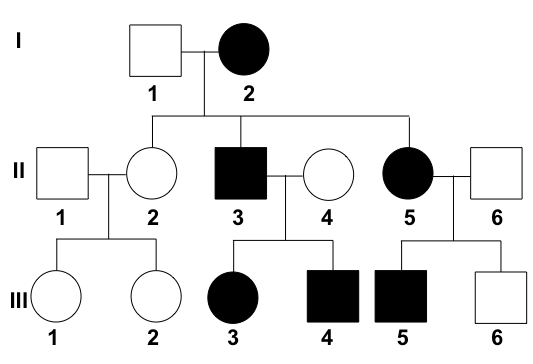
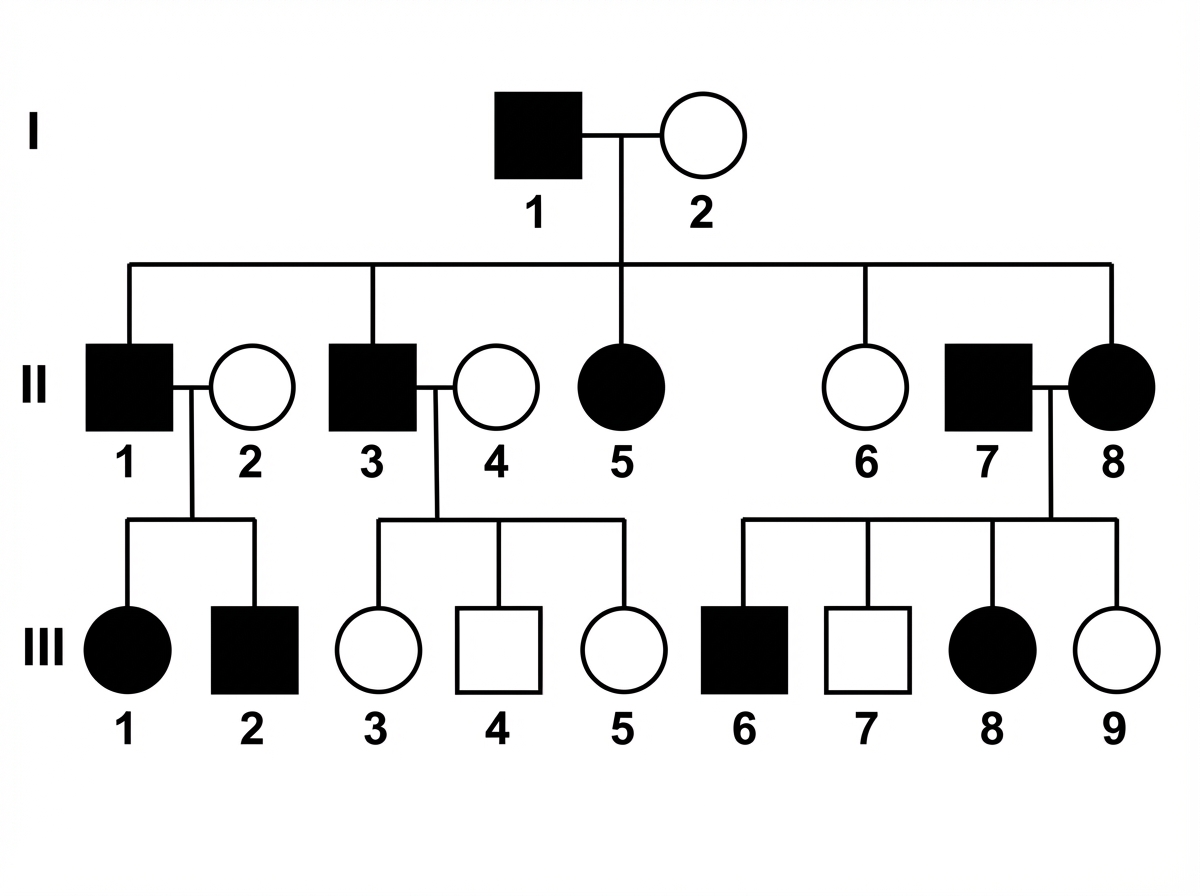
What is the inheritance pattern of Crouzon syndrome?
In which of the following inheritance patterns is father-to-son transmission not observed?
Which of the following is a single gene autosomal recessive disease?
Which one of the following is an autosomal dominant disorder?
Wilson's disease has which of the following inheritance?
Which of the following is not an autosomal recessive disorder?
Which one of the following is an autosomal recessive disorder?
Which of the following conditions is characterized by the presence of telangiectasia?
Which one of the following is an autosomal recessive disease?
Genetic disorder predisposing patients to develop Berry aneurysm includes all EXCEPT:
Explanation: ***Autosomal dominant*** - Crouzon syndrome is caused by a mutation in the **FGFR2 gene**, which is inherited in an **autosomal dominant pattern**. - This means only one copy of the mutated gene is needed for an individual to be affected, and there is a 50% chance of passing it to offspring. *Autosomal recessive* - Autosomal recessive conditions require **two copies of the mutated gene** (one from each parent) for the disease to manifest. - While some craniosynostosis syndromes are autosomal recessive, Crouzon syndrome is not. *X-linked recessive* - **X-linked recessive disorders** primarily affect males, as they only have one X chromosome. - Crouzon syndrome affects both males and females equally, ruling out X-linked inheritance. *X-linked dominant* - **X-linked dominant disorders** affect both males and females but often show more severe manifestations in males. - Crouzon syndrome does not follow an X-linked pattern and is not associated with the X chromosome. *Mitochondrial* - **Mitochondrial inheritance** involves genes within the mitochondrial DNA, passed exclusively from the mother to all her children. - This pattern of inheritance does not match the observed transmission of Crouzon syndrome.
Explanation: ***X-linked recessive inheritance*** - In X-linked inheritance, females have two X chromosomes (XX) and males have one X and one Y chromosome (XY). A father always passes his **Y chromosome** to his son. - He passes his **X chromosome only to his daughters**. Therefore, a father cannot pass an X-linked trait directly to his son. *Autosomal dominant inheritance* - In autosomal dominant inheritance, a disease allele is located on a **non-sex chromosome (autosome)**. - Both males and females can be affected, and **father-to-son transmission is possible** if the father carries the dominant allele on an autosome. *Autosomal recessive inheritance* - This inheritance pattern also involves genes on **autosomes**. - A father can transmit a recessive allele to his son, though the son would only express the trait if he also inherits a recessive allele from his mother. **Father-to-son transmission of the allele is possible**. *Multifactorial inheritance* - This pattern involves the interaction of **multiple genes** and **environmental factors**. - As some of these genes are on autosomes, and environmental factors are independent of sex chromosomes, **father-to-son transmission is observed** for the genetic components.
Explanation: ***Wilson's disease*** - This is an **autosomal recessive disorder** [1] characterized by excessive **copper accumulation** in the liver, brain, and other organs due to a mutation in the ATP7B gene. - Manifestations include **hepatic dysfunction**, neurological symptoms, and characteristic **Kayser-Fleischer rings** in the eyes [1]. *Tuberous sclerosis* - This is an **autosomal dominant disorder** caused by mutations in the TSC1 or TSC2 genes, leading to the formation of benign tumors in multiple organs. - Clinical features include **epilepsy**, intellectual disability, facial angiofibromas, and renal angiomyolipomas. *Huntington's disease* - This is an **autosomal dominant neurodegenerative disorder** caused by a CAG trinucleotide repeat expansion in the HTT gene. - It presents with **progressive chorea**, psychiatric symptoms, and cognitive decline, typically in mid-adulthood. *Schizophrenia* - This is a **complex psychiatric disorder** with a multifactorial etiology, involving a combination of genetic predisposition and environmental factors. - It is not a single gene disorder but rather involves many genes contributing to risk, indicating a **polygenic inheritance pattern**.
Explanation: ***Hereditary spherocytosis*** - It is characterized by **autosomal dominant inheritance** [1], leading to the destruction of red blood cells. - Mutations in proteins that maintain the **red blood cell membrane** integrity result in spherocyte formation [1]. *Cystic fibrosis* - This condition follows a **autosomal recessive inheritance pattern**, requiring two copies of the mutated gene for disease manifestation. - It is caused by mutations in the **CFTR gene**, affecting chloride transport and leading to thick secretions. *G-6PD deficiency* - This disorder is inherited in an **X-linked recessive manner** [2], primarily affecting males and transmitted through carrier females. - Characterized by **hemolytic anemia** triggered by certain medications or infections, it does not follow dominant inheritance [2]. *Sickle cell anemia* - Sickle cell anemia is also an **autosomal recessive disorder** [3], meaning affected individuals must inherit two copies of the sickle cell gene. - It results in a mutation in the **HBB gene**, leading to the production of abnormal hemoglobin (HbS) [3].
Explanation: ***Autosomal recessive*** - Wilson's disease is caused by mutations in the **ATP7B gene**, which codes for a copper-transporting ATPase. - For an individual to develop the disease, they must inherit **two copies of the mutated gene**, one from each parent. *It is an acquired disease* - Wilson's disease is a **genetic disorder**, meaning it is inherited, not acquired through environmental factors or lifestyle [1]. - While symptoms may manifest later in life, the underlying cause is a **predisposing genetic mutation** [1]. *X-linked recessive* - X-linked recessive disorders primarily affect males as they have only one X chromosome; however, Wilson's disease **affects both sexes equally**. - The gene responsible for Wilson's disease, **ATP7B**, is located on **chromosome 13**, an autosome, not on the X chromosome. *Autosomal dominant* - In autosomal dominant inheritance, only **one copy of the mutated gene** is sufficient to cause the disease, and it is usually seen in every generation. - Wilson's disease requires **two mutated copies** of the gene to manifest, and carriers (heterozygotes) are typically asymptomatic.
Explanation: ***Retinoblastoma*** - Retinoblastoma is caused by mutations in the **RB1 gene** and is inherited in an **autosomal dominant** pattern [1], not recessive. - It typically presents as a **tumor in the retina** of children, which is distinct from the conditions listed. *Albinism* - Albinism is a **genetic condition** characterized by a lack of melanin, inherited in an **autosomal recessive** manner. - It commonly presents with **hypopigmentation** of skin and eyes along with vision problems. *Hirschsprung disease* - Hirschsprung disease involves the **absence of ganglion cells** in the intestine, inherited in an **autosomal recessive** fashion. - It leads to **severe constipation** or intestinal obstruction and is linked to **Neural Crest Cell** development. *Sickle cell anaemia* - Sickle cell anaemia is a **hemoglobin disorder** resulting from a mutation in the HBB gene, inherited as an **autosomal recessive** trait. - Patients typically experience **painful crises** due to the sickling of red blood cells and their blockage of blood flow.
Explanation: ***Cystic fibrosis*** - **Cystic fibrosis** is caused by mutations in the **CFTR gene**, leading to defective **chloride channel** function. - It is an **autosomal recessive disorder**, meaning an individual must inherit two copies of the mutated gene (one from each parent) to be affected. *Huntington's disease* - **Huntington's disease** is an **autosomal dominant disorder** caused by a mutation in the HTT gene. - Only one copy of the mutated gene is sufficient to cause the disease, resulting in progressive neurodegeneration. *Marfan syndrome* - **Marfan syndrome** is an **autosomal dominant disorder** affecting connective tissue, caused by mutations in the FBN1 gene. - It results in skeletal, ocular, and cardiovascular abnormalities due to defective **fibrillin-1**. *Neurofibromatosis type 1* - **Neurofibromatosis type 1** is an **autosomal dominant disorder** caused by mutations in the NF1 gene. - It is characterized by multiple neurofibromas, café-au-lait macules, and Lisch nodules.
Explanation: ***Hereditary hemorrhagic telangiectasia*** - This condition, also known as **Osler-Weber-Rendu disease**, is a **genetic disorder** resulting in abnormal blood vessel formation, leading to **telangiectasias** and arteriovenous malformations that can cause significant bleeding. - Key diagnostic criteria include spontaneous recurrent nosebleeds, multiple mucocutaneous telangiectasias, visceral organ involvement (e.g., pulmonary, hepatic, cerebral AVMs), and a family history. *Telangiectasia due to systemic sclerosis* - While telangiectasias can be a feature of **systemic sclerosis** (especially the limited cutaneous form, **CREST syndrome**), they are typically localized and are not the primary defining characteristic of the disease. - Systemic sclerosis is primarily characterized by **fibrosis of skin and internal organs**, and the telangiectasias are a secondary manifestation, not the fundamental underpinning of the condition as in HHT. *Telangiectasia due to rosacea* - **Rosacea** is a chronic inflammatory skin condition characterized by facial erythema, papules, pustules, and **telangiectasias**, particularly on the cheeks and nose. - However, rosacea-associated telangiectasias are localized to the face and are part of a broader inflammatory dermatological process, distinct from the systemic vascular abnormalities seen in HHT. *Acquired telangiectasia due to sun exposure* - **Sun exposure** can indeed cause **telangiectasias**, particularly on sun-damaged skin, due to chronic photodamage to dermal blood vessels. - These are generally localized, non-syndromic, and a result of environmental factors rather than a systemic or inherited disorder as seen in hereditary hemorrhagic telangiectasia.
Explanation: ***Cystic fibrosis*** - **Cystic fibrosis** is caused by mutations in the **CFTR gene**, leading to defective chloride transport and thick, sticky mucus. - It is inherited in an **autosomal recessive pattern**, meaning an individual must inherit two copies of the mutated gene (one from each parent) to develop the disease. *Retinitis pigmentosa* - **Retinitis pigmentosa** is a group of inherited eye disorders, and while some forms are X-linked or autosomal dominant, a significant portion are also inherited in an **autosomal recessive pattern**. - However, it's not exclusively autosomal recessive, making cystic fibrosis a more definitive answer in this context. *Vitamin D resistant rickets* - **Vitamin D resistant rickets**, also known as **X-linked hypophosphatemic rickets**, is primarily inherited in an **X-linked dominant pattern**. - It is characterized by impaired renal phosphate reabsorption and skeletal abnormalities despite normal vitamin D levels. *Neurofibromatosis* - **Neurofibromatosis type 1 (NF1)** and **Neurofibromatosis type 2 (NF2)** are both inherited in an **autosomal dominant pattern**. - NF1 is characterized by **café-au-lait spots**, **neurofibromas**, and optical gliomas, while NF2 involves **bilateral vestibular schwannomas**.
Explanation: ***Neurofibrofomatosis Type II*** - This condition is primarily associated with **central nervous system tumors** like **vestibular schwannomas** and **meningiomas**, not Berry aneurysms [2]. - While it affects the nervous system, its vascular manifestations are typically different from those predisposing to aneurysms. *Marfan’s syndrome* - Patients with Marfan's syndrome have **fragile connective tissue** due to a defect in **fibrillin-1**, which can weaken arterial walls. - This weakness increases the risk of **aortic aneurysms** and dissections, and can also predispose to intracranial aneurysms like Berry aneurysms. *Adult polycystic kidney* - This **autosomal dominant** disorder is characterized by the formation of **cysts in the kidneys**, but also has systemic manifestations [1]. - There is a well-established association between **autosomal dominant polycystic kidney disease (ADPKD)** and an increased incidence of **Berry aneurysms**. *Fibromuscular dysplasia* - This condition involves **abnormal cellular development** in the **arterial walls**, leading to areas of narrowing and enlargement. - It commonly affects the **renal arteries** and **carotid arteries**, and is also a known risk factor for the development of **intracranial aneurysms**, including Berry aneurysms.
Get full access to all questions, explanations, and performance tracking.
Start For Free