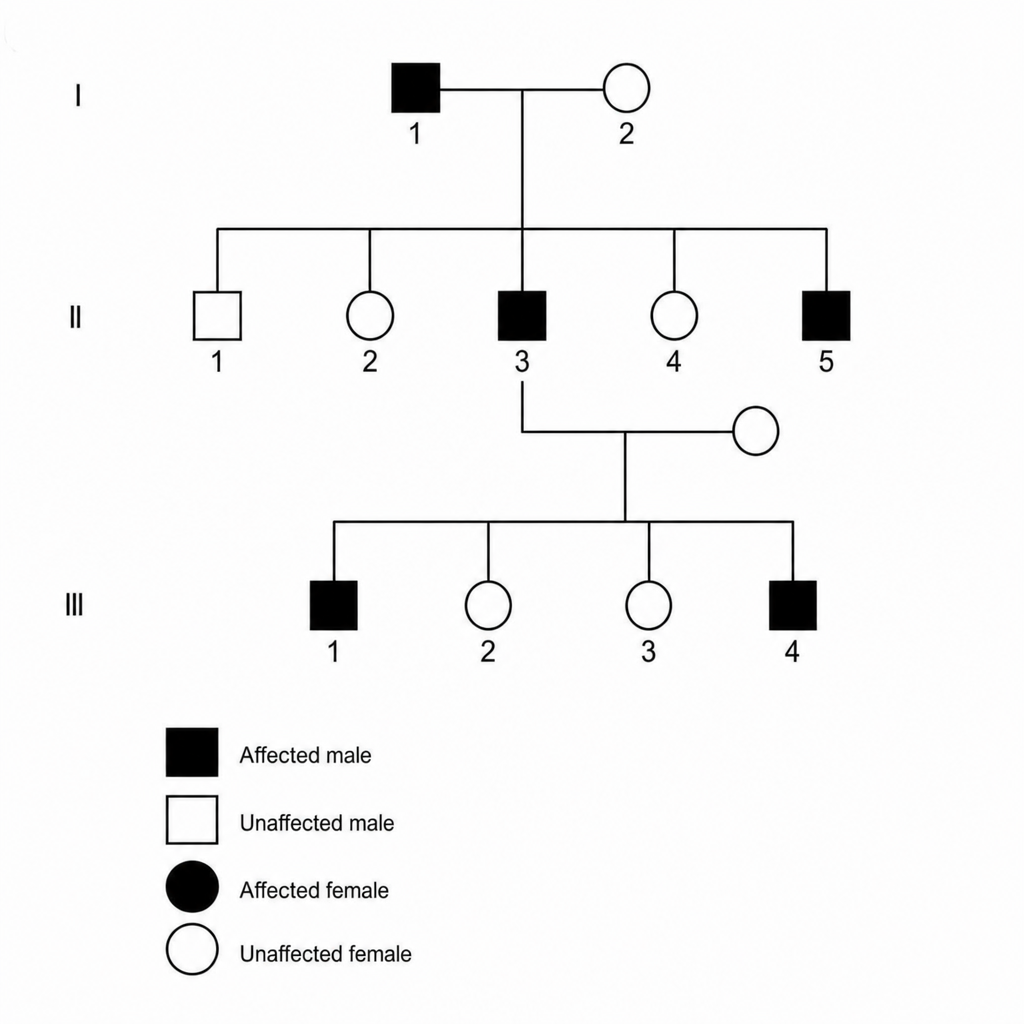
Pattern of inheritance where mother transmits disease to all children -
Which of the following translocations is not associated with Down syndrome?
What is the term for a single mutation in a nucleotide base pair that results in a termination codon?
Best method for the detection of mutations with low allele frequency is:
What is the pattern of inheritance in neural tube defects?
Gluten sensitive enteropathy is strongly associated with:-
Wilson's disease has which of the following inheritance?
Genetic disorder predisposing patients to develop Berry aneurysm includes all EXCEPT:
Which of the following conditions is associated with ectopia lentis?
A patient presents with headache, confusion, and a diagnosis of a brain tumor. The family history reveals brain and kidney tumors. What is the most likely diagnosis?
Explanation: ***Mitochondrial inheritance*** - Mitochondrial DNA (mtDNA) is exclusively inherited from the **mother**, meaning all children of an affected mother will inherit the mitochondrial disease. - Fathers do not pass on their mtDNA to their offspring, so an affected father's children will not inherit mitochondrial conditions from him. *X-linked recessive* - In X-linked recessive inheritance, sons have a 50% chance of being affected if their mother is a carrier, and daughters have a 50% chance of being carriers. - It does not guarantee that **all children** will inherit the disease from an affected mother; affected mothers would pass the X-linked gene to all sons (who would be affected) and all daughters (who would be carriers or affected depending on the other X chromosome). *Autosomal dominant* - In autosomal dominant inheritance, an affected parent has a 50% chance of passing the allele to **each child**, regardless of sex. - This pattern means not all children will necessarily inherit the disease, and both sexes are affected equally. *Autosomal recessive* - For autosomal recessive diseases, both parents must be carriers or affected for a child to inherit the disease, and even then, there is only a 25% chance for each child to be affected if both parents are carriers. - This pattern does not result in **all children** inheriting the disease from an affected mother, as it requires contributions from both parents.
Explanation: ***t (11: 14)*** - The **t(11;14) translocation** is commonly associated with **mantle cell lymphoma**, a B-cell non-Hodgkin lymphoma, and is not a cause of Down syndrome. - This translocation leads to the overexpression of the **cyclin D1 gene**, located on chromosome 11, which promotes cell growth and proliferation. *t (14; 21)* - This is a common **Robertsonian translocation** involving chromosomes 14 and 21, which results in an extra copy of chromosome 21 material [1]. - Individuals with this translocation can have **Down syndrome** because their cells end up with the equivalent of three copies of chromosome 21 [1]. *t (21; 21)* - This translocation is another type of **Robertsonian translocation** where two chromosome 21s fuse. - This specific translocation is rare and results in an extra copy of chromosome 21, leading to **Down syndrome** with a high recurrence risk in offspring. *t (15: 21)* - This is a **Robertsonian translocation** involving chromosomes 15 and 21, resulting in an extra copy of chromosome 21 material. - This translocation is a known cause of **Down syndrome** due to the dosage imbalance of genes on chromosome 21 [1]. **References:** [1] Kumar V, Abbas AK, et al.. Robbins and Cotran Pathologic Basis of Disease. 9th ed. Genetic Disorders, pp. 169-172.
Explanation: ***Nonsense mutation*** - A **nonsense mutation** occurs when a single nucleotide base pair change leads to the formation of a **premature stop codon**, which results in a truncated and often non-functional protein. - The term "nonsense" refers to the fact that the new codon signals an early termination of protein synthesis. *Missense mutation* - A **missense mutation** involves a single nucleotide change that results in a codon coding for a **different amino acid**, potentially altering protein function but not necessarily terminating it. - This type of mutation can have varying effects on protein function, from benign to severe, depending on the amino acid substitution. *Termination mutation* - While a nonsense mutation does result in **premature termination**, "termination mutation" is not the standard or most precise scientific term used to describe this specific type of genetic alteration. - The more accurate and widely accepted terminology is **nonsense mutation** for a change leading to a stop codon. *Silent mutation* - A **silent mutation** is a type of point mutation that changes a single nucleotide, but does not change the amino acid sequence of the protein due to the **degeneracy of the genetic code**. - These mutations have **no observable effect** on the organism's phenotype as the protein produced remains unchanged.
Explanation: ***Droplet digital PCR*** - **Droplet digital PCR (ddPCR)** offers superior sensitivity for detecting **low allele frequency mutations** by partitioning the sample into thousands of individual reactions. - This compartmentalization allows for the direct quantification of target DNA molecules without relying on a standard curve, making it highly accurate for rare mutation detection. *FISH* - **Fluorescence in situ hybridization (FISH)** primarily detects **chromosomal abnormalities** like translocations, deletions, or amplifications, rather than single-nucleotide variants or small indels with low allele frequencies [2]. - It visualizes genetic changes at a **cytogenetic level** on an intracellular basis, not typically for quantifying rare DNA mutations in a heterogeneous sample. *Sanger sequencing* - **Sanger sequencing** is the gold standard for **sequencing individual DNA fragments** but has a detection limit of around 15-20% for allele frequency, making it unsuitable for very low allele frequency mutations [1]. - It struggles to reliably detect minor alleles when they are present in a small proportion of the total DNA pool. *Nested PCR* - **Nested PCR** increases the sensitivity and specificity of amplification by using two sets of primers in a sequential manner but does not inherently provide the **quantification capability** or the same level of **low allele frequency detection** as ddPCR processes. - While sensitive for detecting target sequences, it is not designed for precise quantification of rare mutations in a background of wild-type sequences. **References:** [1] Kumar V, Abbas AK, et al.. Robbins and Cotran Pathologic Basis of Disease. 9th ed. Genetic Disorders, p. 185. [2] Kumar V, Abbas AK, et al.. Robbins and Cotran Pathologic Basis of Disease. 9th ed. Genetic Disorders, pp. 185-186.
Explanation: ***Multifactorial inheritance*** - Neural tube defects (NTDs) are a classic example of **multifactorial inheritance**, meaning they result from a combination of **genetic predispositions** and **environmental factors**. - Risk is influenced by multiple genes, and environmental factors like **folate deficiency** play a significant role. *Autosomal recessive* - This pattern involves two copies of an altered gene to cause disease, typically resulting in a **25% recurrence risk** for siblings. - While some rare isolated NTDs might have an autosomal recessive component, the general presentation of NTDs does not fit this classic mendelian pattern. *X-linked dominant* - Involves genes on the **X chromosome** where one altered copy is sufficient to cause disease; affected fathers pass it to all daughters, but no sons. - This inheritance pattern is very rare for NTDs and would present with a distinct sex-linked pattern of affected individuals. *Autosomal dominant* - Requires only one copy of an altered gene to cause disease, leading to a **50% recurrence risk** for offspring. - While some syndromes associated with NTDs can be autosomal dominant, the primary mechanism for isolated NTDs is not solely due to a single dominant gene. *X-linked recessive* - Involves genes on the **X chromosome** where two altered copies are needed in females, but only one in males; typically affects males predominantly. - This inheritance pattern does not account for the observed familial clustering and environmental contribution seen in NTDs.
Explanation: ### HLA-DQ2 - **HLA-DQ2** is the most significant **genetic risk factor** for **celiac disease** (gluten-sensitive enteropathy), present in about 90-95% of patients [1]. - Its presence is necessary, though not sufficient, for the development of the disease, playing a crucial role in immune response to **gluten peptides** [1]. ### HLA-DQ3 - While other HLA-DQ alleles exist, **HLA-DQ3** is not primarily associated with celiac disease. - The dominant susceptibility alleles are **HLA-DQ2** and, to a lesser extent, **HLA-DQ8** [1]. ### Blood group B - There is **no established strong association** between **blood group B** and the development of celiac disease. - Blood groups are primarily related to red blood cell antigens, not directly to autoimmune conditions like celiac disease. ### HLA-DR4 - **HLA-DR4** is mainly associated with other autoimmune diseases, particularly **rheumatoid arthritis**, and is not a primary genetic marker for celiac disease. - Although it's part of the MHC class II locus, its specific alleles like **HLA-DQ2** and **HLA-DQ8** are more relevant for celiac disease [1].
Explanation: ***Autosomal recessive*** - Wilson's disease is caused by mutations in the **ATP7B gene**, which codes for a copper-transporting ATPase. - For an individual to develop the disease, they must inherit **two copies of the mutated gene**, one from each parent. *It is an acquired disease* - Wilson's disease is a **genetic disorder**, meaning it is inherited, not acquired through environmental factors or lifestyle [1]. - While symptoms may manifest later in life, the underlying cause is a **predisposing genetic mutation** [1]. *X-linked recessive* - X-linked recessive disorders primarily affect males as they have only one X chromosome; however, Wilson's disease **affects both sexes equally**. - The gene responsible for Wilson's disease, **ATP7B**, is located on **chromosome 13**, an autosome, not on the X chromosome. *Autosomal dominant* - In autosomal dominant inheritance, only **one copy of the mutated gene** is sufficient to cause the disease, and it is usually seen in every generation. - Wilson's disease requires **two mutated copies** of the gene to manifest, and carriers (heterozygotes) are typically asymptomatic.
Explanation: ***Neurofibrofomatosis Type II*** - This condition is primarily associated with **central nervous system tumors** like **vestibular schwannomas** and **meningiomas**, not Berry aneurysms [2]. - While it affects the nervous system, its vascular manifestations are typically different from those predisposing to aneurysms. *Marfan’s syndrome* - Patients with Marfan's syndrome have **fragile connective tissue** due to a defect in **fibrillin-1**, which can weaken arterial walls. - This weakness increases the risk of **aortic aneurysms** and dissections, and can also predispose to intracranial aneurysms like Berry aneurysms. *Adult polycystic kidney* - This **autosomal dominant** disorder is characterized by the formation of **cysts in the kidneys**, but also has systemic manifestations [1]. - There is a well-established association between **autosomal dominant polycystic kidney disease (ADPKD)** and an increased incidence of **Berry aneurysms**. *Fibromuscular dysplasia* - This condition involves **abnormal cellular development** in the **arterial walls**, leading to areas of narrowing and enlargement. - It commonly affects the **renal arteries** and **carotid arteries**, and is also a known risk factor for the development of **intracranial aneurysms**, including Berry aneurysms.
Explanation: ***Homocystinuria*** - **Ectopia lentis** (lens dislocation) is a common and characteristic ocular manifestation of homocystinuria. - The lens typically dislocates **downward and inward**, differentiating it from Marfan syndrome. *Alport syndrome* - Characterized by **glomerulonephritis**, **sensorineural hearing loss**, and ocular abnormalities. - Ocular manifestations include **anterior lenticonus** (which can be mistaken for ectopia lentis in some descriptions), posterior polymorphous corneal dystrophy, and retinal flecks, but not classic ectopia lentis. *Lowe syndrome* - Also known as oculocerebrorenal syndrome of Lowe, it primarily affects the **eyes, brain, and kidneys**. - Ocular features include **congenital cataracts** and glaucoma, but not ectopia lentis. *Sulphite oxidase deficiency* - This is a rare metabolic disorder affecting the metabolism of sulfur-containing amino acids, leading to severe neurological symptoms. - While it can manifest with **cataracts** and **lens subluxation** in some cases, ectopia lentis is more characteristically associated with homocystinuria, and the overall clinical picture of sulphite oxidase deficiency is dominated by severe neurological impairment.
Explanation: ***VHL syndrome*** - **Von Hippel-Lindau (VHL) syndrome** is an inherited disorder characterized by the growth of tumors and cysts in various parts of the body, including the **brain (hemangioblastomas)** and **kidneys (renal cell carcinoma)**. - The presentation of a brain tumor, kidney tumors, and a positive family history for both organs strongly points to VHL syndrome. *Neurofibromatosis* - **Neurofibromatosis (NF)** typically presents with **cafe-au-lait spots**, neurofibromas, optic gliomas, and Lisch nodules. - While it involves brain tumors, kidney tumors are not a primary feature of NF. *Li-Fraumeni syndrome* - **Li-Fraumeni syndrome** is associated with an increased risk of various cancers, including **sarcomas**, **breast cancer**, **adrenocortical carcinomas**, and **leukemia**. - While brain tumors can occur, the specific combination of brain and kidney tumors with a clear family history is less characteristic of Li-Fraumeni than VHL syndrome. *Churg-Strauss syndrome* - **Churg-Strauss syndrome (Eosinophilic Granulomatosis with Polyangiitis)** is a systemic vasculitis characterized by **asthma**, **eosinophilia**, and **granulomatous inflammation**. - It does not involve the development of brain or kidney tumors.
Get full access to all questions, explanations, and performance tracking.
Start For Free