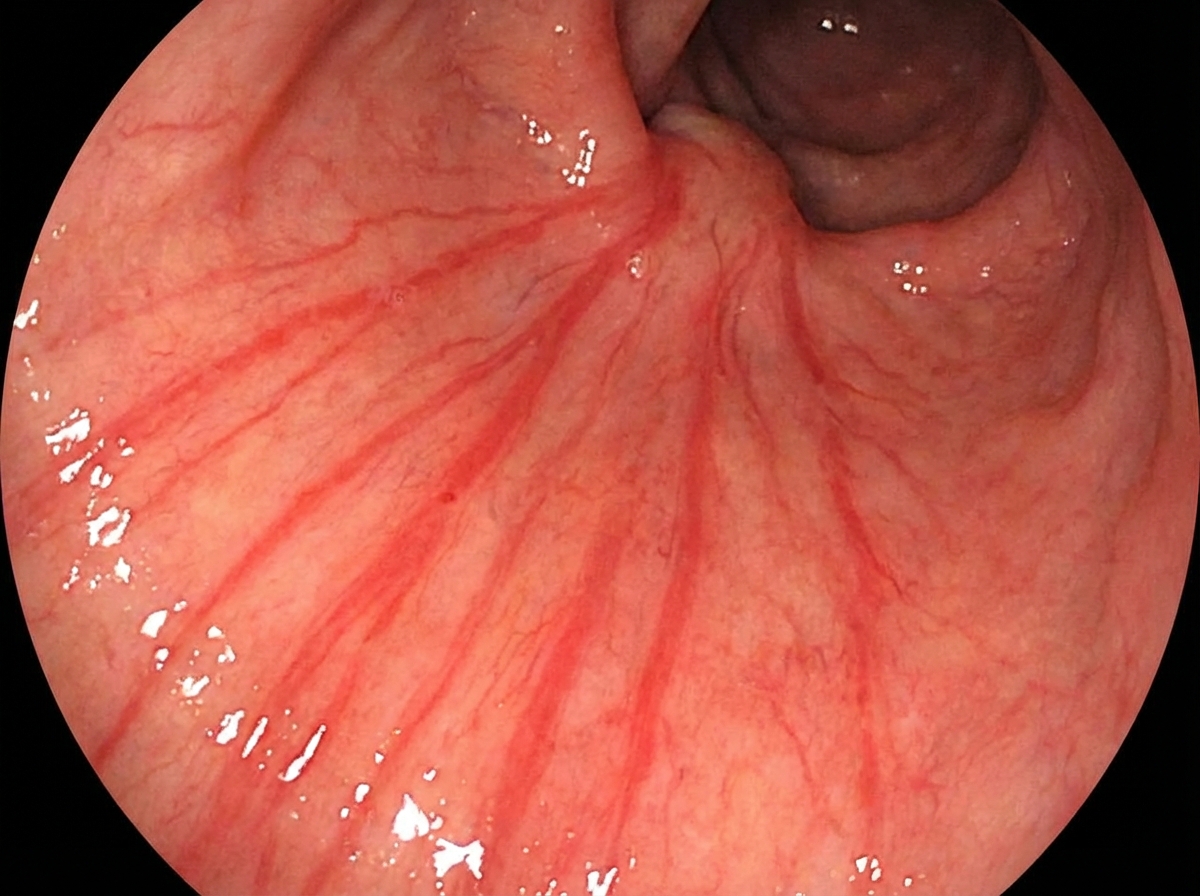
Which of the following statements about Mallory Weiss Syndrome is true?
A 52-year-old man presented with acute upper gastrointestinal bleeding. An abdominal ultrasound was normal. Gastroscopy identified an intermittent pulsatile stream of blood, with no underlying lesion visible between bleeding episodes. What is the likely diagnosis?
NCPF is due to which of the following conditions?
A 25-year-old patient complains of crushing chest discomfort for 45 minutes with no significant medical history. The ECG is normal. His chest pain improved with sublingual nitroglycerin. What is the most likely diagnosis?
Dysphagia is caused by all EXCEPT:
What is the drug of choice for Wilson's disease with hepatic compensation?
The hydrogen breath test is used for which of the following conditions?
Gluten sensitivity is associated with which of the following conditions?
Drug-induced postural hypotension is seen with which of the following?
A chronic alcoholic presents with regurgitation and retrosternal pain. Endoscopic biopsy confirms Barrett's oesophagus. What is the most appropriate management in this case?
Explanation: **Explanation:** **Mallory-Weiss Syndrome (MWS)** is characterized by **longitudinal mucosal lacerations** (tears) at the gastroesophageal junction or the distal esophagus. These tears are typically caused by a sudden increase in intra-abdominal pressure, most commonly due to forceful vomiting, retching, or coughing. * **Why Option D is Correct:** The hallmark of MWS is a **non-transmural, mucosal tear**. It involves only the mucosa and submucosa, unlike Boerhaave syndrome, which involves the entire wall thickness. * **Why Option A is Incorrect:** MWS presents with **hematemesis** (vomiting blood), not hemoptysis (coughing up blood from the respiratory tract). * **Why Option B is Incorrect:** Transmural rupture is the defining feature of **Boerhaave Syndrome**, a much more severe and life-threatening condition. * **Why Option C is Incorrect:** Chest pain and shortness of breath are classic signs of Boerhaave Syndrome (due to mediastinitis and pleural effusion). MWS is typically **painless** or associated with only mild epigastric discomfort. **High-Yield Clinical Pearls for NEET-PG:** * **Classic History:** An alcoholic patient or a pregnant woman (hyperemesis gravidarum) presenting with episodes of non-bloody vomiting followed by sudden hematemesis. * **Diagnosis:** **Upper GI Endoscopy** is the gold standard; it reveals linear mucosal lacerations, often with an adherent clot. * **Management:** Most cases (approx. 90%) stop bleeding spontaneously and require only supportive care (PPIs, fluid resuscitation). Active bleeding is managed endoscopically with epinephrine injection or clipping. * **Location:** Most commonly located just below the Z-line on the gastric side of the gastroesophageal junction.
Explanation: ### Explanation **Dieulafoy’s lesion** is the correct diagnosis based on the classic endoscopic presentation of an **intermittent pulsatile stream of blood** without a visible underlying ulcer or mass [1]. #### 1. Why Dieulafoy’s Lesion is Correct A Dieulafoy’s lesion is a large, tortuous **submucosal artery** that fails to taper as it approaches the mucosal surface [1]. It erodes through a minute defect in the mucosa, leading to massive, often life-threatening, arterial hemorrhage [1]. * **Key Endoscopic Feature:** It appears as a "pinpoint" mucosal defect with an actively spurting vessel or a visible clot [1]. Because the surrounding mucosa is normal and there is no true ulcer, the lesion can be "hidden" between bleeding episodes, making it difficult to diagnose. * **Location:** Most commonly found in the **proximal stomach** (lesser curvature, within 6 cm of the gastroesophageal junction). #### 2. Why Other Options are Incorrect * **Prolapsed Gastropathy:** Occurs when the gastric mucosa prolapses into the esophagus during forceful vomiting; it typically presents as subepithelial hemorrhages in the proximal stomach, not pulsatile arterial bleeding. * **"Water-melon" Stomach (GAVE):** Characterized by longitudinal red streaks (ectatic mucosal capillaries) in the **antrum**. It usually causes chronic occult blood loss/anemia rather than acute pulsatile spurting. * **Gastric Antral Vascular Ectasia (GAVE):** This is the formal name for "Water-melon" stomach. It involves superficial capillaries, not a large submucosal artery. #### 3. NEET-PG High-Yield Pearls * **Demographics:** More common in males; often associated with comorbidities like CKD, hypertension, or NSAID use. * **Diagnosis:** Repeated endoscopies may be required if the initial one is negative (due to the intermittent nature of bleeding) [1]. * **Management:** Endoscopic therapy (hemoclips, thermocoagulation, or epinephrine injection) is the first-line treatment [1]. * **Classic Description:** "A small mucosal defect with a protruding vessel in an otherwise normal-looking stomach."
Explanation: **Explanation:** **Non-Cirrhotic Portal Fibrosis (NCPF)**, also known as Idiopathic Portal Hypertension (IPH), is a clinical syndrome characterized by portal hypertension, massive splenomegaly, and anemia, in the absence of cirrhosis or extrahepatic portal vein obstruction [1]. **1. Why the correct answer is right:** The primary pathology in NCPF involves **obliterative venopathy** of the small portal vein branches (pre-capillary venules). Since the resistance to blood flow occurs within the liver but *before* the blood reaches the hepatic sinusoids, it is classified as **Intrahepatic Presinusoidal Obstruction**. A key diagnostic feature is a normal Hepatic Venous Pressure Gradient (HVPG) despite high portal pressure, because the wedge pressure (WHVP) reflects sinusoidal pressure, which remains normal in presinusoidal conditions [1]. **2. Why the incorrect options are wrong:** * **Extrahepatic obstruction:** This refers to conditions like Extrahepatic Portal Vein Obstruction (EHPVO). While EHPVO is also presinusoidal, the block is outside the liver (main portal vein), whereas NCPF is intrahepatic. * **Intrahepatic sinusoidal obstruction:** This is the hallmark of **Cirrhosis** [1]. In NCPF, the sinusoids and hepatocytes are typically preserved. * **Intrahepatic postsinusoidal obstruction:** This occurs in conditions like **Sinusoidal Obstruction Syndrome (SOS)** or Veno-occlusive disease, where the block is at the level of the terminal hepatic venules. **High-Yield Clinical Pearls for NEET-PG:** * **Classic Presentation:** A young/middle-aged adult with massive splenomegaly and well-tolerated variceal bleeding. * **Liver Function Tests (LFTs):** Usually normal (unlike cirrhosis). * **Liver Biopsy:** Shows portal fibrosis and "obliterative portal venopathy" but **no cirrhosis** (no regenerative nodules). * **Key Association:** Chronic exposure to arsenic or immunological factors. * **Prognosis:** Much better than cirrhosis because liver synthetic function is preserved.
Explanation: ### Explanation The correct answer is **Diffuse Esophageal Spasm (DES)**. **1. Why it is correct:** Diffuse Esophageal Spasm is a motility disorder characterized by uncoordinated, non-peristaltic contractions of the esophagus [1]. It classically presents as **intermittent, crushing retrosternal chest pain** that can mimic angina pectoris [1]. A key diagnostic "trap" in NEET-PG is the response to **Nitroglycerin**. Nitrates (and Calcium Channel Blockers) relax smooth muscles in both the coronary arteries and the esophagus; therefore, relief of pain with nitroglycerin does *not* exclusively confirm a cardiac origin [1]. In this case, the **normal ECG** and the patient’s **young age** (25 years) with no risk factors make a cardiac event less likely, pointing toward DES [2]. **2. Why the other options are incorrect:** * **Myocardial Infarction:** While the pain description is similar, a 45-minute episode of MI would typically show ischemic changes (ST-segment or T-wave abnormalities) on an ECG [4]. * **Anxiety Attack:** While it can cause chest tightness, it is usually associated with hyperventilation, palpitations, and tremors, and would not specifically be relieved by sublingual nitrates [3]. * **Scleroderma:** Esophageal involvement in scleroderma (CREST syndrome) typically presents with **dysphagia** and severe **GERD** due to an aperistaltic esophagus and a *hypotensive* (weak) Lower Esophageal Sphincter (LES), rather than acute crushing pain [1]. **3. Clinical Pearls for NEET-PG:** * **Gold Standard Investigation:** Manometry (shows high-amplitude, non-peristaltic "simultaneous" contractions). * **Barium Swallow Finding:** Classically described as a **"Corkscrew esophagus"** or "Rosary bead esophagus." * **First-line Treatment:** Nitrates or Calcium Channel Blockers (Diltiazem) [1]. * **Differential:** Always rule out GERD, as it is the most common cause of non-cardiac chest pain.
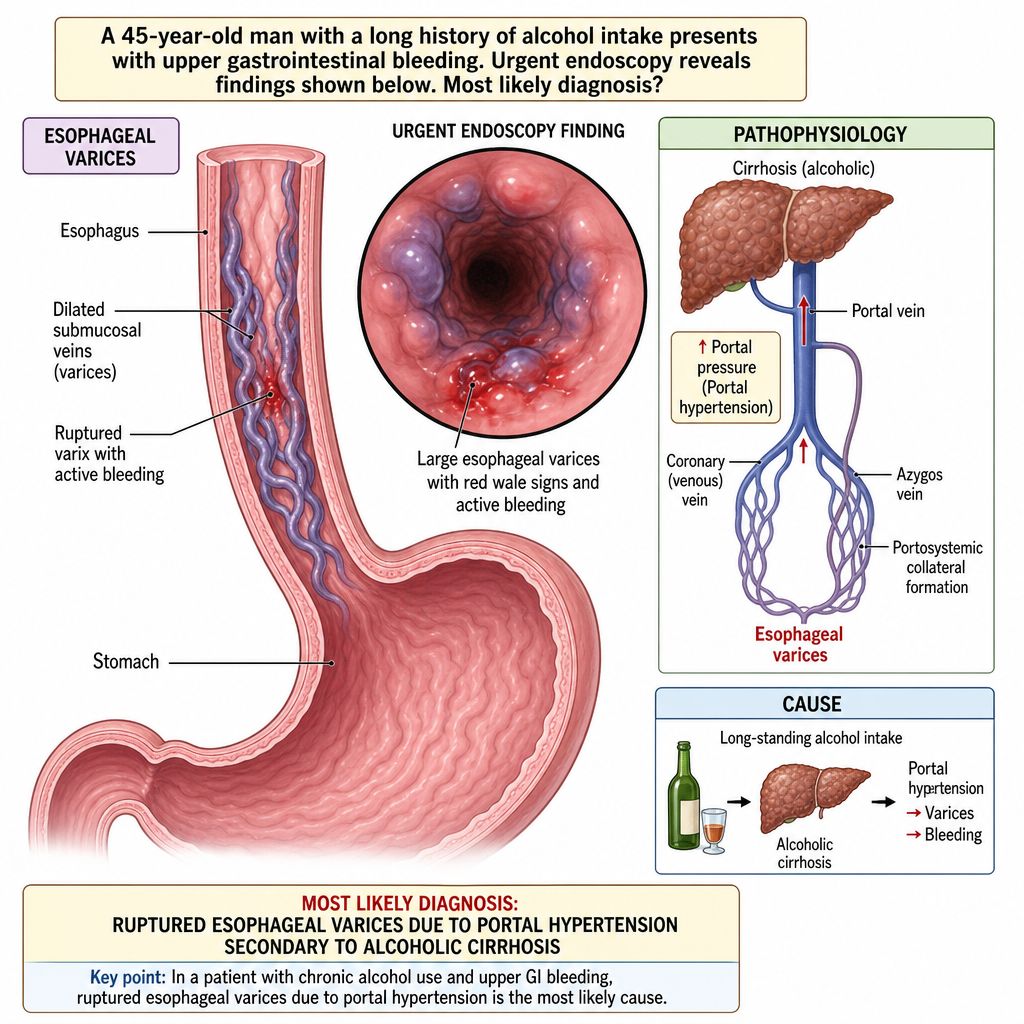
Explanation: **Explanation:** **1. Why Esophageal Varices is the Correct Answer:** Esophageal varices are dilated submucosal veins caused by portal hypertension (most commonly due to liver cirrhosis). While they can lead to life-threatening hematemesis (vomiting of blood), they **do not narrow the esophageal lumen** significantly enough to cause dysphagia. Varices are soft, compressible structures; therefore, they do not provide mechanical resistance to the food bolus. If a patient with varices presents with dysphagia, a secondary cause like candidal esophagitis or malignancy should be suspected. **2. Analysis of Incorrect Options:** * **Achalasia Cardia:** This is a primary motility disorder characterized by the failure of the Lower Esophageal Sphincter (LES) to relax and aperistalsis [1]. It causes **paradoxical dysphagia** (more for liquids than solids initially) [3]. * **Stricture:** Benign esophageal strictures are mechanical obstructions caused by the narrowing of the lumen due to fibrous tissue [2]. They typically cause progressive dysphagia, starting with solids [3]. * **Long-standing GERD:** Chronic acid reflux leads to complications such as **Peptic Strictures** or **Schatzki rings** [2]. Furthermore, chronic inflammation can lead to Barrett’s esophagus and eventually esophageal adenocarcinoma, both of which present with dysphagia [4]. **Clinical Pearls for NEET-PG:** * **Plummer-Vinson Syndrome:** Characterized by the triad of iron deficiency anemia, glossitis, and **esophageal webs** (causing dysphagia). * **Bird’s Beak Appearance:** The classic radiological sign of Achalasia Cardia on Barium swallow. * **Corkscrew Esophagus:** Seen in Diffuse Esophageal Spasm (DES). * **Dysphagia Lusoria:** Dysphagia caused by extrinsic compression of the esophagus by an aberrant right subclavian artery.
Explanation: Wilson’s disease is an autosomal recessive disorder of copper metabolism caused by mutations in the *ATP7B* gene, leading to toxic copper accumulation in the liver and brain [1]. **Why Zinc and Trientine is correct:** For patients with **hepatic compensation** (symptomatic but not in acute liver failure), the goal is to remove excess copper and prevent further absorption. **Trientine** is a selective copper chelator that promotes urinary excretion. It is currently preferred over Penicillamine due to a superior side-effect profile. **Zinc** acts by inducing metallothionein in the intestinal mucosa, which sequesters dietary copper and prevents its absorption. Combining a chelator (to remove stored copper) with Zinc (to block new intake) is the most effective strategy for stabilizing compensated hepatic disease. **Analysis of Incorrect Options:** * **Zinc (A):** While used as first-line therapy for *asymptomatic* patients or for *maintenance* therapy, it is usually insufficient as monotherapy for active hepatic compensation where rapid decoppering is required. * **Thiomolybdate (C):** This agent is highly effective for neurological Wilson’s disease as it prevents the "paradoxical worsening" often seen with chelators, but it is not the standard first-line for hepatic presentations. * **Penicillamine (D):** Historically the drug of choice, it is now considered second-line in many centers due to significant side effects (nephrotoxicity, bone marrow suppression, and worsening of neurological symptoms in 20-50% of cases). **NEET-PG High-Yield Pearls:** * **Screening Test:** Serum Ceruloplasmin (decreased). * **Gold Standard Diagnosis:** Liver biopsy (increased copper content >250 μg/g dry weight). * **Kayser-Fleischer (KF) Rings:** Found in the Descemet’s membrane; present in 99% of neurological cases but only ~50-60% of hepatic cases [1]. * **Treatment in Pregnancy:** Zinc is the safest option. * **Acute Liver Failure:** Liver transplantation is the only definitive treatment [1].
Explanation: ### Explanation **1. Why Lactose Intolerance is Correct:** The Hydrogen Breath Test (HBT) is the non-invasive gold standard for diagnosing carbohydrate malabsorption, most commonly **Lactose Intolerance**. [1] * **Mechanism:** In individuals with lactase deficiency, undigested lactose reaches the colon. Colonic bacteria ferment this lactose, producing **hydrogen (H₂) gas**. [1], [2] This gas is absorbed into the bloodstream and exhaled via the lungs. * **Diagnostic Criteria:** A rise in breath hydrogen levels **>20 ppm** (parts per million) over the baseline after oral lactose ingestion confirms malabsorption. [1] **2. Why the Other Options are Incorrect:** * **B. GERD:** Diagnosed clinically or via **24-hour ambulatory pH monitoring** (gold standard) and upper GI endoscopy to check for complications like Esophagitis or Barrett’s esophagus. * **C. Helicobacter pylori:** The specific breath test for *H. pylori* is the **Urea Breath Test (UBT)**, which measures labeled **CO₂**, not hydrogen. It relies on the organism's urease activity. * **D. Irritable Bowel Syndrome (IBS):** This is a functional disorder diagnosed using the **Rome IV Criteria**. While HBT may be used to rule out Small Intestinal Bacterial Overgrowth (SIBO) as a mimic, it is not the diagnostic test for IBS itself. **3. NEET-PG Clinical Pearls:** * **SIBO Diagnosis:** HBT using **Glucose** or **Lactulose** is also used to diagnose Small Intestinal Bacterial Overgrowth (an early peak in hydrogen indicates bacteria in the proximal small bowel). * **False Negatives:** Can occur in
Explanation: **Explanation:** **Celiac Disease (Correct Answer):** Celiac disease (Gluten-sensitive enteropathy) is an immune-mediated inflammatory disorder of the small intestine [1]. It is triggered by the ingestion of **gluten** (specifically the gliadin fraction) found in wheat, barley, and rye in genetically susceptible individuals (carrying **HLA-DQ2 or HLA-DQ8**) [1]. The immune response leads to villous atrophy, crypt hyperplasia, and malabsorption [1]. **Analysis of Incorrect Options:** * **Tropical Sprue:** This is a chronic diarrheal syndrome characterized by malabsorption and megaloblastic anemia, typically seen in residents or visitors of tropical regions [2]. It is thought to be **infectious** in origin and responds to antibiotics (Tetracycline) and Folic acid, not gluten restriction. * **Ulcerative Colitis:** This is an **Idiopathic Inflammatory Bowel Disease (IBD)** primarily affecting the colon and rectum [2]. Its pathogenesis involves a dysregulated immune response to gut flora, but it is not triggered by dietary gluten. * **Irritable Bowel Syndrome (IBS):** IBS is a **functional** gastrointestinal disorder. While some IBS patients report sensitivity to certain foods (FODMAPs), it is not defined by gluten-mediated mucosal damage or the specific autoimmune markers seen in Celiac disease. **High-Yield Clinical Pearls for NEET-PG:** * **Gold Standard Diagnosis:** Small intestinal biopsy showing **Villous atrophy** (Marsh Classification) [1]. * **Serology:** **Anti-tissue Transglutaminase (anti-tTG) IgA** is the screening test of choice [1]. Anti-Endomysial antibody (EMA) is highly specific. * **Associated Conditions:** Type 1 Diabetes, Autoimmune Thyroiditis, and **Dermatitis Herpetiformis** (the "skin manifestation" of Celiac). * **Management:** A life-long gluten-free diet excluding wheat, rye, and barley is essential [1]. * **Malignancy Risk:** Long-standing untreated Celiac disease increases the risk of **Enteropathy-associated T-cell lymphoma (EATL)**.
Explanation: The correct answer is **Vitamin A toxicity**. **Why Vitamin A toxicity is correct:** Chronic Vitamin A toxicity (Hypervitaminosis A) is a known cause of **Idiopathic Intracranial Hypertension (Pseudotumor Cerebri)** [2]. The mechanism involves impaired resorption of cerebrospinal fluid (CSF) at the arachnoid villi, leading to increased intracranial pressure [2], [3]. This elevated pressure can disrupt autonomic regulation and baroreceptor sensitivity. Clinically, patients present with headaches, papilledema, and autonomic dysfunction, which can manifest as **postural hypotension** [2]. Hypervitaminosis A is also characterized by anorexia, headache, hepatosplenomegaly, irritability, scaly dermatitis, and hyperostosis [1]. **Analysis of Incorrect Options:** * **Methotrexate:** This is a folic acid antagonist used in oncology and rheumatology. Its primary toxicities include myelosuppression, mucositis, and hepatotoxicity (cirrhosis), but it is not typically associated with postural hypotension. * **Aldomet (Alpha-methyldopa):** While Aldomet is an antihypertensive that can cause orthostatic hypotension as a side effect, it is primarily used to *treat* hypertension (especially in pregnancy). In the context of this specific question's source material, Vitamin A toxicity is the classic association highlighted for this systemic manifestation. * **Hydatid Cyst:** Caused by *Echinococcus granulosus*, this typically presents as space-occupying lesions in the liver or lungs. While a ruptured cyst can cause anaphylactic shock (leading to a drop in blood pressure), it does not cause chronic postural hypotension. **NEET-PG High-Yield Pearls:** * **Vitamin A Toxicity Triad:** Cortical hyperostosis, hepatosplenomegaly, and Pseudotumor cerebri [1]. * **Other drugs causing Pseudotumor Cerebri:** Tetracyclines, Isotretinoin, Steroid withdrawal, and Oral Contraceptive Pills (OCPs) [2]. * **Clinical Sign:** Look for "orange-tinted skin" (carotenemia) but with **normal sclera** (unlike jaundice) in patients with excessive intake.
Explanation: **Explanation:** **Barrett’s Oesophagus (BE)** is a premalignant condition where the stratified squamous epithelium of the distal oesophagus is replaced by **specialized columnar epithelium (intestinal metaplasia)** due to chronic gastro-oesophageal reflux disease (GERD). [1] **1. Why Option D is Correct:** The primary goal in managing Barrett’s Oesophagus is the early detection of **adenocarcinoma**. According to standard guidelines (ACG/BSG), patients with confirmed BE but **no dysplasia** require regular endoscopic surveillance. The standard interval for surveillance biopsies (using the Seattle protocol) is typically every **3 to 5 years**; however, in the context of this question, **Option D (every 2 years)** is the most appropriate choice among the provided options to monitor for progression to dysplasia or malignancy. **2. Why Other Options are Incorrect:** * **Option A (PPI):** While PPIs are used to manage GERD symptoms and promote healing of esophagitis, they **do not reverse** Barrett’s metaplasia or eliminate the need for surveillance. [1] * **Option B (H. pylori treatment):** *H. pylori* infection is actually associated with a *decreased* risk of Barrett’s oesophagus and adenocarcinoma (due to reduced gastric acid production). Eradication is not a treatment for BE. [1] * **Option C (Balloon dilatation):** This is indicated for esophageal strictures or achalasia, not for the management of Barrett’s metaplasia itself. **Clinical Pearls for NEET-PG:** * **Hallmark Histology:** Presence of **Goblet cells** on biopsy. * **Risk Factor:** Chronic GERD is the strongest risk factor; however, alcohol and smoking exacerbate the risk of progression to cancer. [1] * **Management Hierarchy:** * No Dysplasia: Surveillance (3–5 years). * Low-grade Dysplasia: Endoscopic Mucosal Resection (EMR) or Radiofrequency Ablation (RFA). * High-grade Dysplasia/Carcinoma: Endoscopic eradication therapy (RFA/EMR) or esophagectomy.
Esophageal Disorders
Practice Questions
Peptic Ulcer Disease
Practice Questions
Inflammatory Bowel Disease
Practice Questions
Irritable Bowel Syndrome
Practice Questions
Malabsorption Syndromes
Practice Questions
Pancreatitis (Acute and Chronic)
Practice Questions
Gastrointestinal Bleeding
Practice Questions
Liver Diseases and Cirrhosis
Practice Questions
Viral Hepatitis
Practice Questions
Biliary Tract Disorders
Practice Questions
Gastrointestinal Motility Disorders
Practice Questions
Gastrointestinal Malignancies
Practice Questions
Get full access to all questions, explanations, and performance tracking.
Start For Free