Which is a typical symptom of gastroesophageal reflux disease?
A 50-year-old woman presents with duodenal ulcer disease and high basal acid secretory outputs. Secretin stimulated serum gastrin levels are in excess of 1000pg/mL. She has a long history of ulcer disease that has not responded to intense medical therapy. What is the most likely diagnosis?
What is the most common metabolic disturbance in cirrhosis?
Which of the following is NOT a cause of upper gastrointestinal bleeding?
Serum-ascites albumin gradient >1.1 g/dL is seen in which of the following conditions?
A 20-year-old male presents with mucus and repeated gastrointestinal bleeding. The patient is positive for ANCA. What is the most likely diagnosis?
Zollinger Ellison syndrome is caused by which of the following?
A patient presents to a physician with "heartburn" and dysphagia. Esophageal motility studies demonstrate a near absence of smooth muscle peristalsis and lower esophageal sphincter tone. No mass lesions are noted, and the esophagus is not dilated. Which of the following findings would most likely also be present?
Which infectious diseases can cause cirrhosis of the liver?
Dysphagia is the awareness of something
Explanation: Gastroesophageal Reflux Disease (GERD) is primarily a clinical diagnosis based on the presence of "typical" symptoms. The two hallmark (typical) symptoms of GERD are **Heartburn** (pyrosis) and **Regurgitation** [1]. 1. **Regurgitation (Correct Answer):** This is defined as the effortless reflux of gastric contents into the mouth or hypopharynx [1]. It is considered a "typical" or "classic" symptom because it directly reflects the retrograde movement of acid/food due to a transient or permanent relaxation of the Lower Esophageal Sphincter (LES) [1]. 2. **Incorrect Options:** * **Dysphagia (B):** While it can occur in GERD, it is considered an **"Alarm Symptom."** Its presence suggests complications like peptic strictures, Schatzki rings, or esophageal adenocarcinoma and warrants immediate endoscopy [2]. * **Chest Pain (C):** This is an **"Atypical"** or "Extra-esophageal" symptom. GERD is a common cause of non-cardiac chest pain, but it is not the primary diagnostic symptom. * **Cough (D):** This is an **"Extra-esophageal"** manifestation. Other extra-esophageal symptoms include laryngitis, asthma, and dental erosions. **High-Yield Clinical Pearls for NEET-PG:** * **Diagnosis:** GERD is usually diagnosed clinically. The gold standard for confirming reflux is **24-hour ambulatory pH monitoring**, but it is only required if symptoms are refractory to treatment. * **Initial Management:** Lifestyle modifications and a trial of Proton Pump Inhibitors (PPIs) for 8 weeks. * **Endoscopy Indications:** Indicated in the presence of alarm symptoms [2] (Dysphagia, odynophagia, weight loss, anemia) or to screen for **Barrett’s Esophagus** (metaplasia of squamous to columnar epithelium) in chronic cases.
Explanation: ### Explanation **Correct Answer: D. Zollinger-Ellison syndrome (ZES)** The clinical presentation is classic for **Zollinger-Ellison Syndrome**, caused by a gastrin-secreting neuroendocrine tumor (gastrinoma) [1]. * **Hypergastrinemia:** A serum gastrin level >1000 pg/mL in the presence of high gastric acid (Basal Acid Output >15 mEq/hr) is virtually diagnostic [1][2]. * **Secretin Stimulation Test:** This is the most sensitive provocative test. In ZES, secretin paradoxically **increases** gastrin levels (usually by >200 pg/mL). In normal individuals, secretin inhibits gastrin. * **Refractory Ulcers:** Ulcers that are multiple, distal to the duodenal bulb, or non-responsive to standard PPI therapy strongly suggest ZES. **Why Incorrect Options are Wrong:** * **A. Hyperparathyroidism:** While associated with ZES in **MEN1 syndrome**, hyperparathyroidism itself causes hypercalcemia, which can mildly increase gastrin, but it does not produce the massive levels (>1000 pg/mL) or the paradoxical secretin response seen here. * **B. Pernicious Anemia:** This causes hypergastrinemia due to **achlorhydria** (loss of feedback inhibition) [2][3]. However, the question specifies high acid output; in pernicious anemia, acid output is zero [3]. * **C. Renal Failure:** Gastrin is cleared by the kidneys, so levels can rise in renal failure. However, it does not cause the profound acid hypersecretion or the specific secretin test results characteristic of a gastrinoma. **NEET-PG High-Yield Pearls:** * **Most common location:** The **Gastrinoma Triangle** (confluence of cystic/common bile duct, junction of 2nd/3rd parts of duodenum, and neck/body of pancreas). * **Most common site:** Duodenum (more common than pancreas). * **Screening:** Best initial test is Fasting Serum Gastrin. * **Association:** 25% of cases occur as part of **MEN1** (3Ps: Parathyroid, Pancreas, Pituitary) [1].
Explanation: **Explanation:** In patients with cirrhosis, **metabolic alkalosis** is the most frequently encountered acid-base disturbance. This occurs primarily due to the complications of the disease and its management rather than the liver failure itself. **Why Metabolic Alkalosis is the Correct Answer:** 1. **Diuretic Therapy:** Patients are often on potent loop diuretics (Furosemide) or thiazides to manage ascites, leading to contraction alkalosis and hypokalemia. 2. **Hyperaldosteronism:** Secondary hyperaldosteronism (due to decreased effective circulating volume) causes increased renal excretion of potassium and hydrogen ions [1]. 3. **Vomiting and Gastric Suction:** Common in patients with portal hypertensive gastropathy or GI bleeds. 4. **Hypokalemia:** Low potassium shifts H+ ions into the cells, further raising extracellular pH [1]. **Analysis of Incorrect Options:** * **Respiratory Alkalosis (Option D):** This is actually the most common **primary** acid-base disturbance directly caused by cirrhosis (due to hyperventilation triggered by progesterone, ammonia, and cytokines). However, when considering "metabolic" disturbances specifically, metabolic alkalosis prevails. * **Metabolic Acidosis (Option A):** Usually seen only in late-stage cirrhosis (lactic acidosis from sepsis or hepatorenal syndrome) [2]. * **Respiratory Acidosis (Option C):** Rare, typically only occurring if there is significant tense ascites limiting diaphragmatic excursion or concomitant pulmonary disease. **High-Yield Clinical Pearls for NEET-PG:** * **Most common acid-base disturbance overall:** Respiratory alkalosis (due to hyperventilation). * **Most common metabolic disturbance:** Metabolic alkalosis. * **Key Trigger:** Hypokalemia is a major driver of metabolic alkalosis in cirrhotics and can precipitate **Hepatic Encephalopathy** by increasing renal ammonia production [1], [3]. * **Management:** Correcting potassium levels is crucial to reversing the alkalosis and stabilizing mental status.
Explanation: The anatomical landmark that differentiates Upper Gastrointestinal Bleeding (UGIB) from Lower Gastrointestinal Bleeding (LGIB) is the **Ligament of Treitz** (suspensory muscle of the duodenum). Any bleeding proximal to this ligament is classified as UGIB, while bleeding distal to it is LGIB. * **Why Meckel’s Diverticulum is the correct answer:** Meckel’s diverticulum is a vestigial remnant of the vitellointestinal duct located in the **ileum** (distal to the Ligament of Treitz). While it often contains ectopic gastric mucosa that can cause ulceration and significant painless bleeding (hematochezia), it is technically a cause of **Lower GI bleeding**. * **Why the other options are incorrect:** * **Mallory-Weiss syndrome:** Characterized by longitudinal mucosal lacerations at the gastroesophageal junction, usually following forceful vomiting. It is a classic cause of UGIB. * **Gastric Antral Vascular Ectasia (GAVE):** Also known as "Watermelon Stomach," this involves dilated capillaries in the antrum of the stomach, leading to chronic UGIB and iron deficiency anemia. * **Portal Hypertension:** Leads to the formation of esophageal and gastric varices. Rupture of these varices is a life-threatening cause of massive UGIB [1]. **High-Yield Clinical Pearls for NEET-PG:** * **Most common cause of UGIB:** Peptic Ulcer Disease (PUD) [1]. * **Most common cause of LGIB:** Diverticulosis (in adults); Meckel’s diverticulum (in children). * **Meckel’s Diverticulum "Rule of 2s":** 2% of population, 2 inches long, 2 feet from the ileocecal valve, 2 types of ectopic tissue (gastric/pancreatic), and presents before age 2. * **Investigation of choice for Meckel’s:** Technetium-99m pertechnetate scan (Meckel’s scan).
Explanation: The **Serum-Ascites Albumin Gradient (SAAG)** is the most reliable physiological index to differentiate the causes of ascites [1]. It is calculated as: *SAAG = (Serum Albumin) – (Ascitic Fluid Albumin)* ### 1. Why Alcoholic Cirrhosis is Correct A **SAAG ≥ 1.1 g/dL** indicates **Portal Hypertension**. In alcoholic cirrhosis, increased hydrostatic pressure in the hepatic sinusoids forces fluid out into the peritoneal cavity [1]. Since albumin is a large molecule, it remains largely within the vascular compartment, creating a wide gradient between the serum and the ascitic fluid [1]. ### 2. Why Other Options are Incorrect A **SAAG < 1.1 g/dL** indicates **Non-Portal Hypertensive** causes. In these conditions, the capillary permeability is increased (due to inflammation or malignancy), allowing albumin to leak into the ascitic fluid, thereby narrowing the gradient [1]. * **Tuberculosis:** Causes peritoneal inflammation, leading to high-protein ascitic fluid (Low SAAG) [1]. * **Pancreatitis:** Results in chemical serositis and leakage of pancreatic enzymes and proteins (Low SAAG) [1]. * **Malignant Ascites:** Peritoneal carcinomatosis increases membrane permeability (Low SAAG) [1]. *Note: Massive liver metastases can occasionally cause high SAAG due to portal compression.* ### 3. High-Yield Clinical Pearls for NEET-PG * **High SAAG (≥ 1.1):** Cirrhosis, Congestive Heart Failure (CHF), Budd-Chiari Syndrome, Portal vein thrombosis [1]. * **Low SAAG (< 1.1):** Nephrotic syndrome, Malignancy, TB, Pancreatitis, Biliary ascites [1]. * **The "Protein" Rule:** To further differentiate High SAAG causes, look at **Ascitic Fluid Total Protein (AFTP)**: * High SAAG + Low AFTP (<2.5 g/dL) = **Cirrhosis** [1] * High SAAG + High AFTP (>2.5 g/dL) = **Cardiac Ascites (CHF)** or **Budd-Chiari** (early) [1].
Explanation: ### Explanation **Correct Option: A. Ulcerative Colitis** The clinical presentation of a young patient with mucus in stools and recurrent gastrointestinal bleeding (hematochezia) is classic for Inflammatory Bowel Disease (IBD). The presence of **p-ANCA (Perinuclear Anti-Neutrophil Cytoplasmic Antibodies)** is a highly specific serological marker for **Ulcerative Colitis (UC)**, seen in 60–70% of cases [1]. In UC, inflammation is typically limited to the mucosa and submucosa, starting in the rectum and extending proximally, leading to friable mucosa that bleeds easily [2]. **Why other options are incorrect:** * **B. Crohn’s Disease:** While it also presents with GI symptoms, it is more commonly associated with **ASCA (Anti-Saccharomyces cerevisiae antibodies)** rather than ANCA. Bleeding is less common than in UC because the inflammation is transmural and often spares the rectum [2], [3]. * **C. Radiation Colitis:** This occurs following pelvic radiotherapy (e.g., for prostate or cervical cancer). It is unlikely in a 20-year-old without a history of malignancy/radiation and has no association with ANCA. * **D. Ischemic Bowel Disease:** This typically affects elderly patients with cardiovascular risk factors (atrial fibrillation, atherosclerosis). It presents with sudden onset "pain out of proportion to physical findings," not chronic mucus and bleeding in a young adult. **High-Yield Clinical Pearls for NEET-PG:** * **Serology:** UC = p-ANCA (+); Crohn’s = ASCA (+). * **Smoking Paradox:** Smoking is **protective** in Ulcerative Colitis but a **risk factor** for Crohn’s Disease. * **Pathology:** UC shows "Crypt Abscesses" and is continuous; Crohn’s shows "Non-caseating Granulomas" and "Skip Lesions" [2], [3]. * **Complications:** Toxic megacolon and Primary Sclerosing Cholangitis (PSC) are more strongly associated with UC [1].
Explanation: **Explanation:** **Zollinger-Ellison Syndrome (ZES)** is a clinical triad consisting of gastric acid hypersecretion, severe peptic ulceration, and non-beta islet cell tumors of the pancreas or duodenum. 1. **Why Option A is Correct:** ZES is caused by a **Gastrinoma**, a neuroendocrine tumor that secretes excessive amounts of **Gastrin**. Gastrin acts on the parietal cells of the stomach (via CCK-B receptors) and stimulates the release of histamine from ECL cells, leading to massive hydrochloric acid production. This results in refractory peptic ulcers and diarrhea (due to the inactivation of pancreatic enzymes by low luminal pH). 2. **Why Other Options are Incorrect:** * **Option B (Somatostatinoma):** These tumors secrete somatostatin, which *inhibits* gastric acid and insulin. Clinical features include diabetes mellitus, cholelithiasis, and steatorrhea. * **Option C (CCK-secreting tumor):** These are extremely rare and not associated with ZES. CCK normally stimulates gallbladder contraction and pancreatic enzyme secretion. * **Option D (Adrenaline-secreting tumor):** This refers to **Pheochromocytoma**, which presents with the classic triad of episodic headache, sweating, and tachycardia due to catecholamine excess. **High-Yield Clinical Pearls for NEET-PG:** * **Location:** Most gastrinomas are found in the **"Gastrinoma Triangle"** (bounded by the junction of the cystic/common bile duct, the junction of the 2nd and 3rd portions of the duodenum, and the neck/body of the pancreas). * **Association:** Approximately 25% of ZES cases are associated with **Multiple Endocrine Neoplasia Type 1 (MEN1)**. * **Diagnosis:** The best initial test is a **fasting serum gastrin level** (>1000 pg/mL is diagnostic). The most specific provocative test is the **Secretin Stimulation Test** (gastrin levels rise in ZES, whereas they fall in normal individuals). * **Management:** High-dose Proton Pump Inhibitors (PPIs) and surgical resection of the tumor.
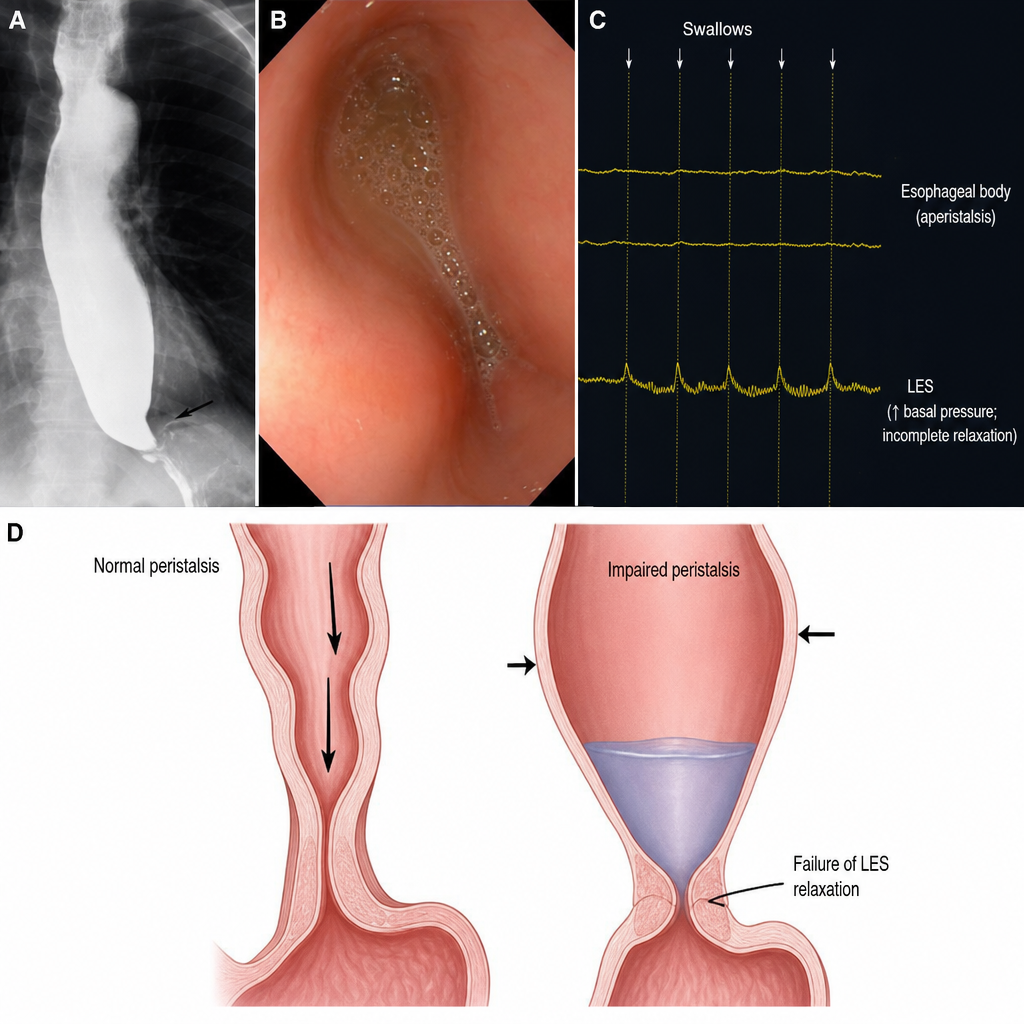
Explanation: **Explanation:** The clinical presentation of heartburn and dysphagia, combined with manometric findings of **absent peristalsis** and **decreased Lower Esophageal Sphincter (LES) tone**, is classic for **Systemic Sclerosis (Scleroderma)**. [3] In Scleroderma, the esophageal smooth muscle undergoes atrophy and fibrosis. [3] This leads to an incompetent LES (causing severe GERD/heartburn) and aperistalsis (causing dysphagia). Since the LES is "wide open" rather than obstructed, the esophagus typically does not dilate significantly, unlike in Achalasia. [1] **Thick skin (Sclerodactyly)** is the hallmark cutaneous finding of this systemic disease. [2] **Analysis of Incorrect Options:** * **A & B (Anemia & Atrophic glossitis):** These are features of **Plummer-Vinson Syndrome**, which presents with esophageal webs and iron-deficiency anemia. However, it does not cause the specific manometric pattern of low LES pressure. * **C (Hourglass stomach):** This is the classic radiological description of a **Sliding Hiatal Hernia**. While hiatal hernias cause heartburn, they do not explain the global absence of esophageal peristalsis. **NEET-PG High-Yield Pearls:** * **Manometry Contrast:** * **Achalasia:** *Increased* LES pressure + Failure to relax + Aperistalsis. [1] * **Scleroderma:** *Decreased* LES pressure + Aperistalsis. [3] * **CREST Syndrome:** Remember the pentad: **C**alcinosis, **R**aynaud’s, **E**sophageal dysmotility, **S**clerodactyly, and **T**elangiectasia. [2] * **Autoantibody:** Anti-Scl-70 (diffuse) and Anti-centromere (limited/CREST).
Explanation: Cirrhosis is the end-stage of chronic liver disease characterized by diffuse fibrosis and the conversion of normal liver architecture into structurally abnormal nodules. While **Viral Hepatitis** (specifically Hepatitis B, C, and D) is the most common infectious cause of cirrhosis globally, other systemic infections can lead to chronic hepatic inflammation and subsequent fibrosis [1]. * **Viral Hepatitis (Option A):** Chronic infection with HBV and HCV leads to persistent immune-mediated hepatocyte destruction [2]. Over decades, this chronic necroinflammation triggers stellate cell activation, leading to extensive collagen deposition and cirrhosis [1]. * **Toxoplasmosis (Option B):** While primarily known for CNS or ocular involvement, *Toxoplasma gondii* can cause granulomatous hepatitis. In immunocompromised individuals or chronic cases, persistent hepatic involvement can progress to fibrosis and cirrhosis. * **Epstein-Barr Virus (Option C):** EBV typically causes transient hepatitis during infectious mononucleosis. However, in rare instances—particularly in chronic active EBV infection (CAEBV)—it can lead to chronic liver injury, autoimmune-like hepatitis, and eventual cirrhosis [3]. **Clinical Pearls for NEET-PG:** * **Most common cause of cirrhosis in India:** Alcohol, followed closely by Hepatitis B. * **Most common cause of cirrhosis worldwide:** Hepatitis C (in developed nations) and Hepatitis B (in developing nations). * **Schistosomiasis:** A high-yield infectious cause of "pipestem fibrosis" which leads to portal hypertension, though it is technically a pre-sinusoidal fibrosis rather than true regenerative nodular cirrhosis. * **Key Histology:** The "bridging fibrosis" seen on biopsy is the precursor to established cirrhosis.
Explanation: **Explanation:** **Dysphagia** is defined as the subjective sensation of difficulty in swallowing. Clinically, it is described as the awareness of food or liquid **"sticking"** or being obstructed in its passage from the mouth to the stomach. This sensation occurs due to either mechanical obstruction (e.g., esophageal cancer, strictures) or motility disorders (e.g., Achalasia cardia). **Analysis of Options:** * **Option C (Correct):** "Sticking" is the classic descriptor used in medical literature (Harrison’s Principles of Internal Medicine) to define the patient's perception of impaired bolus transport. * **Options A, B, and D (Incorrect):** These terms (Gurgling, Gushing, Slushing) are not standard medical descriptors for dysphagia. * **Gurgling** is specifically associated with **Zenker’s Diverticulum**, where undigested food and liquids collect in a pouch in the hypopharynx, but it is a secondary sign rather than the definition of dysphagia itself. **High-Yield Clinical Pearls for NEET-PG:** 1. **Dysphagia to Solids only:** Suggests **Mechanical Obstruction** (e.g., Peptic stricture if chronic/benign, or Carcinoma if progressive and associated with weight loss). 2. **Dysphagia to Solids and Liquids (simultaneous):** Suggests a **Neuromuscular/Motility disorder** (e.g., Achalasia cardia, Diffuse Esophageal Spasm). 3. **Odynophagia:** Refers to *painful* swallowing, most commonly seen in infectious esophagitis (Candida, CMV, Herpes) or pill-induced injury. 4. **Globus Pharyngeus:** The sensation of a "lump in the throat" that is present *between* meals and is not associated with true difficulty in swallowing.
Esophageal Disorders
Practice Questions
Peptic Ulcer Disease
Practice Questions
Inflammatory Bowel Disease
Practice Questions
Irritable Bowel Syndrome
Practice Questions
Malabsorption Syndromes
Practice Questions
Pancreatitis (Acute and Chronic)
Practice Questions
Gastrointestinal Bleeding
Practice Questions
Liver Diseases and Cirrhosis
Practice Questions
Viral Hepatitis
Practice Questions
Biliary Tract Disorders
Practice Questions
Gastrointestinal Motility Disorders
Practice Questions
Gastrointestinal Malignancies
Practice Questions
Get full access to all questions, explanations, and performance tracking.
Start For Free