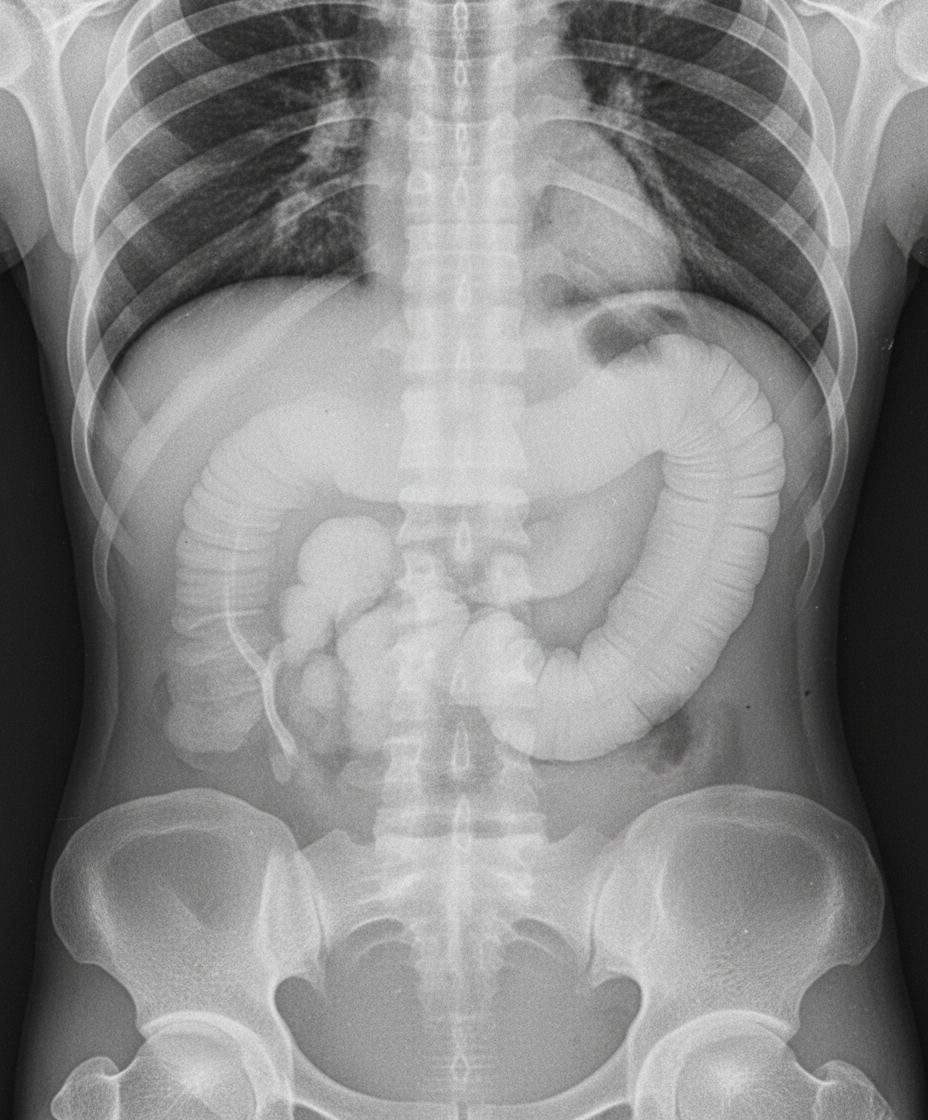
How is Celiac sprue definitively diagnosed?
A 55-year-old woman presents with a 3-year history of recurrent chest pain, unrelated to exertion. She reports a sensation of food getting stuck in her chest, occasional nocturnal cough, and regurgitation. A chest X-ray during an episode revealed a widened mediastinum. She denies other bowel problems or abdominal pain. A trial of proton pump inhibitors (PPI) provided no relief. What is the most appropriate diagnostic test to confirm the underlying condition?
All of the following conditions are associated with raised amylase level except?
Budd-Chiari syndrome is due to thrombosis of which of the following structures?
A 40-year-old male presented with watery diarrhea. Stool cytotoxin assay was positive. Colonoscopy revealed ulcers, plaques, and pseudomembranes. The patient's condition improved significantly with metronidazole. The provided CECT shows a characteristic sign. What is the name of this sign seen on CECT?

Which of the following is not a part of Budd-Chiari's triad?
Poor prognostic factors for acute pancreatitis are all, EXCEPT:
A 52-year-old woman is experiencing abdominal discomfort after meals and early in the morning. She has no weight loss or constitutional symptoms and has tried antacids with minimal relief. Upper endoscopy reveals a duodenal ulcer, and the biopsy is negative for malignancy. What is the most appropriate next step in management?
A 60-year-old male presents with progressive difficulty in swallowing, vomiting, and occasional regurgitation for the past 3 months. Barium studies showed marked dilatation of the upper esophagus with narrowing of the lower segment. Manometry showed absent esophageal peristalsis. What is a likely complication this patient would present with?
Zollinger Ellison Syndrome is diagnosed if serum gastrin level is greater than:
Explanation: **Explanation:** The definitive diagnosis of Celiac disease (Gluten-sensitive enteropathy) relies on the demonstration of clinical and histological improvement following the strict removal of gluten from the diet [1]. **1. Why the correct answer is right:** While serology (Anti-tTG, Anti-endomysial antibodies) and intestinal biopsy (showing villous atrophy, crypt hyperplasia, and increased intraepithelial lymphocytes) are essential diagnostic steps [1], the **"Gold Standard"** for confirmation is an **unequivocal clinical and histological response to a gluten-free diet (GFD)**. This confirms that gluten was indeed the causative agent of the enteropathy. **2. Why the other options are wrong:** * **A. CT scan:** Imaging is non-specific. While it may show dilated bowel loops or "moulage sign," it cannot diagnose microscopic mucosal changes or gluten sensitivity. * **C. Finding of an organism:** This would point toward **Tropical Sprue** or **Whipple’s Disease** (*Tropheryma whipplei*) [2], not Celiac sprue, which is an autoimmune-mediated response to gliadin [1]. * **D. Improvement on dapsone:** Dapsone is the treatment of choice for **Dermatitis Herpetiformis** (the skin manifestation of Celiac), but it does not treat the underlying intestinal malabsorption or define the diagnosis of the sprue itself. **NEET-PG High-Yield Pearls:** * **HLA Association:** Strongly linked to **HLA-DQ2** (95%) and **HLA-DQ8** [1]. * **Best Screening Test:** IgA Anti-tissue Transglutaminase (tTG) antibody. * **Biopsy Site:** Multiple biopsies from the **second part of the duodenum** or distal duodenum. * **Marsh Classification:** Used to grade the severity of histological changes. * **Associated Malignancy:** Increased risk of **Enteropathy-associated T-cell lymphoma (EATL)**.
Explanation: ### Explanation The clinical presentation is highly suggestive of **Achalasia Cardia**, a primary esophageal motility disorder characterized by the failure of the Lower Esophageal Sphincter (LES) to relax and the absence of peristalsis in the distal esophagus [1]. **Why the Correct Answer is Right:** * **Esophageal Motility Study (Manometry):** This is the **gold standard** and the most sensitive test to confirm the diagnosis of Achalasia [2]. It typically shows incomplete LES relaxation (residual pressure >10 mmHg) and aperistalsis in the esophageal body [1]. * The patient’s symptoms—long-standing dysphagia (food getting stuck), regurgitation, and nocturnal cough (due to aspiration of undigested food)—are classic [1]. The **widened mediastinum** on X-ray represents a dilated, food-filled esophagus. **Why Other Options are Incorrect:** * **A. Barium Swallow:** Often the initial screening test. It may show a "Bird’s beak" appearance or a dilated esophagus (sigmoid esophagus), but it is not confirmatory as it cannot definitively assess LES pressures [2]. * **B. CT Scan:** Useful for ruling out malignancy (pseudoachalasia) in older patients with rapid weight loss, but it cannot diagnose a functional motility disorder. * **C. Endoscopy:** Essential to rule out mechanical obstruction or "Pseudoachalasia" (gastric cardia cancer mimicking achalasia), but it is often normal in early stages of the disease and cannot confirm the diagnosis [2]. **High-Yield Clinical Pearls for NEET-PG:** * **Pathophysiology:** Loss of inhibitory nitrergic neurons in the **Auerbach’s (myenteric) plexus** [1]. * **Triad of Achalasia:** 1. Incomplete LES relaxation, 2. Increased LES tone, 3. Aperistalsis [1]. * **Chagas Disease:** Caused by *Trypanosoma cruzi*, it is a common secondary cause of achalasia-like symptoms globally. * **Treatment of Choice:** Laparoscopic Heller’s Myotomy (with partial fundoplication) or Peroral Endoscopic Myotomy (POEM). Medical management (Nitrates/CCBs) is generally ineffective.
Explanation: **Explanation:** Serum amylase is a digestive enzyme primarily produced by the pancreas and salivary glands [1]. While it is the classic biomarker for acute pancreatitis, its elevation is not pathognomonic, as it can be raised in various intra-abdominal and extra-abdominal conditions [2]. **Why Acute Appendicitis is the Correct Answer:** In **Acute Appendicitis**, serum amylase levels typically remain **normal** [3]. The inflammation is localized to the appendix, which does not produce amylase, and there is usually no significant leakage of peritoneal fluid into the upper gastrointestinal compartments that would trigger a systemic rise in amylase. **Analysis of Incorrect Options:** * **Acute Pancreatitis:** This is the most common cause of significantly raised amylase (usually >3 times the upper limit of normal) due to acinar cell injury and enzyme leakage [2]. * **Perforated Ulcer:** In perforated peptic ulcers, amylase levels rise because the enzyme leaks from the duodenum/stomach into the peritoneal cavity and is subsequently absorbed into the bloodstream [2]. * **Carcinoma Pancreas:** While not always elevated, pancreatic tumors can cause ductal obstruction, leading to "back-pressure" and a mild to moderate rise in serum amylase. **NEET-PG High-Yield Pearls:** * **Amylase vs. Lipase:** Lipase is more specific and remains elevated longer (7–14 days) than amylase (3–5 days) in acute pancreatitis. * **Macroamylasemia:** A benign condition where amylase binds to immunoglobulins, causing high serum amylase but **normal urinary amylase** (due to the large size of the complex). * **Other causes of raised amylase:** Mumps (parotitis), Ectopic pregnancy (fallopian tubes produce amylase), Intestinal obstruction, and Diabetic Ketoacidosis (DKA) [2].
Explanation: **Explanation:** **Budd-Chiari Syndrome (BCS)** is a clinical condition characterized by the obstruction of hepatic venous outflow. This obstruction can occur at any level from the **small hepatic veins** to the junction of the **inferior vena cava (IVC)** and the right atrium [1]. 1. **Why Option D is Correct:** The primary pathology in BCS is the thrombosis or occlusion of the **hepatic veins** [2]. This leads to increased sinusoidal pressure, resulting in the classic triad of **abdominal pain, ascites, and hepatomegaly**. In the Indian subcontinent, a common variant involves membranous obstruction of the suprahepatic IVC. 2. **Why Other Options are Incorrect:** * **Option A:** Obstruction of the infrarenal IVC typically presents with bilateral lower limb edema and prominent veins on the back/flanks, but does not cause the hepatic congestion seen in BCS. * **Option B:** Renal artery involvement leads to renovascular hypertension or renal failure, not hepatic outflow obstruction. * **Option C:** Superior mesenteric vein thrombosis leads to mesenteric ischemia and bowel infarction, presenting as acute "pain out of proportion to physical findings." **High-Yield Clinical Pearls for NEET-PG:** * **Most Common Cause:** Polycythemia Vera (myeloproliferative neoplasms). * **Imaging Gold Standard:** Digital Subtraction Angiography (DSA). * **Doppler Ultrasound:** Often the initial investigation of choice. * **Caudate Lob Hypertrophy:** A characteristic finding on CT/MRI because the caudate lobe has independent venous drainage directly into the IVC, sparing it from hepatic vein thrombosis. * **Biopsy Finding:** Centrilobular congestion and necrosis (Nutmeg liver).
Explanation: ***Accordion sign*** - The **accordion sign** on CECT represents **oral contrast trapped between thickened, edematous haustra** in **pseudomembranous colitis**, creating alternating bands of high and low attenuation resembling an accordion. - This sign is **pathognomonic for C. difficile colitis** and correlates with severe mucosal inflammation and **pseudomembrane formation** seen on colonoscopy. *Central stellate scar* - This is a characteristic finding of **focal nodular hyperplasia (FNH)** of the liver, showing a **central fibrous scar** with radiating septa. - It has no association with **colonic pathology** or **C. difficile infection**. *Whorl sign* - The **whorl sign** is seen in **intestinal volvulus**, particularly **sigmoid volvulus**, showing a **twisted bowel loop** with a characteristic spiral appearance. - It indicates **mechanical bowel obstruction**, not infectious colitis with **pseudomembrane formation**. *Honeycombing* - **Honeycombing** is a **pulmonary imaging finding** seen in **end-stage pulmonary fibrosis**, showing clustered cystic spaces in subpleural regions. - It is completely unrelated to **gastrointestinal pathology** and **C. difficile colitis**.
Explanation: **Explanation:** **Budd-Chiari Syndrome (BCS)** is a clinical condition caused by the obstruction of hepatic venous outflow, anywhere from the small hepatic veins to the junction of the inferior vena cava (IVC) and the right atrium. [1] The **classic clinical triad** of Budd-Chiari Syndrome consists of: 1. **Abdominal Pain:** Usually sudden in onset and located in the right upper quadrant. 2. **Hepatomegaly:** Congestion of the liver due to outflow obstruction leads to a painful, enlarged liver. 3. **Ascites:** Increased sinusoidal pressure results in the rapid accumulation of fluid in the peritoneal cavity. **Why "Varices" is the correct answer:** While esophageal varices are a common complication of chronic Budd-Chiari Syndrome due to the development of portal hypertension, they are **not** part of the diagnostic triad. The triad focuses on the acute/subacute presentation of hepatic venous congestion rather than the long-term sequelae of collateral circulation. [1] **Analysis of Incorrect Options:** * **Hepatomegaly & Pain:** These are primary results of acute hepatic congestion and stretching of Glisson’s capsule. * **Ascites:** This is the most common clinical sign (present in >90% of cases) and is typically high in protein content (exudative). **High-Yield Clinical Pearls for NEET-PG:** * **Most common cause:** In the West, it is hypercoagulable states (e.g., Polycythemia Vera); in Asia, it is often membranous webs of the IVC. * **Imaging of choice:** Doppler Ultrasound (shows "reverse flow" or absence of flow). * **Gold Standard:** Venography. * **Biopsy:** Shows "Nutmeg liver" (centrilobular congestion and necrosis). * **Caudate Lobe:** Often undergoes compensatory hypertrophy because its venous drainage enters the IVC directly, bypassing the main hepatic veins.
Explanation: **Explanation:** In acute pancreatitis, the **severity of the disease does not correlate with the magnitude of serum amylase or lipase elevation.** While hyperamylasemia is a diagnostic hallmark, it has no prognostic value. A patient with mild interstitial pancreatitis may have amylase levels >3000 U/L, while a patient with severe necrotizing pancreatitis may have near-normal levels due to extensive pancreatic destruction or hypertriglyceridemia. **Analysis of Options:** * **Hyperamylasemia (Correct Answer):** As stated, it is useful for diagnosis (if >3x upper limit) but does not predict complications or mortality. * **Hyperglycemia:** Included in the **Ranson Criteria** (>200 mg/dL) and **APACHE II** scores. It reflects endocrine pancreatic dysfunction and systemic stress. * **Hypocalcemia:** A sign of severe disease (Ranson’s: <8 mg/dL). It occurs due to "saponification," where calcium deposits in areas of fat necrosis, indicating extensive local damage. * **Raised LDH:** An indicator of tissue breakdown and systemic inflammation (Ranson’s: >350 IU/L). **Clinical Pearls for NEET-PG:** 1. **Ranson Criteria:** Assessed at admission and 48 hours. Remember the mnemonic **GAWBE** (Glucose, Age, WBC, AST, LDH) for admission. 2. **BISAP Score:** (BUN, Impaired mental status, SIRS, Age >60, Pleural effusion) is a rapid bedside tool. 3. **Most Accurate Marker:** Contrast-Enhanced CT (CECT) is the gold standard for assessing necrosis (best done after 72 hours). 4. **Early Prognosis:** Rising **Hematocrit** (indicating hemoconcentration) and **BUN** are the most reliable early indicators of poor prognosis.
Explanation: The patient presents with a classic duodenal ulcer (DU). In the context of Peptic Ulcer Disease (PUD), the most critical management principle is addressing the underlying etiology [1]. **1. Why Option D is Correct:** Over 90% of duodenal ulcers are associated with *Helicobacter pylori* infection [1]. Current guidelines dictate that if a duodenal ulcer is diagnosed, the patient should be treated for *H. pylori* eradication, even if specific testing (like RUT or histology) isn't explicitly mentioned, as the association is near-universal. The standard of care is **Triple Therapy**, which combines a Proton Pump Inhibitor (PPI) like **Omeprazole** (to promote mucosal healing and symptom relief) with **Antibiotics** (typically Clarithromycin and Amoxicillin/Metronidazole) to eradicate the bacteria and prevent ulcer recurrence [1]. **2. Why Other Options are Incorrect:** * **Option A & B:** While PPIs (Omeprazole) or H2 blockers (Ranitidine) provide symptomatic relief and heal the current ulcer, they do not address the *H. pylori* infection. Without antibiotics, the recurrence rate of duodenal ulcers is over 70-80% within a year [1]. * **Option C:** Antibiotics alone are insufficient because they do not provide the rapid acid suppression required for immediate pain relief and optimal mucosal healing. **High-Yield Clinical Pearls for NEET-PG:** * **DU vs. GU:** Duodenal ulcers are almost always benign (biopsy for malignancy is usually not required, unlike Gastric Ulcers) [2]. * **Pain Pattern:** DU pain typically occurs 2-3 hours after meals or at night (nocturnal pain) and is often **relieved by food**. * **Investigation of Choice:** Upper GI Endoscopy (UGIE). * **Eradication Confirmation:** Always check for successful eradication at least 4 weeks after completing therapy using a Urea Breath Test or Stool Antigen Test [1].
Explanation: ### **Explanation** **Diagnosis: Achalasia Cardia** The clinical presentation of progressive dysphagia, regurgitation, and vomiting, combined with the classic "Bird’s Beak" appearance on barium swallow (dilated upper esophagus with distal narrowing) and the gold-standard manometry finding of **aperistalsis**, confirms a diagnosis of **Achalasia Cardia** [1]. **Why Option A is Correct:** In Achalasia, the failure of the Lower Esophageal Sphincter (LES) to relax leads to the stasis of undigested food and saliva in the dilated esophagus [1]. This stagnant material often refluxes into the pharynx, especially when the patient is recumbent (nocturnal regurgitation). This leads to **micro-aspiration** or gross aspiration into the tracheobronchial tree, resulting in **recurrent chest infections**, aspiration pneumonia, lung abscesses, or bronchiectasis [1]. **Why Other Options are Incorrect:** * **Option B:** While stasis can cause stasis esophagitis, it rarely leads to significant upper GI bleeding. Massive bleeding is more characteristic of esophageal varices or Mallory-Weiss tears. * **Option C:** Colicky abdominal pain is a feature of intestinal obstruction. Achalasia is a functional obstruction of the esophagus, which typically presents with retrosternal "chest pain" or pressure, not abdominal colic. * **Option D:** Esophageal perforation is a rare spontaneous event (Boerhaave syndrome) or an iatrogenic complication of treatment (e.g., pneumatic dilation) [1], but it is not a common natural progression of the disease compared to aspiration. ### **High-Yield Clinical Pearls for NEET-PG** * **Gold Standard Investigation:** Esophageal Manometry (shows aperistalsis and incomplete LES relaxation) [1]. * **Barium Swallow Finding:** "Bird’s Beak" or "Rat-tail" appearance [1]. * **Chagas Disease:** Caused by *Trypanosoma cruzi*, it is a secondary cause of achalasia (destruction of the myenteric plexus). * **Long-term Complication:** Squamous Cell Carcinoma of the esophagus (due to chronic irritation from food stasis). * **Treatment of Choice:** Laparoscopic Heller’s Myotomy (often with a partial fundoplication) [1].
Explanation: **Explanation:** Zollinger-Ellison Syndrome (ZES) is caused by a gastrin-secreting tumor (gastrinoma), typically located in the "gastrinoma triangle." The hallmark of ZES is hypergastrinemia leading to excessive gastric acid secretion and refractory peptic ulcers [1]. **Why 1000 pg/ml is the correct answer:** The diagnosis of ZES is highly likely when the fasting serum gastrin (FSG) level is **>1000 pg/ml** (10 times the upper limit of normal) in the presence of a gastric pH < 2.0. This level is considered diagnostic and usually bypasses the need for further provocative testing like the Secretin Stimulation Test. **Analysis of Incorrect Options:** * **A (100 pg/ml):** This is within the normal range for fasting serum gastrin (typically <100-150 pg/ml). * **B (500 pg/ml):** While elevated, levels between 200–1000 pg/ml are non-specific. They can be seen in ZES but also in conditions like atrophic gastritis, Pernicious anemia, or chronic Proton Pump Inhibitor (PPI) use [1]. In this range, a Secretin Stimulation Test is required for confirmation. * **D (5000 pg/ml):** While this level certainly confirms ZES, it is far beyond the minimum threshold required for diagnosis. **High-Yield Clinical Pearls for NEET-PG:** * **Most common location:** The Gastrinoma Triangle (Passaro’s Triangle). * **Association:** 25% of cases are associated with **MEN-1 syndrome** (3Ps: Parathyroid, Pancreas, Pituitary). * **Confirmatory Test:** If gastrin is elevated but <1000 pg/ml, the **Secretin Stimulation Test** is the most sensitive test (ZES shows an increase in gastrin >200 pg/ml). * **Localization:** Somatostatin Receptor Scintigraphy (SRS) or 68Ga-DOTATATE PET/CT are the preferred imaging modalities.
Esophageal Disorders
Practice Questions
Peptic Ulcer Disease
Practice Questions
Inflammatory Bowel Disease
Practice Questions
Irritable Bowel Syndrome
Practice Questions
Malabsorption Syndromes
Practice Questions
Pancreatitis (Acute and Chronic)
Practice Questions
Gastrointestinal Bleeding
Practice Questions
Liver Diseases and Cirrhosis
Practice Questions
Viral Hepatitis
Practice Questions
Biliary Tract Disorders
Practice Questions
Gastrointestinal Motility Disorders
Practice Questions
Gastrointestinal Malignancies
Practice Questions
Get full access to all questions, explanations, and performance tracking.
Start For Free