Which of the following conditions does NOT cause protein-losing enteropathy?
A 30-year-old man presents with a 3-week history of fatigue, occasional fever, yellow skin and sclerae, tenderness below the right costal margin, and dark urine. Physical examination reveals jaundice and mild hepatomegaly. Laboratory studies show elevated serum levels of bilirubin, decreased albumin, and prolonged prothrombin time. Serologic tests disclose antibodies to hepatitis C virus. Which of the following tests is the most accurate method for assessing the extent of liver disease in this patient?
What is the best test for intestinal malabsorption?
Which is the test of choice for assessment of mucosal function of the GIT?
Which of the following is FALSE regarding Primary Sclerosing Cholangitis (PSC)?
Which of the following is a precancerous condition of the stomach?
What is the first-line treatment for Wilson disease with neurologic or psychiatric manifestations?
Which of the following statements is FALSE about Blind loop syndrome?
The Rockall scoring system is used for the assessment of which condition?
Stigmata of chronic liver disease include all of the following, except?
Explanation: **Explanation:** **Protein-losing enteropathy (PLE)** is a clinical syndrome characterized by the excessive loss of serum proteins into the gastrointestinal tract, leading to hypoproteinemia and edema [1]. For PLE to occur, there must be a structural or functional disruption of the intestinal mucosa or lymphatic drainage [1]. **Why Irritable Bowel Syndrome (IBS) is the correct answer:** IBS is a **functional gastrointestinal disorder**. By definition, it lacks any structural, inflammatory, or biochemical abnormalities. Since the intestinal mucosa remains intact and there is no lymphatic obstruction, there is no mechanism for protein leakage. Therefore, IBS does not cause PLE. **Analysis of Incorrect Options:** * **Ulcerative Colitis:** This is an inflammatory bowel disease (IBD) characterized by mucosal ulceration and exudation. Severe inflammation leads to the leakage of plasma proteins across the denuded mucosa [1]. * **Celiac Disease:** This is a malabsorptive disorder where gluten-induced immune damage causes villous atrophy and mucosal inflammation, leading to increased permeability and protein loss [1]. * **Lymphoma:** Intestinal lymphoma can cause PLE through two mechanisms: direct mucosal ulceration and, more commonly, **lymphatic obstruction** (secondary lymphangiectasia), which forces lymph fluid into the bowel lumen [1]. **High-Yield Clinical Pearls for NEET-PG:** * **Gold Standard Diagnosis:** The most reliable test for PLE is the **24-hour fecal alpha-1 antitrypsin clearance**. (Alpha-1 antitrypsin is resistant to degradation by digestive enzymes). * **Primary Cause:** Primary intestinal lymphangiectasia is also known as **Waldmann’s disease**. * **Cardiac Cause:** Constrictive pericarditis is a classic "extra-intestinal" cause of PLE due to increased central venous pressure hindering lymphatic drainage [1]. * **Clinical Sign:** Patients typically present with **pitting edema** (due to low oncotic pressure) and may have lymphocytopenia [1].
Explanation: The patient presents with clinical and biochemical evidence of chronic liver disease (jaundice, hepatomegaly, hypoalbuminemia, and coagulopathy) secondary to **Hepatitis C Virus (HCV)** infection [4]. **Why Liver Biopsy is the Correct Answer:** While serology and PCR confirm the diagnosis of HCV, a **liver biopsy** remains the "gold standard" for assessing the **extent** of liver disease [1]. It provides two critical pieces of information: 1. **Grade:** Reflects the degree of active inflammation and hepatocellular necrosis. 2. **Stage:** Reflects the degree of fibrosis and the presence of cirrhosis (using systems like METAVIR or Ishak). Staging is crucial for determining prognosis and the urgency of treatment, as it identifies patients at high risk for hepatocellular carcinoma (HCC) and portal hypertension. **Why Other Options are Incorrect:** * **B. Serum Alkaline Phosphatase:** This is a marker of cholestasis or biliary obstruction. While it may be elevated in liver disease, it does not correlate with the degree of fibrosis or inflammation. * **C. Serum Ammonia:** This is used to evaluate hepatic encephalopathy but does not reflect the structural extent or stage of chronic liver disease. * **D. Serum Immunoglobulins:** Polyclonal gammopathy (elevated IgG) is common in chronic liver disease and autoimmune hepatitis, but it is non-specific and cannot stage the disease [2]. **NEET-PG High-Yield Pearls:** * **METAVIR Score for HCV:** F0 (no fibrosis) to F4 (cirrhosis). * **Non-invasive alternatives:** In modern practice, **Transient Elastography (FibroScan)** is increasingly used to assess fibrosis, but biopsy remains the most accurate reference standard. * **Prothrombin Time (PT):** This is the best prognostic marker among liver function tests because it reflects the liver's synthetic function and has a short half-life (Factor VII) [3].
Explanation: **Explanation:** The **D-xylose test** is considered the best initial screening test to differentiate between malabsorption caused by mucosal disease (e.g., Celiac disease, Tropical sprue) and malabsorption due to pancreatic insufficiency. D-xylose is a monosaccharide that is absorbed passively in the proximal small intestine without requiring pancreatic enzymes. Therefore, low urinary or blood levels of D-xylose indicate **intestinal mucosal damage**, whereas normal levels in a patient with malabsorption suggest pancreatic etiology. **Analysis of Incorrect Options:** * **B. NBT-PABA test:** This is a test for **pancreatic exocrine function**. It measures the ability of pancreatic chymotrypsin to cleave PABA from a synthetic peptide; it does not assess intestinal mucosal absorption. * **C. Fecal fat estimation (72-hour):** While this is the **gold standard for diagnosing steatorrhea** (confirming that malabsorption is present), it cannot differentiate the *cause* (mucosal vs. pancreatic) [2]. The question asks for the best test to evaluate the "intestinal" component specifically. * **D. Schilling test:** This was historically used to determine the cause of **Vitamin B12 malabsorption** (e.g., Pernicious anemia vs. bacterial overgrowth), but it does not assess general intestinal carbohydrate or protein absorption. **NEET-PG High-Yield Pearls:** * **Gold Standard for Steatorrhea:** 72-hour fecal fat estimation (>7g/day is abnormal). * **D-xylose False Positives:** Low levels can occur in SIBO (bacteria metabolize the sugar), renal failure (delayed excretion), and delayed gastric emptying. * **Most Sensitive Screening Test for Celiac:** Anti-tissue Transglutaminase (tTG) IgA [1]. * **Best Initial Test for Chronic Pancreatitis:** Fecal Elastase (highly specific).
Explanation: **Explanation:** The **D-xylose test** is the gold standard for assessing the **functional integrity of the proximal small intestinal mucosa**. D-xylose is a pentose sugar that is absorbed via passive diffusion in the proximal small bowel without requiring pancreatic enzymes. If the intestinal mucosa is damaged (e.g., in Celiac disease or Tropical sprue), absorption decreases, leading to low levels in the blood and urine. It is primarily used to differentiate **malabsorption** (mucosal disease) from **maldigestion** (pancreatic insufficiency). **Analysis of Incorrect Options:** * **A. Biopsy:** While a biopsy is the "gold standard" for providing a **histological diagnosis** (e.g., identifying villous atrophy), it assesses structure rather than overall mucosal function [1]. * **B. Schilling test:** This test specifically assesses **Vitamin B12 absorption**. It helps localize the cause of B12 deficiency (e.g., Pernicious anemia, ileal disease, or bacterial overgrowth) rather than general mucosal function. * **C. Small bowel study:** Imaging (like Barium follow-through) evaluates the **anatomy and transit time** of the GIT but cannot quantify the absorptive capacity of the mucosa. **NEET-PG High-Yield Pearls:** * **Normal Values:** After a 25g oral dose, a 5-hour urinary excretion of **>4.5g** is considered normal. * **False Positives:** Low urinary D-xylose can occur in **renal failure**, ascites, or **Small Intestinal Bacterial Overgrowth (SIBO)** (bacteria metabolize the sugar before absorption). * **Clinical Use:** It is the best initial test to distinguish between chronic pancreatitis (normal D-xylose) and Celiac disease (abnormal D-xylose).
Explanation: **Explanation:** **1. Why Option A is False (The Correct Answer):** The association between Primary Sclerosing Cholangitis (PSC) and Ulcerative Colitis (UC) is strong, but the percentages are often confused. While **70–80% of patients with PSC have underlying UC**, only about **3–5% of patients with UC actually develop PSC**. Therefore, stating that PSC is associated with UC in 30% of cases is statistically incorrect and significantly underestimates the correlation from the PSC perspective [1]. **2. Analysis of Other Options:** * **Option B:** Despite the presence of biliary strictures, **bacterial cholangitis is relatively uncommon** in PSC unless there has been prior surgical or endoscopic intervention (like ERCP) [1]. * **Option C:** Patients with both PSC and UC have a significantly **higher risk of colorectal neoplasia** compared to those with UC alone. This necessitates annual screening colonoscopies from the time of PSC diagnosis. * **Option D:** PSC typically involves diffuse, "beaded" narrowing of both intrahepatic and extrahepatic ducts. However, the **hepatic duct bifurcation (the confluence)** is classically the site of the most severe involvement and maximal narrowing. **Clinical Pearls for NEET-PG:** * **Gold Standard Diagnosis:** MRCP (shows "beads-on-a-string" appearance). * **Antibody:** p-ANCA is positive in 60–80% of cases (but not specific) [1]. * **Major Complication:** Cholangiocarcinoma (10–15% lifetime risk). * **Liver Biopsy:** Shows characteristic "onion-skin" fibrosis (periductal fibrosis). * **Treatment:** Liver transplantation is the only definitive cure; UDCA is used but does not improve survival.
Explanation: **Explanation:** The development of gastric adenocarcinoma (intestinal type) follows a well-defined multi-step progression known as **Correa’s Cascade**. This sequence begins with chronic inflammation, leading to **Atrophic Gastritis**, followed by intestinal metaplasia, dysplasia, and finally, carcinoma. **1. Why Atrophic Gastritis is correct:** Atrophic gastritis involves the chronic inflammation and subsequent loss of gastric glandular cells, often replaced by intestinal-type epithelium (metaplasia) [1]. This environment, frequently caused by chronic *H. pylori* infection or autoimmune processes, promotes DNA damage and cellular transformation, making it a definitive precancerous condition [1], [2]. **2. Why the other options are incorrect:** * **Lipoma:** This is a benign mesenchymal tumor composed of mature adipose tissue. It has no malignant potential and is usually an incidental finding. * **Linitis Plastica:** This is not a precancerous condition; rather, it is a **manifestation of advanced gastric cancer** (diffuse type). It is characterized by a "leather bottle" appearance of the stomach due to extensive submucosal infiltration by signet ring cells. * **Hyperacidity:** While associated with peptic ulcer disease (specifically duodenal ulcers), hyperacidity is not a precursor to malignancy [3]. In fact, gastric cancer is more commonly associated with *hypochlorhydria* (low acid) resulting from mucosal atrophy [1]. **NEET-PG High-Yield Pearls:** * **Correa’s Cascade:** Normal Mucosa → Chronic Gastritis → Atrophic Gastritis → Intestinal Metaplasia → Dysplasia → Adenocarcinoma. * **Most common site** for atrophic gastritis: Antrum (H. pylori); Body/Fundus (Autoimmune) [2]. * **Other Precancerous Conditions:** Adenomatous gastric polyps (not hyperplastic), Gastric ulcers (rarely), and Menetrier’s disease. * **H. pylori** is classified as a Class 1 Carcinogen by the WHO [1].
Explanation: The management of Wilson disease depends on the clinical presentation. While d-Penicillamine was historically the standard, current guidelines and clinical evidence emphasize avoiding it in patients with **neurologic or psychiatric manifestations** [1]. **Why Tetrathiomolybdate and Zinc is correct:** In patients with neurologic symptoms, chelators like d-Penicillamine can cause a "paradoxical worsening" of symptoms in up to 50% of cases due to the rapid mobilization of copper from the liver into the brain. **Tetrathiomolybdate** is the preferred agent because it forms a stable complex with copper and albumin in the blood and prevents intestinal absorption. It acts more slowly and safely, significantly reducing the risk of neurological deterioration. **Zinc** is added to block intestinal copper absorption by inducing metallothionein. **Analysis of Incorrect Options:** * **A. Trientine and Zinc:** Trientine is an alternative chelator used primarily in patients intolerant to d-Penicillamine. While it has a lower risk of neurological worsening than Penicillamine, it is not the first-line choice over Tetrathiomolybdate for primary neuro-psychiatric presentations. * **B. Zinc alone:** Zinc is excellent for maintenance therapy or asymptomatic patients, but it is too slow-acting for initial treatment of symptomatic Wilson disease. * **D. d-Penicillamine alone:** This is the first-line treatment for **asymptomatic or hepatic** presentations. However, it is contraindicated as a first-line agent in neurologic Wilson disease due to the high risk of irreversible clinical worsening. **NEET-PG High-Yield Pearls:** * **Kayser-Fleischer (KF) rings:** Present in 95-100% of patients with neurologic Wilson disease [1]. * **Diagnosis:** Low serum Ceruloplasmin (<20 mg/dL) and high 24-hour urinary copper excretion (>100 μg). * **Gold Standard Diagnosis:** Liver biopsy (Copper >250 μg/g dry weight). * **Imaging:** "Face of the Giant Panda" sign on MRI brain (midbrain involvement).
Explanation: **Blind Loop Syndrome**, also known as **Small Intestinal Bacterial Overgrowth (SIBO)**, occurs when stasis of intestinal contents allows excessive bacteria to colonize the small bowel [1]. **Why Option D is the Correct (False) Statement:** While broad-spectrum antibiotics (e.g., Rifaximin, Metronidazole) are the mainstay for treating the bacterial overgrowth itself, they are **not sufficient** if the underlying cause is an **anatomic stasis** (e.g., strictures, diverticula, or surgical blind loops). In such cases, surgical correction of the anatomical defect is necessary to prevent recurrence [1]. Antibiotics provide only temporary relief if the structural "stagnant pool" remains. **Analysis of Other Options:** * **Option A:** True. SIBO and Blind Loop Syndrome are often used interchangeably in clinical practice to describe the pathophysiology of bacterial proliferation due to stasis [1]. * **Option B:** True. Bacteria (especially anaerobes) compete with the host for **Vitamin B12 (Cobalamin)**, leading to its consumption and subsequent macrocytic (megaloblastic) anemia [1]. * **Option C:** True. Bacteria deconjugate bile salts [2]. Deconjugated bile salts cannot form micelles, leading to fat malabsorption (steatorrhea) and deficiency of fat-soluble vitamins (A, D, E, K). **NEET-PG High-Yield Pearls:** * **Gold Standard Diagnosis:** Jejunal aspirate culture showing **>10⁵ CFU/mL** (though non-invasive **C14-Xylose** or **Hydrogen breath tests** are more common). * **B12 vs. Folate:** In SIBO, **Vitamin B12 is decreased** (consumed by bacteria), but **Folate levels are often increased** (synthesized by bacteria). * **Common Causes:** Diabetes (motility), Scleroderma, and Billroth II surgery (anatomic) [1].
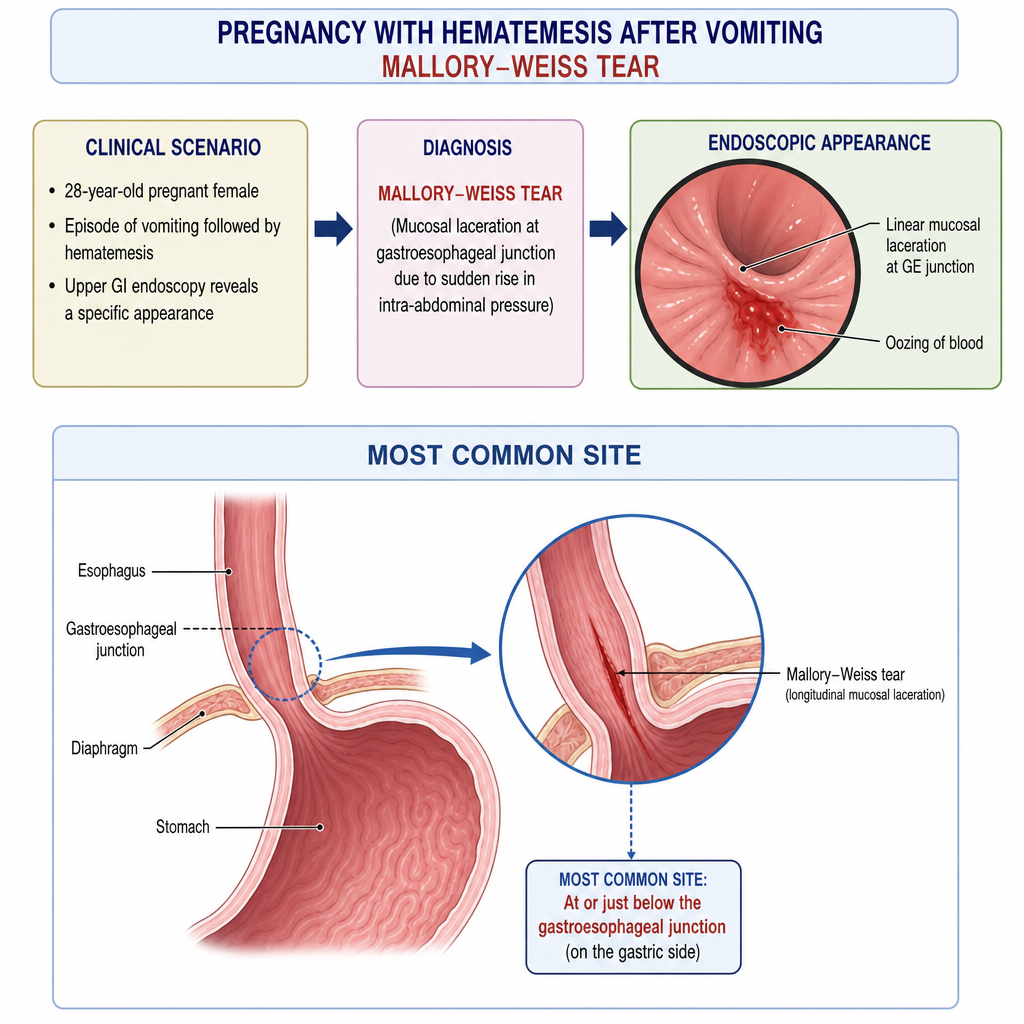
Explanation: The **Rockall Scoring System** is a clinical tool used to predict the risk of re-bleeding and mortality in patients presenting with **Non-Variceal Upper Gastrointestinal Bleeding (NVUGIB)**, such as peptic ulcer disease or Mallory-Weiss tears [1]. #### 1. Why the Correct Answer is Right The Rockall score is unique because it combines **clinical parameters** (age, shock status, comorbidities) with **endoscopic findings** (diagnosis and stigmata of recent hemorrhage, like an adherent clot or visible vessel) [1]. * **Pre-endoscopy score:** Based only on clinical data (max score 7). * **Full Rockall score:** Calculated after endoscopy (max score 11). A score of $\leq 2$ indicates a low risk of re-bleeding and mortality, often allowing for early discharge. #### 2. Why the Incorrect Options are Wrong * **Variceal Bleeding (Options B & C):** While Rockall can be applied to any UGIB, it is specifically validated and primarily used for non-variceal causes [1]. For variceal bleeding (secondary to portal hypertension), the **Child-Pugh Score** or **MELD Score** are more appropriate for prognosis, as they assess underlying liver function. #### 3. Clinical Pearls for NEET-PG * **Glasgow-Blatchford Score (GBS):** Unlike Rockall, GBS is used **strictly pre-endoscopy** to identify "low-risk" patients who do not require hospital admission [1]. It relies on urea, hemoglobin, systolic BP, and clinical markers (syncope/melena). * **Forrest Classification:** Used during endoscopy to grade the risk of re-bleeding in peptic ulcers (e.g., Ia is spurting hemorrhage). * **High-Yield Fact:** If a question asks for the score that predicts the need for **intervention** (transfusion/surgery), the answer is usually **Glasgow-Blatchford**. If it asks for **mortality risk** post-endoscopy, it is **Rockall**.
Explanation: **Explanation:** The "stigmata of chronic liver disease" (CLD) refer to physical signs that suggest long-standing liver dysfunction or portal hypertension. **Why Subcutaneous Nodules is the Correct Answer:** Subcutaneous nodules are not a feature of chronic liver disease. They are typically associated with conditions like **Rheumatoid Arthritis** (rheumatoid nodules), **Acute Rheumatic Fever** (Aschoff bodies), or **Sarcoidosis**. In the context of the GI system, subcutaneous nodules (specifically Erythema Nodosum) are associated with Inflammatory Bowel Disease (IBD), not cirrhosis. **Analysis of Incorrect Options:** * **Palmar Erythema:** This is a classic sign of CLD characterized by redness of the thenar and hypothenar eminences. It is caused by **hyperdynamic circulation** and increased levels of circulating **estrogen** due to decreased hepatic metabolism. * **Spider Nevi (Spider Angiomata):** These are central arterioles with radiating capillaries found in the territory of the superior vena cava (face, neck, upper chest). Like palmar erythema, they are attributed to **hyperestrogenism**. Finding more than five spider nevi is highly suggestive of CLD. * **Testicular Atrophy:** In males with cirrhosis (especially alcoholic cirrhosis), the liver's inability to metabolize estrogen and androstenedione leads to a hormonal imbalance. This results in **hypogonadism**, leading to testicular atrophy, loss of libido, and gynecomastia. **NEET-PG High-Yield Pearls:** * **Most Specific Sign:** Palpable left lobe of the liver or a shrunken, nodular liver. * **Estrogen-related signs:** Spider nevi, palmar erythema, gynecomastia, and loss of axillary/pubic hair. * **Portal Hypertension signs:** Caput medusae, splenomegaly, and ascites. * **Nail Changes:** **Terry’s nails** (proximal 2/3rd white, distal 1/3rd red) and **Muehrcke’s lines** (leukonychia due to hypoalbuminemia). * **Dupuytren’s Contracture:** Often seen in alcoholic cirrhosis due to palmar fascia thickening.
Esophageal Disorders
Practice Questions
Peptic Ulcer Disease
Practice Questions
Inflammatory Bowel Disease
Practice Questions
Irritable Bowel Syndrome
Practice Questions
Malabsorption Syndromes
Practice Questions
Pancreatitis (Acute and Chronic)
Practice Questions
Gastrointestinal Bleeding
Practice Questions
Liver Diseases and Cirrhosis
Practice Questions
Viral Hepatitis
Practice Questions
Biliary Tract Disorders
Practice Questions
Gastrointestinal Motility Disorders
Practice Questions
Gastrointestinal Malignancies
Practice Questions
Get full access to all questions, explanations, and performance tracking.
Start For Free