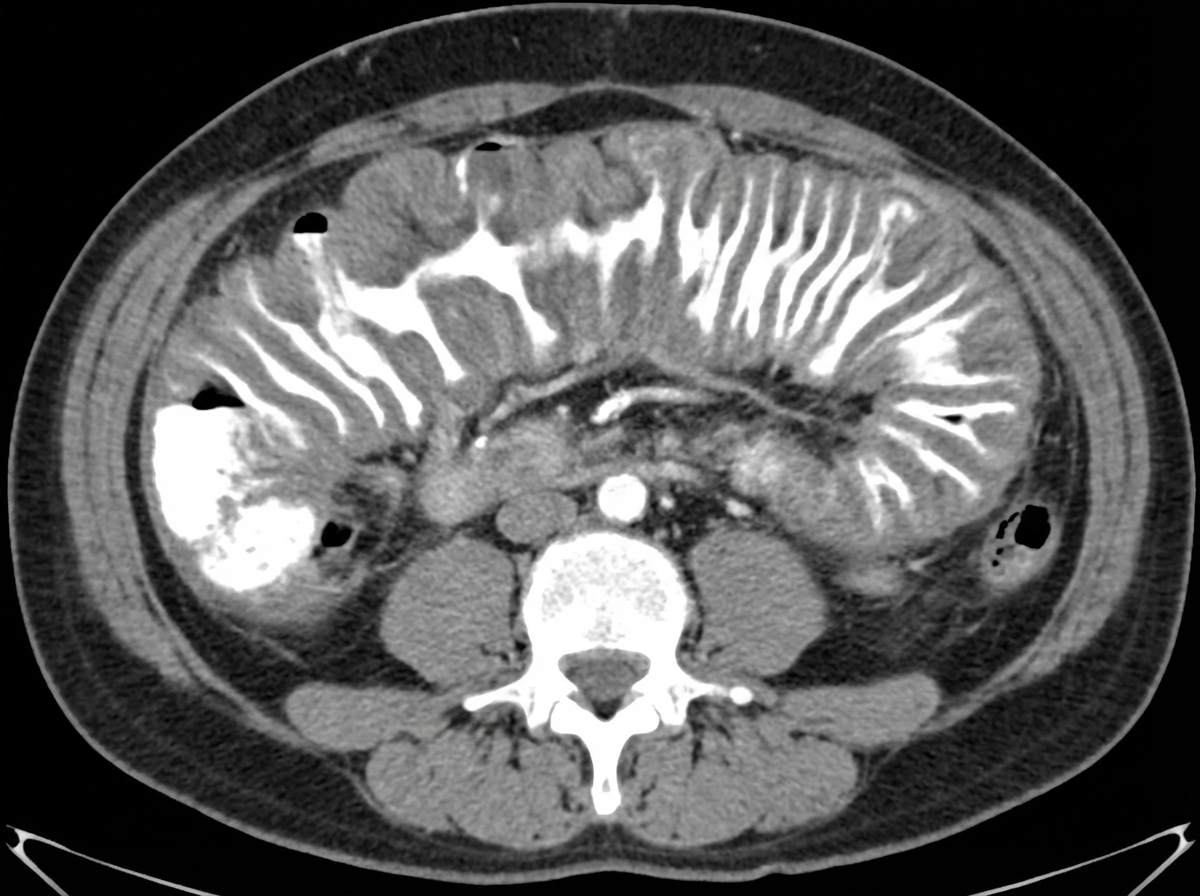
A 35-year-old man complains of weight loss, loss of appetite, abdominal pain, and diffuse thickening of the ileocecal region. What is the most likely diagnosis?
What is the most common antibody found in autoimmune hepatitis?
Which is the most sensitive and specific antibody for Celiac sprue?
A 30-year-old male presents with jaundice. Blood examination shows total serum bilirubin 21 mg%, direct bilirubin 9.6 mg%, and alkaline phosphatase 84 KA units. What is the most likely diagnosis?
Anti-endomysial antibody is used in the diagnosis of which condition?
Which drug is used in the management of hepatic encephalopathy?
Which of the following are characteristic features of hepatorenal syndrome?
Which of the following statements regarding peptic ulcer disease is false?
Spider nevi are a characteristic feature of which of the following conditions?
Kayser Fleischer ring is seen in which condition?
Explanation: ### Explanation The correct diagnosis is **Ileocecal Tuberculosis (TB)**. In the Indian subcontinent, the combination of constitutional symptoms (weight loss, anorexia) and a mass or diffuse thickening in the ileocecal region is classically indicative of abdominal tuberculosis. **Why Ileocecal TB is the correct answer:** * **Location:** The ileocecal region is the most common site for intestinal TB due to the high density of lymphoid tissue (Peyer’s patches) and increased physiological stasis, which allows the *Mycobacterium tuberculosis* bacilli longer contact with the mucosa. * **Clinical Presentation:** The "Hyperplastic" variety of intestinal TB typically presents with diffuse thickening of the bowel wall, leading to a palpable mass in the right iliac fossa, abdominal pain, and systemic symptoms like weight loss and loss of appetite. **Why other options are incorrect:** * **Crohn’s Disease:** While it also affects the terminal ileum and presents with thickening [1], the presence of constitutional symptoms like significant weight loss and anorexia in an endemic region strongly favors TB. On imaging/histology, TB shows confluent, large caseating granulomas, whereas Crohn’s shows small, non-caseating granulomas. * **Ulcerative Colitis:** This primarily involves the rectum and colon (continuous spread) and rarely affects the ileum (except for "backwash ileitis"). It typically presents with bloody diarrhea rather than an ileocecal mass. * **Carcinoma:** While cecal carcinoma can present with a mass and weight loss, it is less common in a 35-year-old and usually presents with iron deficiency anemia or altered bowel habits. **NEET-PG High-Yield Pearls:** * **Most common site of Intestinal TB:** Ileocecal region. * **Morphological types:** Ulcerative (most common), Hyperplastic (presents as a mass), and Ulceroconstrictive. * **Pathognomonic sign on Barium:** Stierlin’s sign (rapid emptying of the inflamed cecum) and Sterling’s sign (narrowed terminal ileum). * **Gold Standard for diagnosis:** Colonoscopy with biopsy showing **caseating granulomas** or positive AFB culture/GeneXpert.
Explanation: **Explanation:** Autoimmune Hepatitis (AIH) is a chronic inflammatory liver disease characterized by hypergammaglobulinemia and the presence of specific autoantibodies. **Why ANA is the correct answer:** **Antinuclear Antibody (ANA)** is the most common antibody found in AIH, occurring in approximately **70-80%** of patients [1]. It is the hallmark of **Type 1 AIH**, which is the most prevalent form globally (accounting for 80% of cases). While ANA is not highly specific, its high sensitivity makes it the primary screening marker [1]. Smooth Muscle Antibody (SMA) is often found concurrently with ANA in Type 1 AIH. **Analysis of Incorrect Options:** * **u1RNP (Option A):** This is the characteristic marker for **Mixed Connective Tissue Disease (MCTD)**, occurring in 100% of cases, not primary liver pathology [1]. * **Anti-Sm (Option B):** Anti-Smith antibodies are highly specific for **Systemic Lupus Erythematosus (SLE)** and are found in a minority of these patients [1]. * **Anti-LKM (Option D):** Anti-Liver Kidney Microsomal type 1 (anti-LKM1) antibodies are the hallmark of **Type 2 AIH**. While highly specific for this subtype, Type 2 AIH is much rarer than Type 1 and typically affects children and adolescents. **High-Yield Clinical Pearls for NEET-PG:** * **Type 1 AIH:** ANA (+), SMA (+), and Anti-SLA (most specific). Affects all ages. * **Type 2 AIH:** Anti-LKM1 (+), Anti-LC1 (+). Affects children; more severe progression. * **Gold Standard Diagnosis:** Liver biopsy showing **Interface Hepatitis** (piecemeal necrosis) and plasma cell infiltration. * **Treatment:** Prednisolone (Corticosteroids) alone or in combination with Azathioprine.
Explanation: ### Explanation Celiac disease is an immune-mediated enteropathy triggered by gluten ingestion in genetically predisposed individuals (HLA-DQ2/DQ8) [1]. Diagnosis relies on serology and small bowel biopsy. **Why Anti-endomysial Antibody (EMA) is the correct answer:** The **IgA Anti-endomysial antibody** is considered the most specific (nearly 100%) and highly sensitive test for Celiac disease. It targets the connective tissue covering of muscle fibers. While it is the "gold standard" for specificity, it is an indirect immunofluorescence assay, making it more observer-dependent and expensive than other tests. **Analysis of Incorrect Options:** * **B. Anti-tissue transglutaminase (TTG) antibody:** This is the **test of choice for initial screening** because it is highly sensitive, easier to perform (ELISA), and less expensive [1]. However, its specificity is slightly lower than EMA. Note: Tissue transglutaminase is actually the autoantigen targeted by EMA. * **C. Anti-gliadin antibody (AGA):** These antibodies target the gluten protein itself. They have low sensitivity and specificity compared to newer tests and are no longer recommended for routine diagnosis in adults. * **D. Anti-reticulin antibody:** This was one of the earliest markers used but has been largely phased out due to poor sensitivity compared to TTG and EMA. **High-Yield Clinical Pearls for NEET-PG:** * **Best Initial Screening Test:** IgA Anti-tissue transglutaminase (TTG). * **Most Specific Test:** IgA Anti-endomysial antibody (EMA). * **Gold Standard Diagnosis:** Small bowel biopsy showing villous atrophy, crypt hyperplasia, and increased intraepithelial lymphocytes (Marsh Criteria) [1]. * **IgA Deficiency:** Since most Celiac markers are IgA-based, always check total IgA levels. In IgA-deficient patients, **IgG-deamidated gliadin peptide (DGP)** or **IgG-TTG** should be used. * **Dermatitis Herpetiformis:** The pathognomonic skin manifestation of Celiac disease.
Explanation: ### Explanation The clinical presentation and laboratory findings point directly toward **Obstructive Jaundice** (Extrahepatic Cholestasis). [1] **1. Why Obstructive Jaundice is Correct:** The key to this diagnosis lies in the **Alkaline Phosphatase (ALP)** level. The normal range for ALP is approximately 3–13 KA units (or 30–120 IU/L). In this patient, the ALP is **84 KA units**, which is more than 6 times the upper limit of normal. * **Marked elevation of ALP** (>3x normal) is the hallmark of cholestasis or biliary obstruction. [1] * **Bilirubin Profile:** The total bilirubin is significantly elevated (21 mg%), and the **direct (conjugated) bilirubin** is 9.6 mg% (nearly 50% of the total). In obstructive jaundice, the liver can still conjugate bilirubin, but it cannot excrete it into the bile duct, leading to its regurgitation into the bloodstream. [1] **2. Why the Other Options are Incorrect:** * **Hemolytic Jaundice:** Characterized by **indirect (unconjugated) hyperbilirubinemia**. ALP levels remain normal because there is no biliary obstruction. [2] * **Viral Hepatitis / Chronic Active Hepatitis:** These are hepatocellular patterns of injury. While bilirubin is elevated, the **Transaminases (AST/ALT)** are typically markedly elevated, whereas ALP shows only a mild to moderate rise (usually <3x normal). [1] **3. NEET-PG High-Yield Pearls:** * **ALP vs. ALT:** If ALP is disproportionately higher than ALT, think **Obstructive**. If ALT is disproportionately higher than ALP, think **Hepatocellular**. [1] * **Courvoisier’s Law:** In a patient with obstructive jaundice, if the gallbladder is palpable, the obstruction is likely due to a malignancy (e.g., periampullary carcinoma) rather than gallstones. * **Fractionation:** Direct bilirubin >50% of total bilirubin is highly suggestive of obstructive causes. [2]
Explanation: ### Explanation **Correct Answer: C. Celiac disease** **Medical Concept:** Celiac disease is an immune-mediated enteropathy triggered by the ingestion of gluten [1]. The **Anti-endomysial antibody (EMA)** is a highly specific IgA antibody directed against the connective tissue covering of muscle fibers (endomysium). The actual target antigen for EMA is **tissue Transglutaminase (tTG)** [1]. Because of its high specificity (nearly 100%), EMA is used as a confirmatory serological test, although IgA tTG is the preferred initial screening test due to its lower cost and ease of performance. **Analysis of Incorrect Options:** * **A. Tropical sprue:** This is a malabsorption syndrome prevalent in tropical regions, likely post-infectious [2]. Diagnosis is based on clinical history and biopsy (villous atrophy), but it lacks specific autoimmune markers like EMA. * **B. Whipple's disease:** Caused by the bacterium *Tropheryma whipplei* [2]. Diagnosis is confirmed by a small bowel biopsy showing **PAS-positive macrophages** containing rod-shaped bacilli. * **C. Ulcerative colitis:** An inflammatory bowel disease (IBD) primarily involving the colon [2]. The characteristic serological marker is **p-ANCA** (Perinuclear Anti-Neutrophil Cytoplasmic Antibody), not EMA. **High-Yield Clinical Pearls for NEET-PG:** * **Gold Standard Diagnosis:** Small intestinal biopsy showing villous atrophy, crypt hyperplasia, and increased intraepithelial lymphocytes (Marsh Criteria) [1]. * **Best Initial Screening Test:** IgA tissue Transglutaminase (tTG) antibody. * **Important Caveat:** In patients with **selective IgA deficiency** (common in Celiac disease), IgA-based tests will be false negatives. In such cases, **IgG tTG** or **IgG Deamidated Gliadin Peptide (DGP)** should be tested. * **HLA Association:** Strongly linked with **HLA-DQ2** (95%) and **HLA-DQ8** [1]. * **Dermatological Link:** Associated with **Dermatitis Herpetiformis**, a pruritic vesicular skin rash.
Explanation: **Explanation:** **Hepatic Encephalopathy (HE)** is primarily caused by the accumulation of neurotoxic substances, most notably **ammonia ($NH_3$)**, which the failing liver cannot detoxify via the urea cycle [1]. **Why Lactulose is the Correct Answer:** Lactulose is a non-absorbable disaccharide and is considered the first-line treatment for HE. It works through two main mechanisms: 1. **Acidification:** Colonic bacteria ferment lactulose into lactic and acetic acids. This lowers the luminal pH, converting ammonia ($NH_3$) into ammonium ions ($NH_4^+$). Unlike $NH_3$, $NH_4^+$ is polar and cannot be reabsorbed into the bloodstream (**"ammonia trapping"**). 2. **Catharsis:** It acts as an osmotic laxative, increasing gut motility and physically removing nitrogenous waste before it can be converted to ammonia. **Why Other Options are Incorrect:** * **Magnesium sulphate:** Primarily used as an osmotic laxative or for eclampsia; it has no specific role in ammonia metabolism. * **Bisacodyl:** A stimulant laxative. While it treats constipation, it does not alter the pH of the gut or trap ammonia. * **Bisphosphonates:** Used in the management of osteoporosis and hypercalcemia; they have no relevance to liver disease. **High-Yield Clinical Pearls for NEET-PG:** * **Target:** Titrate lactulose dose to achieve **2–3 soft stools per day**. * **Combination Therapy:** If HE persists despite lactulose, **Rifaximin** (a non-absorbable antibiotic) is added to reduce ammonia-producing gut flora. * **Precipitating Factors:** Always look for triggers like GI bleed, infection (SBP), constipation, or hypokalemia in exam vignettes [2]. * **Flumazenil:** May be used transiently if benzodiazepine overdose is suspected as a precipitant.
Explanation: **Explanation:** Hepatorenal Syndrome (HRS) is a form of functional renal failure that occurs in patients with advanced liver disease (cirrhosis or fulminant hepatic failure) [1]. The pathophysiology involves intense renal vasoconstriction triggered by systemic vasodilation and portal hypertension. **Why Option C is the Correct Answer:** The hallmark of HRS is that it is a **functional** failure, not a structural one [1]. The kidneys themselves are healthy but are reacting to the hemodynamic changes of liver failure. Therefore, the definitive treatment for HRS is a liver transplant [1]. Once the underlying liver pathology is corrected (or if liver function improves significantly), the renal vasoconstriction resolves, and **renal function typically returns to normal**. Thus, the statement that renal function remains abnormal even after liver improvement is **incorrect** regarding the nature of HRS, making it the "except" or the false characteristic in many contexts (Note: In this specific question format, it is identified as the characteristic that does *not* fit the standard definition). **Analysis of Other Options:** * **A. Urine sodium < 10 mEq/L:** This is a classic diagnostic criterion [1]. Due to intense renal vasoconstriction and activation of the Renin-Angiotensin-Aldosterone System (RAAS), the kidneys avidly reabsorb sodium. * **B. Normal renal histology:** Since HRS is functional, the kidney architecture remains intact [1]. These kidneys can actually be used for transplantation into a patient without liver disease and will function perfectly. * **D. Proteinuria < 500 mg/day:** Significant proteinuria or hematuria suggests intrinsic renal disease (like glomerulonephritis) rather than HRS [1]. Minimal to no proteinuria is a diagnostic requirement. **NEET-PG High-Yield Pearls:** * **Type 1 HRS:** Rapidly progressive (doubling of creatinine in <2 weeks); poor prognosis [1]. * **Type 2 HRS:** Slower progression; associated with refractory ascites [1]. * **Treatment of Choice:** Terlipressin (vasoconstrictor) + Albumin (volume expansion) [1]. * **Definitive Treatment:** Liver Transplantation [1].
Explanation: The correct answer is **D** because the statement is logically and clinically flawed. The **Urea Breath Test (UBT)** is a **non-invasive** diagnostic tool [1]. Its primary clinical utility lies in its ability to diagnose *H. pylori* infection without the need for an invasive procedure like an Upper GI Endoscopy. If an endoscopy is already being performed, clinicians typically obtain a mucosal biopsy for a **Rapid Urease Test (RUT)** or histopathology instead [1]. **Analysis of Options:** * **Option A:** Correct. Zollinger-Ellison Syndrome (ZES) is characterized by gastrinomas (usually in the pancreas or duodenum) leading to gastric acid hypersecretion and refractory peptic ulcers. * **Option B:** Correct. *H. pylori* and NSAIDs are the two most common etiological factors for peptic ulcer disease worldwide [1]. * **Option C:** Correct. To prevent antibiotic resistance and ensure high eradication rates, "Triple Therapy" (PPI + Clarithromycin + Amoxicillin/Metronidazole) or "Quadruple Therapy" is the standard of care. **High-Yield Clinical Pearls for NEET-PG:** * **Urea Breath Test:** It is the **investigation of choice** to confirm the **eradication** of *H. pylori* after treatment (done 4 weeks post-therapy) [1]. * **Rapid Urease Test (RUT):** Also known as the CLO test; it is the invasive test of choice during endoscopy [1]. * **Gold Standard:** Culture is the most specific, but histopathology is generally considered the gold standard for diagnosis in clinical practice [1]. * **False Negatives:** PPIs, bismuth, and antibiotics must be stopped (2–4 weeks prior) before performing UBT or RUT to avoid false-negative results.
Explanation: **Explanation:** **Spider Nevi (Spider Angioma)** are a hallmark cutaneous manifestation of **Chronic Liver Disease (CLD)**, particularly cirrhosis [3]. **Why Chronic Liver Disease is correct:** The primary pathophysiology involves **hyperestrogenism**. In a failing liver, there is decreased metabolism of estrogen and increased peripheral conversion of androgens to estrogens. Elevated estrogen levels cause permanent dilatation of precapillary arterioles. A spider nevus consists of a central arteriole (the body) with radiating thin-walled capillaries (the legs). They are typically found in the distribution of the **superior vena cava** (face, neck, upper chest, and arms). **Why the other options are incorrect:** * **Nephrotic Syndrome:** Characterized by proteinuria, hypoalbuminemia, and edema. While it may cause Muehrcke’s lines (leukonychia) [2], it does not cause hyperestrogenism or spider nevi. * **Hypothyroidism:** Typically presents with dry skin, myxedema, and loss of the outer third of eyebrows (Madarosis), but not vascular spiders. * **Tuberculosis:** A chronic infectious disease that does not involve the estrogen-metabolic pathways required to produce spider nevi. **High-Yield Clinical Pearls for NEET-PG:** * **Blanching Sign:** Applying pressure to the central body of a spider nevus causes the entire lesion to blanch; it refills from the center outward upon release. * **Other Hyperestrogenic States:** Spider nevi can also be seen in **pregnancy** and in patients taking **OCPs**. * **Associated Findings in CLD:** Palmar erythema, gynecomastia, and testicular atrophy are also driven by hyperestrogenism [3]. * **Prognostic Value:** The presence of numerous spider nevi in CLD often correlates with a higher risk of esophageal varices [1].
Explanation: **Explanation:** **Wilson’s Disease (Hepatolenticular Degeneration)** is an autosomal recessive disorder caused by a mutation in the **ATP7B gene** on chromosome 13. This defect leads to impaired biliary copper excretion and failure to incorporate copper into ceruloplasmin [1]. Consequently, free copper deposits in various tissues, leading to liver disease, neurological symptoms such as tremor and choreoathetosis, and renal tubulopathy [1]. The **Kayser-Fleischer (KF) ring** is a pathognomonic sign representing copper deposition in the **Descemet’s membrane** of the cornea. It appears as a golden-brown or greenish ring at the limbus and is best visualized via a **slit-lamp examination**. **Analysis of Incorrect Options:** * **Alpha 1-antitrypsin deficiency:** Characterized by the accumulation of misfolded AAT proteins in the liver (PAS-positive globules), leading to cirrhosis and emphysema, but no ocular copper deposition. * **Hemochromatosis:** A disorder of iron overload [2]. While it causes "bronze diabetes" (skin hyperpigmentation), iron deposits do not form KF rings; diagnosis often involves the Hepatic Iron Index (HII) [2]. * **Primary Biliary Cirrhosis (PBC):** While chronic cholestasis in PBC can occasionally lead to secondary copper retention and rare KF-like rings, the classic association for exams remains Wilson’s disease. **NEET-PG High-Yield Pearls:** * **KF Rings:** Present in >95% of patients with neurological Wilson’s but only ~50-60% of those with isolated hepatic presentation. * **Sunflower Cataract:** Another ocular finding in Wilson’s (copper deposition in the lens). * **Diagnosis:** Low serum ceruloplasmin (<20 mg/dL), increased 24-hour urinary copper excretion, and increased hepatic copper content on biopsy [3]. * **Treatment:** Chelating agents like **D-Penicillamine** or Trientine; Zinc is used for maintenance [1].
Esophageal Disorders
Practice Questions
Peptic Ulcer Disease
Practice Questions
Inflammatory Bowel Disease
Practice Questions
Irritable Bowel Syndrome
Practice Questions
Malabsorption Syndromes
Practice Questions
Pancreatitis (Acute and Chronic)
Practice Questions
Gastrointestinal Bleeding
Practice Questions
Liver Diseases and Cirrhosis
Practice Questions
Viral Hepatitis
Practice Questions
Biliary Tract Disorders
Practice Questions
Gastrointestinal Motility Disorders
Practice Questions
Gastrointestinal Malignancies
Practice Questions
Get full access to all questions, explanations, and performance tracking.
Start For Free