Chicken fat clot is seen in -
A dead fetus retained in utero characteristically shows
During autopsy of a 65-year-old man who collapsed while eating dinner at home, a foreign body (food bolus) is found obstructing the larynx with no other injuries. The manner of death is:
What is the primary distinguishing feature of postmortem wounds compared to antemortem wounds?
Autopsy finding after 24 hours in a case of death due to myocardial infarction is
Which feature differentiates antemortem bruises from postmortem bruises?
A person died 24 hours ago. Which postmortem change is most likely?
All are useful in knowing the time since death Except
Which of the following is true regarding adipocere formation?
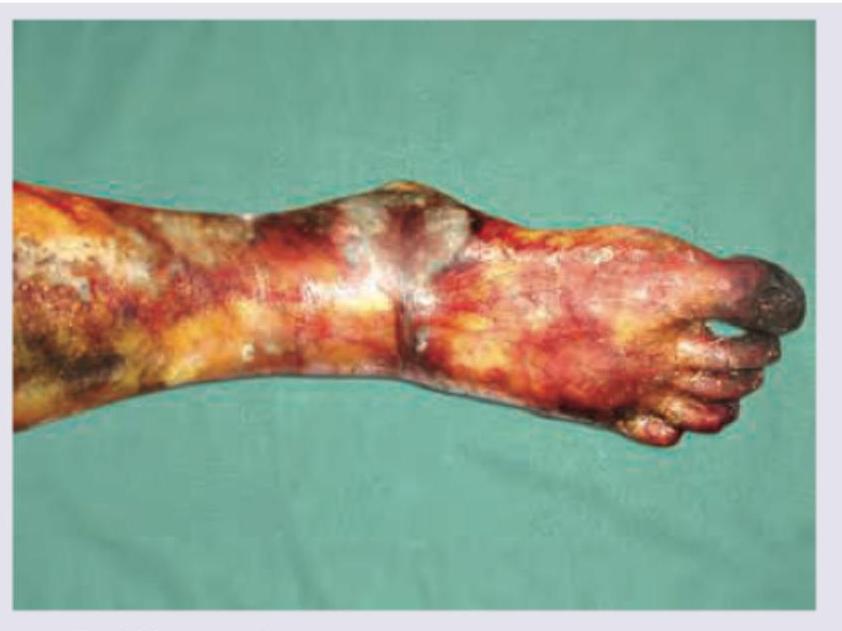
All are true about the mummification shown in the image except:
Explanation: ***Postmortem clot*** - **"Chicken fat" clot** is a classical postmortem finding observed during autopsy in the **heart chambers and large blood vessels**. - It appears as a **yellowish, gelatinous layer** (plasma with lipids) overlying a **darker red layer** (settled red blood cells) due to gravitational separation of blood components after cessation of circulation. - This appearance indicates **postmortem blood coagulation** and helps distinguish postmortem clots from antemortem thrombi. - **Key differentiating features**: Postmortem clots are smooth, shiny, unattached to vessel walls, and rubbery in consistency. *Antemortem thrombus* - **Antemortem thrombi** form during life and show attachment to the vessel wall (**lines of Zahn**), dull surface, and friable consistency. - They are **firmly adherent** to the endothelium and show evidence of organization with inflammatory response. - The texture is **uniform** without the characteristic yellow-red separation seen in chicken fat clots. *Currant jelly clot* - **Currant jelly clot** is another type of postmortem clot that appears **dark red and gelatinous** throughout. - It forms when red blood cells remain relatively mixed with plasma, unlike the separated appearance of chicken fat clots. - Both are postmortem findings, but have different gross appearances. *Antemortem wound* - **Antemortem wounds** show vital reactions including hemorrhage, inflammation, and tissue response. - Blood at antemortem injury sites shows **active coagulation** during life, not the passive gravitational separation characteristic of chicken fat clots. - The chicken fat appearance is specific to **intravascular postmortem clots**, not wound sites.
Explanation: ***Maceration*** - This is the characteristic post-mortem change observed in a **fetus that dies in utero** and remains within the amniotic fluid for an extended period. - The skin becomes soft, wrinkled, and eventually peels, often referred to as "**washerwoman's hands**" or "glove-and-stocking" appearance. *Mummification* - This occurs when a body dries out quickly in very **dry and hot environments**, preventing putrefaction and bacterial decay. - It's rarely seen in a fetus inside the uterus due to the presence of amniotic fluid. *Rigor mortis* - This is the **stiffening of muscles** after death due to the depletion of adenosine triphosphate (ATP), typically occurring several hours post-mortem. - While it can occur in a neonate after birth, it is not consistently observed in a fetus that dies and remains in utero. *Adipocere formation* - This is the transformation of fatty tissues into a **waxy, soap-like substance** (grave wax), occurring in damp, anaerobic environments. - It usually takes weeks to months and is not the typical immediate post-mortem change seen in a fetus within the uterus.
Explanation: ***Unintentional injury*** - The presence of a **food bolus obstructing the respiratory tract** in a person who collapsed while eating, with **no evidence of trauma or suspicious circumstances**, is classified as **accidental/unintentional death**. - This is the most common manner of death associated with foreign body airway obstruction, particularly in elderly individuals or those with neurological conditions affecting swallowing. - **Café coronary syndrome** (choking on food mimicking cardiac arrest) is a classic example of accidental asphyxia. *Intentional harm (Homicide)* - Homicidal foreign body aspiration would require evidence of: - **Forced insertion** of the foreign body - **Other traumatic injuries** (bruising, struggle marks) - **Suspicious circumstances** at the scene - The scenario described lacks these features, making homicide unlikely. *Self-inflicted harm (Suicide)* - Suicide by foreign body aspiration is **extremely rare** and would require: - **Evidence of suicidal intent** (suicide note, psychiatric history) - Deliberate insertion beyond the gag reflex - Accidental choking while eating does not constitute suicidal behavior. *Death from natural causes* - **Natural death** results from disease processes, not external physical agents. - A foreign body causing mechanical airway obstruction is an **external cause of death**, not a natural disease process. - Even if the person had a predisposing medical condition, the immediate cause (foreign body obstruction) makes this an unintentional injury, not natural death.
Explanation: ***Absence of vital reaction*** - Postmortem wounds lack a **vital reaction** because the body's physiological processes, such as **circulation** and **inflammation**, have ceased. - This means there will be no **hemorrhage**, **clotting**, or **cellular response** to tissue injury. *Presence of vital reaction* - The presence of a vital reaction, including **bleeding** and early signs of **inflammation**, indicates an antemortem injury. - This suggests the injury occurred when the person was **alive** and the circulatory system was functioning. *Presence of inflammatory cells* - **Inflammatory cells** (e.g., **neutrophils**, **macrophages**) are recruited to the site of injury as part of the body's **immune response** to tissue damage. - Their presence signifies an **antemortem injury** and an active biological process of healing or containment. *Absence of inflammatory cells* - While the **absence of inflammatory cells** is true for postmortem wounds, it is a consequence of the broader "absence of vital reaction." - The lack of cellular response is a more specific histological finding rather than the primary macroscopic distinguishing feature; the **lack of hemorrhage** and **tissue response** is more direct.
Explanation: ***Coagulative necrosis*** - Coagulative necrosis is the predominant histological finding after **myocardial infarction**, typically occurring within the first 12 hours [1]. - It results in preserved tissue architecture with **cellular outlines** remaining visible, indicating ischemic tissue damage [1,2]. *Liquefactive necrosis* - Commonly associated with **bacterial infections** or brain infarction, it leads to the transformation of tissue into liquid pus, which is not characteristic of myocardial infarction. - It occurs later and is not typically observed in heart tissue within 12 hours post-infarction. *Fat necrosis* - Primarily occurs due to damage to **adipose tissue**, as seen in cases of pancreatitis or trauma, and is not relevant to myocardial injury. - It is characterized by the release of **lipases** and fatty acids, a response not seen in myocardial infarction. *Caseous necrosis* - Often associated with **tuberculosis** or fungal infections, presenting as cheese-like necrotic tissue, it is not a feature of myocardial infarction. - This type of necrosis appears much later and reflects chronic granulomatous inflammation rather than acute ischemic damage. **References:** [1] Kumar V, Abbas AK, et al.. Robbins and Cotran Pathologic Basis of Disease. 9th ed. The Heart, p. 552. [2] Kumar V, Abbas AK, et al.. Robbins and Cotran Pathologic Basis of Disease. 9th ed. The Heart, pp. 552-554.
Explanation: ***Presence of yellow color*** - **Yellow coloration** indicates the breakdown of hemoglobin into **bilirubin** and occurs due to vital reactions in antemortem bruises. - This change is a sign of **healing and metabolism**, which cannot happen in a postmortem state. *Well-defined margins* - The definition of margins in a bruise is not a reliable differentiator, as both antemortem and postmortem bruises can have varying margin characteristics depending on the force and tissue type. - **Well-defined margins** can be seen in both, especially in cases of direct impact or specific tissue types. *Capillary rupture with extravasation of blood* - This is a fundamental characteristic of **all bruises**, whether antemortem or postmortem, as it describes the underlying mechanism of blood leaking from damaged vessels. - The difference lies in the body's reaction to this extravasation, not the initial event itself. *Gaping* - Gaping is typically associated with **lacerations or incisions** where the tissue is separated, rather than just a bruise. - While significant trauma can accompany bruising, gaping is not a defining characteristic that differentiates purely antemortem from postmortem bruises.
Explanation: ***Rigor mortis*** - Rigor mortis typically begins 2-6 hours after death, becomes fully established at 12-18 hours, and starts resolving by 24-36 hours - At **24 hours post-mortem**, the body is typically in **established rigor** or just beginning to resolve, making this the most characteristic finding - Occurs due to **ATP depletion**, preventing breakdown of actomyosin cross-bridges, leading to muscle stiffness *Putrefaction* - Putrefaction is a later stage of decomposition caused by bacterial activity - Usually becomes evident after **36-48 hours** in temperate climates, appearing as green discoloration of the abdomen - Significant signs (marbling, bloating) are unlikely to be the predominant change at exactly 24 hours *Cadaveric spasm* - Rare phenomenon of **instantaneous stiffening** at the moment of death, usually due to extreme emotional stress or violent death - Does not develop gradually over time and is distinct from rigor mortis - Not typical or expected in routine deaths *Cooling of body (Algor mortis)* - Begins immediately after death and typically reaches ambient temperature by **12-18 hours** depending on environmental factors - While the body would be cooler at 24 hours, cooling is an early change that would have largely completed by this time - Rigor mortis is the more specific and prominent stage at the 24-hour timeframe
Explanation: ***Postmortem bruising*** - **Postmortem bruising** is not a reliable indicator for determining the time since death. It represents an injury that occurred **perimortem** or shortly before death, indicating trauma rather than a specific postmortem interval. - While it can help establish the circumstances of death, it doesn't follow a predictable timeline after death that allows for accurate time estimation. *Postmortem staining* - **Postmortem staining**, also known as **livor mortis** or **lividity**, is the settling of blood in dependent parts of the body due to gravity. - Its presence, distribution, and fixity can provide an estimation of the time of death, appearing within **30 minutes to 2 hours** and becoming fixed after **8-12 hours**. *Cooling of the body* - **Cooling of the body**, or **algor mortis**, refers to the decrease in body temperature after death until it equilibrates with the ambient temperature. - This process is used to estimate time since death, with the rate of cooling influenced by factors like **ambient temperature**, body size, and clothing. *Rigor mortis* - **Rigor mortis** is the stiffening of muscles that occurs after death due to chemical changes within the muscle cells. - It typically begins **2-4 hours** after death, becomes fully established around **8-12 hours**, and resolves after **24-48 hours**, following a predictable sequence of appearance and disappearance.
Explanation: ***Preservation by saponification*** - Adipocere, also known as **grave wax**, is formed through the process of **saponification**, where body fat hydrolyzes into fatty acids. - This process leads to the formation of a **waxy, grayish-white substance** that can preserve the body tissues. *High temperature needed* - Adipocere formation is actually favored by **cooler temperatures**, which slow down putrefaction and create a more conducive environment for saponification. - **High temperatures** typically accelerate decomposition, making adipocere formation less likely. *Cool and dry climate needed* - While a **cool environment** is favorable, adipocere formation primarily requires a **moist or wet environment**, such as burial in damp soil or immersion in water. - A **dry climate** would generally lead to mummification rather than adipocere formation. *Occurs within minutes to hours* - Adipocere formation is a **slow process** that usually takes **several weeks to months** (typically 3 weeks to 3 months) to become evident, and even longer to fully develop. - It does not occur within minutes or hours, which is the timeframe for early post-mortem changes like livor mortis or rigor mortis.
Explanation: ***Presence of moisture is required*** - This statement is **INCORRECT** and is the correct answer to this "except" question. - **Mummification** is a type of post-mortem change that occurs in **dry, well-ventilated conditions** with **absence of moisture**. - The tissues become desiccated, shrunken, and leather-like due to evaporation of body fluids. - Moisture would promote putrefaction rather than mummification. *Goldilocks phenomenon* - This refers to conditions that are "just right" for mummification to occur. - Requires **adequate air circulation** with **low humidity** - not too wet (which causes putrefaction) and not completely sealed (which prevents drying). - The balance of environmental factors must favor desiccation over decomposition. *Air movements increase the process* - **Air circulation is essential** for mummification as it promotes evaporation of tissue fluids. - Increased air movement accelerates the drying process and enhances mummification. - This is why bodies found in well-ventilated areas (deserts, attics) undergo mummification. *Intrinsic water is consumed* - During mummification, the **intrinsic water content of tissues evaporates**. - This leads to the characteristic **dry, shrunken, leather-like appearance** of mummified tissues. - Loss of water content prevents bacterial growth and decomposition, allowing for body preservation.
Get full access to all questions, explanations, and performance tracking.
Start For Free