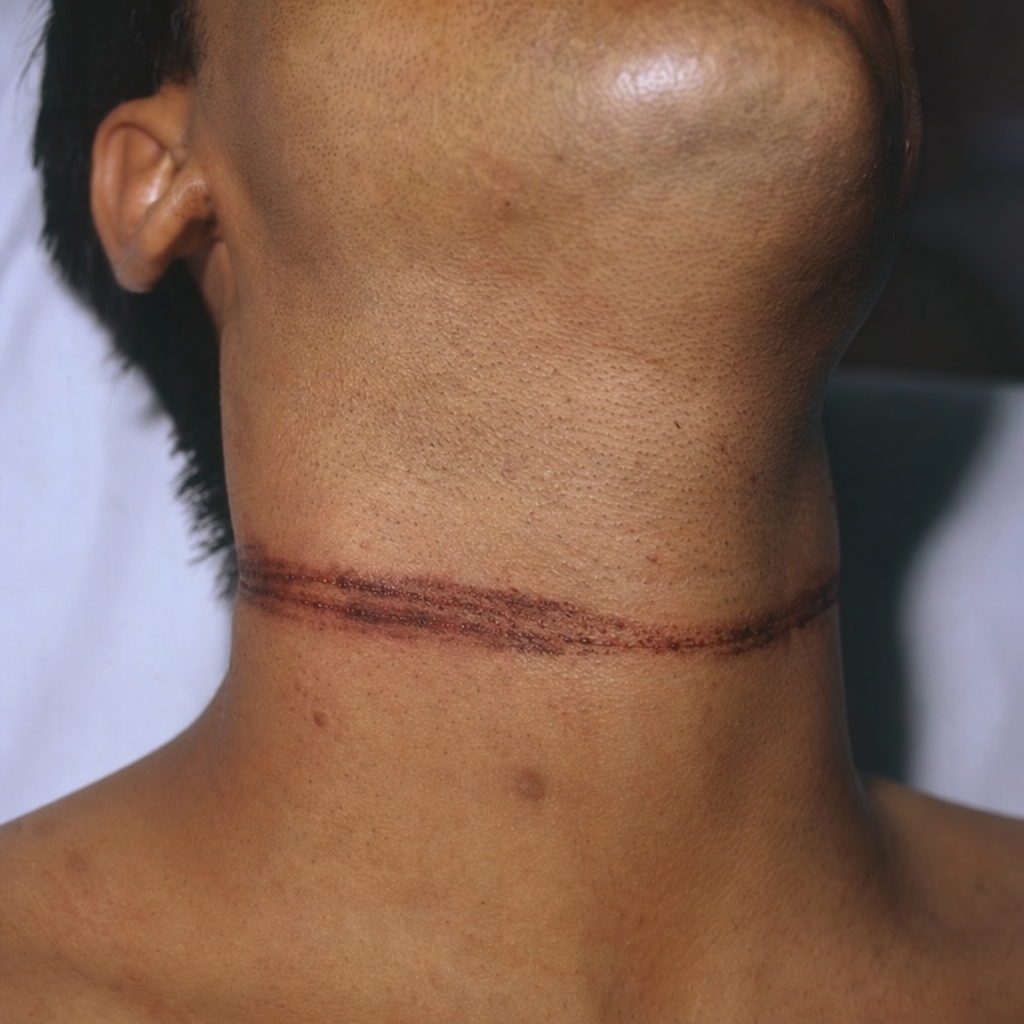
Post-mortem caloricity is not seen in which of the following conditions?
Which feature differentiates antemortem bruises from postmortem bruises?
Which of the following is the most important objective of a medicolegal autopsy?
All of the following helps in determination of time since death, Except
A person died 24 hours ago. Which postmortem change is most likely?
A woman died within 5 years of marriage under suspicious circumstances. Her parents complained that her in-laws used to frequently demand dowry. Under which of the following sections can a magistrate authorize an autopsy of the case?
During autopsy of a fetal death case, what is the correct order of examination to differentiate between live birth and stillbirth?
Certain obligations on the part of a doctor who undertakes a postmortem examination are the following, EXCEPT:
ECV is absolutely contraindicated in all except :
Identify the post mortem lividity of the image: (AIIMS Nov 2018)

Explanation: ***Post-mortem glycogenolysis*** - **Post-mortem glycogenolysis** is a **normal biochemical process** that occurs after death, involving the breakdown of glycogen in tissues. - It is **NOT a pre-death pathological condition** and does not cause the body temperature to rise after death. - **Post-mortem caloricity** occurs due to ante-mortem conditions with intense metabolic activity or thermoregulatory dysfunction, not from normal post-mortem biochemical changes. - This is the **correct answer** as it does NOT cause post-mortem caloricity. *Pontine haemorrhage* - **Pontine haemorrhage** causes damage to the **thermoregulatory centers** in the brainstem. - This leads to dysregulation and **uncontrolled heat generation**, resulting in hyperthermia. - The elevated metabolic state can persist briefly after death, causing **post-mortem caloricity**. *Bacteremia* - **Bacteremia** and **sepsis** trigger a massive **inflammatory response** with increased metabolic activity. - The heightened metabolic state generates significant heat before and immediately after death. - This contributes to elevated body temperature observed as **post-mortem caloricity**. *Status epilepticus* - **Status epilepticus** involves **prolonged, intense muscle contractions** and widespread neuronal activity. - This extreme metabolic demand generates substantial heat through continuous muscle activity. - The heat generation can persist briefly post-mortem, leading to **post-mortem caloricity**.
Explanation: ***Presence of yellow color*** - **Yellow coloration** indicates the breakdown of hemoglobin into **bilirubin** and occurs due to vital reactions in antemortem bruises. - This change is a sign of **healing and metabolism**, which cannot happen in a postmortem state. *Well-defined margins* - The definition of margins in a bruise is not a reliable differentiator, as both antemortem and postmortem bruises can have varying margin characteristics depending on the force and tissue type. - **Well-defined margins** can be seen in both, especially in cases of direct impact or specific tissue types. *Capillary rupture with extravasation of blood* - This is a fundamental characteristic of **all bruises**, whether antemortem or postmortem, as it describes the underlying mechanism of blood leaking from damaged vessels. - The difference lies in the body's reaction to this extravasation, not the initial event itself. *Gaping* - Gaping is typically associated with **lacerations or incisions** where the tissue is separated, rather than just a bruise. - While significant trauma can accompany bruising, gaping is not a defining characteristic that differentiates purely antemortem from postmortem bruises.
Explanation: ***Cause of death*** - Ascertaining the **cause of death** is the primary objective of a medicolegal autopsy, as it identifies the disease or injury responsible for physiological derangement leading to death. - This determination is crucial for legal proceedings and public health data, providing the foundational medical reason for the individual's demise. *Manner of death* - While important, the **manner of death** (homicide, suicide, accidental, natural, undetermined) is a classification based on the cause of death and other investigative findings, making it a secondary objective derived from the primary cause. - The manner specifies how the cause of death arose, but the autopsy's direct medical contribution is establishing the cause itself. *Time since death* - Estimating the **time since death** is a significant aspect of a medicolegal autopsy, aiding in establishing timelines for investigations. - However, it is a piece of crucial information that supports the investigation rather than the ultimate objective of understanding why the person died. *All of the options* - Although all mentioned aspects are important components of a comprehensive medicolegal autopsy report, pinpointing the **cause of death** is the singular, most fundamental objective around which other conclusions are built. - The cause of death forms the basis for subsequent legal and public health classifications and without it, other aspects would lack their primary context.
Explanation: ***Pugilistic attitude*** - A **pugilistic attitude** is a postmortem change characterized by the posturing of the body into a "boxer-like" stance, caused by the **coagulation of muscle proteins** due to heat from a fire. - While it indicates exposure to high temperatures, it does not reliably help in determining the **time since death**. *Algor mortis* - **Algor mortis** refers to the postmortem cooling of the body. - The rate of cooling can be used to estimate the **time since death**, with various mathematical formulas and environmental factors influencing the calculation. *Rigor mortis* - **Rigor mortis** is the stiffening of muscles after death due to the depletion of **ATP** and the irreversible cross-linking of **actin** and **myosin**. - Its presence, progression, and regression provide valuable clues for estimating the **time since death**. *Livor mortis* - **Livor mortis**, or lividity, is the discoloration of the skin after death due to the **gravitational pooling of blood** in capillaries. - The onset, fixation, and distribution of lividity can help in determining the **time since death** and whether the body has been moved postmortem.
Explanation: ***Rigor mortis*** - Rigor mortis typically begins 2-6 hours after death, becomes fully established at 12-18 hours, and starts resolving by 24-36 hours - At **24 hours post-mortem**, the body is typically in **established rigor** or just beginning to resolve, making this the most characteristic finding - Occurs due to **ATP depletion**, preventing breakdown of actomyosin cross-bridges, leading to muscle stiffness *Putrefaction* - Putrefaction is a later stage of decomposition caused by bacterial activity - Usually becomes evident after **36-48 hours** in temperate climates, appearing as green discoloration of the abdomen - Significant signs (marbling, bloating) are unlikely to be the predominant change at exactly 24 hours *Cadaveric spasm* - Rare phenomenon of **instantaneous stiffening** at the moment of death, usually due to extreme emotional stress or violent death - Does not develop gradually over time and is distinct from rigor mortis - Not typical or expected in routine deaths *Cooling of body (Algor mortis)* - Begins immediately after death and typically reaches ambient temperature by **12-18 hours** depending on environmental factors - While the body would be cooler at 24 hours, cooling is an early change that would have largely completed by this time - Rigor mortis is the more specific and prominent stage at the 24-hour timeframe
Explanation: ***Section 176 Cr PC*** - This section empowers a **Magistrate to hold an inquiry into the cause of death** in cases of suspicious circumstances, including deaths within seven years of marriage where dowry harassment is alleged. - The magistrate can **order a post-mortem examination** or even a second post-mortem if there are doubts about the initial findings, making it the appropriate section for **magisterial authorization** of autopsy. - In dowry death cases, Section 176 provides judicial oversight and ensures an independent inquiry beyond police investigation. *Section 174 Cr PC* - This section deals with **police inquiry** and report on suicide and suspicious deaths, empowering the **police officer** (not magistrate) to investigate and order an autopsy. - While Section 174 is used for initial police investigation in suspicious deaths, the question specifically asks about **magistrate authorization**, which falls under Section 176. - Section 174 is the procedural provision for police-initiated investigation, whereas magisterial inquiry requires Section 176. *Section 304 IPC* - This section pertains to **punishment for culpable homicide not amounting to murder**. It is a substantive penal provision, not a procedural law. - It deals with the legal consequence of an act after investigation and trial, not with the investigative procedure for conducting an autopsy. - Charges under Section 304 IPC may result from findings after the autopsy, but it doesn't authorize the autopsy itself. *Section 302 IPC* - This section specifies the **punishment for murder**. Like Section 304 IPC, it is substantive criminal law defining a crime and its penalty. - It would be invoked *after* the investigation reveals evidence of murder, not during the initial phase of ordering an autopsy for a suspicious death. - An autopsy authorized under Cr PC sections might lead to charges under Section 302 IPC, but it doesn't authorize the autopsy procedure.
Explanation: ***Head > thorax > abdomen*** - The **head** is examined first to preserve delicate structures and avoid artifactual changes that could obscure signs of **intrauterine pathology** or **trauma** related to birth. - After the head, the **thorax** is examined to assess the lungs for signs of **air insufflation** (indicating respiration) and the presence of **congenital anomalies** or injuries. *Thorax > head > abdomen* - Examining the **thorax** before the head may introduce artifacts to the head, such as **hemorrhage** or **tissue distortion**, compromising the investigation of **cephalic injuries** or malformations crucial for distinguishing **live birth** from **stillbirth**. - **Head injuries** or **intracranial bleeds** are often critical in determining the mode of delivery or potential trauma, so their undisturbed assessment is prioritized. *Abdomen > thorax > head* - Beginning with the **abdomen** risks significant disruption to the **thoracic** and **cephalic** structures as a consequence of handling and evisceration, potentially obscuring vital evidence of **respiration** or **birth trauma**. - The integrity of the **head** and **thorax** is paramount for identifying subtle macroscopic and microscopic findings that definitively point to a **live birth**, such as **pulmonary aeration** or **intracranial hemorrhages**. *Thorax > abdomen > head* - This sequence is suboptimal because starting with the **thorax** and then the **abdomen** still leaves the **head** vulnerable to post-mortem changes and handling artifacts due to the initial dissections. - Critical evidence in the head pertaining to **neurological insult** or **traumatic injury** during birth might be overlooked or misinterpreted if not examined early in a pristine state.
Explanation: ***He must keep the police informed about the findings*** - This is **NOT a formal obligation** of the doctor conducting a postmortem examination. - The doctor's primary duty is to conduct a thorough, objective examination and prepare a **formal postmortem report** that is submitted to the authority who requisitioned the examination (magistrate/police as per CrPC Section 174). - While findings may eventually reach the police through the official report, there is **no obligation to informally update or keep police informed** during the examination process. - The doctor's role is that of an **independent expert witness** to the court, not an investigative assistant to the police. - Maintaining independence and objectivity requires the doctor to document findings formally rather than providing ongoing informal updates to investigating officers. *Routinely record all positive findings and important negative ones* - This IS a **fundamental obligation** for any doctor performing a postmortem examination. - Both positive findings (pathological changes, injuries) and significant negative findings (absence of expected pathology) must be documented to provide a comprehensive and accurate record. - This meticulous documentation ensures the **integrity, reliability, and legal validity** of the postmortem examination and its conclusions. *The examination should be meticulous and complete* - This IS a **professional, ethical, and legal obligation** for any doctor undertaking a postmortem examination. - A systematic and thorough examination of all body systems is essential to accurately determine the cause of death and identify all relevant findings. - Incomplete examinations can lead to **missed diagnoses and miscarriage of justice** in medico-legal cases. *He must preserve viscera and send for toxicology examination in case of poisoning* - This IS a **crucial obligation** when poisoning is suspected or cannot be ruled out based on the postmortem findings. - Relevant viscera (liver, kidney, stomach contents) and bodily fluids (blood, urine) must be preserved in appropriate containers for subsequent toxicological analysis. - This step is **essential to confirm or exclude toxicological involvement** in the death and is a standard protocol in medico-legal postmortem examinations as per established guidelines.
Explanation: ***Previous LICS scar*** - A **previous lower uterine segment C-section (LICS) scar** is considered a **relative contraindication**, not an absolute contraindication for ECV. - Current guidelines (ACOG, RCOG) indicate that ECV can be attempted in carefully selected women with one prior cesarean delivery, though success rates may be lower. - While there is a theoretical increased risk of **uterine rupture** or **scar dehiscence**, studies have shown this risk remains low (approximately 0.02-0.08%), and many practitioners will offer ECV after thorough counseling and informed consent. - **This is the correct answer** - it is NOT an absolute contraindication. *Septate uterus* - A **septate uterus** (uterine anomaly) is generally considered a **relative contraindication** or significant limiting factor for ECV, though some sources treat it more strictly. - The uterine septum can impair fetal manipulation and reduce success rates significantly, making ECV technically challenging and potentially less likely to succeed. - While not universally classified as "absolute," severe uterine anomalies create substantial barriers to successful version and increase procedural risks, leading many practitioners to avoid ECV in these cases. *Severe pre-eclampsia* - **Severe pre-eclampsia** is an **absolute contraindication** for ECV. - The procedure can exacerbate maternal hypertension, increase risk of **seizures (eclampsia)**, and trigger **placental abruption** or **fetal compromise**. - The physiological stress of ECV is contraindicated in an already unstable maternal-fetal condition. *Placenta previa* - **Placenta previa** is an **absolute contraindication** for ECV. - Any uterine or fetal manipulation carries significant risk of causing **severe hemorrhage** and **placental separation**. - The abnormal placental location makes vaginal delivery contraindicated regardless of presentation, and ECV would serve no clinical purpose while exposing mother and fetus to serious bleeding risks.
Explanation: ***Suggillation*** - Suggillation refers to the extravasation of blood into the tissues due to crushing pressure or trauma, often seen in cases of severe blunt force injury, leaving **diffuse, purplish discoloration.** - In post-mortem examination, a **suggillation** can be distinguished from common **livor mortis** (lividity) by its darker color and by the fact that it is not blanchable under pressure, indicating **capillary rupture and hemorrhage** rather than just pooling of blood. *Tattooing* - Tattooing involves the insertion of **indelible ink** into the dermis of the skin, creating permanent designs. - Tattoos have distinct, often patterned, appearances and would not resemble the **irregular, deep discoloration** of lividity or hemorrhage. *Putrefaction* - Putrefaction is a later stage of decomposition, characterized by the breakdown of tissues by bacteria, producing **gases, discoloration (greenish-black), and foul odors.** - This process is distinct from the **vascular pooling** or **hemorrhage** that forms suggillation; putrefaction typically starts later (after 24-48 hours) and involves more widespread tissue destruction. *Decomposition* - Decomposition is the broader process of decay of organic matter after death, encompassing various stages like **autolysis, putrefaction, and skeletonization.** - While suggillation occurs post-mortem, it is a specific type of **post-mortem bruising** or lividity, distinct from the generalized tissue breakdown and gaseous changes seen in advanced decomposition.
Get full access to all questions, explanations, and performance tracking.
Start For Free