What is the forensic method of identification that utilizes lip prints?
Cheilography is the study of ?
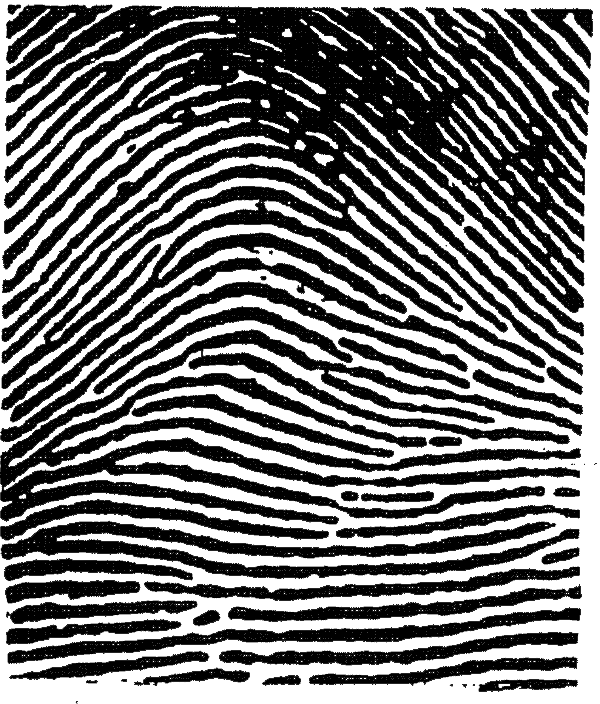
The pattern of fingerprint demonstrated here is
Doctor or nurse disclosing the identity of a rape victim is punishable under the following section of IPC?
Which traditional method is considered most reliable for personal identification in forensic science?
In a macerated baby, the ideal sample for genetic analysis is obtained from:
If a fracture gives the pattern of the striking surface of the weapon it is called
Which of the following statements best describes a key characteristic of fingerprint development?
Disputed maternity can be solved by using the following tests, EXCEPT:
Identical twins can be differentiated by their ________.
Explanation: ***Cheiloscopy*** - **Cheiloscopy** is the scientific study of lip prints for human identification, based on the unique patterns of furrows on the human lips. - These patterns are considered individual and permanent, making them useful in forensic investigations. *Dactylography* - **Dactylography** is the study of fingerprints, which involves analyzing the unique patterns of ridges and furrows on the fingertips for identification. - It is one of the most widely used and reliable methods for personal identification in forensic science, but does not involve lip prints, *Poroscopy* - **Poroscopy** is a forensic technique that involves the examination of the pores on the ridges of fingerprints. - It is used to individualize fingerprints when there is insufficient ridge detail, but it focuses on pores, not lip prints. *Trichology* - **Trichology** is the scientific study of hair and scalp. - In forensics, it involves analyzing hair samples to determine characteristics such as origin, race, and presence of toxins, but not lip prints.
Explanation: ***Lip prints:*** - **Cheiloscopy**, or cheilography, is the forensic study of **lip prints** for individual identification. - Just like fingerprints, lip prints are unique to each individual and can be used as evidence. *Finger prints:* - The study of **fingerprints** is known as **dermatoglyphics** or dactyloscopy, not cheilography. - Fingerprints are commonly used in forensic science due to their unique ridge patterns. *Breath analysis:* - **Breath analysis** typically involves examining exhaled air for substances like alcohol or gases, used for diagnostic or forensic purposes. - This field is known as **breathomics** or clinical breath testing, not cheilography. *Foot prints:* - The examination of **footprints** is known as **podoscopy** or **pedobarography**, used in forensics and biomechanics. - Footprints provide information about an individual's gait and foot structure.
Explanation: ***Arch*** - An **arch pattern** is characterized by ridges that enter from one side of the finger, rise in the center to form an arch, and then exit on the **opposite side** without recurving. - Arches **do not have deltas or cores**, which is the defining characteristic seen in the provided fingerprint image. - This is the **simplest and least common** fingerprint pattern, accounting for approximately 5% of all fingerprints. *Loop* - A **loop pattern** features ridges that enter from one side, form a curve or recurve, and then exit on the **same side**. - Loops contain **one delta and one core**, which are absent in the given pattern. - Loops are the most common pattern (60-65% of fingerprints). *Whorl* - A **whorl pattern** is characterized by ridges that make at least one complete circuit, forming a **spiral, oval, or circular shape**. - Whorls typically have **two or more deltas**, which is not consistent with the simple arch pattern shown. - Whorls account for approximately 30-35% of fingerprints. *Composite* - **Composite patterns** combine features of different primary patterns within a single fingerprint, such as a central pocket loop, double loop, or accidental whorl. - The given fingerprint displays a clear, simple **arch structure** with no deltas or cores, not a combination of multiple patterns.
Explanation: ***Section 228A IPC*** - This section of the Indian Penal Code specifically deals with the **disclosure of the identity of a victim of rape and certain sexual offenses** (Sections 376, 376A, 376AB, 376B, 376C, 376D, 376DA, 376DB, 376E). - Making public the name or any matter that can reveal the identity of a rape victim by **any person, including doctors and nurses**, is a punishable offense. - **Punishment**: Imprisonment up to **2 years** and fine. - **Exception**: Disclosure is permitted only to authorized persons like police officers for investigation purposes. - **Important**: This is now covered under **Section 72 of Bharatiya Nyaya Sanhita (BNS) 2023**, which replaced the IPC. *Section 224A* - This is **not a valid or recognized provision** within the Indian Penal Code. - It does not relate to offenses concerning privacy or the identity of sexual assault victims. *Section 226A* - This is **not a valid or recognized provision** within the Indian Penal Code. - It does not pertain to the confidentiality of victims of sexual offenses. *Section 222A* - This is **not a valid or recognized provision** within the Indian Penal Code. - There is no such specific section addressing disclosure of victim identity in the IPC.
Explanation: ***Galton method*** - The **Galton method**, which refers to **fingerprint analysis**, is considered a highly reliable traditional method for personal identification due to the uniqueness and permanence of fingerprints. - No two individuals, even identical twins, have been found to have the exact same **fingerprint patterns**, making it a robust identifier. *Gustafson's method* - **Gustafson's method** is a technique used for **age estimation based on dental changes**, not for definitive personal identification. - While it provides an estimate of age, it cannot uniquely identify an individual. *DNA profiling* - **DNA profiling** is indeed the most reliable method for personal identification in modern forensic science, but it is not considered a "traditional" method. - The question specifically asks for a **traditional method**, distinguishing it from newer genetic techniques. *Anthropometry* - **Anthropometry** involves the measurement of the **human body and its parts**, often used for classification or to establish demographic profiles. - It is not reliable for unique personal identification as many individuals share similar physical measurements.
Explanation: ***Placental Tissue*** - **Placental tissue** (chorionic villi) is preferred for genetic analysis in macerated fetuses because it is less susceptible to **autolysis** and **bacterial contamination** compared to fetal tissues. - The placenta often retains viable cells with intact DNA even when fetal tissues have significantly degraded, making it a more reliable source for **karyotyping** or **molecular genetic studies**. *Clotted fetal blood* - **Clotted fetal blood** from a macerated fetus is generally unsuitable due to significant **cellular degradation** and **DNA fragmentation** caused by autolysis. - The quality of DNA extracted from such a sample would likely be poor, leading to unreliable or unsuccessful genetic testing. *Fibroblast from skin* - While fibroblasts can be cultured from skin, obtaining a viable biopsy from a **macerated fetus** is challenging due to extensive **tissue degradation** and the high risk of **bacterial contamination**. - Successful culture and growth of fibroblasts would be unlikely given the compromised state of the fetal tissue. *Fibroblast from Achilles tendon* - Similar to skin, obtaining viable fibroblasts from the **Achilles tendon** of a macerated fetus is difficult due to widespread **autolysis** and **tissue degeneration**. - The degradation of cells in macerated fetuses significantly reduces the chances of culturing viable cells needed for genetic analysis from any fetal tissue, including tendons.
Explanation: ***Signature fracture*** - A **signature fracture** is a term used when the bone fracture pattern directly reflects or reproduces the shape of the imparting object or weapon. - This type of fracture provides crucial forensic evidence, directly linking the injury to a specific weapon. *Pond fracture* - A **pond fracture** is a type of depressed skull fracture, typically seen in infants, where the bone is indented without complete disruption, resembling an indentation in a flexible surface. - It does not involve the replication of the weapon's striking surface but rather a localized depression. *Ring fracture* - A **ring fracture** (or foramen magnum fracture) is a fracture around the base of the skull, specifically encircling the foramen magnum. - These fractures are usually caused by an axial load impact (e.g., a fall on the head or feet) or hyperextension/hyperflexion injuries, not by replicating an object's surface. *Comminuted fracture* - A **comminuted fracture** is characterized by the bone breaking into several fragments, often three or more pieces, at the site of injury. - While it indicates high-energy trauma, it describes the number of bone fragments and not the pattern reflecting the striking object.
Explanation: ***Fingerprints are fully formed before birth.*** - Fingerprints begin to develop during the **fetal stage**, specifically between the 10th and 17th weeks of gestation. - Once formed, their unique ridge patterns remain **unchanged throughout life**, except for changes due to injury or disease. *DNA analysis is the most specific method of identification.* - While **DNA analysis** is a highly specific method of identification, the statement refers to its specificity generally, not as a characteristic of fingerprint development itself. - Fingerprints are a distinct form of identification based on unique **dermal ridge patterns**, independent of genetic material. *The most common type of fingerprint is loops.* - It is true that **loops** are indeed the most common type of fingerprint pattern, occurring in about 60-70% of the population. - However, this statement describes a characteristic of fingerprint patterns, not a key characteristic of their **development** or formation. *None of the options are true.* - This option is incorrect because the statement that **fingerprints are fully formed before birth** is a key characteristic of fingerprint development. - This option would only be correct if all other statements were false.
Explanation: ***Precipitin test*** - The **precipitin test** is used to determine the origin of a **blood sample**, specifically whether it is **human or animal blood**, by detecting species-specific proteins. It is not used for assessing maternity. - This test is primarily employed in **forensic serology** to differentiate between blood from different animal species, making it irrelevant for paternity or maternity disputes. *Blood grouping* - **Blood grouping** (e.g., ABO and Rh systems) can be used to **exclude paternity or maternity** by comparing the blood types of the child, mother, and alleged father. - If the child's blood type is incompatible with the alleged parents based on Mendelian inheritance, one or both can be excluded. *HLA typing* - **HLA typing** (Human Leukocyte Antigen) is a more powerful genetic marker system than ABO/Rh for determining paternity or maternity. - It involves analyzing highly polymorphic genes on chromosome 6 that encode cell surface proteins, providing a more definitive means of **inclusion or exclusion**. *DNA fingerprinting* - **DNA fingerprinting** (also known as **DNA profiling**) is the **most accurate and widely accepted method** for resolving paternity and maternity disputes. - It analyzes highly variable regions of DNA unique to each individual, providing a statistically strong basis for **inclusion or exclusion** by comparing genetic profiles.
Explanation: ***Fingerprint*** - Although identical twins originate from a single zygote and share nearly identical DNA, their **fingerprints** develop uniquely due to environmental factors in the womb affecting dermal ridge formation. - This results in distinct fingerprint patterns, making them a reliable identifier to differentiate between them. *Blood grouping* - Identical twins share the same **genetic makeup** and therefore have the same **blood type**. - Blood grouping cannot be used to differentiate between them. *DNA fingerprinting* - Identical twins are derived from the same zygote, resulting in nearly **identical DNA sequences**. - While extremely fine differences might exist (e.g., somatic mutations), standard **DNA fingerprinting** would show them as the same. *Age* - Identical twins are born at the same time from the same pregnancy, meaning they have the **exact same age**. - This characteristic cannot be used to differentiate between them.
Get full access to all questions, explanations, and performance tracking.
Start For Free