Disputed maternity can be solved by using the following tests, EXCEPT:
Certain obligations on the part of a doctor who undertakes a postmortem examination are the following, EXCEPT:
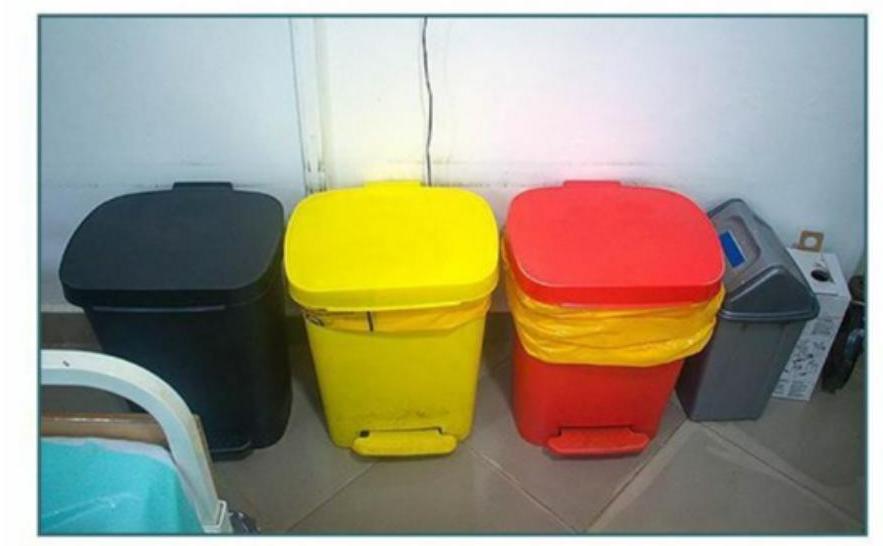
A nurse keeps the bins as shown in the image in the hospital ward. Which of the following items would go into the black bin?
A person with unsound mind can be released with pending investigation or trial under:-
Which of the following is the least suitable source for DNA extraction?
Amputated digits are preserved in:
During autopsy for virology study which agent is used for storing tissue:
What are the reasons a sample may be disqualified for culture?
The most specific test to detect blood stains is:
What is the most reliable method to determine the time of death within the first 24 hours after death?
Explanation: ***Precipitin test*** - The **precipitin test** is used to determine the origin of a **blood sample**, specifically whether it is **human or animal blood**, by detecting species-specific proteins. It is not used for assessing maternity. - This test is primarily employed in **forensic serology** to differentiate between blood from different animal species, making it irrelevant for paternity or maternity disputes. *Blood grouping* - **Blood grouping** (e.g., ABO and Rh systems) can be used to **exclude paternity or maternity** by comparing the blood types of the child, mother, and alleged father. - If the child's blood type is incompatible with the alleged parents based on Mendelian inheritance, one or both can be excluded. *HLA typing* - **HLA typing** (Human Leukocyte Antigen) is a more powerful genetic marker system than ABO/Rh for determining paternity or maternity. - It involves analyzing highly polymorphic genes on chromosome 6 that encode cell surface proteins, providing a more definitive means of **inclusion or exclusion**. *DNA fingerprinting* - **DNA fingerprinting** (also known as **DNA profiling**) is the **most accurate and widely accepted method** for resolving paternity and maternity disputes. - It analyzes highly variable regions of DNA unique to each individual, providing a statistically strong basis for **inclusion or exclusion** by comparing genetic profiles.
Explanation: ***He must keep the police informed about the findings*** - This is **NOT a formal obligation** of the doctor conducting a postmortem examination. - The doctor's primary duty is to conduct a thorough, objective examination and prepare a **formal postmortem report** that is submitted to the authority who requisitioned the examination (magistrate/police as per CrPC Section 174). - While findings may eventually reach the police through the official report, there is **no obligation to informally update or keep police informed** during the examination process. - The doctor's role is that of an **independent expert witness** to the court, not an investigative assistant to the police. - Maintaining independence and objectivity requires the doctor to document findings formally rather than providing ongoing informal updates to investigating officers. *Routinely record all positive findings and important negative ones* - This IS a **fundamental obligation** for any doctor performing a postmortem examination. - Both positive findings (pathological changes, injuries) and significant negative findings (absence of expected pathology) must be documented to provide a comprehensive and accurate record. - This meticulous documentation ensures the **integrity, reliability, and legal validity** of the postmortem examination and its conclusions. *The examination should be meticulous and complete* - This IS a **professional, ethical, and legal obligation** for any doctor undertaking a postmortem examination. - A systematic and thorough examination of all body systems is essential to accurately determine the cause of death and identify all relevant findings. - Incomplete examinations can lead to **missed diagnoses and miscarriage of justice** in medico-legal cases. *He must preserve viscera and send for toxicology examination in case of poisoning* - This IS a **crucial obligation** when poisoning is suspected or cannot be ruled out based on the postmortem findings. - Relevant viscera (liver, kidney, stomach contents) and bodily fluids (blood, urine) must be preserved in appropriate containers for subsequent toxicological analysis. - This step is **essential to confirm or exclude toxicological involvement** in the death and is a standard protocol in medico-legal postmortem examinations as per established guidelines.
Explanation: ***Glove paper cover*** - The black bin is typically designated for **general waste** that is neither infectious nor sharp. - A glove paper cover is considered **non-hazardous**, non-recyclable waste and would be appropriately disposed of in a black bin. *Gloves* - **Used gloves**, even if not obviously contaminated with bodily fluids, are considered potentially infectious waste and should not be placed in the black bin. - These should generally be disposed of in a **yellow bag or bin** (infectious waste) to prevent cross-contamination. *Soiled linen bedsheet* - A soiled linen bedsheet is considered **infectious waste**, as it may contain bodily fluids or pathogens. - This type of waste requires specific handling and disposal, usually in **red bags or bins**, not general waste. *Contaminated gloves* - **Contaminated gloves** are classified as infectious waste and must be disposed of in designated containers for biohazard materials. - Placing them in a black bin would pose a **risk of infection** to waste handlers and is against standard medical waste disposal protocols.
Explanation: ***Section 330 Cr P C*** - This section specifically deals with the power of the Court to **release a person with unsound mind** (or other mental incapacitation) pending investigation or trial. - It allows for the release of such individuals on **sufficient security** being given that they will be properly taken care of and produced in Court when required. *Section 84 Cr P C* - **Section 84 CrPC** does not deal with the release of persons with unsound mind. - This option is a distractor that may confuse candidates with Section 84 IPC or other provisions. *Section 328 Cr P C* - This section deals with the **procedure** when an accused appears to be of unsound mind during an inquiry or trial before a Magistrate. - It focuses on stopping the proceedings and determining the accused's mental state, not directly on release pending investigation or trial. *Section 84 IPC* - This section of the Indian Penal Code (IPC) addresses the **acts of a person of unsound mind** and provides a defense against criminal liability. - It applies to the substantive criminal law regarding culpability, not the procedural aspects of release during investigation or trial.
Explanation: ***CSF*** - **Cerebrospinal fluid (CSF)** contains a relatively **low number of cells**, making it a poor source for DNA extraction compared to other bodily fluids due to the scarcity of nuclear DNA. - While DNA can be extracted from CSF for specific diagnostic purposes (e.g., detection of pathogens), it is generally **not the preferred source** for DNA profiling or genetic studies due to the limited yield and potential for degradation. *Hair roots* - **Hair roots** (specifically the follicular tag) contain a significant number of **nucleated cells**, making them an excellent source for DNA extraction. - The DNA extracted from hair roots is often robust and sufficient for **forensic analysis** and genetic testing. *Semen* - **Semen** contains a high concentration of **sperm cells**, which are rich in nuclear DNA, making it a very good source for DNA extraction. - It is frequently used in **forensic investigations** and paternity testing due to its high DNA content. *Buccal mucosa* - **Buccal cells** scraped from the inside of the cheek provide a non-invasive and **abundant source of nucleated cells** for DNA extraction. - This method is widely used for genetic testing, **ancestry tracing**, and clinical diagnostics because of its ease of collection and high DNA yield.
Explanation: ***Plastic bag in ice*** - The amputated digit should be placed in a **sterile plastic bag** and then immersed in a container with **ice water**. This method provides adequate cooling to preserve tissue viability without direct contact with ice, which can cause **frostbite**. - This approach slows down metabolic processes and reduces oxygen demand, extending the time window for successful **replantation**. *Deep freezer* - Placing an amputated digit directly into a deep freezer causes **ice crystal formation** within the cells, leading to severe **tissue damage** and making replantation impossible. - Extreme cold results in **cellular dehydration** and destruction, rendering the tissue non-viable for reattachment. *Cold ringer lactate* - While Ringer's lactate is an appropriate solution for **tissue irrigation** or to keep a digit moist in an emergency, it should not be used as the primary medium for prolonged preservation without adequate cooling. - For optimal preservation, Ringer's lactate could be used *inside* the plastic bag to bathe the digit, but the bag still needs to be placed on ice to achieve the necessary **hypothermic conditions**. *Cold saline* - Similar to Ringer's lactate, cold saline can be used to **cleanse** the amputated part or keep it moist temporarily. However, it is not ideal as the sole preservation method. - Direct immersion in saline with ice is better than plain saline at room temperature but still carries the risk of **tissue maceration** if not properly managed within a sealed bag on ice. The primary goal is cooling, not just hydration.
Explanation: ***50% glycerine*** - **Glycerine** is commonly used for preserving tissues for virological studies because it helps to maintain viral viability by preventing **desiccation** and **denaturation** of viral particles. - It acts as a **cryoprotectant**, stabilizing cell membranes and protein structures, which is crucial for subsequent **viral isolation** and detection. *Alcohol* - **Alcohol** acts as a **fixative** by denaturing proteins and dehydrating tissues, which would inactivate most viruses and make them unsuitable for viability studies. - While useful for histopathology, it is not appropriate for preserving viral infectivity or integrity. *Rectified spirit* - **Rectified spirit** is a highly concentrated form of alcohol (typically 95% ethanol), and like alcohol, it causes **protein denaturation** and **dehydration**. - This property makes it unsuitable for preserving viral viability for subsequent virological studies. *Sodium chloride* - **Sodium chloride** alone in isotonic solutions can maintain tissue hydration but does not provide adequate **viral stabilization** or protection against degradation. - It would not prevent **enzymatic degradation** or maintain viral infectivity over time, especially at room temperature.
Explanation: ***Sample brought in formalin*** - Formalin is a **fixative** that will kill any viable **microorganisms** present in the sample, rendering it unsuitable for culture because no growth will occur. - The purpose of a culture is to identify living organisms; a fixed sample prevents this crucial step. *Sample brought within 2 hr of collection* - This is an **ideal scenario** for sample integrity, as it minimizes the time for degradation or overgrowth of contaminants. - **Prompt transport** ensures the viability of fastidious organisms and accurate representation of the original microbial load. *Sample brought in sterile plastic container* - Using a **sterile container** is essential for preventing **contamination** from external sources. - A non-sterile container would introduce environmental microbes, leading to misleading culture results. *Sample obtained after cleaning the collection site* - **Cleaning the collection site** reduces the presence of **normal flora** or skin contaminants. - This practice helps to ensure that any organisms grown in culture are more likely to be pathogens from the infection site rather than surface contaminants.
Explanation: ***Spectroscopic test*** - The **spectroscopic test** is considered the most specific for detecting blood stains because it identifies the characteristic absorption bands of **hemoglobin** and its derivatives. - This test is highly definitive due to the unique **light absorption properties** of blood components, making it less prone to false positives compared to chemical tests. *Benzidine test* - The **benzidine test** is a sensitive preliminary test for blood but is **not specific**, as it reacts with other oxidizing agents (e.g., rust, certain plant peroxidases). - It works by detecting the **peroxidase-like activity of hemoglobin**, leading to color changes but lacks confirmation of blood origin. *Teichmann's test* - **Teichmann's test** (hemin crystal test) is a moderately specific confirmatory test that produces **rhombic crystals of hemin** when heated with glacial acetic acid and a halide salt. - While more specific than presumptive tests, it can sometimes produce **false-negative results** with old or degraded bloodstains and may be less sensitive than spectroscopy. *Orthotoluidine test* - Similar to the benzidine test, the **orthotoluidine test** is another **presumptive test** that detects the peroxidase-like activity of hemoglobin, resulting in a blue-green color change. - It is **highly sensitive but not specific**, meaning it can also give positive reactions with other substances that have similar peroxidase activity, leading to potential false positives.
Explanation: ***Algor mortis using rectal temperature with standard nomograms*** - **Algor mortis** (body cooling) measured via **rectal temperature** using standardized nomograms (such as **Henssge's nomogram**) is considered the **most reliable method** for estimating time of death within the first 24 hours. - While environmental factors affect cooling rate, the use of **mathematical models and nomograms** that account for body weight, ambient temperature, and clothing make this method more **objective and reproducible** than other postmortem changes. - Provides **quantitative data** that can be standardized, unlike the more subjective assessments of rigor or livor mortis. *Rigor mortis appears first in smaller muscles and progresses to larger muscles* - **Rigor mortis** follows **Nysten's rule** (progression from smaller to larger muscles), typically appearing within 2-6 hours, peaking at 12-24 hours. - However, the **onset time is highly variable** depending on factors like ante-mortem physical activity, environmental temperature, and cause of death. - The subjective nature of assessment and **significant individual variation** make it less reliable than temperature-based methods for precise time estimation. *Livor mortis is fixed and cannot be displaced after 8-12 hours* - **Livor mortis** (postmortem lividity) becomes fixed and non-blanchable after approximately 8-12 hours. - While useful, the **wide time range** for fixation and the fact that it provides only a few discrete time points (appearance, confluence, fixation) make it less precise than continuous temperature measurements. *Putrefaction begins immediately after death in all environmental conditions* - This statement is **incorrect**. **Putrefaction** (bacterial decomposition) typically begins hours to days after death, heavily dependent on **environmental temperature** and humidity. - Putrefaction is useful for estimating time of death **beyond 24-48 hours**, not within the first 24 hours as asked in this question.
Get full access to all questions, explanations, and performance tracking.
Start For Free